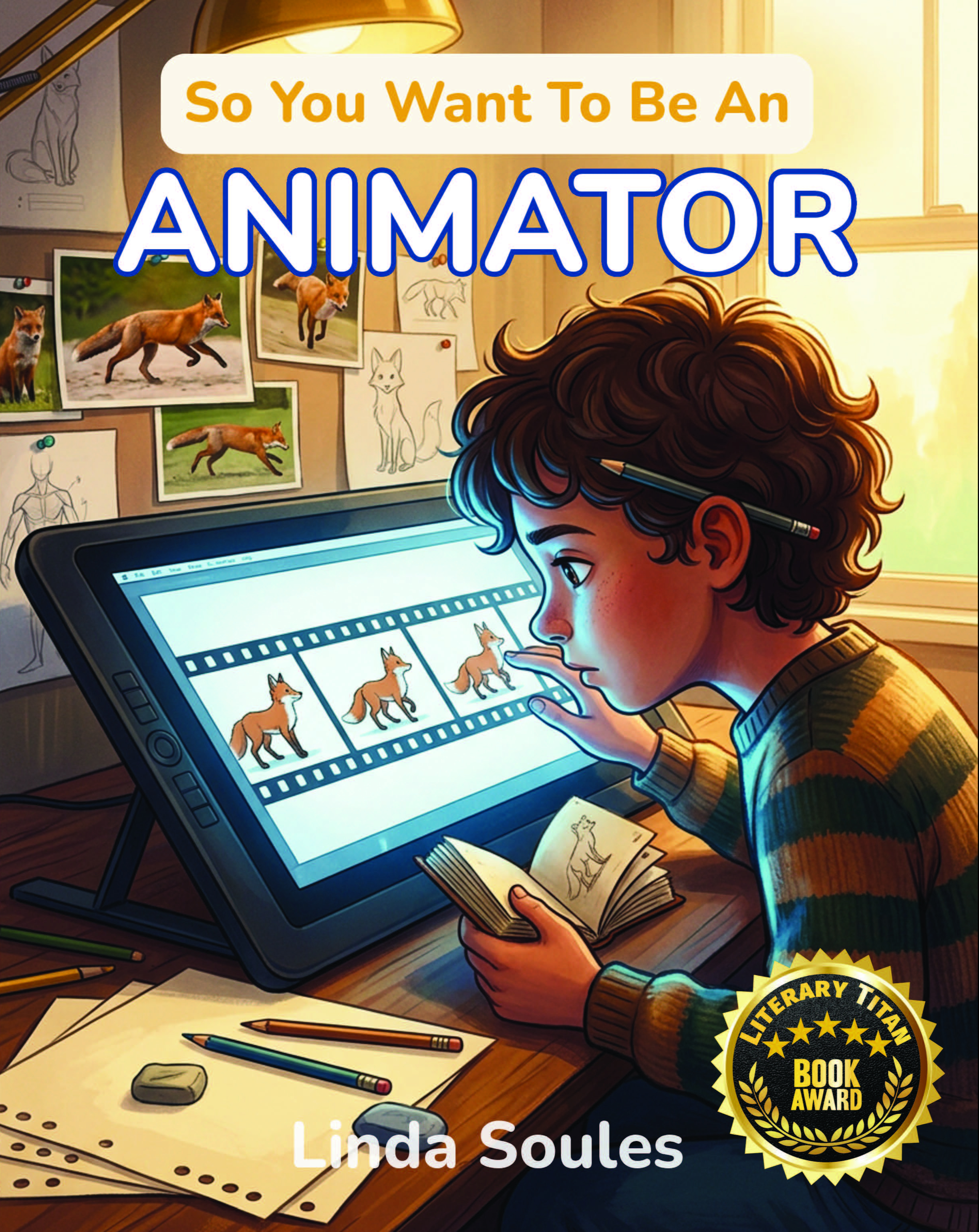
So You Want To Be An Animator
by Linda Soules
Key Takeaways
Summary
Thirty thousand years ago, someone painted a bison on a wall in what is now France’s Chauvet Cave, drawing eight legs in overlapping positions. Archaeologists believe that, in the flickering light of a torch, those legs may have seemed to move: the bison appeared to run. Long before movies, cameras, or electricity, someone wanted a drawing to come alive. From torchlight to computer pixels, people have kept trying to make still images move, and animators grant that wish frame by frame, often at twenty-four frames per second.
Animation is more than movement. A ball bouncing is motion; a ball that hesitates before bouncing, as if it is thinking, seems alive. That pause is part of the art: it suggests a mind behind the action. The animator’s real work is performance. Like an actor, the animator gives a character weight, personality, and emotion, but performs through a pencil or stylus rather than appearing on screen. Lines and timing become the character’s body language.
An animator must be several things at once. First, an actor: to draw a character’s fear, the animator needs to understand fear physically. Animators may stand up at their desks, tense their bodies, or strike the pose they want to draw, then translate what they feel into lines. If they cannot feel the movement, the drawing may not communicate it.
They must also think like physicists, though observation matters more than equations. Movement should follow the laws of physics—or break them deliberately and convincingly. A heavy character walks differently from a light one; a cat’s landing and the fall of water each offer clues to how forces work. The animator studies these details so that even imaginary movement has a physical logic.
An animator is also a timekeeper. How long a character holds a pose can reveal what is going through their mind. A quick blink suggests alertness; a slow one, weariness. A pause before an action can make it seem that the character is deciding, while a pause afterward can suggest regret. The animator controls these beats down to fractions of a second. And the animator is an observer, watching the real world closely and storing its movement as reference for imagined characters.
Finally, animation demands the stamina of a marathon. A professional hand-drawn animator may finish only three to five seconds in a day. A ninety-minute film represents years of work by artists drawing together. Many animators remember the first time they made a drawing move: perhaps, at ten or twelve, drawing the same character in a notebook again and again, changing the pose slightly each time. The feet might slide and the head wobble when the pages are flipped, but the character takes a step. The drawing was still, then it moved—and the young artist discovered that drawings could live.
An animator’s workplace may be a cubicle in a large studio, a desk in a smaller production house, or a home office. Whatever the setting, a screen sits at the center of the work. Animators look closely at images that differ only slightly from one another, checking and adjusting motion frame by frame. In a large studio, walls may be covered with character designs and storyboards, while colleagues gather to discuss colors or expressions. Review rooms with cinema-scale screens reveal problems that might be hard to see on a desk monitor. Extraordinary worlds are made in ordinary buildings, through careful work at desks.
Some animation still begins with a pencil and paper. A light box shines through the page, allowing the animator to see a faint “ghost” of the previous drawing beneath the sheet being worked on. The animator draws one frame, places a new sheet on top, and adjusts the movement slightly. This makes it easier to keep successive drawings consistent and create smooth action. The flipbook—a stack of pages, a pencil, and a way to test the result—is animation in its simplest form. If movement works when the pages are flipped, the basic idea works.
Digital animators may use software such as Maya or Toon Boom, along with a drawing tablet that combines the feel of hand-drawing with digital precision and flexibility. Characters can be built with digital skeletons and posed frame by frame. Whether the drawings are on paper or on a screen, the animator still has to make choices about how a character moves.
Those choices need organization. In traditional animation, the exposure sheet, or X-sheet, is a grid that specifies which drawing appears in which frame and helps align movement with a soundtrack. Digital animation uses a timeline for the same purpose, arranging frames and actions like a musical score for motion. The schedule and the images work together: the drawing determines what the audience sees, and its placement in time helps determine what that action means.
The most important tool, though, is the animator’s eye. Animators watch how people walk, how birds land, and how water falls, observing not just once but until they can replay the movement in their minds. They notice the hitch in a limp, the half-beat before a wave, or the way a heavy bag swings a moment behind the arm carrying it. Such observations become a mental library. Even when a scene is exaggerated or entirely imaginary, details borrowed from the world help its movement feel grounded.
That careful watching pays off in the moment an audience forgets it is looking at drawings. A plain circle on a screen inspires little feeling, but let it bounce, squash on landing, stretch as it rises, overshoot its destination, and wobble while it settles, and people begin to care. They worry when it falls and smile when it recovers. The circle is not alive; its movement simply gives the brain enough signs of life to invite empathy.
The same principle can make a tiny scene feel enormous. Imagine a round orange character holding an ice cream cone. The scoop drops to the ground. The character looks at the empty cone, then at the fallen ice cream, then back at the cone. Its eyes fill with tears. The moment lasts only twelve seconds, yet its slow, sad look follows the rhythm of human grief. Someone in the audience may sniff, not because they are admiring the drawing, but because they recognize the feeling. The animator’s real task is to move the audience: the character carries the emotion, and the audience is where that emotion arrives. Lines on paper and shapes on a screen have no hearts of their own, but viewers lend them hearts when their performance feels true.
The work behind that moment is demanding in ways that are easy to miss. A film running at twenty-four frames per second requires twenty-four separate images for every second of fully drawn movement. Animators often work “on twos,” holding each drawing for two frames, but that still means twelve drawings per second. A day spent animating a few seconds of a character walking can disappear into a few seconds of screen time. Finished work may also be sent back for major revisions because a story beat changes or a character’s design is altered. Sometimes an animator must redo a scene already completed; sometimes they begin work knowing it may change. Patience means caring for the tiny choices even when the process is repetitive, difficult, or likely to send work back to the drawing board.
One surprise is how much animated magic begins with studying real bodies. When Disney animators were developing Snow White in 1937, America’s first feature-length animated film, they had been warned that audiences would not sit through such a long cartoon. They also did not yet know how to animate realistic humans. To learn, they filmed live actors performing important scenes and used the footage as reference. The imaginary world depended on close attention to actual movement. Another surprise is that animators do not create motion alone. When still images appear quickly enough, the audience’s brain connects them, filling the gaps and perceiving movement. The animator supplies the frames; the viewer’s mind makes them flow.
Even cartoon physics relies on that partnership. A character that squashes flat on impact or stretches while speeding away could not behave that way in life, yet exaggeration can make the action feel more convincing. Our brains infer weight from how much something compresses when it hits the ground. Push the squash further, and the audience may feel the weight more strongly. The impossible distortion works because it clarifies something real.
A typical workday might begin at eight in the morning with reference for a character lifting a heavy box. The animator films themself doing the action, watches the footage several times, and notes where effort appears: the bend of the knees, the adjustment of the hands, the strain through the body. At nine-thirty comes blocking, the rough arrangement of three key poses: the starting position, the effort, and the recovery. The result may look like a rough cartoon of a rough cartoon, but its purpose is to establish the action’s shape before the details arrive.
At eleven, an animation supervisor reviews the work and asks for bigger anticipation before the lift and more time on the settling afterward. Those notes concern emotion as much as mechanics: the audience needs to feel the effort and the body’s response. After lunch, the animator moves into the curves stage. The key poses are polished, and the computer generates the in-between drawings, making the movement smoother but also softer and less decisive. The animator adjusts the computer’s curves frame by frame until the motion commits to a feeling.
At four, a polish pass adds details that suggest thought: fingers lagging slightly as an arm swings, shoulders continuing to move after the rest of the body stops, or a blink just before the effort begins. Such small touches can take as long as the earlier work. At six, the animator plays the shot back in real time. The character seems to lift something heavy. The animator watches again, notices two things to fix, and leaves those for tomorrow.
No frame belongs to only one person. A director guides the vision; story artists make storyboards; character designers determine how a character looks; and background artists paint the worlds. Riggers build the digital skeletons that allow characters to be posed and moved. Voice actors give characters voices before animation begins. Lighters decide how illumination falls across a face, while compositors bring the visual layers together. Sound designers and composers create the world the audience hears. Each person contributes knowledge the others do not have. A two-hour film might take three hundred people four years to finish. The director may understand the story, the character designer every angle of a face, and the rigger how a digital puppet can move; none can simply replace the others. For the animator, that shared effort is part of the reward: a whole community working to make the same story as strong as it can be.
Animation can also help people imagine lives beyond their own. Stories can give shape to feelings and make friendship, fear, bravery, and kindness available for children to explore. A child might encounter a Japanese forest spirit waiting at a bus stop, a Mexican family lighting candles for loved ones who have died, a Scottish princess who refuses to marry, or a small robot falling in love on an abandoned Earth. Spending time inside another person’s story can make it easier to imagine being that person. The image, voice, sound, and story each contribute to the experience, and the character becomes more than a drawing.
There are many ways to make that character live. Hand-drawn animation begins with pencil and paper, as in Studio Ghibli’s films and Disney’s early classics. Stop-motion animators photograph real puppets, clay figures, or cutouts, changing their positions by tiny amounts between pictures; Coraline and Chicken Run were made this way. Three-dimensional computer animation builds digital sculptures that move through virtual worlds, as in Pixar and DreamWorks films. Silhouette and cutout animation, among the oldest forms, uses paper figures and light. The materials differ, but each approach seeks to make still images or objects seem alive.
Believable animation rests on qualities that are learned as much as they are innate. An animator needs an observant eye: noticing how sadness changes a person’s walk, how a cat gathers itself before jumping, or how cloth responds to wind. Those details become a mental library to draw on when inventing movement. Patience matters just as much. A feature may require hundreds of thousands of drawings, and the same care must go into a late frame as into the first. Drawing consistency is the technical foundation: a character must remain recognizably the same from one image to the next, even after it has been drawn thousands of times. Timing is another language, where a pause or a delayed reaction can tell the audience what a character thinks. And because animation belongs to a team, a strong animator serves the shared vision rather than trying to make every scene a showcase for a personal style.
Some useful tools are less obvious. Animators may keep a mirror beside their desk, using their own faces as references for laughter, fear, or any other expression. They learn to live with repetition, finding satisfaction in refining a walk cycle or correcting one elbow on the hundredth attempt. A musical ear helps, too. Movement has rhythm: a walk can follow a beat, and a joke can land on a precisely chosen moment. Animation draws on acting, observation, drawing, and timing, but it also asks artists to keep looking closely and trying again.
The history of animation shows how different imaginations have solved the same problem. Lotte Reiniger made The Adventures of Prince Achmed, the oldest animated feature that still exists, completing it in 1926—almost a decade before Snow White. She cut intricate figures from black paper and photographed them frame by frame over backlit glass. Across more than forty silhouette films, she turned scissors, patience, and imagination into a distinctive art. Her layered technique gave silhouettes depth and later inspired Disney’s multiplane camera, which helped create the deep, dreamlike forests of Snow White and Bambi.
Walt Disney, a boy from Missouri who loved drawing, was once fired from a newspaper for “lacking imagination.” He went on to co-create Mickey Mouse with animator Ub Iwerks and build Snow White, Fantasia, Disneyland, and an entertainment empire. Floyd Norman entered Disney in 1956, when there were almost no Black animators in the industry, becoming the studio’s first Black animator. He helped animate Sleeping Beauty and The Jungle Book, then continued working for decades on films including Robin Hood, Mulan, and Toy Story 2. After nearly seventy years of drawing, he still shows up, reminding young artists that animation is about the heart, not the software. Hayao Miyazaki, creator of Spirited Away, My Neighbor Totoro, and Princess Mononoke, likewise makes films by hand, drawing thousands of frames and holding on to the wonder he says he tries to give the ten-year-old version of himself.
The craft’s history includes invention, shortcuts, and extraordinary persistence. J. Stuart Blackton’s Humorous Phases of Funny Faces, from 1906, lasted about a minute; he drew faces on a chalkboard and photographed them one frame at a time, changing the chalk between photographs. Mickey Mouse’s four-fingered hands began as a practical shortcut: four fingers were faster to draw than five, and audiences on small screens could not tell the difference. The choice became a cartoon convention, shared by characters from Bugs Bunny to SpongeBob. Chuck Jones imposed his own strict rules on Road Runner cartoons: the Road Runner could never leave the road, the Coyote could only be harmed by his own schemes, and gravity worked on him only after he noticed it. And The King and the Mockingbird took an astonishing thirty-two years to complete: director Paul Grimault began it in 1948 and finished in 1980.
A beginning animator does not need to wait for special equipment or a perfect idea. A stack of sticky notes and a pencil are enough to make a flipbook. Draw a simple character in one corner, shift it slightly on each following page, then flip the stack and watch it move. Squash the character on impact and stretch it as it rises, and the movement gains expression. For stop-motion, prop a phone securely, photograph a toy or clay figure, move it a tiny amount, and take another picture. Repeat the process and play the photographs as a video. Everyday objects can become performers.
Acting out movement is another way to learn. Before drawing surprise, surprise yourself; before drawing exhaustion, slump in a chair. The body supplies information that a pencil cannot invent on its own. A simple circle face can become ten different people through changes in eyebrows, eyes, and mouth. Try joy, sadness, anger, fear, surprise, disgust, confusion, determination, mischief, and love, and notice how little adjustments shift the feeling. Drawing the same character repeatedly builds the consistency the work requires: see whether you can reproduce its eyes, nose, smile, and ears fifty times, then a hundred.
Practice can also mean looking at animation differently. Watch a film once for its story, then watch it again while concentrating only on how the characters move. Time someone walking across a room, a door swinging shut, or a wave, and begin translating those seconds into frames. Free tools make further experiments possible: Brush Ninja allows frame-by-frame animation in a browser, while Scratch combines animation with simple coding. Pixar in a Box offers lessons from Pixar artists and engineers, and OpenToonz—the professional 2D software customized by Studio Ghibli—has been released free to the public. For hands-on projects, Animation Lab for Kids introduces flipbooks, zoetropes, cel animation, claymation, and pixilation.
Books offer other paths into the craft. Richard Williams’s The Animator’s Survival Kit explains how to animate walks, runs, and double-takes; Frank Thomas and Ollie Johnston’s The Illusion of Life lays out Disney’s twelve principles. Scott McCloud’s Making Comics explores how pacing, framing, and expression guide a story through pictures. Fiona Robinson’s illustrated account of Reiniger’s work offers a way into animation history, too. Young animators can also explore ASIFA-Hollywood, which offers student membership and educational programs, and Women in Animation, whose mentorship circles and scholarships support women and non-binary artists.
The questions that guide an animator are simple to ask and difficult to answer well: What is this character feeling, and how does the whole body show it? How can something that does not exist feel undeniably alive? What is the smallest movement that can tell the biggest story? A person drawn to creating characters, attentive to the way things move, and willing to work patiently frame by frame may find animation a fitting calling. The first step is modest: draw a circle, shift it a little, and draw it again. One drawing is a picture; two, placed in the right order, begin a life.
Chapter Summaries
What If You Were an Animator?
The book opens by connecting animation to humanity’s ancient desire to make images move. It points to overlapping bison legs painted in Chauvet Cave around 30,000 years ago, which may have appeared to run in flickering torchlight. The tools have changed from cave walls and firelight to paper, cameras, and pixels, but the impulse remains: someone wants a drawing to come alive.
What an Animator Does: Skills, Workplaces, and Tools
An animator must combine several ways of thinking. They act out a character’s feelings and movements, observe how real bodies and objects behave, apply or deliberately bend physical principles, and use timing to reveal a character’s thoughts. They are also marathon workers: a professional hand-drawn animator may complete only three to five seconds of footage per day, while a feature film takes a large team years to make.
The Rewards, Difficulties, and Surprises of Animation
The central reward of animation is the ability to create an emotional response with images that have no real life of their own. A circle becomes sympathetic when it bounces, hesitates, squashes on landing, and wobbles. In a more elaborate example, an orange character’s slow look from an empty ice-cream cone to the scoop on the ground makes an audience recognize the rhythm of disappointment and grief. The animator’s real achievement, the book argues, is not merely moving a character but moving an audience.
A Day in the Life
A sample workday follows an animator developing a character lifting a heavy box. The morning begins with filming and studying the action: where the knees bend, how the hands adjust, and how effort appears in the body. The animator then blocks the action with three rough key poses—the starting position, the moment of effort, and the recovery—before reviewing the work with a supervisor, who asks for more anticipation before the lift and a longer settling moment afterward.
The Team Behind the Story—and the People It Reaches
An animated production depends on many specialists. Directors guide the vision; story artists create storyboards; character and background artists design the people and places; riggers build digital skeletons; voice actors perform before the animation is complete; and lighters, compositors, sound designers, and composers shape the finished world. A two-hour film might involve 300 people over four years, with no single contributor able to make it alone.
The Animator’s Qualities and the History of the Craft
The book identifies observation, patience, drawing consistency, timing, and a collaborative spirit as central qualities of an animator. A character must remain recognizable across thousands of frames, and an animator needs to notice how small differences in posture or movement reveal emotion. Less obvious requirements include mirror practice for studying facial expressions, comfort with repeating a walk cycle until it feels right, and musical sensitivity for coordinating movement with sound and rhythm.
Starting Out: Practice, Questions, and Next Steps
The book encourages aspiring animators to begin immediately rather than wait for professional equipment or training. Suggested exercises include making a 20-drawing flipbook and applying squash and stretch, photographing small movements of toys or clay for a stop-motion video, acting out a character’s movement before drawing it, and giving a simple face ten distinct emotions. Repeatedly drawing one character also builds the consistency needed to keep it recognizable from frame to frame.
Notable Quotes
A bouncing ball is movement. A bouncing ball that hesitates before it bounces — as if it is thinking about it — is alive.
An animator does not move characters. An animator moves audiences.
The audience does most of the work.
The impossible part is exactly what makes it feel real.
The animator's gift is the companionship — being surrounded every day by people all trying to make something as good as it can be, in a craft they all love.
One drawing is a picture. Two, in the right order, are the beginning of a life.
There is no reason that someone shouldn't be you.
