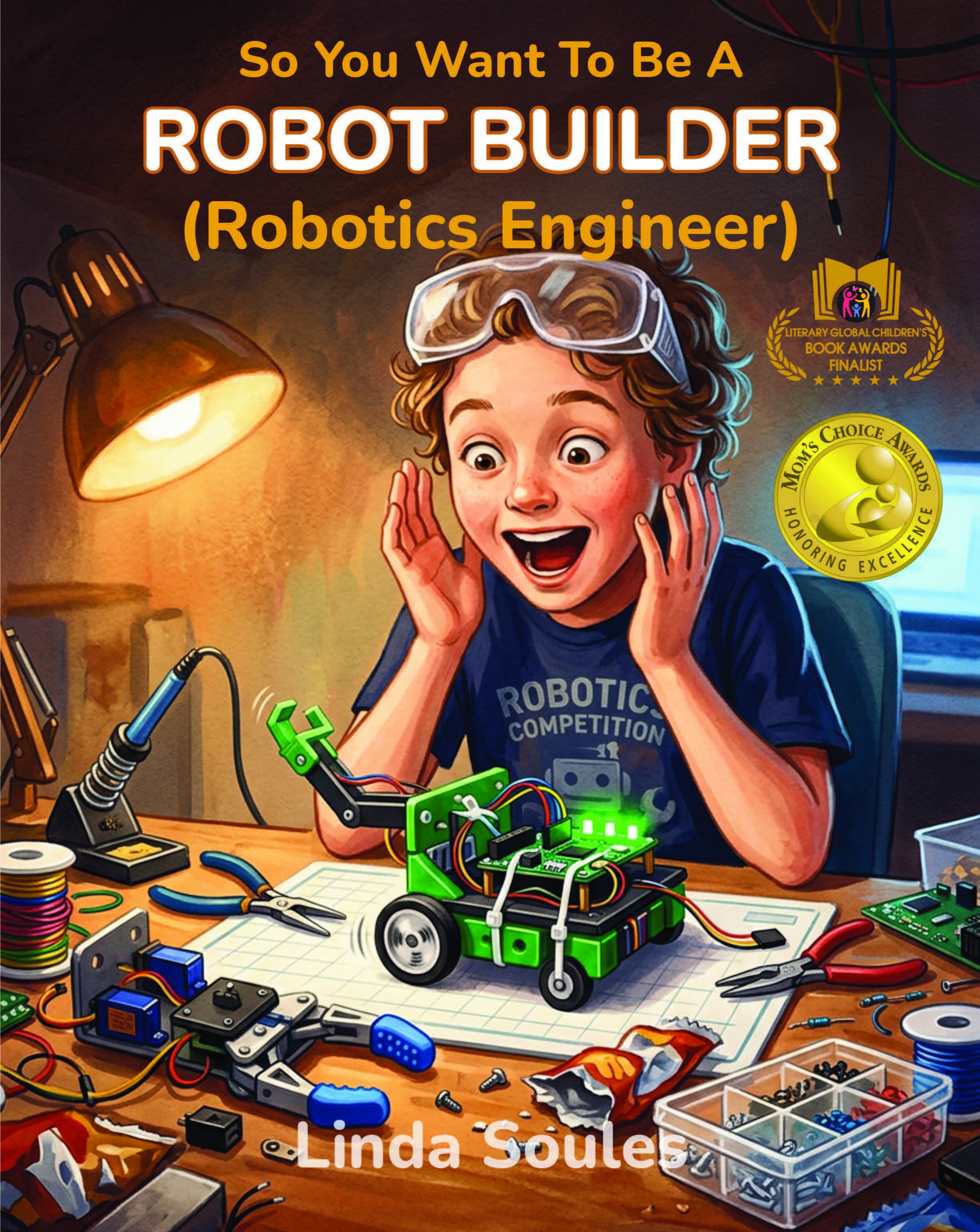
So You Want To Be A Robot Builder (Robotics Engineer)
by Linda Soules
Key Takeaways
Summary
A robot is not necessarily a chrome humanoid with glowing eyes. It is a machine that senses the world, processes what it senses, and acts on the result. Sense, think, act: those abilities distinguish a robot from a toaster. A toaster heats when someone pushes its lever; it does not know whether bread is inside. A robot, by contrast, repeatedly perceives, decides, and does, running through that loop many times a second.
Building one means bringing together three kinds of engineering. The body belongs to mechanical engineering: its frame, joints, actuators, and the gripper or tool that touches the world. Its nervous system is electrical engineering: the sensors, wiring, and circuit boards that link perception to action. Its brain is software: the code that interprets sensor information, makes decisions, and sends commands to motors. Each part depends on the others. If any one fails, the whole machine can fail.
That is why a robotics engineer has to think about the entire system, not just one component. The work begins with a gap: something that needs to happen in the world that no existing machine can do. The engineer must devise a structure capable of the necessary movements, connect sensors and circuits so the machine can perceive its situation, and write instructions that turn perception into action. Each layer can go wrong on its own, or in combination with the others.
A robot does not do what its builder wants; it does what it was told to do. Those two things are often different. The robot follows instructions precisely, even if those instructions produce the wrong result. Much of engineering lies in finding the gap between intention and implementation, then narrowing it. A mechanical design may not support what the software asks of it. In that case, the engineer may need to redesign the mechanism, change the code, or do both. Building advances through repeated versions, each one tested and refined.
Robotics also pushes engineers against the limits of sensors, materials, software, and power. Some robots now help surgeons work with greater precision, navigate city streets, or search collapsed buildings for survivors. Making a robot perform its intended task reliably in the real world can take months or years. Increasingly, engineers also use machine learning. Instead of trying to write a rule for every possible situation—if an obstacle appears, turn left, for instance—they can show a robot many examples and let it discover patterns. That can enable behavior its builders did not anticipate, making the approach exciting as well as demanding.
The work environment reflects this mix of physical and digital problem-solving. A robotics lab is part machine shop, part electronics bench, and part programming workspace. Its shelves and benches might hold manipulators, sensors, motors, microcontrollers, cables, fasteners, and other parts, among the smells of metal and lubricant and the faint ozone of working electronics. The workshop is where mechanical design, electrical systems, and software meet on the same bench, often in the same problem.
On the mechanical side, engineers use computer-aided design software to plan a robot’s structure and 3D printers to make prototype parts quickly. Drill presses, laser cutters, and soldering irons help turn designs into physical hardware. Small choices can have large effects: every joint and gear ratio influences what a robot can do.
Sensors give the machine information about its surroundings and its own movement. Cameras let it see; proximity sensors detect when something is nearby; encoders track how far a joint has moved, down to a fraction of an inch. Tiny computing boards called microcontrollers run code that tells the robot’s parts when and how to move. Programming brings the mechanical and electrical systems together. Without code, the robot is an assembly of parts; with it, the machine can respond to its environment, make decisions, and act.
The first time a robot moves under its own power is one of the job’s great rewards. It may lurch, swing its arm too far, or open its gripper when it should close. But the parts have become a machine that responds to the world, and the builder has made that happen. That moment can be addictive, and every new robot offers another chance to experience creation in a literal, tangible way.
The work also brings plenty of failure. A robot may function perfectly in a controlled lab and behave unpredictably when conditions shift, or fail during a demonstration after succeeding in tests. When something goes wrong, the cause might be in the hardware, the software, their interaction, or the environment. Finding it can take longer than fixing it. A sensor that behaves just slightly differently than expected may set off a chain of effects that eventually disrupts the whole system. The engineer must trace the symptoms back patiently, checking the machine rather than assuming the first visible problem is the original one. If the robot acts incorrectly, the mistake is in its design, wiring, or code: the machine has followed its instructions.
A day’s work can revolve around just such a small discrepancy. At eight in the morning, an engineer reviews data from twenty failed attempts by a robotic arm. Careful comparison reveals that the arm reacts a little too slowly to a slight sideways tilt at the start of a movement. At ten-thirty, the engineer rewrites part of the control instructions so the arm checks its sensors more often and begins predicting what is coming instead of merely responding to what has already happened.
By eleven, it is time to test. The arm picks up a round object, then repeats the task twelve more times. Rather than stopping at the successful result, the engineer changes the challenge, trying different shapes, surfaces, and weights to see where the improvement stops working. In the afternoon, a mechanical adjustment to the gripper is considered, followed by documentation detailed enough for someone else to understand and maintain the updated control system. A final test may still reveal an imperfect robot, but the day has produced a specific, recorded improvement that can be repeated.
For all the stubborn work involved, robotics offers a reward few other jobs can match: the moment a machine built from separate parts moves under its own power. Its first motion may be awkward—the arm swings too far, the gripper opens at the wrong time—but the machine is responding to the world. Its parts have become a working system, and the builder has made that happen. That first success can fuel a career spent pursuing the same feeling in more demanding forms. The work also draws people who enjoy crossing between fields. A single project can involve mechanical design, electronics, software, artificial intelligence, materials science, and human factors, with new areas to learn at every turn. And the purpose matters: robots can help surgeons operate precisely, enter collapsed buildings to search for survivors, explore space, or help people with disabilities regain independence.
The same physical reality that makes the work exciting also makes it difficult. A robot may perform perfectly under controlled laboratory conditions and then fail when the surroundings change even slightly. It may fall over during a demonstration or malfunction in a way that seems inexplicable. Unlike a software problem in isolation, a robot’s failure might come from hardware, code, the environment, or an interaction among all three. The robot has followed its instructions exactly; the mismatch lies between what its builders intended and what they designed, wired, or programmed. Sometimes the source is a nearly imperceptible sensor variation. Small faults can compound until the whole machine behaves badly, and the engineer must trace the chain back to its beginning. That investigation takes patience: symptoms must be examined carefully, causes tested, and fixes verified rather than guessed.
One especially humbling challenge is that machines can be astonishingly capable and still struggle with tasks that are easy for people. Even a toddler can enter a room full of scattered objects and pick up the one they want. For a robot, recognizing a messy pile, choosing an object, and grasping it without dropping or crushing it remains extremely hard. Human eyes and hands do this without conscious effort, but robots cannot yet do it reliably. A warehouse robot may embody remarkable advances and still be less capable than a child reaching into a toy box.
Nature helps explain both the difficulty and the opportunity. A common housefly can take off, avoid obstacles, land on a moving surface, recover after being struck, and detect danger in real time, using a brain the size of a sesame seed. Evolution has refined such abilities over hundreds of millions of years, while human-built machines have had only a few decades of development. Rather than inventing every solution from scratch, robotics researchers study insects and other animals for ways to move, balance, sense, and navigate. A cockroach’s ability to cross uneven ground, for example, may offer lessons for a walking robot. Biology is not merely an interesting comparison; it is a rich source of ideas for problems engineers have not yet solved.
Making those ideas into a working machine requires many people. Mechanical engineers design the robot’s body and moving parts; electrical engineers work out power and wiring; software engineers write its instructions; and control-systems engineers aim for smooth, accurate movement. Computer-vision engineers help it interpret images, while AI researchers work on learning. Machinists and fabricators turn designs into physical parts, and safety engineers consider how the robot can operate around people without injuring them. The people who use a robot every day, whether in a factory or an operating room, contribute practical knowledge that cannot be supplied from a desk.
No one specialist can hold the whole project alone. A mechanical solution may create a problem for the software, and a change in software can expose a physical limitation. Failures in the field often involve several parts of the system at once, interacting in an unexpected way. For that reason, communication cannot be saved for the start and finish of a project: the team must keep talking as the design develops and as evidence from tests changes what they understand. Users, too, need to be heard. Their experience shapes what the robot must actually do and what future designs should improve.
Robotics also asks builders to look beyond technical capability. Robots can go into nuclear reactors, travel to the bottom of the ocean, or explore Mars, taking on work people cannot do. They can handle tasks that are dangerous, repetitive, or demanding of extreme precision, and work alongside people toward goals neither could achieve alone. But engineers must also ask who benefits and who bears the cost. A surgical robot may help save lives; a robot that replaces a factory worker without any plan for that person may disrupt one. Systems that influence decisions about loans or security can shape people’s futures. Designing only for what a machine can do leaves out half the responsibility. The human consequences belong in the conversation from the beginning.
The qualities the work calls for reflect this whole-system view. Integration thinking means being able to consider mechanical, electrical, software, and sensory parts together, rather than treating each as a separate problem. Physical intuition—recognizing that a joint is binding or a linkage is inefficient—grows through making, breaking, repairing, and paying attention. When hardware fails, rewriting code may not be enough; creative problem-solving can mean finding a different mechanical approach to reach the same goal. Comfort with iteration matters just as much. Prototypes take time to build and can fail quickly, so progress depends on treating failure as information and recording what it teaches. Safety, meanwhile, is not an afterthought for a robot that works near people. It is a design value that helps determine whether the machine can leave the laboratory and serve in the world.
Robotics also rewards a willingness to remain a beginner. New sensors, programming languages, and ways to teach machines appear continually, so even experienced engineers encounter subjects they have not mastered. They need to ask basic questions without embarrassment and learn openly. Biology can be part of that learning: studying how living creatures move, sense, and navigate may reveal approaches that engineering alone has missed. And as robots become more capable, ethical imagination becomes essential too. Questions about where robots should be used, who is responsible when they cause harm, and how they make decisions affecting people are moral as well as technical questions. The engineer must consider not only whether a robot can act, but how its actions will meet the people around it.
Robotics has been shaped by engineers willing to question what a robot should be. Rodney Brooks pioneered an approach that borrowed from insects: rather than trying to make machines think like humans, he built robots that could act simply, quickly, and adaptively. The philosophy helped produce the Roomba vacuum cleaner and influenced a generation of robots used in manufacturing and everyday life. Brooks argued that behavior could emerge from a robot’s design instead of being programmed rule by rule. Cynthia Breazeal took a different path, creating Kismet, a robot designed to interact socially with people by reading faces and expressions and responding to them. Her work helped establish social robotics and raised a lasting challenge: machines that share our spaces need some ability to understand us. Denis Hong has built two-legged robots, machines for rough terrain, and devices that assist people with disabilities. He also created the first soccer-playing robot team, and is known for making robotics accessible to young people.
The history and present-day uses of robots are full of surprises. The word “robot” appeared in a 1920 Czech play by Karel Čapek, with the word suggested by his brother Josef; it comes from “robota,” meaning drudgery or forced labor. NASA’s Opportunity rover was intended to work for 90 days on Mars but lasted more than 14 years, until a planet-wide dust storm covered its solar panels. In Japan, a hotel staffed almost entirely by robots—including robotic luggage carriers—had to reduce its robot workforce after the machines created more work for human employees than they replaced. Boston Dynamics spent years teaching Atlas to do a backflip, not because the maneuver was needed, but because it tested balance and timing. Surgical robots can work through incisions smaller than a keyhole; in one demonstration, a robot stitched a peeled grape back together. Meanwhile, heavy, fast factory robots operate in spaces where people cannot safely work alongside them.
A person curious about building robots does not need an advanced laboratory to begin. A LEGO Education SPIKE, VEX IQ, or micro:bit starter kit can introduce real robotics concepts, and some libraries lend kits. Or start with cardboard, tape, craft sticks, and rubber bands: build something sturdy, then find a way to make part of it move. Programming can begin with Scratch, where the central lesson is that code consists of precise instructions. A broken toy can become a lesson in motors and gears if you carefully take it apart to see how its parts work. Robotics competition videos, including FIRST LEGO League, show young teams solving engineering problems; joining a school club—or asking a teacher to help start one—offers a chance to build with others.
A robot log makes those experiments more useful. After each building session, record what you made, what it was meant to do, what it actually did, and what the difference taught you. That difference is not wasted effort; it points toward the next change to try. The questions worth returning to are practical and ethical at once: What should this robot do, and what must it never do? How can a machine handle a situation no one specifically programmed it for? Where might its hardware and software work against each other? The same questions help a beginner investigate a failed build: What instructions did I give? What happened instead? Is the problem in the body, the wiring, or the code? What will I change next time?
The language of robotics gives names to the pieces of these problems. An actuator—such as a motor, servo, or piston—makes a robot move. A sensor gathers information from its surroundings, while a feedback loop lets the robot check its performance and adjust. Autonomy means operating and making decisions without a human continuously sending commands. Computer vision teaches robots to interpret camera images; machine learning lets them discover patterns from examples rather than relying only on rules. Degrees of freedom count the independent ways a robot can move: a shoulder has three, while a typical factory arm has six. Kinematics describes the geometry of movement through space. At the end of a robotic arm, an end effector—a gripper, welder, camera, or surgical instrument—lets the robot interact with the world. A prototype is an early working model made to test ideas, and simulation is a virtual environment for trying software before risking a physical machine. Human-robot interaction studies how people and robots can work together safely and comfortably.
These ideas are available through books, websites, teams, and visits. Kathy Ceceri’s *Robotics: Discover the Science and Technology of the Future with 20 Projects* offers hands-on builds using craft materials and salvaged toy parts. Scratch and micro:bit let beginners use block coding to control a physical circuit board; Tinkercad Circuits provides a free browser-based way to wire and program a virtual circuit. NASA Robotics shares information about machines sent to Mars, the Moon, and the International Space Station. FIRST, founded by inventor Dean Kamen in 1989, runs student programs in more than 100 countries. VEX Robotics supplies kits used by student teams, while the REC Foundation runs competitions from elementary school through college. Watching a FIRST, VEX, or REC event reveals how teams respond when a robot misbehaves under a countdown clock. University open houses and science museums offer another view of working robots and the people who build them.
A young builder who makes something move, sense, or respond is already practicing robotics, even if the first attempt works badly. The profession is a fit for people who enjoy discovering how things work, bringing the physical and digital together, and trying again after being wrong. Every robot carries decisions in its metal and code: what it notices, what it ignores, what it does when something goes wrong, and whose safety it protects. The builder’s responsibility is not merely to make a machine function, but to consider the people who will live and work alongside it. Start with a small machine, pay attention to what it actually does, and keep revising until its behavior reflects what you meant.
Chapter Summaries
What It Means to Build Robots
The book begins by replacing the familiar movie image of a robot with a practical definition: a robot senses the world, thinks about what it senses, and acts. A toaster simply performs a fixed task, while a robot responds to its surroundings in a continuing loop. Robotics engineers design, build, and program these machines by combining three disciplines: mechanical engineering for the body and movement, electrical engineering for wiring and sensors, and software for decisions and control. The work starts with a need that existing machines cannot meet. Engineers design a structure, connect the components that gather information, and write instructions that turn information into action. Since the robot does exactly what it is told—not necessarily what its builder meant—much of the work lies in closing the gap between intention and instructions. The book also introduces machine learning: instead of writing a rule for every possible situation, engineers can train a robot with examples, opening new possibilities while adding responsibility for how it learns and behaves.
The Workshop, Tools, and Daily Work
A robotics lab is part machine shop, electronics bench, and programming workspace. Engineers use computer-aided design software to plan structures, 3D printers and workshop tools to make prototypes, and sensors such as cameras, proximity detectors, and encoders to help robots gather information. Microcontrollers run the code that coordinates the machine’s parts. In the workshop, mechanical, electrical, and software work meet on the same robot and the same problem. The book’s sample workday shows how incremental progress happens. An engineer studies records from repeated failures, notices that an arm reacts too slowly to a slight tilt, changes the software, and tests the improvement repeatedly with different objects. The team then considers a physical change to the gripper, and the engineer documents the update so others can maintain and build on it. A successful day does not mean achieving perfection; it means making a specific, tested, recorded improvement.
Rewards, Frustrations, and Unexpected Challenges
One of the job’s greatest rewards is seeing a machine move under its own power for the first time. The first movement may be awkward—a robot may lurch, overshoot, or mishandle its gripper—but it marks the moment when separate parts begin responding to the world as a system. Engineers are also drawn to robotics because each project can involve design, electronics, programming, artificial intelligence, materials, and human factors, with applications ranging from medicine and space exploration to rescue work and assistance for people with disabilities. The difficult side is that a robot can succeed in a lab and fail in the field. A fault may come from hardware, software, the interaction between them, or a changed environment, and a tiny sensor variation can trigger a larger failure. The book emphasizes patient investigation: collect evidence, trace symptoms to causes, and keep testing. It also highlights how hard ordinary tasks can be for machines. Picking a specific irregular object from a cluttered pile remains challenging, while even a housefly performs complex navigation and balance that engineers cannot yet match. Studying nature can therefore be as valuable as inventing new mechanisms.
Teams and the Human Impact of Robotics
No single person can master every part of a complex robot. Teams may include mechanical and electrical engineers, software developers, control-systems engineers, computer-vision specialists, AI researchers, machinists, fabricators, and safety engineers. People who use the robot contribute essential knowledge from actual workplaces, such as factories and operating rooms. Since a solution in one specialty can create a problem in another, the team needs ongoing communication rather than a handoff only at the beginning or end of a project. Robots can enter dangerous places, perform repetitive tasks, and support work requiring exceptional precision. But technical capability is only part of the responsibility. A surgical robot may help save lives; automation may also change a worker’s livelihood, and systems that make decisions about people can shape their futures. Engineers should ask who benefits and who bears the costs, and they must design for safety and human consequences from the start. The author’s closing note reinforces that every robot carries its builders’ choices in its instructions and behavior.
The Qualities and Knowledge the Work Requires
The book identifies integration thinking as essential: a builder must understand how a robot’s physical body, electronics, sensors, and software affect one another. Physical intuition develops through making, breaking, and repairing things, while creative hardware problem-solving helps when code alone cannot fix a limitation. Robotics also demands comfort with iteration: prototypes often fail quickly, but each failure can provide useful information if it is carefully recorded. Some important abilities may be less obvious. Biology can inspire better ways to move, balance, and sense; robotics engineers may need to be beginners in new areas throughout their careers as tools and methods change. Ethical imagination matters too, because decisions about a robot’s uses, safety, and effects on people are moral as well as technical. Famous examples illustrate the field’s range: Rodney Brooks drew inspiration from insect behavior, Cynthia Breazeal pioneered social robotics with Kismet, and Denis Hong has worked on walking robots, rough-terrain navigation, accessibility, and student robotics.
Robotics in the World—and How to Get Started
A collection of facts makes the field tangible. The word “robot” comes from the Czech word “robota,” associated with forced labor; the Mars rover Opportunity worked for more than fourteen years despite a ninety-day design lifetime; and a Japanese hotel reduced its robot workforce after some robots created extra work for staff. Other examples show how robot backflips can test balance and timing, how surgical systems can work through tiny incisions, and why fast, heavy factory robots need spaces separated from people. For beginners, the book recommends building with robotics kits or everyday materials such as cardboard, tape, and rubber bands; learning programming logic with Scratch; taking apart old toys to inspect motors and gears; watching competitions; joining a club; and keeping a robot log. The log can record what a build was supposed to do, what it actually did, what the difference teaches, and what to try next. Readers are encouraged to start small: even a rough creation that moves, senses, or responds to the world is a beginning in robotics.
Questions, Glossary, and Imagining a Career
The book closes by inviting readers to think like robot builders. They can ask what a robot should do—and what it must never do—how it could handle situations it was not explicitly programmed for, and where hardware and software might conflict. When something fails, the reader is encouraged to ask what instructions were given, what the robot actually did, whether the problem is in its body, wiring, or code, and what to change next time. A glossary explains foundational terms such as actuator, autonomy, degrees of freedom, end effector, feedback loop, kinematics, machine learning, prototype, sensor, and simulation. The career invitation is practical and encouraging: enjoyment of building, a desire to understand how things work, and willingness to be wrong repeatedly may point toward robotics. The author’s note adds a deeper challenge: robots do not have values of their own; they carry the priorities and judgments of the people who build them. The book’s further-learning resources—including books, websites, NASA material, competitions, organizations, and lab visits—help turn that invitation into next steps.
Notable Quotes
A robot is something much simpler and much stranger: a machine that can sense the world, think about what it senses, and act on what it thinks.
The robot does not do what you want. It does what you told it to do.
The robot is always right. If it did something wrong, the error is yours — in your design, your wiring, or your code.
Nature has had millions of years to figure out how to build things that move. Engineers have had a few decades.
The engineer who builds only for capability, without asking who benefits and who bears the cost, is only doing half the job.
Every robot is a sentence you write in metal and code — and the machine reads it back to you exactly as written.
