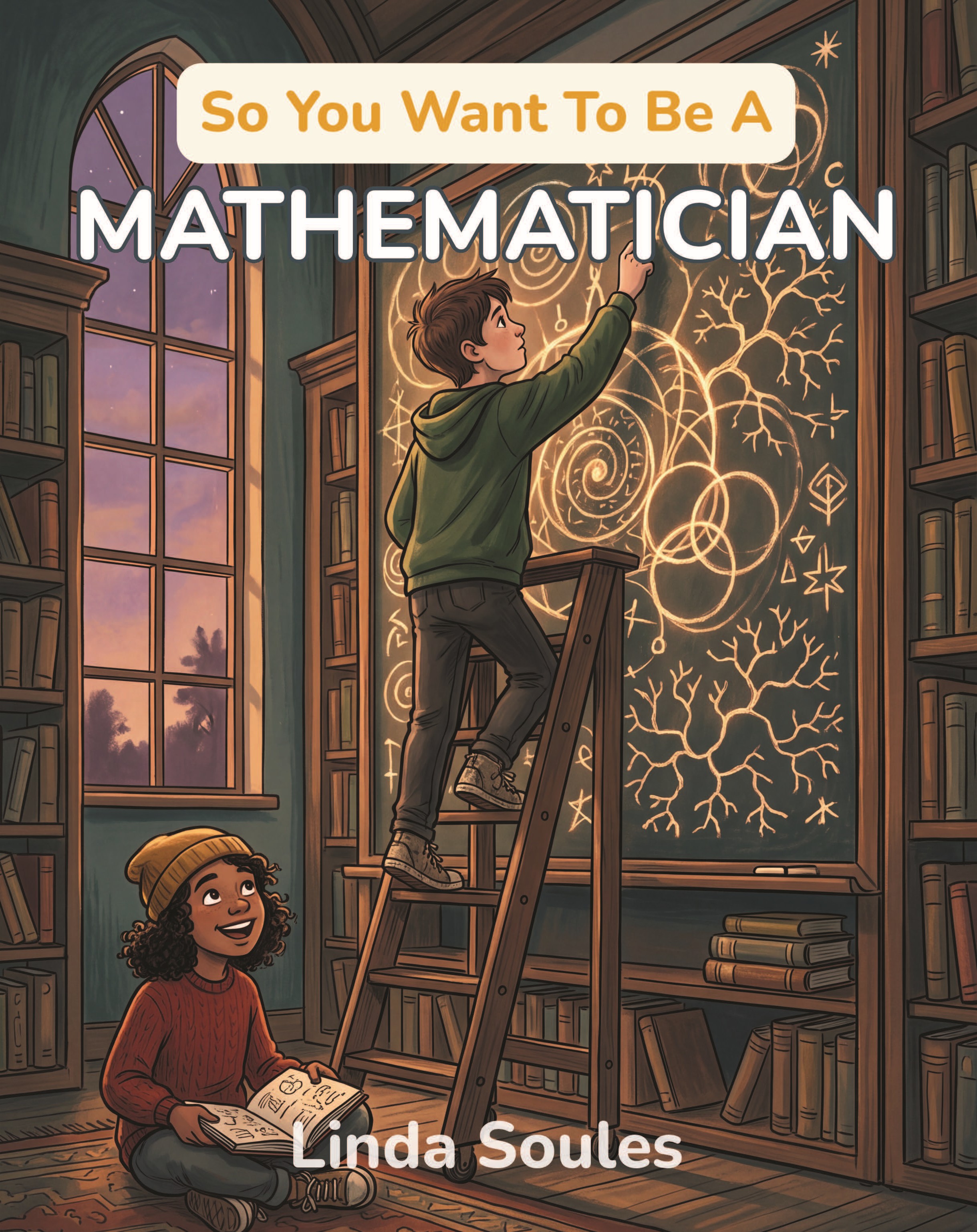
So You Want To Be A Mathematician
by Linda Soules
Key Takeaways
Summary
Somewhere in New York City, two people have exactly the same number of hairs on their heads. Nobody needs to count to know it. There are millions of people but fewer than a million possible hair counts, so if each person is placed in a bucket marked with their count, at least one bucket must hold two. Mathematicians call this the pigeonhole principle: when there are more things than places to put them, some place must contain more than one. Put thirteen people in a room, and the same reasoning guarantees that at least two share a birth month, since there are only twelve months.
Mathematics is much bigger than the arithmetic practiced on worksheets. Those exercises are useful training, but the subject itself is a hunt for patterns and the hidden rules behind them. Mathematicians ask “What if?” and follow the answer. Some questions yield quickly; others remain open for centuries, with no guarantee that anyone will find an answer.
The patterns mathematics investigates are all around us. Sunflower seeds form spirals in two directions, and counting those spirals often gives neighboring numbers in the sequence 1, 1, 2, 3, 5, 8, 13, 21, and onward. Each number is the sum of the two before it. These Fibonacci numbers also appear in daisy petals, pinecone scales, and the spiraling arrangement of leaves. Fibonacci wrote about the sequence in 1202, using a puzzle about rabbits, but the Indian scholar Virahanka had described the same rule about five hundred years earlier while studying the rhythms of Sanskrit poetry. Spotting a pattern may take a moment; understanding why it appears can take years. And nature does not cooperate every time, so a careful observer keeps an honest tally instead of assuming every pinecone will fit.
Mathematicians may focus on the world or on ideas for their own sake. Applied mathematicians build models out of equations to represent things such as bridges, viruses, or hurricanes, then use those models to predict what might happen. Pure mathematicians pursue ideas because they are interesting. For both, a central task is often proof: a step-by-step argument showing that a statement must be true in every possible case.
Prime numbers offer a classic example. Twelve marbles can be arranged in a rectangle, such as three rows of four, but seven cannot make a rectangle except for a single line. Numbers like seven are prime. Every whole number greater than one is either prime or can be made by multiplying primes together, making primes the building blocks of the whole numbers. Around 300 BC, Euclid proved that primes never run out. Imagine someone claiming to have listed them all. Multiply the listed primes and add one. Dividing the result by any prime on the list leaves a remainder of one. The new number is either a prime missing from the list or has prime factors missing from it, so the list could not have been complete. The argument still works more than two thousand years later. In 2024, volunteer Luke Durant found the largest prime then discovered: a number with 41,024,320 digits, identified using graphics cards spread across data centers in seventeen countries.
Proof distinguishes mathematics from checking whether a theory seems to fit the evidence. A pattern can work repeatedly and then fail. Draw dots around a circle and join every pair with a straight line, arranging the dots so no three lines meet at the same point. With two, three, four, and five dots, the circle is divided into 2, 4, 8, and 16 pieces. It is tempting to guess that six dots will double the count to 32. Draw it and count: the answer is 31. Four successful examples are not enough to establish a rule, and even hundreds might not be. Mathematicians want proof.
Popular images of mathematicians miss the point. They do not need to memorize piles of formulas; they look formulas up and focus on understanding why they work. A problem can have many valid solutions: the Pythagorean theorem has hundreds of proofs, including one discovered in 1876 by Ohio congressman James Garfield, who later became president. No mathematician knows all of mathematics, a field divided into more than sixty main areas and thousands of smaller ones. Computers handle enormous calculations, while mathematicians pursue questions a calculator cannot answer. Nor must they be superhuman geniuses. The mathematicians described in the book include people who struggled in school, left high school, or faced barriers to being paid for their work. What they shared was an inability to let a question go.
Because much mathematical work happens in the mind, it can happen almost anywhere: in an office, at a kitchen table, in a library, or outdoors. A notebook helps capture ideas wherever they arrive. William Rowan Hamilton had pursued an idea for years when it came to him during a walk with his wife in 1843. He carved the key formula into a bridge in Dublin with his pocketknife. The carving is gone, but a plaque marks the spot, and mathematicians still gather there each October 16 to celebrate an idea now used in steering spacecraft and creating video-game characters.
Applied mathematicians work in technology companies, aerospace firms, hospitals, and government laboratories, tackling problems such as predicting hurricane paths or shaping cars to move smoothly through the air. Many people who study mathematics hope to become professors, but academic jobs are scarce. Others find engaging mathematical work in places they had not expected, including banks and video-game studios.
The subject itself branches widely. Algebra uses unknown quantities, often represented by x and y; its name comes from a book written around 820 in Baghdad by Muhammad ibn Musa al-Khwarizmi, whose name also gave us “algorithm.” Geometry studies shapes and space. Topology asks what remains unchanged when shapes are stretched or squashed without tearing, so a doughnut and a coffee mug count as the same shape because each has one hole. Number theory studies whole numbers and primes; probability and statistics make sense of chance and data; logic examines whether arguments hold together; and calculus describes change, from a rocket’s acceleration to cocoa cooling in a mug.
Only about 2,200 people in the United States have the official job title “mathematician,” and more than half work for the federal government. Many others use mathematics under different titles. Statisticians analyze data, actuaries measure risk for insurance companies, cryptographers design codes, and data scientists find patterns in huge collections of information. Professors and math teachers belong to this wider community, too.
There is no single route into the profession, but a strong start is to take as much mathematics as possible in middle and high school: algebra, geometry, and, when ready, statistics and calculus. Classes that involve writing proofs are especially useful, and learning to code helps with testing ideas. Math teams and summer programs such as Canada/USA Mathcamp and PROMYS bring young problem-solvers together to spend weeks on challenging questions. In college, future mathematicians commonly major in mathematics, applied mathematics, or statistics, sometimes adding computer science, physics, or economics, and may join summer research programs to work on unsolved problems. The next steps depend on the goal: teachers need a bachelor’s degree and teaching license; actuaries pass professional exams, often while working; many statisticians and data scientists earn master’s degrees; and research mathematicians and professors pursue PhDs, which typically take five or six more years and culminate in a substantial paper proving something new.
Once mathematicians begin doing the work, their tools are surprisingly ordinary. A pencil and paper remain favorites: sketching, scribbling, erasing, and starting again can help an idea take shape in a way a screen rarely does. Mathematical notation is another tool, and even familiar symbols have histories. In 1557, Welsh mathematician Robert Recorde grew tired of writing “is equal to” and invented the two parallel lines we use today, reasoning that no two things could be more equal. His original lines were longer, and the symbol took about sixty years to catch on.
Computers can help with proofs as well as calculations. In 1976, two mathematicians used a computer to help prove that any map can be colored with four colors so that neighboring countries have different colors. Francis Guthrie had noticed the puzzle while coloring a map of England’s counties in 1852, but it took 124 years to prove the answer. The computer checked an enormous number of cases, a method that some mathematicians initially questioned. Today, proof assistants can check every step of an argument, and artificial intelligence has begun finding proofs too. Still, people decide which questions are worth asking and judge whether an answer makes sense. Try coloring a map of your own: as long as each country is one connected piece, and countries touching only at a corner do not count as neighbors, four colors will always suffice.
Chalk is another tool mathematicians often prefer, partly because writing slowly gives everyone in a room time to follow. They can be particular about the kind they use. When a Japanese factory that made the famously smooth Hagoromo chalk closed in 2015, mathematicians started stockpiling it. Dave Bayer, a Columbia University professor, heard the news in the middle of the night and bought every remaining box he could find in the United States, expecting it to last his career. A Korean company later bought the factory’s machines and began making the chalk again. Yet the most important tool is imagination: the ability to hold a complicated idea in mind, turn it around, and picture a route from what is known to what is not. It is not something anyone is born with fully developed. It grows each time someone sticks with a hard problem.
For many mathematicians, the finest moment comes when a proof finally works. After weeks or years of effort, the last step clicks into place, and a question has an answer that will never change. A proved statement is called a theorem, and theorems do not expire; some discoveries carry their makers’ names for centuries. Mathematicians also value beauty. In a 2014 brain-scanning study in London, the equations mathematicians judged most beautiful activated the same part of the brain that responds to great music and art.
Even when a theorem is settled, its proof can be improved. The Hungarian mathematician Paul Erdős imagined a heavenly book containing the most beautiful proof of every theorem. An especially elegant argument, he said, must have come straight from The Book; a clumsy one had not. Two mathematicians eventually turned the idea into a real volume, Proofs from THE BOOK, gathering their candidates for its finest proofs. Surprise is another pleasure: a careful argument can overturn what seems obvious. The hairy ball theorem says that you cannot comb all the hair on a tennis ball flat without leaving a cowlick or bald spot somewhere. Apply the same idea to wind lying along Earth’s surface, and there must always be at least one place where no wind is blowing across the ground. The calm spot exists, though nobody knows where it is at any given moment, and it moves.
A proof can also bring a centuries-old mystery to an end. Two square numbers can add to another square: a 3-by-3 square and a 4-by-4 square contain 9 and 16 tiles, which together make a 5-by-5 square of 25. But cubes of whole numbers never add to another perfect cube, Fermat claimed, and neither do fourth powers or any higher powers. Around 1637, he wrote that he had a marvelous proof but that the margin of his book was too small to contain it. He died without writing the proof down. Andrew Wiles found the problem as a ten-year-old in a Cambridge library and spent thirty years pursuing it. In 1993, he presented a proof to applause, only for a gap to emerge months later. With help from his former student Richard Taylor, he repaired it the following year. In 1997, he received a prize that had been waiting since 1908 for a solution.
The long stretches before such breakthroughs are among the hardest parts of the job. Wiles spent seven of his thirty years working almost alone in the attic of his house, telling almost no one what he was attempting. A mathematician may spend months or years building new techniques, following dead ends, and discovering why promising ideas fail, without any visible progress. Some keep their failed attempts in a folder, knowing that each one eliminates a path. Other times, stepping away helps. In 1880, Henri Poincaré struggled with a problem for two weeks, then went on a geology trip. As he stepped onto a horse-drawn bus, the answer suddenly came to him. He carried on chatting with a friend, then checked the idea at home and found it was right.
Few disappointments sting like finding a mistake in a proof that seemed finished. A mathematician may have to retract a discovery, and anyone who relied on it must check their own work again. A proof earns no partial credit: either it works or it does not. The hardest problems can seem impossibly distant. In 2000, the Clay Mathematics Institute named seven major unsolved problems and offered a million dollars for each solution. The first solved was a question about the shape of space, originally asked by Poincaré. Grigori Perelman proved it in 2003, then turned down the prize, saying that another mathematician whose ideas he had built on deserved equal credit. In September 2026, researchers announced that artificial intelligence had helped solve a second problem, concerning how water and air flow. Mathematicians around the world are checking the result. Other questions are easy to try but extraordinarily hard to settle: Christian Goldbach guessed in 1742 that every even number greater than two is a sum of two primes. Computers have tested the claim for every even number up to four quintillion, but no proof is known.
One of the most surprising things about mathematics is that work pursued purely for its own sake can become useful far beyond anything its creators imagined. In the nineteenth century, mathematicians changed one of Euclid’s rules about parallel lines and created strange new geometries. Much later, those ideas helped Einstein explain how gravity bends space and time. Number theory, once considered so useless that G. H. Hardy praised it for seeming unlikely to have military applications, now protects online payments. Multiplying two enormous prime numbers is easy for a computer, but working backward from their product to find the primes would take today’s fastest computers billions of years. The mathematics was explored for centuries because primes were interesting, long before anyone could foresee online shopping. Following curiosity, the author suggests, is like planting fruit trees for people not yet born.
Prime numbers may even help explain cicadas’ long cycles. Some species stay underground for thirteen or seventeen years before emerging in huge numbers. Because those intervals are prime, they may help the insects avoid predators whose cycles repeat every few years. A predator returning every six years, for example, would meet a seventeen-year cicada only once every 102 years. And mathematics is still expanding: more new mathematics is published each year than ever before, with each answer opening up further questions. A child’s unanswered question at breakfast might one day lead to a whole new branch of the subject.
A mathematician’s day may begin with coffee, a blank page, and a proof that has resisted for weeks. The computer can wait while a new approach is tested: perhaps the obstacle is a wall requiring a different route, or a locked door with a key still to be found. At a seminar, one small question can set a roomful of mathematicians talking. Over lunch, colleagues may debate a research paper they have been writing for months, covering a paper place mat with diagrams. A flaw in a proof can sting, but sometimes it points toward a stronger idea. Later, a mathematician might plan a class by looking for the clearest way to introduce a new concept. At home, even dividing the last slice of cake can become a mathematical problem: tell one child to cut and the other to choose, and the cutter suddenly takes fairness very seriously.
Mathematics may look solitary, but mathematicians often work together. In the 1930s, a group in Lwów, Poland, met at the Scottish Café and wrote ideas on its marble tabletops. Since waiters wiped the tables clean each night, Stefan Banach’s wife, Łucja, arranged for a notebook to be kept at the café. Mathematicians filled it with unsolved problems and prizes for solutions. One prize was a live goose, promised by Stanisław Mazur. Thirty-six years later, Per Enflo solved the problem and received the goose at a ceremony broadcast on Polish television. The notebook, known as the Scottish Book, still holds problems mathematicians are trying to solve. Paul Erdős made collaboration a way of life, traveling with a suitcase and arriving at colleagues’ homes with the announcement, “My brain is open!” He wrote papers with more than 500 coauthors.
Mathematicians also work with people in other fields. For the animated film Frozen, Disney’s artists teamed up with mathematician Joseph Teran to develop equations that made computer-generated snow pack, crumble, and puff apart convincingly. GPS offers another example of mathematics at work: satellites carry precise clocks, and a phone uses the timing of their signals to locate you. Because Einstein’s equations predict that satellite clocks gain about 38 millionths of a second each day in orbit, the system needs mathematical corrections. Without them, a phone’s map would drift miles each day. Mathematics also helps test medicines, forecast weather, plan ambulance routes, and guide spacecraft. When a boater goes missing, probability-based programs help the Coast Guard estimate where wind and currents may have carried the boat, directing rescuers toward the likeliest search areas.
Mathematicians take proofs seriously without taking themselves too seriously. The Wobbly Table Theorem says that a square table on a bumpy floor that is not too steep can be turned within a quarter circle until all four legs touch the ground. The Happy Ending Problem began when Esther Klein noticed that, among five dots with no three in a straight line, four can always be found that form a shape without dents. Her friend George Szekeres worked on the problem and eventually married her, inspiring Paul Erdős to give it its name. Even Bill Gates contributed to mathematics: as a Harvard student, he worked with professor Christos Papadimitriou on the Pancake Problem, asking how many flips it takes to sort pancakes of different sizes when only part of a stack can be flipped. And an endless queue of mathematicians ordering successively smaller scoops of ice cream receives exactly two scoops in total: the amounts approach two without ever passing it, which is why the server tells them to know their limits.
Good mathematicians are comfortable saying, “I don’t know yet.” Andrew Wiles compared working on mathematics to exploring a dark mansion, stumbling into furniture until a light switch suddenly reveals the room. Simple questions deserve courage, too. Georg Cantor asked whether one infinity could be larger than another, and his proof opened a new field of mathematics. Playfulness helps mathematicians explore what happens when an assumption changes or an idea is borrowed from another problem. So does honest self-checking: test an argument against unusual cases, then try to find a flaw in it. Other experts may inspect a proof line by line for years. Patience with details matters; at NASA, a 1999 spacecraft was lost at Mars after one team’s software used pounds and another’s used metric units, and the mismatch went unnoticed.
Mathematical ability has never followed one predictable path. Emmy Noether, barred from being listed as a university teacher because she was a woman, taught for years without pay. Her work connected the unchanging rules of nature with the conservation of energy, a result physicists still rely on. Srinivasa Ramanujan taught himself advanced mathematics in India, working in chalk on a slate because paper was expensive. After he sent his formulas to G. H. Hardy at Cambridge, Hardy recognized their extraordinary imagination and brought him to England. Katherine Johnson, a Black mathematician working at the segregated agency that became NASA, checked by hand the electronic computer’s calculations for John Glenn’s flight; Glenn would not fly until she had confirmed them. Maryam Mirzakhani once thought she was bad at mathematics, then became the first woman to win the Fields Medal. June Huh, whose grades were poor and who left high school to write poetry, found his way to mathematics in college and later won a Fields Medal himself. Their stories show that setbacks, barriers, and uncertain beginnings need not determine what someone can discover.
You can begin exploring mathematics with a strip of paper. Give it a half-twist, tape the ends together, and try coloring one side red and the other blue: the loop has only one side. Cut it down the middle, and instead of getting two loops, you get one long loop with two twists. Another puzzle, the Collatz conjecture, starts with any whole number. If it is even, halve it; if it is odd, multiply it by three and add one. Starting with six gives 6, 3, 10, 5, 16, 8, 4, 2, 1. Every number tested so far reaches one, but no one has proved that all numbers do. You can also try Kaprekar’s four-digit trick: arrange a number’s digits from largest to smallest and smallest to largest, subtract, and repeat. Within seven rounds, the process reaches 6174 and stays there. Or play Sprouts with a friend, adding dots and lines under rules that quickly make every move matter.
Keep asking whether a pattern always holds, whether there is a simpler way to understand it, and what might happen if an assumption changed. The work begins with curiosity, grows through patient testing, and can lead somewhere nobody has reached before.
Chapter Summaries
What If You Were a Mathematician?
The book opens with a puzzle that demonstrates how mathematical reasoning can establish certainty without counting: because New York City has more people than possible hair-count buckets, at least two people must have the same number of hairs. This is the pigeonhole principle, which also explains why among 13 people at least two share a birth month. The example introduces mathematics as a way to use a simple idea to prove something that would otherwise seem impossible to check directly. The chapter presents mathematics as a search for patterns and the rules behind them, not simply school exercises. Sunflower seeds, pinecone scales, and leaves can follow Fibonacci-number patterns, though nature does not match them every time. Readers are encouraged to investigate for themselves, while also learning that spotting a pattern is only a beginning: mathematicians want to understand why it appears and whether it always holds.
What Mathematicians Do—and What They Don’t
Mathematicians may study abstract ideas or build mathematical models of real things such as bridges, viruses, and hurricanes. In either case, much of their work involves proving claims. The book uses prime numbers to show how proof can uncover a lasting result: Euclid’s argument demonstrates that primes never run out. Multiplying any proposed complete list of primes and adding one produces a number that cannot be divided evenly by any prime on the list, so the list must be incomplete. The chapter contrasts proof with checking examples. A circle divided by lines joining points around its edge appears to follow a doubling pattern for several cases, leading to a tempting prediction of 32 regions with six points. The actual answer is 31. This illustrates why examples, even many examples, cannot replace a proof. The book also challenges familiar myths: mathematicians need not memorize every formula, know all of mathematics, perform giant calculations by hand, or be born geniuses. What matters is understanding why ideas work and staying engaged with questions.
Where Mathematicians Work, and the Many Kinds of Math
Because mathematical work often happens through thinking, sketching, and discussion, mathematicians can work in universities, homes, libraries, companies, hospitals, aerospace firms, and government laboratories. Ideas may arrive away from a desk: William Rowan Hamilton famously carved a mathematical formula into a Dublin bridge during a walk, after years of pursuing it. The story captures the mix of patience, excitement, and unexpected settings that can shape mathematical work. The book introduces several branches of mathematics: algebra studies unknown quantities, geometry explores shapes and space, topology examines what remains unchanged when shapes are stretched or twisted, number theory studies whole numbers and primes, probability and statistics analyze chance and data, logic tests arguments, and calculus describes change. It also explains that many people use mathematics under other job titles, including statistician, actuary, cryptographer, data scientist, professor, and teacher. The range of careers means mathematical interests can lead to many kinds of work, not just a university position.
How You Become a Mathematician
There is no single route into mathematics, but the book recommends building a strong foundation through algebra, geometry, statistics, calculus, and classes that teach proof. Learning to code is useful because computers help mathematicians test ideas. Math teams and summer programs can offer a chance to tackle challenging questions alongside peers who enjoy problem-solving. In college, future mathematicians often study mathematics, applied mathematics, or statistics, sometimes combining these with computer science, physics, or economics. Career requirements then differ: teachers need a degree and teaching license; actuaries take professional exams; many statisticians and data scientists pursue master’s degrees; and research mathematicians and professors often earn PhDs. The chapter makes clear that education is a set of possible routes rather than one required recipe, and that the destination may be a career the student has not yet imagined.
The Tools of the Trade
Pencil and paper remain central tools because sketching, crossing out, and revising can help an idea take shape. Mathematical notation makes reasoning easier to express: the equal sign, for example, was introduced by Robert Recorde, who chose parallel lines because he thought no two things could be more equal. The book also describes computers and proof assistants, which can check complicated arguments and have expanded what mathematicians can verify. The four-color theorem illustrates both the promise and debate around computer-assisted proofs. A computer helped establish that any suitable map can be colored with four colors so neighboring countries have different colors; the conjecture itself had gone unproved since Francis Guthrie noticed it while coloring a map in 1852. Chalk also remains valued for its slower, shared pace, and mathematicians’ affection for a particular chalk became so strong that one professor bought up the remaining U.S. supply when its factory closed. Above all, the chapter calls imagination the essential tool—and emphasizes that it grows through practice with difficult problems.
The Best Parts of the Job
For many mathematicians, the greatest reward is completing a proof: an unresolved question becomes a theorem whose truth does not expire. The book also describes mathematical beauty as a genuine source of pleasure. Research on mathematicians’ responses to equations found that those they considered especially beautiful activated a brain area associated with art and music. Paul Erdős’s idea of a heavenly “Book” containing the most elegant proofs gives mathematicians a playful way to praise a particularly beautiful argument. Mathematics also offers the pleasure of surprise. The hairy ball theorem says that a hairy sphere cannot be combed completely flat without leaving a cowlick or bald spot; applied to Earth, it implies that somewhere there must be a point with no wind blowing across the ground. The chapter then tells the long story of Fermat’s Last Theorem: Andrew Wiles pursued it for decades, presented a proof in 1993, found a gap, and repaired it with Richard Taylor’s help. Their achievement shows the extraordinary satisfaction that can come from resolving a problem that resisted generations of mathematicians.
The Hardest Parts—and the Unexpected Reach of Math
The hardest part of mathematical research is often the long period before a breakthrough. Wiles spent years working largely alone on Fermat’s Last Theorem, while other mathematicians keep records of failed approaches and learn from dead ends. Sometimes ideas emerge after a break: Henri Poincaré described finding a solution while stepping onto a bus after setting a problem aside. Mistakes in a nearly finished proof can be painful, and results must be checked carefully because a proof either works or does not. The chapter also shows how abstract mathematics can acquire practical importance long after it is developed. Geometry that began by questioning Euclid’s parallel-line rule helped Einstein explain gravity, while number theory—once considered impractical—now underpins online encryption. Prime-number cycles may also help cicadas avoid predators: a predator on a six-year cycle would meet a 17-year cicada only once every 102 years. These examples encourage readers to follow mathematical curiosity without requiring an immediate application; ideas can become useful in ways their original investigators could not foresee.
A Day in the Life—and the People Around You
A mathematician’s day might begin with coffee and a blank page while testing a new approach to a proof, continue with a seminar and collaborative research over lunch, and include teaching or explaining an idea. Progress can involve discovering that an approach has failed, then using that failure to find a better route. The book’s examples also show mathematics in ordinary decisions: Gauss’s clever pairing method quickly sums the numbers from 1 to 100, while fair cake-cutting has inspired research into how to divide a dessert without leaving anyone envious. Although mathematics has a reputation for solitude, the chapter emphasizes its collaborative culture. At the Scottish Café in Lwów, mathematicians recorded unsolved problems in a notebook and even offered a live goose as a prize; Per Enflo solved the goose-worthy problem decades later. Paul Erdős coauthored papers with more than 500 people. Mathematicians also work with artists, engineers, physicists, and others: equations helped Disney animators simulate snow in Frozen, and mathematical corrections to satellite clocks make GPS positioning accurate.
How Math Helps—and How Mathematicians Play
Mathematics affects people’s lives through medical trials, ambulance routing, spacecraft navigation, weather forecasting, and search-and-rescue operations. In a missing-boat search, probability models help the Coast Guard estimate where wind and currents may have carried the boat, directing rescuers toward the most likely areas first. The book stresses that mathematical models do not always provide certainty, but they can improve decisions when time and resources matter. The lighter side of the subject appears in puzzles and jokes. The Wobbly Table Theorem says a square table can be rotated on a suitably uneven floor until all four legs touch. The Happy Ending Problem grew from Esther Klein’s observation that five dots contain four that form a shape without inward dents; the problem’s name reflects the later marriage of Klein and fellow mathematician George Szekeres. Readers also meet the pancake-flipping problem, a joke about an infinite series approaching a limit of two, and the reminder that serious mathematical thinking can be playful.
Qualities, Role Models, and Mathematical Surprises
The book identifies comfort with uncertainty, courage to ask simple questions, playful exploration, honest self-checking, and patience with details as important mathematical qualities. It recommends testing an idea against unusual cases—such as zero, negative numbers, or very large values—and trying to find flaws before someone else does. Good writing and clear explanations matter too: a proof must be understandable to others, and explaining an idea to a beginner can reveal whether one truly understands it. A sense of beauty can also help mathematicians decide which ideas are worth pursuing. Biographical examples show that mathematical achievement does not require a perfect school record or an easy path. Emmy Noether made lasting contributions linking symmetry and conservation laws despite being denied equal academic standing. Srinivasa Ramanujan taught himself advanced mathematics in India and sent striking formulas to G. H. Hardy. Katherine Johnson’s calculations helped NASA send astronauts into orbit, while Maryam Mirzakhani became the first woman to win the Fields Medal. June Huh, once a high-school dropout who considered himself poor at math, later won the Fields Medal after finding a new way to apply geometric ideas to counting problems. Fun facts—from Hilbert’s infinite hotel to the enormous number of possible card orders—further reveal how counterintuitive mathematical ideas can be.
Try Mathematics for Yourself
The final practical section offers activities that make mathematical habits accessible now. Readers can keep a notebook of patterns in music, leaves, tiles, or numbers, and ask what rule explains them. They can make and cut a Möbius strip, follow the Collatz process—halve an even number, or triple an odd number and add one—and investigate why every tested starting number eventually reaches one. Other challenges include checking the famous four-digit Kaprekar routine, playing the game Sprouts, and spotting why a purported equation in The Simpsons cannot be correct. The book closes by inviting readers to decide whether they enjoy the work itself: asking why a trick works, continuing when a problem has no obvious starting point, and treating confusion as a reason to investigate. It points toward related careers such as engineering, meteorology, epidemiology, coding, puzzle design, and chess, and suggests books, websites, museums, festivals, and hands-on investigations for further exploration. The author’s note reinforces the central invitation: mathematics values whether an argument is true, not the age or status of the person who proves it, and there is room for new people in the ongoing conversation.
Notable Quotes
“The real subject is patterns and the hunt for the hidden rules that make them work.”
“That is how much of mathematics works.”
“Proof is what sets mathematics apart from other subjects.”
“Confusion usually means you’ve reached the interesting part.”
“A mathematician is a machine for turning coffee into theorems.”
“There is no permanent place in the world for ugly mathematics.”
“Whichever it is, there is room in the conversation for you.”
