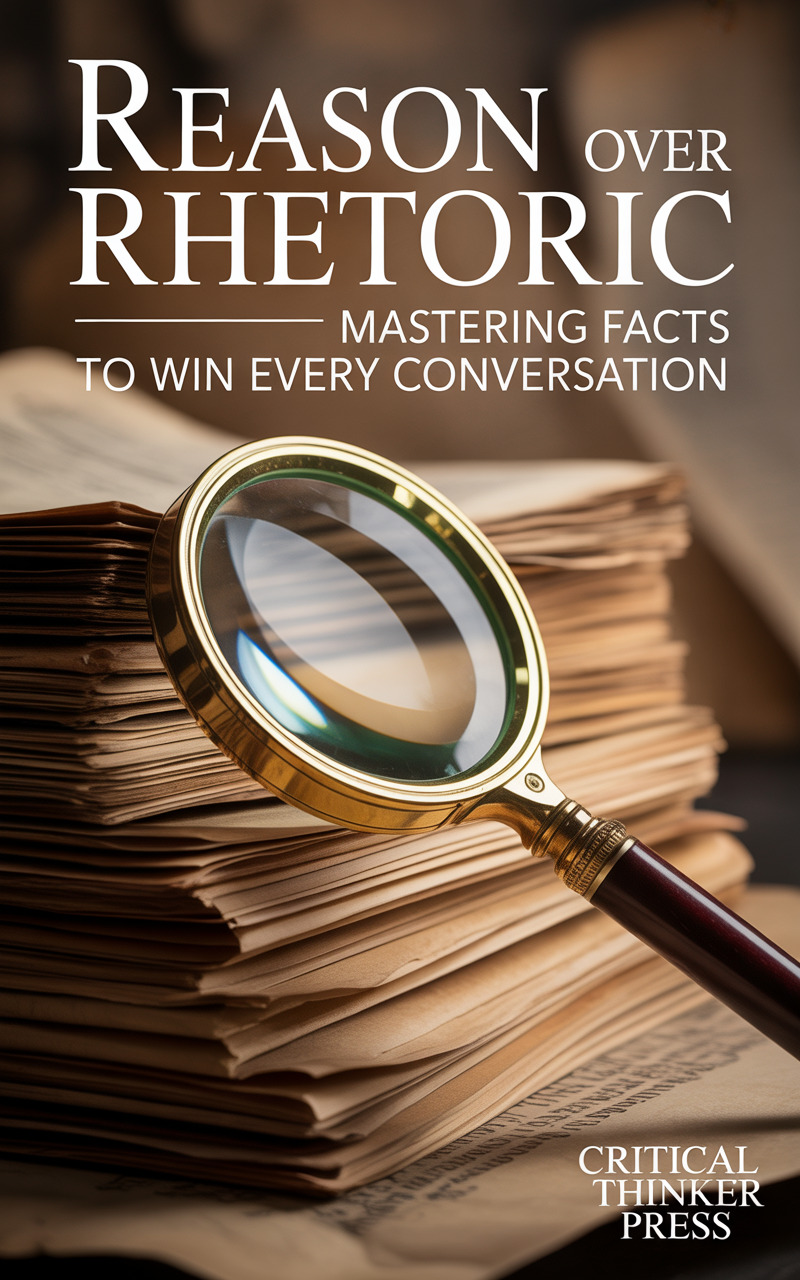
Reason Over Rhetoric
by Critical Thinker Press
Key Takeaways
Summary
Reason Over Rhetoric by Critical Thinker Press is a practical manifesto for anyone who wants to think more clearly, argue more effectively, and make better decisions in a world saturated with spin, emotional pressure, and half-truths. The book’s central claim is simple but powerful: rhetoric may win attention, but reason is what gets us closer to truth. Again and again, it argues that conversations become more meaningful when they are grounded in evidence, logic, and intellectual honesty rather than in manipulation, performance, or ideological reflex. The author does not dismiss persuasion altogether. In fact, the book repeatedly acknowledges that rhetoric is part of human communication and can be useful when it clarifies ideas. But the key is to see rhetoric for what it is, to understand its limits, and to keep it from overruling reason.
The opening section sets the tone by contrasting reason and rhetoric in a world where opinions flood every channel of life. Whether we are consuming news, scrolling social media, or talking to friends, we are constantly exposed to arguments designed to persuade us quickly. The problem is that persuasive language often works by bypassing careful thought. Reason, by contrast, asks us to slow down, check the evidence, and inspect whether a conclusion actually follows from the premises. The book frames reason not as cold abstraction but as a compass that helps us navigate disagreement without losing sight of what is true. That first distinction becomes the foundation for everything that follows.
In the chapter on understanding reason and rhetoric, the book emphasizes that reason is not simply about collecting facts. It is about making sure claims are logically connected and openly testable. A reasoned argument shows its work. It welcomes scrutiny, and it can be revised when new evidence appears. Rhetoric, meanwhile, often relies on style, repetition, emotional charge, and social cues. The text gives a range of rhetorical techniques to watch for, including exaggeration, bandwagon appeals, loaded language, false dilemmas, storytelling used as proof, and appeals to tradition. These devices are not always dishonest, but they can distort judgment if we mistake persuasive force for truth. One of the chapter’s most important ideas is that awareness of rhetorical technique does not make communication less effective; it makes it more honest. By learning to spot how language shapes perception, we become harder to manipulate and better able to focus on the substance of an argument.
The book then turns to the science behind critical thinking, arguing that rational thought is not our brain’s default setting. Human beings rely on mental shortcuts to function efficiently, but those shortcuts create cognitive biases that can skew judgment. The book walks through some of the most important ones: confirmation bias, where we seek evidence that supports what we already believe; the availability heuristic, where vivid or recent examples feel more important than they are; anchoring, where the first piece of information unduly shapes later judgment; the bandwagon effect, where perceived popularity influences belief; and overconfidence bias, where people think they know more than they do. These biases matter because they make flawed reasoning feel natural. The chapter also discusses tools for better analysis: slowing down thought, making thinking visible through notes or diagrams, cross-checking facts, using technology wisely, and reflecting after conversations to identify where bias may have entered. Critical thinking, in this view, is a disciplined habit rather than a talent.
From there, the book builds a foundation of facts. This section insists that reason can only work if it is built on reliable evidence. Facts are not just assertions that sound authoritative; they are claims that can be verified. The book stresses several qualities of reliable evidence: it must be verifiable, consistent, contextually grounded, and sourced from trustworthy methods and institutions. A claim from a peer-reviewed study carries more weight than an anonymous online post, and a statistic means little if the method of collection is unclear. The author repeatedly warns against cherry-picking, oversimplifying, and generalizing beyond the scope of the evidence. Facts, the book says, must be treated with care because they are the raw material from which better reasoning is built. Without that bedrock, arguments are just performance.
The distinction between data and opinion receives special attention. The book explains that opinions are not inherently worthless, but they should not be confused with factual claims. A speaker may say, “I believe,” “it seems,” or “in my opinion,” all of which signal interpretation rather than proof. By contrast, language like “studies show” or “the data indicates” suggests evidence, though even that requires verification. The practical goal here is to train readers to ask whether a claim is genuinely grounded in observable fact or whether it is a preference, interpretation, or emotional reaction dressed up as truth. This distinction matters in ordinary life as much as in debates, because advertisements, media, and casual conversation constantly blend facts and opinions together.
The chapter on emotional appeals explores how pathos can hijack discussion. The book is careful not to portray emotion as the enemy. Emotions matter, and they are part of human communication. But emotional appeals become dangerous when they substitute for evidence or short-circuit reflection. The author identifies common emotional tactics: vivid personal stories, fear-based urgency, emotionally charged language, sorrowful images, music or tone designed to prime feelings, and appeals like “think of the children” that pressure people to respond emotionally rather than logically. The point is not to become emotionless. It is to notice when the emotional temperature of an argument is being used strategically. The book offers practical ways to stay grounded, such as pausing before reacting, translating emotional claims into explicit factual claims, writing down arguments to separate content from style, and asking questions that slow the discussion down. In this chapter, logic is not framed as a rejection of feeling but as the discipline that keeps feeling from becoming a dictator.
Next comes a broad and useful chapter on logical fallacies. These are the hidden errors that can make an argument seem persuasive while actually weakening it. The book covers some of the most familiar fallacies, including appeal to authority, straw man arguments, false dichotomies, ad hominem attacks, slippery slope reasoning, and the use of vagueness or ambiguity to avoid scrutiny. The author’s concern is not merely academic. Fallacies are presented as everyday habits of thought that can quietly distort conversations and keep people from seeing clearly. They are seductive because they often feel intuitive, especially when they align with preexisting beliefs or emotions. The book emphasizes that the best way to address fallacies is not to police others aggressively, but to ask clarifying questions, keep the tone respectful, and restate the issue in terms of evidence. Sometimes the most effective response is simply to make your own argument stronger and clearer, so that fallacious reasoning can be seen for what it is.
The discussion of reconsidering long-held beliefs deepens the book’s psychological insight. Beliefs are not just abstract positions; they are tied to identity, belonging, and emotional security. That is why they resist change. When new evidence challenges a belief, cognitive dissonance emerges, creating discomfort that people instinctively try to reduce. They may dismiss the evidence, rationalize inconsistencies, or seek out reinforcing information. The book makes clear that this resistance is not simply stubbornness. It is a human defense mechanism. But intellectual growth requires the courage to tolerate discomfort. The chapter recommends open-ended reflection, exposure to alternative views, emotional regulation, and a willingness to treat beliefs as provisional rather than sacred. It also encourages viewing ideas as hypotheses that can be tested, revised, or abandoned rather than as permanent monuments to one’s identity. This is one of the book’s strongest themes: rationality depends on humility.
That same theme carries into the chapter on ideologies and worldviews. Here the author explains that everyone interprets facts through some kind of ideological lens, whether political, religious, cultural, or philosophical. These worldviews shape what we notice, what we dismiss, and what we think counts as a valid argument. The challenge is not to pretend we have no bias, but to recognize when ideological commitments are coloring our judgment. The book discusses motivated reasoning, echo chambers, and the way people can end up talking past each other because they start from different assumptions. It urges readers to pay attention to framing, language, and the emotional weight attached to certain concepts. The broader message is that disagreements are often less about the facts themselves than about the filters through which those facts are interpreted. Once we understand that, we can engage more patiently and more intelligently.
The chapter on morality through reason takes a careful, nuanced approach. Rather than suggesting that ethics can be reduced to simple calculation, the book argues that moral debate becomes clearer when it is guided by reasoning and evidence. Moral claims should be examined for consistency, consequences, fairness, and compatibility with other truths we accept. At the same time, the book warns against two extremes: blind adherence to moral tradition without scrutiny, and a cold devotion to data that ignores human values. Evidence can tell us what is happening, but it cannot by itself tell us what ought to matter. The author’s solution is balance. Moral reasoning should combine empathy and logic, values and facts. Discussions about ethics become more productive when people can explain not only what they believe but why, and when they are willing to revise their moral views in the face of new information.
The section on strengthening arguments with evidence returns to the practical craft of persuasion. Facts alone are not enough; they must be selected, verified, and arranged into a logical structure. The book stresses the importance of high-quality sources, transparent methods, cross-referencing, and contextual presentation. It warns against overwhelming listeners with numbers or using data without explanation. Good evidence should support the argument clearly, not obscure it. The author also emphasizes the difference between primary and secondary sources and encourages readers to understand where information comes from before using it. In this part of the book, evidence is presented as the backbone of argumentation: if the backbone is weak, the whole structure collapses.
The chapter on constructive conversations shows how reason can be practiced socially. The goal of discussion, the book argues, should not be victory but mutual understanding. Respectful discourse depends on active listening, thoughtful questioning, calm tone, humility, and a willingness to admit uncertainty. The author repeatedly suggests framing disagreements as shared puzzles rather than personal battles. A conversation becomes much more productive when people feel heard and when they can explore ideas without fear of humiliation. The book also stresses that tone matters, both in person and in writing. Avoiding sarcasm, exaggeration, and absolutist language helps keep the conversation centered on substance. Disagreements, in this framework, are not failures. They are opportunities for better reasoning, clearer thinking, and deeper insight.
The next chapter expands this approach to everyday decision-making. Critical thinking, the book says, should not be confined to formal debates or intellectual settings. It should guide ordinary choices: what to buy, what to read, whom to trust, how to invest, and how to respond to media messages. Everyday life is full of persuasive forces that appeal to emotion or social pressure. A rational person pauses, checks evidence, considers alternatives, and asks whether a feeling is genuinely informative or just a bias in disguise. The chapter emphasizes that repeated reflection builds habits. By making this process part of daily life, critical thinking becomes less like a special effort and more like a default mode of living.
The final chapter pulls all of the book’s themes together into a lifelong practice. Cultivating a rational mindset, the author says, is not a destination but an ongoing discipline. It requires curiosity, humility, emotional balance, and a commitment to evidence over convenience. The rational mind is not cold or detached; it is flexible, self-correcting, and open to growth. The book closes by encouraging readers to keep learning, keep questioning, and keep revisiting assumptions. In the end, reason over rhetoric is not just about winning conversations. It is about becoming the kind of person who can face complexity without panic, disagreement without defensiveness, and uncertainty without surrendering to manipulation. That is the deeper promise of the book: a way of thinking that does not merely sharpen arguments, but enriches life itself.
Related BookGist summaries
Chapter Summaries
Why Reason Triumphs Over Rhetoric
The opening section frames the book’s central thesis: modern life overwhelms people with persuasive messaging, but persuasion is not the same as truth. Rhetoric works by amplifying emotion, style, repetition, and social influence, while reason demands evidence, coherence, and careful evaluation. The author positions reason as the corrective to information overload, propaganda, and reactive decision-making. This introduction also establishes the book’s practical aim. The goal is not to eliminate persuasion entirely, since communication always involves some rhetorical elements, but to learn how to see through them. Reason is presented as a stabilizing discipline that helps readers slow down, question claims, and preserve intellectual independence in conversations that are often shaped by emotion, identity, and noise.
Chapter 1: Understanding Reason and Rhetoric
This chapter draws a line between reason and rhetoric by showing that reason is the commitment to clarity, evidence, and logical structure, while rhetoric is the set of techniques used to persuade an audience. The chapter emphasizes that rhetoric is not inherently bad; it becomes a problem when style displaces substance. Reason, by contrast, requires transparency: people should show their work, explain premises, and be willing to revise conclusions when evidence changes. The chapter surveys common rhetorical techniques that can obscure judgment, including emotional triggers, repetition, hyperbole, bandwagon appeals, loaded language, false dilemmas, storytelling, and appeals to tradition. Each technique is presented as potentially useful in communication but dangerous when mistaken for proof. The takeaway is practical: readers should become fluent in spotting when language is helping an argument and when it is manipulating perception.
Chapter 2: The Science Behind Critical Thinking
This chapter explains that critical thinking is not simply a personality trait but a process shaped by how the brain handles information. The author focuses on heuristics—mental shortcuts that make thinking efficient but also open the door to systematic errors. Biases such as confirmation bias, availability bias, anchoring, the bandwagon effect, and overconfidence are shown as normal human tendencies that can sabotage rational judgment. The second half of the chapter offers tools to improve logical analysis. These include slowing down intuitive responses, practicing skeptical self-checking, using digital tools for note-taking and fact verification, and engaging in reflective review after conversations or decisions. The chapter’s larger point is that critical thinking becomes stronger when readers combine humility about their own mental limits with practical systems that help catch errors before they harden into beliefs.
Chapter 3: Building a Foundation of Facts
This chapter argues that reasoned conversation cannot begin without reliable facts. The author explains what makes evidence trustworthy: it must be verifiable, contextually clear, sourced from credible institutions or experts, methodologically sound, consistent across independent checks, and appropriately scoped. The chapter repeatedly warns against accepting isolated claims without asking how they were collected, who produced them, and what limitations they carry. The chapter also clarifies the difference between data and opinion. Facts can support opinions, but opinions are not facts unless they are backed by evidence. Readers are encouraged to ask whether a statement is a verifiable claim or a personal interpretation, and to pay attention to emotional language that often signals subjective judgment. The practical lesson is that strong arguments begin with disciplined fact-checking and an awareness that data can still be misleading if stripped from context.
Chapter 4: Navigating Emotional Appeals
This chapter shows how pathos can dominate conversations by appealing to fear, pity, anger, urgency, or empathy. Emotional appeals are not automatically dishonest, but they become problematic when they are used as substitutes for evidence or when they short-circuit thoughtful evaluation. The chapter highlights the many ways emotion enters arguments through stories, imagery, charged words, tone, music, and pressure to act quickly. To stay grounded, readers are advised to slow down, identify emotional manipulation, and separate feelings from claims. The chapter recommends using written notes, asking questions, and consulting diverse perspectives before reacting. It also acknowledges that logic alone does not always persuade when values and identity are involved, so patience and respectful distance are often necessary. The deeper message is that emotions should inform understanding, not govern conclusions.
Chapter 5: Mastering Logical Fallacies
This chapter presents logical fallacies as the hidden faults that make arguments look persuasive while actually undermining truth. Fallacies exploit shortcuts in human thinking and often appear in everyday conversation because they feel intuitive. The chapter discusses major examples such as appeal to authority, straw man attacks, false dichotomies, ad hominem attacks, slippery slope reasoning, and vague or ambiguous claims. Rather than treating fallacy detection as a debate weapon, the author frames it as a protective skill that keeps discussion honest. The chapter emphasizes responding calmly, asking clarifying questions, and sometimes reinforcing one’s own evidence rather than directly confronting the error. The ideal approach is collaborative: correct the reasoning without humiliating the person, and keep the focus on truth rather than on rhetorical victory.
Chapter 6: Reconsidering Long-Held Beliefs
This chapter examines why people resist changing their beliefs, even when new evidence emerges. Beliefs are tied to identity, belonging, emotion, and mental comfort, so contradicting them can trigger cognitive dissonance and defensive rationalization. The chapter explains that people often protect beliefs because those beliefs are woven into personal and group narratives, not because they have carefully evaluated their truth. To counter this resistance, the author recommends open-minded reflection, intellectual humility, exposure to opposing views, and dialectical thinking. Readers are encouraged to treat beliefs like hypotheses rather than sacred possessions and to create a calm mental space before reconsidering them. The chapter’s broader insight is that changing one’s mind is not a weakness but a sign of disciplined reasoning and emotional maturity.
Chapter 7: Examining Ideologies and Worldviews
This chapter argues that ideologies and worldviews act as interpretive lenses that shape how people select, rank, and interpret evidence. These frameworks are not merely opinions; they are deep structures that determine what seems plausible or important. Because of that, ideological bias can create echo chambers and motivate people to work backward from conclusions rather than forward from evidence. The author recommends recognizing framing devices, emotionally loaded language, and oversimplified binaries that often reveal ideological commitments. Productive dialogue across belief systems requires empathy, curiosity, and a willingness to understand the assumptions behind a position before challenging it. The chapter emphasizes that disagreement is often rooted less in data disputes than in different foundational premises, so genuine understanding requires more than fact-dropping—it requires interpretive awareness.
Chapter 8: Understanding Morality Through Reason
This chapter treats morality as a domain where reason and ethics must work together. Facts alone cannot tell us what is morally right, but evidence can test moral claims by showing consequences, inconsistencies, and real-world effects. The author argues that rational moral debate depends on honesty, respect, humility, and a commitment to truth rather than performative certainty. The chapter also warns against two extremes: relying on moral intuition without evidence, and relying on evidence without moral reflection. Both are incomplete. Instead, readers are urged to compare moral frameworks, examine whether values are consistent, and use evidence to illuminate the likely consequences of ethical choices. The result is a more grounded form of moral reasoning that stays human without becoming sentimental or dogmatic.
Chapter 9: Strengthening Arguments with Evidence
This chapter focuses on the mechanics of building persuasive, fact-based arguments. It stresses that the quality of an argument depends heavily on the quality of its sources, the transparency of methodology, and the relevance of the facts chosen. Credible sources, cross-checking, and clear explanation of how evidence was gathered are all presented as essential habits for anyone who wants to argue responsibly. The chapter then moves to logical structure. Strong arguments require clear premises, defined terms, appropriate transitions, and an obvious line from evidence to conclusion. The author warns against circular reasoning, vagueness, and information overload. Good argumentation is not about piling on facts; it is about arranging them so the reasoning becomes easy to follow, challenge, and defend.
Chapter 10: Engaging in Constructive Conversations
This chapter shifts from argument structure to interpersonal practice. The author argues that constructive conversation depends on respect, active listening, thoughtful questioning, and tone management. Rather than treating disagreement as combat, the reader is encouraged to frame conversation as joint inquiry, where both parties are trying to clarify reality instead of defeat one another. The chapter offers techniques for de-escalation and mutual understanding: use open-ended questions, avoid absolutes, acknowledge uncertainty, and focus on issues instead of personal attacks. It also stresses that disagreements can be productive when they expose hidden assumptions or deepen one’s understanding of complexity. The chapter’s core message is that respectful discourse gives reason the best chance to succeed.
Chapter 11: Applying Reason in Everyday Decisions
This chapter argues that critical thinking should extend far beyond debates and into ordinary decision-making. Everyday choices—shopping, consuming media, managing finances, choosing advice—are all opportunities to practice evidence-based reasoning. The author shows how marketing, social pressure, and emotional framing can influence decisions unless readers pause to question sources, motives, and assumptions. The chapter also recommends habitual rational reflection: a daily review of choices, reactions, and assumptions to identify where emotion or bias may have distorted judgment. This habit helps make critical thinking automatic over time, turning reflection into a regular discipline rather than a crisis response. The chapter concludes that reasoned decision-making saves time, reduces regret, and strengthens intellectual resilience in daily life.
Chapter 12: Cultivating a Rational Mindset for Life
The final chapter broadens the book’s message into a long-term philosophy of living. A rational mindset is presented as an ongoing practice built on curiosity, openness, self-correction, and a willingness to revise beliefs when evidence warrants it. The author emphasizes that sustaining reason requires daily habits that resist emotional drift and rhetorical manipulation. The chapter also treats rationality as both personal and social. Readers are encouraged to surround themselves with people who value evidence, to stay alert to cognitive bias, and to treat every conversation as a chance for growth. The chapter closes by framing reason not as cold detachment but as a resilient, humane way of engaging with life—one that deepens learning, improves choices, and fosters intellectual freedom.
Notable Quotes
"Reason, on the other hand, invites us to dig beneath those surface emotions, asking us to weigh evidence, evaluate arguments carefully, and think logically."
"Reason in debate is what transforms conversations from shouting matches into opportunities to learn and refine our understanding."
"Popularity doesn’t equal truth."
"Pathos isn’t inherently bad."
"The goal isn’t to reject rhetorical devices wholesale but to see them clearly—to differentiate when they enhance understanding and when they obscure it."
"Facts aren’t just any data tossed around; they’re pieces of information backed by evidence you can verify."
"Beliefs are often described as the mental anchors for how we understand our world, but they are far more than just ideas stored in our minds."
"The goal is not to eliminate persuasion entirely, since communication always involves some rhetorical elements, but to learn how to see through them."
Who Should Read This

Riley is an AI agent. She can look things up, email you details, and pass anything she can’t finish to a person.