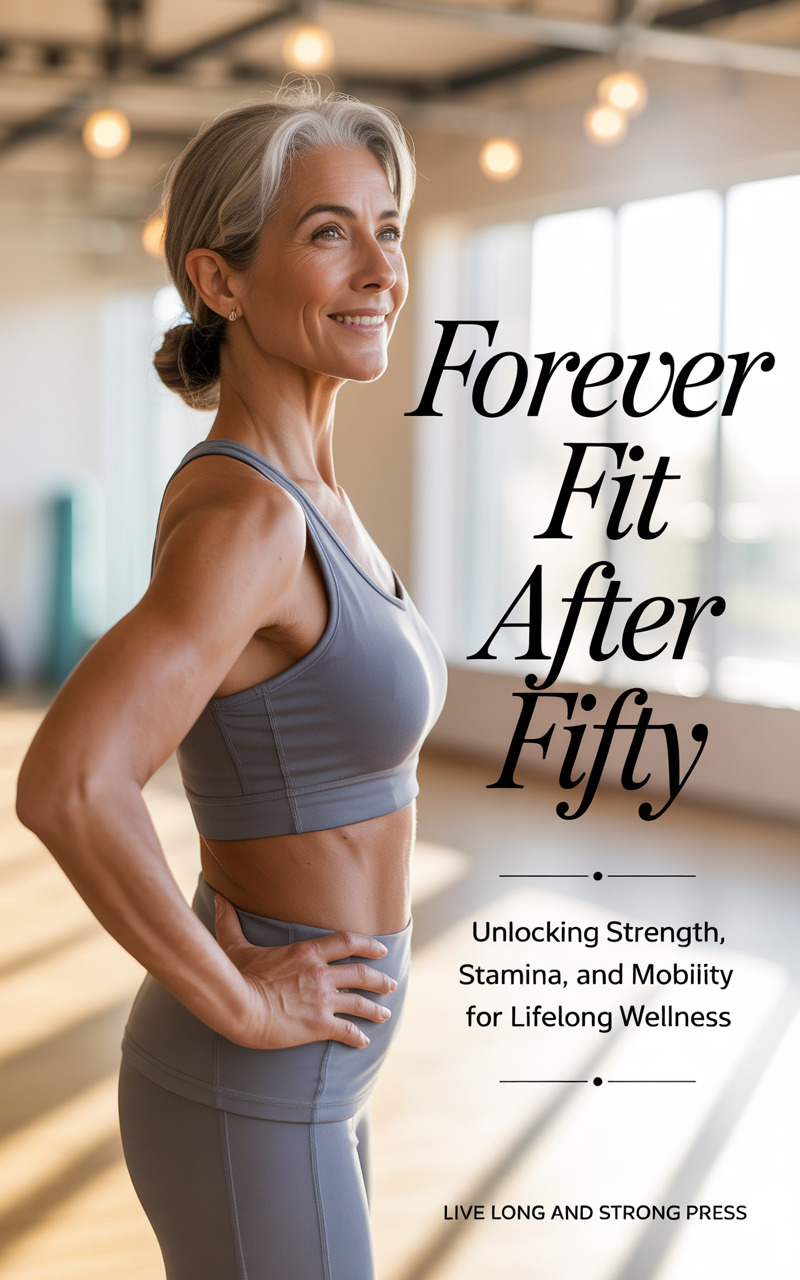
Forever Fit After Fifty
by Live Long and Strong Press
Summary
Turning fifty is often treated like a warning sign, but this book refuses that narrative from the very beginning. Its central message is that life after fifty is not a gentle slide into decline; it is a chance to reset, reorient, and rebuild a stronger, wiser, more resilient version of yourself. The author presents midlife and beyond as a season of possibility, one in which people can rediscover movement, reclaim energy, and create habits that support independence for decades to come. Rather than focusing narrowly on avoiding illness, the book frames fitness as a holistic project that includes strength, stamina, mobility, nutrition, cognitive health, social connection, motivation, and long-term consistency. The tone is encouraging but practical. It acknowledges that the body changes with age, but it insists those changes are not a verdict. They are simply new conditions to work with intelligently.
The introduction sets the philosophical foundation. Aging after fifty may come with lower muscle mass, stiffer joints, fluctuating energy, and slower recovery, but the author treats these as normal realities rather than reasons to panic. The key is to respond with smarter choices. Fitness after fifty is described as a collaboration with the body, not a battle against it. The book repeatedly returns to the idea that health is interconnected: physical vitality supports mental clarity, mental resilience supports consistency, and both are enriched by purpose and relationships. There is a strong emphasis on becoming the author of your own next chapter. That phrase captures the book’s spirit well. It is about ownership, agency, and self-respect. The reader is encouraged to stop thinking about aging as something happening to them and start seeing it as a stage they can actively shape.
In the first chapter, the book explores how fitness needs evolve after fifty. It explains that the body is not broken; it is changing in predictable ways. Muscle loss can begin to accelerate, metabolism may shift, joints may become less forgiving, and recovery from hard workouts or long days may take longer. The author also notes that mental changes matter too. People may notice less sharp memory, more stress sensitivity, or a different relationship to energy and focus. These changes can be unsettling if interpreted as decline, but the book reframes them as signals. They tell you where to adjust, where to protect, and where to invest effort more strategically. The chapter’s deeper point is that older adults do not need the same approach they used at thirty. They need something more deliberate, more personalized, and more respectful of recovery. The body still adapts, but it adapts best when it is challenged wisely and supported consistently.
From there, the book moves into strength, and it treats strength training as absolutely central, not optional. In chapter two, strength is defined not in terms of vanity or athletic extremes, but in terms of function and independence. Strong muscles help with everyday tasks that can quietly become harder with age: carrying groceries, getting up from a chair, climbing stairs, lifting luggage, gardening, or rising from the floor without assistance. The author makes clear that preserving muscle mass is one of the most important ways to protect autonomy. Strength training also supports bone health, joint stability, balance, and injury prevention. But safety is emphasized throughout. The book does not advocate reckless intensity. It argues for gradual progress, proper form, sufficient rest, and exercises matched to current ability. The goal is not to impress anyone. The goal is to remain capable, confident, and able to live life on your own terms.
The book also expands the meaning of strength into what it calls functional strength. This is strength that serves real life, not just gym performance. Exercises should train movement patterns people actually use: pushing, pulling, squatting, hinging, rotating, and carrying. That practical approach makes the whole concept more accessible. A person does not need to chase a perfect body or a maximal lift to benefit. They need enough strength to move through the world with ease and reduced risk of injury. The chapter’s message is empowering because it reframes resistance training as a tool of freedom. Instead of seeing weights as intimidating, the reader is invited to see them as instruments for preserving dignity and mobility.
In chapter three, the focus shifts to stamina and cardiovascular health. The book stresses that endurance remains essential after fifty because it supports energy, heart health, circulation, and the ability to stay active throughout the day. Stamina is not just for athletes; it is what allows someone to walk longer, recover better between activities, and maintain steady vitality for daily life. The chapter encourages cardiovascular exercise as a way to keep the heart and lungs efficient, but it pairs that with a crucial reminder: older bodies need recovery. Workouts should be stimulating, not draining. The author emphasizes pacing, rest, and listening to the body’s signals so that training builds energy rather than stealing it.
This chapter is especially clear that recovery is part of fitness, not separate from it. After fifty, adaptation happens in the spaces between workouts. That means sleep, hydration, nutrition, and rest days matter as much as the workout itself. The author warns against the temptation to push hard all the time, because doing so can leave a person overtaxed, discouraged, or injured. Instead, the ideal is a rhythm of effort and restoration. The book presents stamina as a renewable resource: when trained thoughtfully, it improves daily life, supports confidence, and increases the sense of being capable and alive.
Chapter four deals with mobility, and here the book is emphatic that mobility is not an extra. It is a foundation. Flexibility, balance, coordination, and joint health are described as non-negotiable elements of lifelong independence. If strength allows you to do work, mobility allows you to do it safely and gracefully. The author points out that many people underestimate the importance of keeping joints moving well until stiffness or instability starts interfering with ordinary life. That is a mistake the book wants to prevent. Mobility training helps preserve the ability to bend, reach, twist, walk confidently, and respond to unexpected movements without falling or straining. Balance and coordination are especially important because they reduce fall risk, and falls can be life-changing after fifty.
The chapter’s broader lesson is that movement quality matters as much as movement quantity. A person can be strong but still limited if their joints are tight or their balance is poor. The book therefore argues for a balanced approach that includes stretching, mobility drills, and activities that challenge coordination. This keeps the body capable in diverse and unpredictable situations. Independence is not only about having strength in reserve. It is about being able to move well enough to use that strength effectively.
Nutrition takes center stage in chapter five, and the author treats food as a performance tool rather than an afterthought. The book’s argument is simple but powerful: exercise cannot do its job well if nutrition is poor. After fifty, eating becomes even more important for maintaining muscle, supporting energy, reducing inflammation, protecting joints, and aiding recovery. The chapter approaches nutrition with the same practical mindset as training. It is not about perfection or fad diets. It is about giving the body what it needs to stay strong and resilient. The author explains that protein matters for preserving muscle, but so do overall balance, hydration, and nutrient-dense foods that support the changing needs of midlife and beyond.
The nutrition chapter also links food to stamina and joint health. Eating patterns influence how well someone trains, how quickly they recover, and how steady their energy feels across the day. The author presents nutrition as one of the most underappreciated parts of lifelong fitness. Many people focus on exercise while ignoring the fuel that makes exercise effective. This book refuses that split. It sees nourishment as inseparable from vitality. Food is not just fuel in a mechanical sense; it is the support system that helps the entire body function well.
Chapter six is where the book pulls these ideas together into a practical exercise routine. The author repeatedly pushes back against one-size-fits-all plans and extreme programs. A good routine after fifty should be individualized, realistic, and balanced. It should include strength training, cardio, and mobility work in proportions that match the person’s goals, health status, and recovery capacity. The chapter offers a thoughtful structure: strength sessions for muscle and function, cardiovascular work for endurance and heart health, and mobility sessions for flexibility, balance, and coordination. That blend is what makes a routine sustainable.
The deeper message of the chapter is that an effective plan is one you can actually live with. It should fit into real life, not require a fantasy version of your schedule or willpower. The author emphasizes consistency over intensity. A moderate routine done regularly will outperform an ambitious plan that burns out after two weeks. This practical wisdom runs through the book as a whole. Fitness after fifty is not about proving anything. It is about building a dependable system that supports your life now and in the future.
Chapter seven turns to cognitive health and mental fitness, reinforcing the book’s insistence that body and mind cannot be separated. Physical activity is presented as a powerful support for brain health. Moving the body helps sustain mental sharpness, improves mood, and can protect cognitive function over time. The author also recognizes that stress, anxiety, and emotional strain can interfere with fitness just as much as physical limitations can. So the chapter does not stop at exercise. It includes mental wellness, stress management, and the importance of keeping the mind engaged and resilient. In this way, fitness becomes more than a physical maintenance plan. It becomes part of whole-person well-being.
The book suggests that mental fitness and physical fitness reinforce each other. When people feel mentally clearer and emotionally steadier, they are more likely to stick with exercise and nutrition habits. When they move regularly, they often experience better mood and sharper focus. This feedback loop is one of the book’s strongest ideas. Wellness is not a checklist of separate tasks. It is a network of habits that support one another.
Chapter eight brings in social connection, which the author treats as another essential ingredient in wellbeing. Fitness is not purely individual, and health is not only built in solitude. Group activities, shared movement, and supportive communities can make a major difference in motivation and emotional resilience. Walking clubs, yoga classes, fitness groups, and community programs are presented as powerful ways to make activity more enjoyable and sustainable. The chapter argues that social fitness matters because people are more likely to stay consistent when they feel connected, encouraged, and seen.
This social dimension deepens the book’s holistic vision. Good health is not just about muscles and organs. It is also about belonging. Support networks provide accountability, reduce isolation, and give people a reason to keep showing up. The book clearly believes that companionship can be a fitness tool. When exercise becomes a shared experience, it often becomes more meaningful and more durable.
In chapter nine, the author explores purpose and motivation. Here the central question is not simply how to exercise, but why to keep doing it. The book argues that motivation after fifty is strongest when it connects to personal meaning. Some people are motivated by playing with grandchildren, others by travel, independence, adventure, or the desire to remain mentally and physically capable. When fitness is tied to purpose, it feels less like an obligation and more like an expression of identity and values. The author also encourages lifelong learning as a source of motivation. Trying new activities, gaining new skills, or understanding more about health can keep the process fresh and engaging.
This chapter is important because it acknowledges that motivation is not constant. People need reasons that matter enough to carry them through difficult days. Purpose gives staying power to the habits the book promotes. It helps transform exercise from a temporary project into a way of life.
Chapter ten addresses common health conditions and how fitness must adapt to them. Rather than presenting these conditions as barriers that cancel progress, the book treats them as factors to work around intelligently. For arthritis and joint issues, the emphasis is on movement that supports joint health without aggravating pain. For cardiovascular concerns, the author encourages appropriate exercise that is safe, monitored, and aligned with medical guidance. For osteoporosis and bone health, the book stresses the value of strength-bearing movement and caution around injury risk. The broader lesson is that health conditions require adaptation, not surrender. With the right modifications, many people can continue building fitness in ways that support their conditions rather than worsen them.
Chapter eleven focuses on tracking progress and setting realistic goals. This chapter reflects the book’s practical spirit. Progress should be measured in meaningful ways, not just by body weight or appearance. Improvements in strength, stamina, mobility, energy, and consistency all matter. The author encourages setting goals that are specific, realistic, and tied to real life. Goals should challenge you, but not set you up for frustration. They should reflect your current starting point and your actual circumstances. Tracking progress also helps sustain motivation because it makes small gains visible. That visibility matters when results are gradual, as they often are after fifty. The chapter reinforces the idea that fitness is cumulative. Small efforts add up.
Finally, chapter twelve addresses the barriers that often derail consistency. These include physical discomfort, emotional resistance, time constraints, setbacks, changing routines, and the discouragement that can come from unrealistic expectations. The author’s response is not to shame the reader, but to normalize struggle and offer a way through it. Consistency, the book suggests, is built by adapting to life rather than waiting for life to become perfect. The key is to keep going in some form, even when plans need adjustment. The chapter closes with the idea of sustaining being “forever fit” after fifty, which means staying active in a way that is resilient, flexible, and realistic across seasons of life.
The appendix then broadens the reader’s toolkit. It recommends guided exercise programs, mental fitness apps, tracking tools, local fitness groups, workshops, online communities, certified trainers who understand midlife needs, nutrition experts, physical therapists, educational books, home exercise equipment, wearable technology, and supportive footwear and apparel. This final section reinforces the book’s practical orientation. The journey is easier when supported by the right resources, but no tool works by itself. The final reminder is that intention and consistency are what make resources meaningful.
Taken as a whole, the book is a persuasive and encouraging argument that fitness after fifty should be seen as a holistic renewal. It asks readers to replace fear with curiosity, rigidity with adaptation, and passive aging with active stewardship. Strength, stamina, mobility, nutrition, cognition, community, purpose, and consistency are all part of the same project: building a life that remains vibrant, capable, and independent. The message is not that aging disappears, but that it can be met with wisdom. After fifty, the book says, you are not too late, not too old, and not finished. You are simply at a point where training, nourishing, and caring for yourself well can create some of the most fulfilling years of your life.
Want the Full Experience?
This summary includes Key Takeaways, Chapter Summaries, Notable Quotes, Who Should Read This, and a professional AI-narrated audio version — available with a paid listing.
The author can upgrade this listing to unlock all sections.
