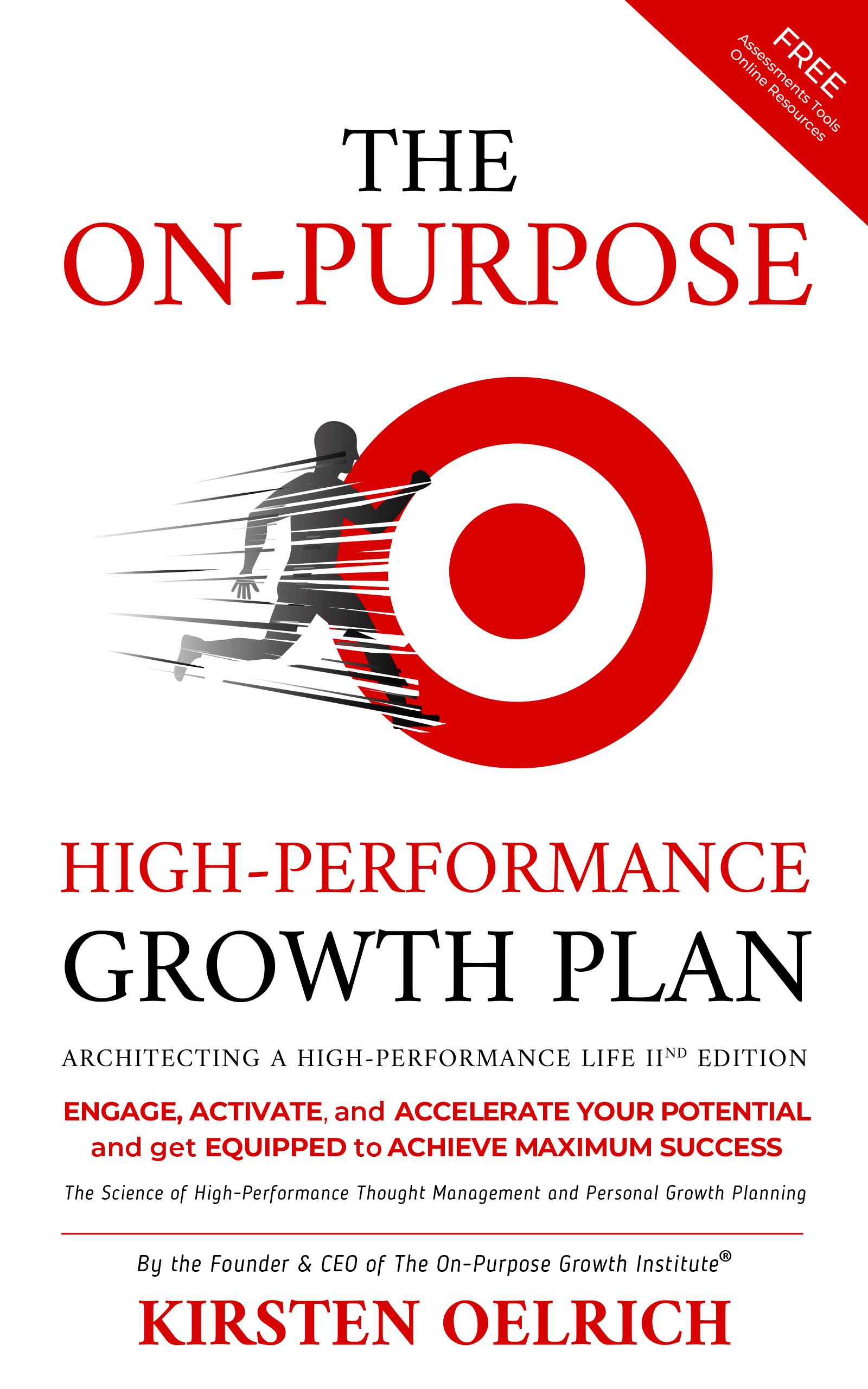
The On-Purpose High-Performance Growth Plan ll Edition
by Kirsten Oelrich
Key Takeaways
Summary
The book presents high performance growth as something far more intentional than a burst of inspiration or a vague desire to “do better.” From the start, the author’s message is that lasting progress does not happen by accident. It is built through an on-purpose system: a clear vision, specific goals, daily habits, a resilient mindset, supportive environments, and a willingness to revisit and refine the plan over time. The tone throughout is practical and encouraging, but also disciplined. Rather than treating growth as a personality trait or a temporary mood, the book frames it as a repeatable process anyone can learn and apply.
That foundation is set in the opening material, where the author positions the high-performance growth plan as the answer to the common problem of scattered effort. Many people want improvement, but their intentions remain abstract. They say they want to be healthier, more productive, more successful, or more fulfilled, yet they have no structure connecting those hopes to their day-to-day behavior. The book insists that this gap is the central obstacle. A growth plan matters because it gives shape to ambition. It turns “someday” into a system for today. It also makes room for self-awareness, because sustainable growth requires both confidence and honesty. You need to know your strengths, but also your blind spots. You need ambition, but you also need the patience to build steadily.
One of the first major ideas the author develops is that vision and purpose must come before goal setting. The book repeatedly returns to the idea of a personal vision statement, treating it as the anchor for everything that follows. A vision statement is not presented as a decorative exercise or a corporate-style slogan. It is the starting point for meaningful growth because it answers the deeper questions: What kind of person do you want to become? What values do you want to embody? What does success actually mean to you? When a vision is clear, daily choices become easier because they can be measured against a larger identity and direction. Without that, growth becomes reactive and inconsistent. With it, even small decisions begin to feel purposeful.
The author makes a strong case that the vision statement is what keeps a growth plan from becoming just another productivity list. It gives the plan emotional and moral coherence. The book emphasizes that when your long-term purpose is defined, your habits, goals, and priorities stop competing with one another and start reinforcing each other. This is where the author’s perspective becomes especially practical: you are not merely trying to be busy or achieve isolated wins. You are trying to live in alignment. The vision is what makes the plan personal. It ties growth to identity, not just to output.
From there, the book moves into the importance of specific goals. The central argument here is that vague aspirations do not create reliable progress. Saying “I want to get better” or “I want to be more successful” does not give your brain enough information to act. The author insists on concrete priorities, measurable outcomes, deadlines, and checkpoints. In other words, the growth plan must be translated into a set of goals that can be tracked and adjusted. This specificity is not presented as a bureaucratic habit; it is presented as a way of turning intention into traction. If you do not know what you are aiming at, you cannot tell whether you are moving forward.
The author also stresses that goals should be connected to the vision statement. Rather than collecting random ambitions, the reader is encouraged to create a focused path. The emphasis on measurable progress appears again and again because it solves one of the most common problems in self-improvement: people feel inspired, but they do not know how to evaluate whether they are actually improving. By making goals specific, the book brings clarity to effort. It also creates momentum, because each completed checkpoint becomes evidence that change is happening.
Daily habits are then presented as the engine of the entire system. If vision gives direction and goals provide targets, habits are what make growth real. The author is clear that sustainable success does not come from occasional surges of motivation. It comes from small, repeated actions performed consistently over time. This is one of the book’s most important themes, and it is developed with great insistence. The reader is encouraged to think less about heroic effort and more about reliable routines. A person does not become high-performing by trying hard once in a while; they become high-performing by structuring ordinary days in a way that supports extraordinary outcomes.
The book treats habits as both practical and psychological. They reduce decision fatigue, create rhythm, and make progress less dependent on mood. The author repeatedly suggests that consistency matters more than intensity because consistency accumulates. A small action repeated daily can produce more growth than a dramatic effort that never becomes part of a system. This section also links habits to identity. A habit is not merely something you do; it is evidence of the kind of person you are becoming. That perspective is powerful because it shifts growth from a question of willpower to a question of alignment and repetition.
Mindset is another major pillar, but the author is careful not to romanticize it. Positive thinking is not dismissed, but it is never allowed to stand alone. The book’s view is that mindset matters only when it is translated into behavior. Confidence is useful, but only if it leads to action. Belief is valuable, but only if it results in discipline and follow-through. This is one of the book’s most pragmatic distinctions. The author does not want readers to confuse feeling ready with being ready. Mindset is not a replacement for effort; it is what helps effort continue when the work gets difficult.
The discussion of self-belief also includes the necessity of honest self-assessment. Growth requires encouragement, but it also requires reality. Readers are urged to notice where they sabotage themselves, where they doubt themselves, and where they let fear dictate behavior. The author treats fear, limiting beliefs, and complacency as predictable obstacles rather than mysterious failures. This is important because it removes shame from the process. If these roadblocks are normal, then the answer is not self-criticism but structure. The reader is taught to identify the obstacle, name it, and work around it.
As the book develops, it expands beyond personal motivation into personal and professional development. Growth is not limited to self-help in the abstract. It includes skill-building, learning, expanding competence, and improving the quality of one’s contribution. The author presents development as a long-term investment. A high-performance life requires ongoing growth in knowledge, capability, and character. The reader is encouraged to see themselves as a work in progress, someone who can always deepen expertise, refine communication, strengthen leadership, and become more adaptable. This section reinforces one of the book’s core messages: growth is not about proving you are already finished. It is about building capacity.
The book also makes the case that personal and professional growth should be integrated rather than separated. The habits and mindset that help someone lead effectively at work are often the same ones that improve their life outside work. The author treats consistency, clarity, discipline, and self-awareness as transferable traits. The implication is that growth should not be fragmented into separate compartments. A person who develops one area well can often strengthen the others, provided the effort is connected to a larger purpose and guided by a coherent plan.
When the book turns to roadblocks, it becomes even more grounded. The author names the most common barriers to growth: fear, inconsistency, complacency, distraction, and limiting beliefs. What makes this section effective is that these barriers are not portrayed as rare setbacks. They are presented as part of the process. Growth plans do not fail only because people are lazy; they fail because people encounter internal resistance and do not know how to respond. The book therefore encourages readers to treat roadblocks as signals. Fear may be pointing to a stretch opportunity. Inconsistency may reveal a weak system. Complacency may signal that the vision is too vague or too distant. Limiting beliefs may be distorting what feels possible.
The author’s approach is to replace vague self-blame with diagnosis and action. If fear is present, confront it with small steps. If complacency is creeping in, re-engage with the vision and raise the standard. If distractions are pulling attention away, refine the environment and simplify the day. The insight here is that roadblocks are not just emotional problems; they are design problems. They can be managed more effectively when the growth plan is specific enough to reveal where things are breaking down.
Accountability, support, and environment form another major pillar of the book. This section argues that high performance is not a solo achievement. Even highly motivated people need systems, relationships, and surroundings that reinforce the right behavior. The author emphasizes accountability because it makes goals visible and commitments harder to ignore. When progress is shared, there is more follow-through. When someone else knows your plan, it becomes easier to stay honest with yourself. Accountability is presented not as pressure for its own sake, but as a form of support for discipline.
Support is similarly important. The author suggests that encouragement from others can help a person stay committed during moments when confidence weakens. But support is not just emotional; it is also practical. The right people can provide advice, perspective, and structure. The wrong people, by contrast, can drain energy or normalize stagnation. That is why environment matters so much. The book treats environment as a hidden force that shapes behavior. A cluttered, distracting, or unsupportive environment can undermine even the best intentions, while a well-designed environment can make good habits easier and bad habits harder. High performance, in this framework, is never purely internal. It is always influenced by context.
This section also reinforces the idea that growth should be easier to sustain, not harder. Rather than relying on endless self-control, the author encourages readers to design their surroundings, relationships, and routines so that the desired behavior becomes more natural. This practical wisdom is one of the book’s strengths. It acknowledges that people do not live in a vacuum. They are shaped by the systems around them. So the growth plan should include not only goals and habits, but also social and environmental scaffolding.
In the final chapters, the book turns toward maintaining momentum and thinking long term. Here the author makes an important point: starting strong is not the same as continuing strong. Many people make progress early because the idea is exciting, but they struggle once the novelty fades. The book argues that long-term growth depends on revisiting the plan, measuring results, and adapting when necessary. Reflection is not treated as a one-time exercise. It is built into the process. Annual reviews, regular check-ins, and honest evaluation are all part of preserving momentum.
The author also emphasizes that growth is cyclical. You set goals, build habits, face obstacles, gather feedback, and adjust. Then you do it again. This prevents the growth plan from becoming rigid. It also keeps the reader from mistaking progress for perfection. There will always be new challenges, new opportunities, and new versions of yourself to consider. Long-term success requires humility, because the person you were when you set the plan may not be exactly the person you are later on. The author therefore encourages ongoing revision, not as a sign of failure, but as a sign of maturity.
The concluding message is that high-performance growth is a deliberate practice of aligning vision, goals, habits, mindset, and environment over time. The book returns to the same central truth in different forms: success is not built by hoping harder. It is built by acting consistently on what matters most. The growth plan helps the reader move from scattered intention to intentional living. It asks them to think carefully about who they want to become, what they need to do, what habits will support that identity, what roadblocks will appear, and what systems will keep them moving when motivation fades.
Taken as a whole, the book is a steady and practical call to action. It does not promise shortcuts. It does not rely on inspirational language alone. Instead, it offers a framework for turning ambition into daily practice. Its message is that high performance is available to anyone willing to build it intentionally. Vision gives the work meaning. Goals give it direction. Habits give it consistency. Mindset gives it resilience. Self-awareness keeps it honest. Accountability and environment make it sustainable. And long-term reflection keeps it alive. The result is a growth philosophy that is less about chasing moments of motivation and more about becoming the kind of person who can keep growing on purpose.
Related BookGist summaries
Chapter Summaries
Introduction and Foundation
The opening material establishes the book’s central thesis: high performance and growth do not happen by accident. The author positions the plan as a practical, purpose-driven framework for readers who want to improve results in life and work through deliberate effort. The introduction also emphasizes that the material is informational rather than prescriptive, encouraging readers to adapt the ideas to their own circumstances and use them as a tool for reflection and action. This section sets the tone for the entire book by stressing responsibility, consistency, and clarity. Rather than promising shortcuts, it frames growth as a disciplined process of aligning beliefs, behavior, and long-term goals. The early pages also suggest that readers should treat the book as a working system: something to revisit, apply, and personalize rather than merely read once.
Why You Need a High-Performance Growth Plan
This chapter argues that growth without a plan tends to drift. The author explains that many people are busy, ambitious, or talented, yet still fail to make durable progress because they rely on intention instead of structure. A high-performance growth plan, by contrast, provides a clear path for turning hopes into measurable outcomes. The chapter stresses that the plan must be rooted in purpose so that effort is directed toward what truly matters. The practical message is that growth plans should not be generic. They need to be tied to a person’s real life, strengths, and challenges. The chapter also introduces the idea that a plan creates focus during difficult periods, helping readers avoid being pulled off course by distractions, emotional swings, or vague ambitions. In effect, the plan becomes both a roadmap and a filter for decision-making.
The Power of Vision and Purpose
This chapter builds the case that vision is the first major ingredient of sustainable growth. A personal vision statement is described as a compass that helps readers understand who they want to become and why their effort matters. The chapter strongly links vision to identity: when people know what they stand for, they make better decisions and resist distractions more effectively. The author also stresses that a vision should be inspiring but practical. It is not meant to be a fantasy; it should clarify direction, values, and priorities in a way that can guide daily behavior. Readers are encouraged to write down their vision, revisit it often, and use it as a standard against which opportunities, habits, and goals are measured.
Setting Specific Goals
This chapter shifts from inspiration to execution by showing how broad vision becomes concrete through goals. The author insists that meaningful goals must be specific, measurable, and tied to a larger purpose. Vague goals are treated as ineffective because they do not tell you what to do next or how to track progress. The chapter also emphasizes that goal-setting is not just about ambition; it is about operational clarity. Readers are encouraged to break broad aspirations into actionable steps and define what success looks like in practical terms. The underlying insight is that goals should create focus, eliminate ambiguity, and make progress visible enough to sustain motivation.
Building Daily Habits for Growth
This chapter argues that habits are the real driver of long-term performance. The author repeatedly stresses that small actions, done consistently, matter more than occasional intensity. Habits shape identity, and identity shapes results, which means readers need to pay attention not just to what they do once, but what they do repeatedly. The practical guidance centers on designing habits that support goals rather than undermine them. The chapter encourages readers to make growth automatic through routines, cues, and repetition. It also presents habit-building as an ongoing process of refinement, not a one-time event, reinforcing the idea that excellence is built one disciplined choice at a time.
Strengthening Mindset and Self-Belief
This chapter explores the internal side of performance: confidence, optimism, and mental discipline. The author makes clear that mindset is important, but only when paired with action. Positive thinking without execution is framed as insufficient; readers must use their beliefs to support behavior, not replace it. The chapter also addresses self-doubt and limiting beliefs, suggesting that readers examine the assumptions that hold them back. By becoming aware of internal narratives and replacing them with more constructive ones, readers can improve resilience and consistency. The overall message is that mental strength is not the absence of fear, but the ability to keep moving despite it.
Personal and Professional Development
This chapter expands the growth conversation beyond personal habits into broader life domains. It treats development as holistic, showing how communication, leadership, emotional regulation, relationships, and work performance reinforce each other. The reader is encouraged to see personal growth and professional success as interconnected rather than separate tracks. The chapter highlights continuous learning, adaptability, and intentional self-improvement as essential traits of high performers. It also suggests that growth should be visible in real-world behavior—how you lead, collaborate, solve problems, and respond under pressure. The practical implication is that development should improve both capability and character.
Identifying and Overcoming Roadblocks
This chapter focuses on the barriers that prevent people from sustaining progress. It identifies common obstacles such as complacency, fear, inconsistency, distraction, and negative thinking. The author treats these not as rare failures, but as predictable challenges that anyone pursuing meaningful growth will encounter. Rather than simply naming the obstacles, the chapter points readers toward awareness and response. The goal is to recognize roadblocks early, understand their patterns, and act before they become identity-level habits. The chapter’s message is that growth requires honest self-assessment and the willingness to confront uncomfortable truths about one’s behavior and environment.
Accountability, Support, and Environment
This chapter emphasizes that growth is easier when it is supported by other people and by a well-designed environment. Mentors, peers, feedback, and accountability structures are presented as powerful aids in staying committed and making improvements faster. The author suggests that progress is strengthened when others can reflect our blind spots and help sustain momentum. The environment also matters because habits are often shaped by what surrounds us. The chapter encourages readers to make supportive choices about routines, spaces, and relationships so that growth becomes the path of least resistance. This section reinforces a key principle of the book: success is not only about internal motivation, but also about external design.
Maintaining Momentum and Long-Term Growth
The closing chapter brings together the book’s major themes into a sustaining framework for the future. It emphasizes that growth is not a one-time achievement but an ongoing practice of reflection, recalibration, and recommitment. Readers are encouraged to keep revisiting their goals, updating their plans, and measuring progress as life changes. The chapter ends with a strong call to continue building a life of intention. High performance is framed as something earned through repeated alignment between vision, habits, and action. The final takeaway is that long-term success depends on staying purposeful, adaptable, and disciplined over time.
Notable Quotes
"A positive mindset will position you to achieve a high-performance lifestyle."
"Champions are made in the vision."
"Believe you can and you're halfway there."
"When you have a purpose, you have a path."
"Growth is a process, not an event."
"Small steps, done consistently, create big results."
"What gets measured gets managed."
Who Should Read This

Riley is an AI agent. She can look things up, email you details, and pass anything she can’t finish to a person.