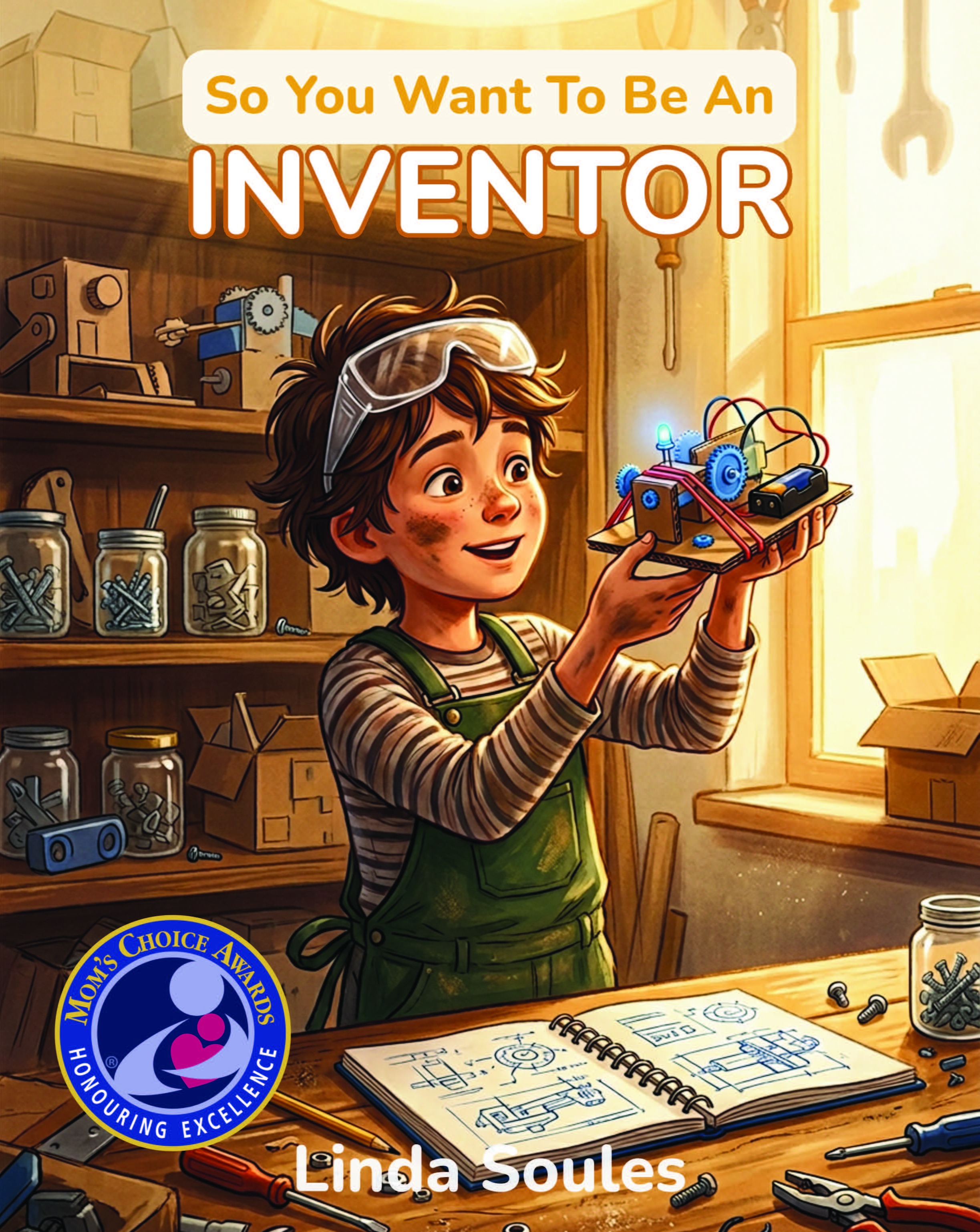
So You Want To Be An Inventor
by Linda Soules
Key Takeaways
Summary
An inventor creates something new: a device, process, material, or system that did not exist before. The work is less like a sudden flash of genius than a series of deliberate steps. First comes a problem worth solving. The inventor researches what already exists, makes a prototype, tests it, studies what went wrong, changes the design, and tries again. Thomas Edison was once asked how it felt to have failed a thousand times before finding the right lightbulb filament. He answered, “I didn’t fail 1,000 times. I found 1,000 ways that didn’t work.” That is the practical spirit of invention: an unsuccessful test can still teach you exactly what to do next.
Inventions begin with noticing. An inventor pays attention to the small difficulties people have learned to accept, then asks why things have to be that way. Velcro began when a scientist came home covered in burrs. Instead of simply picking them off, he looked at one under a microscope and saw that nature had already worked out a way to make tiny hooks cling to loops. The stethoscope began with a doctor who felt too modest to put his ear directly against a patient’s chest. He rolled a piece of paper into a tube and discovered that it made the heartbeat easier to hear. In both cases, an ordinary irritation or constraint became a question—and then an experiment.
Inventors work in nearly every field, from medical devices and agriculture to software, materials science, environmental technology, and consumer products. Their workplaces vary just as widely. A workshop or laboratory may have a workbench lined with tools, shelves crowded with parts, and unfinished prototypes spread across the surfaces. But invention does not require a perfect workshop. It can happen in a garage, a basement, or at a kitchen table, wherever there is room to think and make. The Wright brothers built their first airplane in a bicycle repair shop in Ohio. A useful place, some materials, and a willingness to make a mess can matter more than fancy equipment.
Professional inventors in research and development departments may have specialized laboratories, rapid-prototyping machines, and testing rigs. These workplaces are built for experimentation and for making the next version. Whether the setting is a sophisticated lab or a cluttered home workbench, the central task remains the same: get an idea out of your head and into a form that reality can test.
That is the purpose of a prototype, the first physical version of an idea. It need not be polished or beautiful. It only has to work well enough to reveal something about the concept. Inventors may use foam, cardboard, wood, 3D-printed plastic, or salvaged parts—whatever is available to build an early version. The prototype is not a miniature final product; it is a way to find out what is true. A design that seems convincing on paper may behave differently once it is built, handled, or placed under pressure. You have to build the thing to understand the thing.
An inventor’s notebook helps keep track of that learning. It is a place to capture ideas as they arrive, sketch designs while they are fresh, and record what happened during a test. Ideas can disappear almost as soon as they occur, so the notebook acts like a net for the mind. Leonardo da Vinci filled more than 7,000 pages of notebooks, and Thomas Edison kept 3,500. Many inventors date each entry and avoid erasing, creating a chronological record of ideas and experiments. When you are trying different approaches, the record can help you remember what you have already tried and what each attempt revealed.
Three-dimensional printing has made it possible to move from a computer design to a physical part in hours, shrinking a cycle of revision that could once take months to a matter of days. But the most important tool is testing itself. Put the prototype into the conditions it was designed for, and watch honestly. Thinking can suggest what might happen; testing shows what actually happens. A prototype may slip, break, or work only under certain conditions. Those results are not a verdict on the idea. They are evidence that can guide the next version.
A typical workday might begin at eight in the morning with three pages of free writing about problems noticed and ideas that are only half formed. Much of the writing may be useless; the point is to generate many possibilities, including bad ones, so that better ideas have a chance to emerge. At nine-thirty, the inventor revises a prototype: a tool intended to help people with limited hand strength open jars. A new mechanism is tested with twenty jar sizes, with notes on where it slips and where it works.
At noon, the inventor researches patents to see what others have already tried. The aim is to understand earlier approaches, including those that nearly solved the problem, and to look for what remains unresolved. At two, work returns to the bench. The inventor rebuilds the mechanism using textured rubber in place of smooth plastic. The change alters the friction, and twelve jars can now be opened with one hand.
At four, a meeting with a patent attorney brings another kind of work: translating between the language of a design and the language used to protect it legally. Later, the inventor tries the opener at dinner. It works, but the day’s progress does not mean the invention is finished. The notebook entry says, “Three more tests. Then user testing.” Each day may advance the design without completing it. The job is to keep asking questions, building, and checking the answers against the world.
The finest reward comes when an invention finally does what it was made to do. After sketches, adjustments, and disappointing trials, a mechanism catches, a light turns on, or a device works in the conditions that matter. Inventors describe the moment in different ways: some cry or shout, while others stand perfectly still, hardly believing what they see. The object need not be flawless. What matters is that it has become an answer to a real problem.
That answer is most powerful when the inventor can picture the person who needs it. A clever idea by itself may not carry someone through months or years of slow progress, but imagining one particular person whose life could be easier, safer, or more independent can provide a reason to continue. The effects may eventually reach far beyond that individual. Inventions can become so familiar that people forget there was a time before them, even as millions rely on them. An invention’s contribution can outlast the inventor’s name.
The difficulty is that most inventions do not work as hoped, and even promising ones can fail when they leave the laboratory. A solution may fix one problem but create two others; a product its inventor believes people need may turn out to be something the market does not want. Between an idea and a dependable product lies an enormous stretch of repeated, careful work. A flaw can persist through prototype after prototype, and progress may consist of discovering one more thing that has to change. The hardest nontechnical challenge is staying with the work long enough to learn from those setbacks. Many people do not stop because the problem is impossible, but because the process takes longer than they can bear.
Inventing is therefore not a solitary performance, even when one person first notices the problem. In a company, inventors may work with engineers, patent attorneys, manufacturing engineers, business developers, and investors. Machinists and fabricators turn drawings into physical objects, while attorneys help express a design in the precise language required for legal protection. Each person brings a different kind of expertise, and practical inventions depend on those contributions as well as on the original idea.
Customers matter especially once an invention reaches the people meant to use it. Early customers live with the product and reveal what works in ordinary circumstances, not just under ideal conditions. Their response can be the most honest feedback an inventor receives. In a healthy inventive workplace, people explain openly how a prototype broke and what that taught them. Disagreement is welcome because accepting a weak idea merely to avoid an argument can lead to costly mistakes. When a group agrees that something works, it is because people have tried hard to find reasons it does not. Seeing a real person use the invention to solve the problem it was designed for confirms the value of all that effort.
Certain qualities help an inventor keep going without confusing hope with wishful thinking. Honest looking means watching a prototype fail without explaining away what happened. The useful question is not what should have happened, but what actually went wrong. Tolerance for being wrong turns that observation into forward motion: a failed attempt is data that can narrow the search, not a verdict on the inventor. Resourcefulness helps, too. A limited supply of materials can lead to inventive choices, with cardboard serving as a prototype or an ordinary kitchen timer becoming a sensor. Constraints are not always obstacles; they can push a design toward a cleverer solution.
Inventors also need the courage to make an ugly version that can be tested rather than waiting for a beautiful version that exists only in the imagination. And they need stubborn optimism: the ability to hear someone say an idea will not work, consider the criticism honestly, and still continue when the evidence supports trying again. Clear explanation is another practical skill. An invention trapped inside its creator’s head cannot help anyone. The inventor must be able to make the idea understandable to people with different needs and backgrounds, from an investor or patent attorney to a child.
One surprising feature of invention is that the same idea can arrive independently to several people at nearly the same time. This is called multiple discovery. Alexander Graham Bell filed the telephone patent on the same morning as Elisha Gray. Four inventors built working airplanes within a two-year period at the beginning of the twentieth century, and two teams patented the safety elevator within months of one another. These coincidences suggest that important inventions often depend on their historical moment. Once the necessary knowledge and conditions are in place, people in different locations may recognize the same possibility. A promising idea is a reason to begin, not to assume there will be no one else pursuing it.
Being first, however, is not always what makes an invention consequential. At least twenty-two people invented versions of the lightbulb before Thomas Edison. What made Edison’s work famous was not simply the device, but a bulb that was inexpensive and reliable, together with the electrical infrastructure that made it useful. In many cases, the celebrated inventor is remembered not as the first person to imagine something, but as the one who made it practical. Turning an idea into a system people can actually use can demand as much ingenuity as conceiving the original device.
Unexpected connections can also change what is possible. The Japanese bullet train was too noisy until its engineers redesigned its nose to resemble the beak of a kingfisher, a bird that enters water without a splash. An engineer’s curiosity about biology could thus help solve an engineering problem. Looking across fields—at nature, cooking, design, or anything else—can reveal a solution that would not appear if inventors confined themselves to one discipline.
History shows that invention is not reserved for people whose work is welcomed or recognized. Garrett Morgan created a breathing hood that saved dozens of workers trapped in a 1916 tunnel disaster beneath Lake Erie. Because he was Black, buyers who refused to meet him were shown the device by a white actor he hired. His three-position traffic signal, patented in 1923, became the foundation of the modern traffic light. Morgan tackled problems that people in power often ignored, while facing a patent system that worked against him.
Hedy Lamarr, the Hollywood actress, co-invented frequency-hopping radio technology in 1942 to help keep enemy forces from jamming Allied torpedoes. The U.S. Navy ignored her patent, in part because it would not take a woman or a film star seriously. Her invention remained unused for twenty years, but the technology later became a foundation for WiFi, Bluetooth, and GPS. The inventors’ community recognized her only three years before she died. Gitanjali Rao’s story offers a different reminder: you need not wait for adulthood to begin. At eleven, after learning about the water crisis in Flint, Michigan, she set out to design a device that could detect lead in drinking water in minutes rather than days. She later invented tools to help identify cyberbullying and early signs of opioid addiction. At fifteen, she became TIME magazine’s first-ever Kid of the Year. Her question—why can’t this be better?—was enough to get her started.
Some inventions begin with accidents. NASA engineer Lonnie Johnson was testing a heat pump in his bathroom in 1982 when water shot across the room; he saw the makings of an extraordinary water gun. The Super Soaker that followed eventually sold over a billion dollars’ worth. A scientist trying to make a strong adhesive instead made one that barely stuck. It sat unused for six years, until a colleague found that it could keep bookmarks from slipping out of his hymn book. Those weak-stick notes became Post-it Notes. The microwave oven began when an engineer near a radar tube noticed that a chocolate bar in his pocket had melted. The first microwave was six feet tall and weighed 750 pounds. Other paths to invention can be much longer: the inventor of intermittent windshield wipers spent twelve years fighting Ford in court and eventually won $30 million, refusing settlements because he wanted acknowledgment. Even the word “debugging” has a literal origin: in 1947, engineers found a moth caught in a computer relay, taped it into their logbook, and called it the first actual case of a bug being found. More patents are filed every year than ever before, a sign that human invention is accelerating.
You can begin preparing today with a notebook beside your bed. Catch questions, odd ideas, and “what ifs,” even the silly ones. Walk around your home, find five things that annoy you, choose one, and sketch a better version. Chester Greenwood was fifteen when cold ears and frustration with scarves led him to invent earmuffs. With a grown-up’s permission, take apart an old clock, broken toy, or used-up pen and discover what is inside. Visit a library or makerspace; some offer tools, 3D printers, and craft materials. Read about inventors such as Garrett Morgan, Stephanie Kwolek, or Gitanjali Rao, then follow whichever story makes you curious. Or start with a small problem at school: organize a backpack more effectively, create a game with new rules, or improve something that bothers you. You do not need to earn the title of inventor first. You begin by trying to solve what is in front of you.
The questions to carry with you are simple and demanding: Why does this have to work the way it always has? What problem have people accepted without asking whether it could be solved? If this idea worked, what would the world look like—and would that change be worth the effort? If you love joining ideas from different places, picture better ways of doing things, or would rather try and fail than keep wondering, inventing may suit you. A mind shaped by your own experiences can notice possibilities no one else sees.
The vocabulary of invention gives names to the work. A prototype is the first physical version of an idea, made to be tested and improved, not perfected. Iteration means repeating the cycle of making, testing, finding flaws, and redesigning. Failure is not merely an obstacle; it is the common, useful result of experiments, narrowing the search. A eureka moment is a sudden flash of insight, named for Archimedes, who allegedly shouted “I have found it!” in Syracuse; real inventions usually grow through smaller steps. A lab notebook is a dated, signed record of experiments and ideas, sometimes crucial when inventors dispute who arrived first. Prior art means what has already been invented, published, or patented; searching it reveals both what exists and where earlier attempts stopped. A patent legally protects an invention, while intellectual property is the legal ownership of creative work. Commercialization is the journey from a working prototype to a product people can buy, a stage where many brilliant inventions falter. Multiple discovery describes different people independently reaching the same invention when the necessary knowledge is ready. Problem-solving is the central skill, and STEM—science, technology, engineering, and mathematics—provides many of inventors’ tools, alongside fields such as art, psychology, and history.
For further exploration, William Kamkwamba and Bryan Mealer’s young readers’ edition of The Boy Who Harnessed the Wind tells how, at fourteen, Kamkwamba built a working windmill from scrap metal and bicycle parts during a famine in Malawi, using a library book. Girls Think of Everything by Catherine Thimmesh presents inventions by women and girls, while Whoosh! tells Lonnie Johnson’s story. Rosie Revere, Engineer celebrates a crash as a reason to keep going, not to stop. Online, USPTO Kids explains patents and inventions; the Smithsonian Lemelson Center offers inventor biographies and its hands-on Draper Spark!Lab; Science Buddies provides build-and-test projects. You can also make a cardboard version of an idea from your notebook, search Google Patents for prior art, enter a student invention contest, or visit a Maker Faire. A discovery in a notebook becomes more useful when it meets the world.
The author’s hope is that a child will encounter work that fascinates them and think, maybe me. Invention is different from art that may succeed by moving someone: a mechanism must hold, and a cure must work. Reality gives an invention an uncompromising test. It may take years, or begin with a mistake, but the problems worth solving are waiting for someone curious and persistent enough to keep asking. An idea can be debated endlessly; a prototype lets reality answer. Build the first one, however rough, and let the next question lead you onward.
Chapter Summaries
What Inventors Do and Where They Begin
The book presents invention as a practical, learnable way of looking at the world, not a talent reserved for geniuses. Inventors notice problems people have learned to tolerate, investigate what already exists, and ask how it might work better. Examples show how observations can become inventions: Velcro grew from examining burrs caught on clothing, while the stethoscope began when a doctor rolled paper into a tube to listen to a patient’s heartbeat. The first essential step is therefore not a brilliant idea but paying attention to real needs. Ideas become inventions through repeated experimentation. An inventor builds a prototype, tests it, studies where it fails, and revises it; each failed attempt provides evidence about what to change. The work can happen in a professional research lab, a workshop, or a makeshift home workspace. The Wright Brothers’ bicycle shop illustrates that a person does not need a prestigious laboratory to start—curiosity, a place to work, materials, and persistence matter more.
Tools, Testing, and a Typical Workday
The book highlights a few foundational tools. A prototype is an early, functional version of an idea, often made from accessible materials such as cardboard, foam, wood, salvaged parts, or 3D-printed plastic. An inventor’s notebook captures sketches, ideas, dates, and observations before they disappear; the notebooks kept by Leonardo da Vinci and Thomas Edison demonstrate the value of recording work consistently. Modern 3D printing can shorten the cycle between a digital design and a physical test, but the most important tool remains testing the prototype under the conditions it is meant to face. A sample day makes the process concrete. An inventor might begin by writing freely about problems and possible ideas, revise a jar-opening tool, test it across many jar sizes, and consult patents to understand earlier attempts. After changing smooth plastic to textured rubber, the inventor finds that the new material provides more grip. The day may also involve meeting a patent attorney and trying the device at home. Even when a prototype works, the next steps—additional tests and user feedback—remain, showing that improvement is gradual rather than completed in a single moment.
Rewards, Difficulties, and Working With Others
One of invention’s greatest rewards is the moment a prototype finally does what it was designed to do: gears engage, a light turns on, or a device solves a problem. The book also emphasizes the longer-lasting satisfaction of seeing an invention improve people’s lives, sometimes on a huge scale and sometimes through a small everyday convenience. The strongest ideas begin with a real person’s difficulty, not with a clever concept searching for a use; imagining who will benefit can give an inventor motivation through setbacks. The path is demanding because many prototypes fail outside the lab, solutions can create new problems, and a technically sound product may not be wanted by customers. The gap between an idea and a reliable product can require many careful versions. Inventors often work alongside engineers, machinists, patent attorneys, manufacturing specialists, business developers, and investors. Early customers are especially valuable because their experience tests whether the invention actually helps. A healthy inventive culture discusses failures openly, welcomes disagreement, and tries to disprove a design before relying on it.
Inventor Qualities and the Surprising Nature of Discovery
Successful inventors combine technical work with habits of mind: they look honestly at what happened, tolerate being wrong, use available materials resourcefully, and have the courage to build imperfect prototypes. Stubborn optimism does not mean ignoring criticism; it means evaluating it and continuing when the evidence supports another attempt. The book also recommends noticing moments of frustration, making connections across fields, and explaining ideas clearly to audiences ranging from investors and attorneys to children. The history of invention complicates the familiar story of the solitary genius. Multiple discovery occurs when different people independently develop similar inventions around the same time, as happened with the telephone, airplanes, and safety elevators. The book also distinguishes inventing an initial device from making it practical: Edison’s remembered achievement was not simply the first lightbulb, but a cheap, reliable bulb supported by an electrical system. Together these examples suggest that invention depends on its historical moment, the surrounding infrastructure, and the work of making an idea usable.
Inventors in History and Ways to Start Today
Profiles and anecdotes show how invention can come from unexpected people and circumstances. Garrett Morgan created a breathing hood that helped rescue trapped workers and developed a three-position traffic signal, despite facing racism that made it harder to sell his work. Hedy Lamarr co-invented frequency-hopping technology intended to protect wartime torpedoes from interference; although the Navy did not use her patent at the time, the underlying technology later contributed to systems associated with WiFi, Bluetooth, and GPS. Gitanjali Rao began working on a rapid lead-detection device as a child after learning about the Flint water crisis, demonstrating that young people can pursue serious problems. The book’s practical advice turns that inspiration into activities. Keep a notebook of questions and odd ideas, list five everyday annoyances, sketch a better solution, and— with an adult’s permission—take apart an old object to see how it works. Libraries and makerspaces can offer biographies, tools, and 3D printers. Readers are encouraged to make a physical version from whatever materials are available, search patent records for prior art, and consider student invention contests. Stories of the Super Soaker, Post-it Notes, and microwave oven also illustrate how accidents and initially unpromising results can lead to useful products.
Questions, Vocabulary, and Continuing the Journey
The final sections help readers evaluate whether inventing fits how they think. They are invited to ask why something must work as it always has, what difficulties people have accepted, and whether a possible solution is worth pursuing. The glossary explains terms including prototype, iteration, prior art, patent, intellectual property, commercialization, and multiple discovery. Its definitions reinforce that invention involves more than making a device: an idea must be tested, understood in relation to existing work, protected where appropriate, and often brought through the difficult process of reaching users. The author closes by framing invention as hopeful work grounded in reality: unlike an idea that remains on paper, an invention has to perform its intended function. The book’s recommended next steps include inventor biographies, educational websites, hands-on projects, makerspaces, and organizations such as Invention Convention Worldwide. Its central encouragement is to begin with an imperfect prototype and learn from what happens. Inventors are not simply people who might emerge someday; they are people who start asking questions and making attempts now.
Notable Quotes
“being an inventor isn't really about being a genius. It's about being curious”
“Every failure isn’t the end. It’s data.”
“You have to build the thing to understand the thing.”
“Your brain is a lightning storm of ideas. Most vanish in seconds if you don’t catch them. The notebook is your net.”
“The best invention begins with a real person's real difficulty, not with a clever idea looking for somewhere to land.”
“An inventor isn’t a title you earn after you build something great. You start being one right now, with whatever is in front of you.”
“An idea can be argued about forever. A prototype settles it.”
