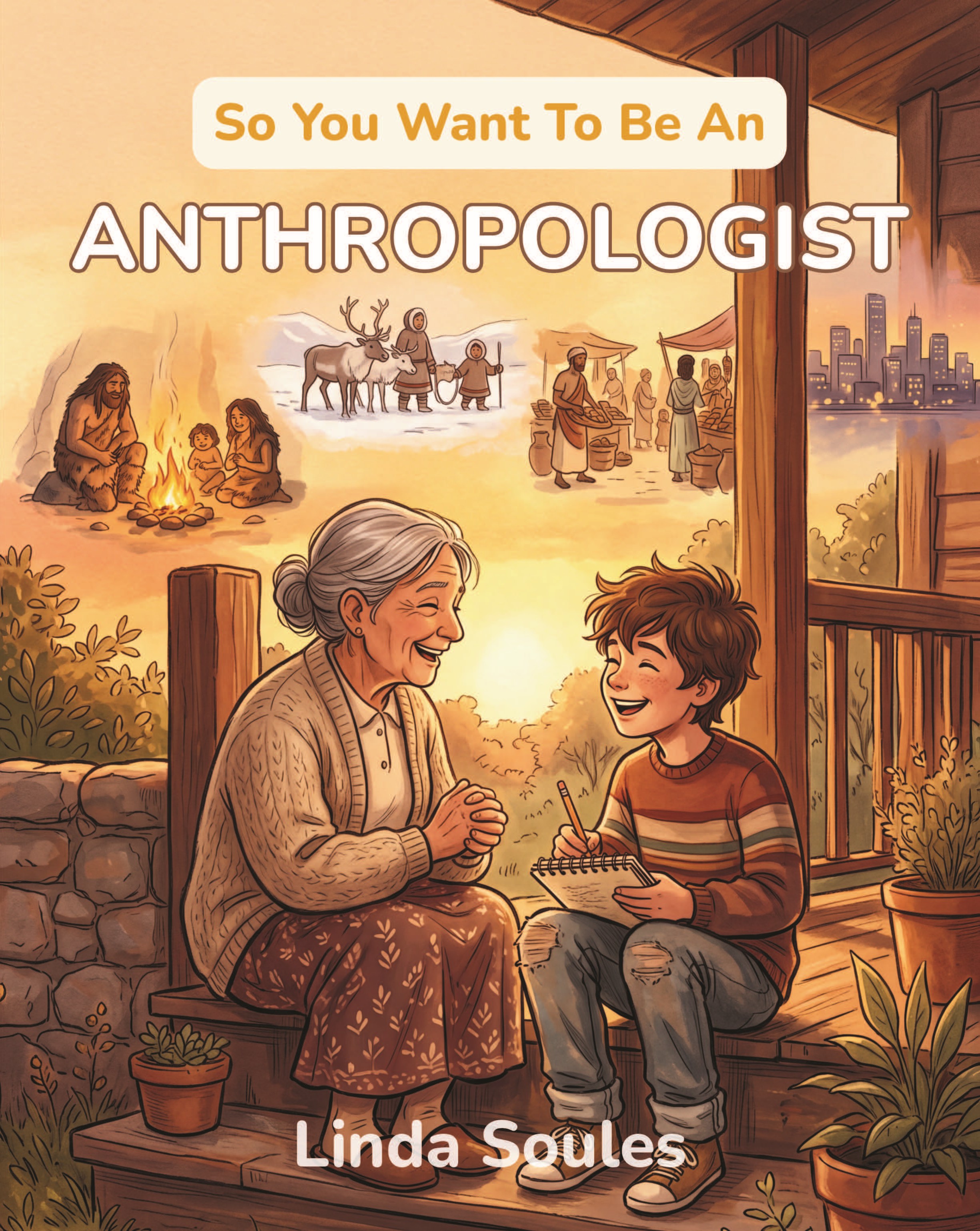
So You Want To Be An Anthropologist
by Linda Soules
Key Takeaways
Summary
Anthropology is the study of human beings everywhere and across all of time. Its subject ranges from families herding reindeer across the Arctic to people riding elevators in city towers, from ancient human relatives whose footprints were pressed into volcanic ash millions of years ago to children sharing a school lunch today. And because people are part of humanity, they are part of what anthropology studies.
Anthropologists describe their work as making the strange familiar and the familiar strange. A custom that looks peculiar to an outsider often makes sense to the people who practice it. At the same time, familiar habits deserve a closer look. Why do people sing to someone on their birthday while that person blows out candles on a cake, or say “bless you” after a sneeze? People follow hundreds of unwritten rules: facing forward in an elevator, for instance, or knowing how close to stand to another person. Because we learn these rules as we grow up, they can seem natural, almost like instincts. But a baby born anywhere could grow up speaking Korean, Swahili, or Navajo, and learn to eat with chopsticks, a fork, or fingers, depending on the family and community raising them. These practices do not come from our genes. They are learned, and anthropology calls the shared ways of life people learn and pass on culture.
One of anthropology’s key ways of learning about culture began with an unexpected stay. In 1914, Polish scientist Bronisław Malinowski was in Australia when World War I broke out. Because his homeland was ruled by Austria-Hungary, on the opposing side, returning home was difficult. He pitched his tent among the houses of a village in the Trobriand Islands, off New Guinea, and stayed there on and off for about two years. He found that living beside people taught him more than interviewing them from a guest’s porch. The approach is now called participant observation: spending time in a community, taking part in daily life, watching carefully, and listening. Fieldworkers may learn the local language, eat what their hosts eat, help with fishing or harvests, and attend weddings and funerals. They also make mistakes, which can become opportunities to ask what a custom means.
Anthropologist Laura Bohannan learned this when she told the Tiv people of Nigeria the story of Hamlet. The elders rejected her assumption that the ghost was a dead man returned to speak; since the dead could not walk, they decided it must be an omen sent by a witch. They also approved of Hamlet’s uncle marrying his brother’s widow, because that matched their own custom. Their response revealed how people interpret stories through the knowledge and expectations of their community. Living alongside people can uncover details that surveys and books miss. A family might never explain that guests are seated according to age, because the arrangement seems obvious to them. An observer may notice it at dinner, then ask about it and learn what it says about respect.
In the United States, anthropology is commonly divided into four connected branches. Cultural anthropologists study people’s lives today, including family, religion, food, money, music, and social rules. They might look at how teenagers in Seoul use phones or how a Peruvian village shares water during a drought. Biological anthropologists investigate the human body and its origins. Some search for fossils of ancient human relatives, known as hominins; others study primates or how bodies adapt to deserts and high mountains. In 1960, Jane Goodall observed a chimpanzee named David Greybeard poking a twig into a termite mound to fish out food. Her mentor, Louis Leakey, sent a telegram saying, “Now we must redefine tool, redefine man, or accept chimpanzees as humans.”
Archaeologists study the past through objects and places people left behind: tools, pottery, houses, refuse heaps, and graves. Even a broken pot may reveal what a family cooked, where its clay came from, and whom its makers traded with. Linguistic anthropologists study language, from the spread of a slang word through a school to efforts to keep an endangered language alive. A single research question may draw on all four branches. Asking how people first reached the Americas, for instance, can involve fossils, DNA, stone tools, and histories Native nations have passed down orally.
Across the branches, research usually begins with a question and proceeds to gathering evidence, whether through community fieldwork, an archaeological excavation, or measurements in a laboratory. To investigate ancient diets, an archaeologist might study coprolites, or fossilized poop. Human coprolites from Oregon’s Paisley Caves are about 14,000 years old and preserve traces of food. Scientists may soak one to soften it; occasionally it begins to smell again, and that smell can help identify who or what left it. Then comes the less visible work: months of sorting, comparing, and analyzing evidence, followed by writing. Charcoal from an ancient fire may go to a laboratory for carbon dating, while recorded interviews are typed out word for word. Findings can become a book or article, a museum exhibit, advice for a hospital welcoming families from different backgrounds, or a report helping a town plan for floods. Anthropologists may also return recordings to the families who shared them or explain to a court why a site matters to the descendants of its builders.
Anthropologists work in places where people live now and in places they lived long ago. A field site could be an Andean farming village, a refugee camp, a fossil bed in Ethiopia, an Arctic fishing town, or a neighborhood near the researcher’s home. Fieldwork might mean sleeping in a tent, renting a room with a local family, or taking the bus to the site; some researchers study one town for years, while others travel to a different site each summer. Even a garbage dump can provide evidence. The University of Arizona’s Garbage Project, led by William Rathje, spent decades examining modern trash. Rathje called the work “garbology.” In 1989 the team found a readable 1952 newspaper and an ear of corn that had been buried for roughly eighteen years, still wearing its husks. Comparing garbage with surveys also showed that families sometimes reported eating less junk food and drinking less beer than their discarded packaging suggested.
Many anthropologists teach and conduct research at universities, but in the United States the largest group works for consulting firms. Before certain projects using government money or permission—such as highways, pipelines, and new neighborhoods—can proceed, the law requires checks for significant traces of the past. In cultural resource management, anthropologists survey land, dig test pits, and help determine what should be protected before construction begins. Museum anthropologists develop exhibits and care for collections, sometimes consulting Indigenous communities about how belongings should be stored, displayed, or returned. Laboratory researchers may examine DNA, tooth enamel, or seeds. In Denmark, scientists recovered DNA from a lump of birch tar chewed like gum 5,700 years ago. They nicknamed the woman whose saliva it held Lola; her genes suggested dark skin, dark hair, and blue eyes, while food DNA pointed to hazelnuts and duck.
Government agencies employ anthropologists as well. The National Park Service protects archaeological sites, while the Defense POW/MIA Accounting Agency operates a Hawaiian laboratory where forensic anthropologists identify service members missing from past wars. Some have been missing for more than eighty years. Anthropologists also work for technology companies, public health agencies, aid organizations, and human rights groups.
The field notebook is one of their most important and least expensive tools. It can hold conversations, sketches of houses and fields, maps, family trees, market prices, observations about who sat where at a meeting, and notes about the researcher’s own questions and mistakes. Many anthropologists jot down details during the day, then expand them into full field notes at night, before memories fade. Some keep a separate private journal, so feelings such as homesickness do not get mixed up with observations.
A voice recorder can preserve a person’s exact words, tone, and laughter, but recording requires informed consent. Before an interview, the anthropologist explains the project and how the recording will be used, and makes clear that the person may refuse or stop at any time. University ethics boards review research plans to check that people will be treated fairly.
Archaeologists use small pointed trowels to scrape away soil a few millimeters at a time. They pour each bucket through a wire screen that catches tiny finds such as beads, bone chips, and stone flakes. Before an object is moved, its location is mapped, because digging removes the evidence of exactly where it lay. Archaeologists may even touch a brown crumb to a wet tongue: porous bone sticks, while stone does not. Another useful tool is confusion. Anthropologist Michael Agar called moments of bafflement “rich points”—when everyone laughs at a joke you do not understand, or a host gasps at something you thought was polite. The confusion signals a rule you have not learned yet, and a careful observer records it and asks about it later.
That willingness to be baffled can eventually bring a reward: after months of being an outsider, making mistakes and breaking rules you did not know existed, you may be treated like family. A host might tease you as they would a cousin, or save you a seat without asking. Anthropologists describe that welcome as one of the most moving experiences of fieldwork. Discovery brings another kind of excitement: brushing dust from a tooth millions of years old, finding a potter’s fingerprint pressed into ancient clay, or recording an elder’s story in a language spoken by only a handful of people. And after months of studying a language, you may finally tell a joke and hear everyone laugh at the punch line.
The friendships can last for decades. Anthropologists return to attend the weddings of children they watched grow up, bring photographs and books, and sometimes help young people apply to college. A researcher might even become an honorary family member—or acquire a lasting, less flattering nickname such as “Mister Too Many Questions.” Sometimes the significance of a discovery reaches far beyond the field site. Lucy, found in Ethiopia in 1974, showed that human ancestors walked upright long before they had large brains. Her name came from the Beatles song “Lucy in the Sky with Diamonds,” played repeatedly at the team’s camp the night she was found. A study of one neighborhood, meanwhile, might help an entire city prepare for hurricanes.
The work has difficult stretches, too. Fieldwork may mean spending a year thousands of miles from home, still struggling with the language and unsure of local rules. Culture shock can leave you tired from constant misunderstandings, and unfamiliar food or water may make you sick. Heat, cold, poverty, violence, and grief can be part of what an anthropologist encounters, even when there is little they can do to change it. Nor is the path into the profession quick: it often starts with an anthropology degree and a summer field school, and researchers leading projects commonly need a PhD, which may take seven years or more of graduate study in the United States. Professor jobs are scarce, so many anthropologists work in museums, government, consulting, or business.
The field also has a history it must face. Some anthropologists took Indigenous human remains and sacred objects without permission, while early scientists used skull measurements to promote false claims that some races were superior. The harm was real, and modern anthropology has spent decades confronting it. The 1990 Native American Graves Protection and Repatriation Act, or NAGPRA, requires museums and federal agencies to return certain remains and sacred objects to the Native nations they belong to. Stronger rules took effect in 2024; some museums closed exhibit halls while consulting with Native nations, and some now invite those nations to write exhibit signs in their own words. Returning ancestors and belongings is called repatriation. It is slow, serious work, alongside the daily responsibility to ask who benefits from research, whether a community would recognize its story, and what will happen to recordings in the future.
Several familiar ideas about anthropology turn out to be myths. Anthropologists study people, not dinosaurs; that is the work of paleontologists. They are not movie treasure hunters who snatch golden idols and flee: real finds are mapped and cared for, and usually stay in the country where they were discovered. Human evolution is not a search for one “missing link,” but a bushy family tree with many branches, including Lucy, Selam, Karabo, and Neanderthals. And experts can be fooled. The supposed ancient Piltdown skull, found in England in 1912, persuaded many scientists until tests in 1953 revealed a human skull joined to an orangutan’s jaw, with filed teeth and stained bones. Science caught the trick because someone checked again.
Anthropologists may also be found in places people do not expect: a hospital emergency room, school cafeteria, online gaming community, stock exchange, or fast-food kitchen. Every group has its own vocabulary and unwritten rules. Companies hire anthropologists to observe how people actually use technology. Genevieve Bell, raised partly in Aboriginal communities in Australia, spent eighteen years at Intel visiting homes around the world. In 2005, she started the company’s first user-experience group, using observation to help design products for real people. And research into ancient people can overturn old assumptions. Neanderthals made tools, controlled fire, and twisted fibers into string; they also had children with our species, and many people today carry some Neanderthal DNA.
At Shanidar Cave in Iraq, a Neanderthal nicknamed Nandy revealed something striking. His bones showed an injury that likely left him blind in one eye, a thin and shrunken right arm, an old foot fracture, arthritis, and probable hearing loss. Yet he lived to somewhere between 35 and 45, unusually old for a Neanderthal. He would have struggled to hunt or escape danger alone, suggesting that others shared food and protected him. Another Neanderthal, a child nicknamed Tina, had Down syndrome and likely struggled with hearing and balance, yet lived to at least six. Their remains suggest that care for people who needed help existed long before anyone wrote down rules about kindness.
A field researcher’s day can mix close observation with ordinary chores. Eight months into a year studying a fishing town, an anthropologist might reach the harbor at 5:30 in the morning, help haul crates, and hear a captain explain why he now fishes farther from shore than his father did. Breakfast with the host family brings grammar corrections from their nine-year-old daughter. Later, a retired captain agrees to an interview on the condition that his name not appear; his stories turn to storms, failing catches, and a son who moved away because fishing could no longer support a family. At the market, the researcher maps fish stalls and changing prices, then helps the festival committee hang lights. Conversations often come more easily while people work than when they feel interviewed.
That evening, a town meeting about government catch limits reveals who speaks first and who is interrupted. Dinner afterward with the host family brings opinions the meeting did not. At night, the researcher turns scribbles into careful field notes and sends an update to an advising professor. The work is collaborative from beginning to end. Local people know what an outsider cannot: a fisher reads tides, and a grandmother may name cousins four generations back. Interpreters, research assistants, elders, knowledge keepers, and tribal historic preservation officers contribute expertise and help protect ancestral places. On archaeological digs, geologists read soil layers, surveyors map sites, and conservators protect fragile finds; biological anthropologists may work with geneticists, chemists, and dentists. In Croatia, trained dogs Sattve and Mali helped sniff out graves about 2,700 years old.
Collaboration can also bring the past back into a community’s hands. In 1890, Jesse Walter Fewkes used a wax-cylinder phonograph to record Passamaquoddy people singing and telling stories in Maine. The cylinders stayed far from home for much of the next century. After they were restored, Passamaquoddy language keeper Dwayne Tomah listened and translated songs his community had not heard for generations; today, the tribe decides how those ancestral voices are shared. Anthropology’s oddities include a 2013 job advertisement from scientist Lee Berger for skinny, brave scientists experienced in caving. Six women squeezed through a rock chimney only eight inches wide in a South African cave and helped recover more than 1,500 fossils of Homo naledi. And Gilbert Daniels, measuring 4,063 pilots for the U.S. Air Force around 1950, found that not one was average in all ten key body measurements—a discovery that helped lead to adjustable cockpit seats.
Anthropology can make a practical difference, sometimes by helping people survive. On the Indonesian island of Simeulue, families remembered the word “smong,” meaning the giant wave that follows an earthquake when the sea suddenly retreats. Songs, poems, and bedtime stories had carried the warning since a devastating tsunami in 1907. When the sea pulled back again in 2004, people ran uphill instead of toward the exposed beach. More than 200,000 people died around the Indian Ocean, but on Simeulue, with more than 70,000 residents, only seven people were killed. Researchers studying disaster survival helped share the lesson, and Indonesian schools now teach it.
During the Ebola outbreak in West Africa from 2014 to 2016, anthropologists helped health workers understand why families resisted some burial practices. Washing and touching the dead mattered deeply to mourners; teams that removed bodies without explaining why often met resistance. Anthropologists helped develop “safe and dignified burials,” protecting the living while honoring the dead. Language can also be restored through anthropological work. Wampanoag scholar jessie little doe baird began rebuilding Wôpanâak, the language of her people, after dreaming that her ancestors spoke words she could not understand. She studied linguistics and drew on old letters, land deeds, and a seventeenth-century Bible translated into Wôpanâak. Her daughter Mae became the first person in more than a century to grow up speaking it.
Paul Farmer, both a doctor and an anthropologist, learned in Haiti that patients with tuberculosis were not failing treatment because they lacked commitment. Hunger and the cost of reaching a clinic stood in their way. His team provided food and trained neighbors to visit patients at home; many more recovered. The organization he helped found, Partners In Health, now runs hospitals and clinics in countries including Haiti, Rwanda, Peru, and Sierra Leone. Anthropology also challenges beliefs used to divide people. Two people anywhere on Earth share about 99.9 percent of their DNA, and in 1950 anthropologists helped write a UNESCO statement explaining that race offers no scientific basis for ranking human groups. Across human societies, people make music, tell jokes, play, and name one another; learning how others do these things can turn strangers into neighbors.
Children, too, leave traces that reveal lives often missing from history books. In France’s Cave of a Hundred Mammoths, children dragged their fingers through soft clay about 13,000 years ago. The width of the marks suggests some artists were between three and seven, and the busiest was a girl of about five. Since some designs reach high across the ceiling, an adult may have lifted a child onto their shoulders. At White Sands, New Mexico, ancient footprints show an adult carrying a toddler for nearly a mile, at least 10,000 years ago, sometimes setting the child down. A giant ground sloth and a woolly mammoth crossed the same path; nearby tracks from 21,000 to 23,000 years ago were made mostly by children and teenagers.
In 2008, nine-year-old Matthew Berger spotted a bone in a South African hillside and called his scientist father over. It belonged to a nearly two-million-year-old early human relative, whose skeleton was that of a child. A seventeen-year-old contest winner named the child Karabo, meaning “answer” in Setswana. Young beings also create customs that others learn: on Japan’s Koshima Island, a young macaque named Imo began washing sandy sweet potatoes before eating them. Her playmates copied her, then her mother, while older males were slower to adopt the habit. Anthropologists study such changes to understand how culture spreads. Margaret Mead, only twenty-three when she went to Samoa in 1925, investigated whether adolescence was difficult everywhere or depended on the society. Her book, Coming of Age in Samoa, became a bestseller, and later debate over her conclusions showed how scientific ideas are examined and challenged.
Anthropologists can make familiar life seem strange by describing it as if they had arrived from another planet. In one playful field report, grown-ups gather silently around a steaming brown drink, treasure glowing rectangles, and keep drawers full of dead batteries, rubber bands, and keys to doors nobody can find. Their children, the report observes, can hear “Dinner is ready!” from anywhere but apparently cannot hear “Clean your room” from three feet away. Describing ordinary habits this way invites people to explain customs they normally take for granted.
That curious outlook depends on habits anyone can practice. Anthropologists notice small details: who is served first, who speaks most, and who clears the table. They accept being beginners, willing to learn skills that local children already know, and they wait patiently for trust to grow. They also hold their assumptions loosely. Richard Lee learned this among the Ju/’hoansi of the Kalahari after buying an ox for a feast. Everyone called it a bag of bones, though it was fat and plentiful. Mocking a generous gift, he discovered, kept the giver humble: teasing cooled the heart of anyone who began to think himself a “big man.” Respect is visible in learning greetings, paying fairly, keeping promises, asking before taking photographs, and sharing finished work with the people who made it possible.
The evidence of human life can be a story, a bone, a language, or an object. Studying it takes more than curiosity: anthropologists need strong writing to make an ethnography vivid and to win research funding, along with mathematics and computer skills for statistics, maps, interviews, and language comparisons. They must also know what not to publish. A ceremony may be private, a site may attract looters, or a name may put someone in danger.
The people who shaped anthropology found evidence in many forms. Franz Boas, often called the father of American anthropology, came to believe that cultures must be understood on their own terms. By measuring nearly 18,000 immigrants and their children, he showed that children’s head shapes changed as they grew up in a new country, undermining the use of skull measurements to rank races. Zora Neale Hurston, his student at Barnard, returned to the South to collect Black folktales, songs, and sayings that scholars had neglected; her interviews with Cudjo Lewis, a survivor of the last known slave ship to reach the United States, later became Barracoon. Yankton Dakota scholar Ella Cara Deloria recorded Dakota and Lakota stories, songs, and daily life in the communities’ own words, preserving language in Dakota Texts and Dakota Grammar.
In Tanzania, Mary Leakey’s patient excavation uncovered a 1.75-million-year-old skull in 1959 and, at Laetoli, footprints made by upright-walking human relatives about 3.6 million years ago. Zeresenay Alemseged’s team found Selam, a three-year-old child from 3.3 million years ago, and spent years freeing her bones from sandstone grain by grain. Forensic anthropologist Clyde Snow used skeletons to help identify people murdered under Argentina’s military dictatorship, trained Argentine students who formed a team that later worked in more than sixty countries, and testified at the generals’ trial. Their work shows how much can be learned from careful attention to evidence—and how that knowledge can matter to living families.
A young person can begin now by keeping a notebook in a school cafeteria or park, interviewing an elder with permission, learning a language, drawing objects carefully, or making a family tree. The questions to carry are simple but powerful: Why does this custom make sense from the inside? Whose voices have not been heard? What would it feel like to be the person studied? What do children know that adults have forgotten?
Anthropology may fit someone who people-watches, loves stories and old objects, asks why things are done a certain way, and feels interest rather than judgment when meeting someone different. It combines science and people, and it rewards curiosity joined with patience and courtesy. Related paths include museum work, conservation, genetics, medical research, translation, journalism, documentary filmmaking, diplomacy, and aid work. Whatever career someone chooses, learning to listen closely and meet unfamiliar lives with the thought “Tell me how you see it” can make them a better guest—and a more thoughtful neighbor.
Chapter Summaries
What If You Were an Anthropologist?
The book introduces anthropology as the study of humans everywhere and across time, from families living in the Arctic to people in modern cities and ancient human relatives. Its central habit is to “make the strange familiar, and the familiar strange”: learn why an unfamiliar custom makes sense to the people who practice it, then examine familiar routines as cultural choices rather than universal rules. Language, food, manners, celebrations, and personal space are learned through culture, not simply dictated by biology. The chapter introduces participant observation through Bronisław Malinowski’s extended stay among people in the Trobriand Islands during World War I. Living with a community lets researchers learn its language and everyday expectations, while also revealing how an outsider’s assumptions can distort understanding. Laura Bohannan’s retelling of Hamlet to Tiv elders illustrates this vividly: they interpreted its ghost and marriage customs through their own knowledge and traditions. The lesson is to listen closely, notice what people take for granted, and ask how their interpretations differ from your own.
What Anthropologists Do
Anthropology is presented through four major branches. Cultural anthropologists study contemporary ways of life; biological anthropologists investigate human bodies, evolution, and primates; archaeologists interpret the material traces of past lives; and linguistic anthropologists study language, including how it changes and how endangered languages can be supported. The branches often work together. Questions about the peopling of the Americas, for example, can involve DNA, fossils, tools, and histories preserved by Native nations. The work usually begins with a question, moves into evidence-gathering, and continues through careful analysis and communication. Researchers might study fossilized coprolites to learn what people ate, use carbon dating to estimate the age of charcoal, or compare interview transcripts and field notes. Results can become a book, museum exhibit, community report, or practical advice for a town or hospital. The chapter emphasizes that responsible anthropologists share their findings with the communities whose knowledge made the work possible.
Where Anthropologists Work
Anthropologists work wherever people live or have lived. Field sites can include farming villages, refugee camps, Arctic towns, fossil beds, city neighborhoods, and even garbage dumps. The University of Arizona’s Garbage Project, led by William Rathje, used discarded waste to study what people actually did; the team found that garbage could contradict what families reported in surveys. A readable newspaper from 1952 and an ear of corn still wearing its husks after years in a landfill show how ordinary refuse can preserve surprising evidence. Many anthropologists teach or conduct university research, but others work for consulting firms, museums, laboratories, government agencies, technology companies, public health organizations, and human rights groups. Cultural resource management is a major area: before certain construction projects proceed, specialists survey land and help protect historically important places. Museums may consult Indigenous communities about collections and repatriation, while forensic anthropologists use skeletal evidence to identify missing service members and return them to their families. Lola, whose DNA and traces of food were recovered from ancient birch tar, illustrates how laboratory work can illuminate an individual life.
The Tools of the Trade
A field notebook is one of an anthropologist’s most dependable tools. Researchers record conversations, sketches, maps, prices, seating arrangements, questions, and mistakes, often expanding quick notes into detailed field notes each night. Some keep a separate private journal so their reactions and homesickness do not become confused with observations. Interviews can be recorded, but only after informed consent: participants must understand the project, how recordings will be used, and that they may decline or stop. Ethics boards review research plans to help protect participants. Archaeologists use small trowels and screens to excavate carefully, mapping each find before removing it because its original location is part of the evidence. The chapter also identifies confusion as a research tool. Michael Agar called moments when an unfamiliar rule becomes noticeable “rich points”—for example, when a joke makes everyone laugh except the visitor, or a host reacts to an action the visitor thought was polite. Instead of dismissing these moments, an anthropologist records them and asks about them later.
The Rewards and Difficulties of the Work
The rewarding moments of anthropology often grow out of patient participation. An outsider may make language mistakes, misunderstand local expectations, and feel awkward for months before being welcomed into ordinary relationships. A host saving a seat or teasing the researcher like a cousin can mark a meaningful shift from visitor to trusted participant. Discovery brings a different kind of excitement: uncovering an ancient tooth, a potter’s fingerprint, or a story recorded in a language with few remaining speakers. Long-term friendships and the chance to contribute findings that change a textbook or improve community planning can make the work especially significant. Fieldwork can also be lonely, uncomfortable, and emotionally difficult. Researchers may be far from home, struggle with language and culture shock, become ill, or encounter poverty, violence, and grief they cannot resolve. Training is demanding: students often begin with an anthropology degree and field school, and research leadership commonly requires graduate study; academic positions are competitive, so many professionals build careers elsewhere. The chapter also addresses the field’s harmful past, including the removal of Indigenous ancestors and sacred objects and false racial hierarchies. Repatriation laws such as NAGPRA, stronger rules, and consultation with Native nations are part of ongoing efforts to repair that harm. Ethical questions about who benefits, whose story is being told, and what happens to research materials remain central.
Myths, Surprises, and an Anthropologist’s Day
The book corrects common misconceptions: anthropologists study humans, not dinosaurs; they do not take treasure; human evolution is a branching family tree rather than a search for one “missing link”; and experts can be wrong. The Piltdown skull, accepted by many researchers before later testing exposed it as a fake, shows why scientific claims must remain open to rechecking. Anthropology also happens in places people may not expect, including schools, hospitals, companies, and online communities. Genevieve Bell’s work at Intel demonstrates how observing families using technology in their homes can help a company design products around real behavior instead of assumptions. A sample day in a coastal fishing town shows how fieldwork combines observation, participation, and analysis. The researcher meets boats at dawn, listens to fishers describe changing catches, interviews a retired captain after reviewing consent, maps market stalls and prices, helps prepare a festival, and observes who speaks at a town meeting. Informal conversations over meals can reveal as much as formal interviews. At night, the researcher turns notes into a careful record and later prepares findings for the town council. The example makes clear that fieldwork is not a string of dramatic discoveries; it is sustained attention to ordinary life and change.
Collaborators and Strange-but-True Stories
The people in a research community are not merely sources of information; many anthropologists describe them as collaborators. Fishers, elders, knowledge keepers, children, interpreters, and local research assistants bring expertise outsiders cannot gain from books. Some projects involve community members in choosing the research questions from the beginning. Archaeologists may work with geologists, surveyors, and conservators, while biological anthropologists partner with geneticists, chemists, and other specialists. Anthropologists also collaborate with professionals such as doctors, teachers, planners, judges, and engineers. Stories show the unexpected forms this teamwork can take. In South Africa, six women with caving experience were recruited to retrieve fossils from a narrow underground passage, contributing to the discovery of more than 1,500 Homo naledi fossils. Physical anthropologist Gilbert Daniels measured thousands of pilots and found that no one fit the “average” on all ten key measurements—a finding that helped inspire adjustable car seats. The chapter also describes “deep hanging out,” the long-term presence that helps researchers understand daily life. A collaboration with lasting consequences is the restoration of Passamaquoddy recordings made in 1890: more than a century later, language keeper Dwayne Tomah helped translate songs the community had not heard for generations, and the tribe now decides how its ancestors’ voices are shared.
How Anthropology Helps, and the Children It Finds
Anthropological knowledge can make practical differences. On Simeulue, Indonesia, stories and songs about “smong,” the giant wave that follows an earthquake and a retreating sea, helped residents flee uphill during the 2004 tsunami; seven people died on the island, compared with more than 200,000 deaths across the wider Indian Ocean region. During the Ebola outbreak in West Africa, anthropologists helped health workers develop safe, dignified burials that protected the living while respecting grieving families’ rituals. The chapter also describes jessie little doe baird’s work rebuilding Wôpanâak from historical documents and Paul Farmer’s use of listening and practical support—food and home visits—to improve tuberculosis treatment in Haiti. Anthropologists also recover the presence of children in the past. In a French cave, finger trails in clay were made by young artists, including a girl estimated to be about five. Footprints at White Sands show an adult carrying a toddler and setting the child down along the way. Nine-year-old Matthew Berger noticed a fossil that led to the discovery of an early human relative later named Karabo. The chapter connects children’s role in culture to Imo, a young macaque whose potato-washing behavior spread through her group, and to Margaret Mead’s research on adolescence in Samoa. Together, these examples show that children are not just background figures in human history; they shape it.
Looking at Familiar Life and Building Anthropological Qualities
A playful field report describes grown-up habits as if they belonged to an unfamiliar people: adults gather around a hot brown drink, search anxiously for glowing rectangles, preserve mysterious objects in drawers, and use a child’s full name when especially upset. The joke demonstrates anthropology’s method of making the familiar strange. Readers are invited to describe a household custom in the same way and then ask an adult to explain it, turning everyday curiosity into a small exercise in fieldwork. The book identifies several qualities that make this work possible: noticing small patterns, being comfortable as a beginner, waiting patiently for trust, questioning assumptions, and showing respect through concrete actions. Richard Lee’s experience among the Ju/'hoansi illustrates why researchers must avoid assuming their own standards are universal: his hosts criticized a large ox he brought for a feast, not because it was actually poor meat but because teasing a generous hunter discouraged arrogance. The practical skills extend beyond field observation. Anthropologists need vivid writing for ethnographies and grant proposals, math and computing for statistics and mapping, and judgment about what should remain private because it is sacred, dangerous, or otherwise unsuitable for publication.
Anthropologists and the Evidence They Study
Profiles of influential anthropologists show the range of paths into the field. Franz Boas challenged racial ranking and argued that cultures must be understood on their own terms; his measurements of immigrant families helped show that head shape could change across generations. Zora Neale Hurston collected Black Southern folktales, songs, and sayings that scholars had neglected, while Ella Cara Deloria recorded Dakota and Lakota language and daily life as an insider studying her own communities. Their work highlights the importance of whose perspective is preserved and who gets to interpret it. Other profiles emphasize discovery and service. Mary Leakey’s finds at Olduvai Gorge and Laetoli helped transform knowledge of human origins and upright walking. Zeresenay Alemseged led the painstaking recovery of Selam, a young fossil from the same species as Lucy. Forensic anthropologist Clyde Snow helped identify people killed during Argentina’s dictatorship, trained local students, and testified at the generals’ trial. The chapter presents anthropology not as the work of one kind of person or one kind of evidence, but as a field shaped by varied expertise, perseverance, and responsibility to the people whose histories are being uncovered.
Exploring Anthropology and Deciding Whether It Fits
A collection of examples illustrates how varied human customs can be: Guugu Yimithirr speakers use compass directions in everyday descriptions; Yao honey hunters cooperate with honeyguide birds; Silbo Gomero carries spoken Spanish across valleys by whistling; and people on Yap remember ownership of enormous stone money without moving it. Other examples include Ötzi the Iceman’s tattoos and last meal, the different traditions surrounding children’s lost teeth, the near-universal sound “Huh?”, and evidence of ancient art and care for a sick puppy. The point is not to treat customs as curiosities detached from people, but to use them as openings for asking how a practice works in its own setting. Readers are encouraged to try anthropology immediately: keep a field notebook, interview an elder with permission and share the recording, learn another language, read authors from the communities being studied, practice biology, history, and math, draw objects carefully, and map a family tree. The book’s reflection questions ask whose voices are missing and how a situation looks from the other side. It then suggests adjacent careers—from museum work and genetics to journalism, translation, diplomacy, and forensic science—and offers a glossary and further books, websites, organizations, and visits. The author closes by presenting anthropology as a habit of listening that can help anyone become a more thoughtful guest and neighbor.
Notable Quotes
“make the strange familiar, and the familiar strange.”
“A baby born anywhere on Earth could grow up speaking Korean, Swahili, or Navajo, eating with chopsticks, a fork, or fingers, and laughing at the jokes of whichever family raised it.”
“Some say that if you never feel confused in the field, you aren’t paying attention.”
“Few other jobs pay you to be nosy in the most respectful way possible.”
“The best anthropologists are glad to be studied.”
“Tell me how you see it.”
