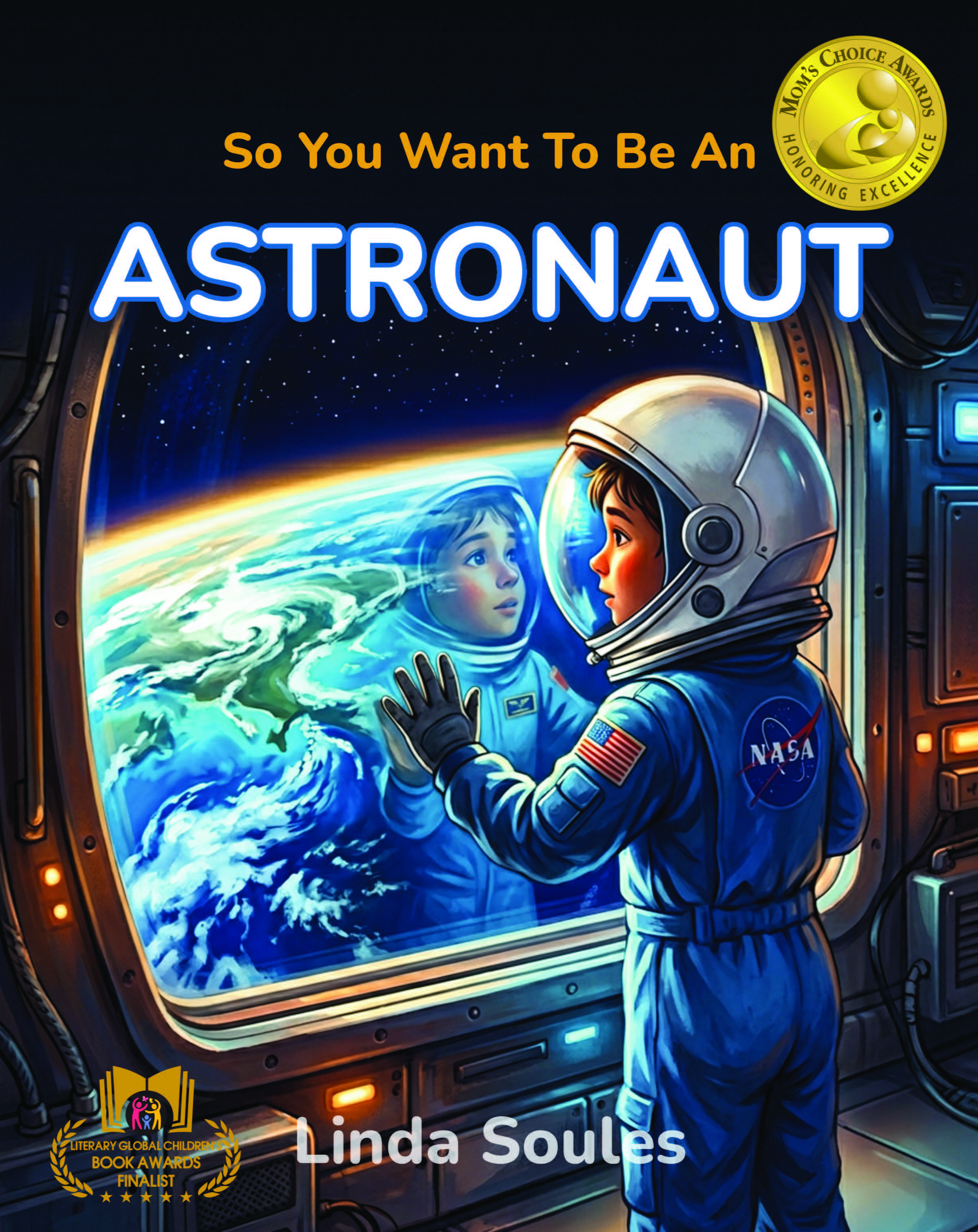
So You Want To Be An Astronaut
by Linda Soules
Key Takeaways
Summary
So you want to be an astronaut: not just to dream about leaving Earth, but to strap into a rocket and ride through the atmosphere until blue sky gives way to black and the stars shine in every direction. From orbit, the whole world hangs in darkness like a blue jewel. It is a huge dream, but people have made it real. More than 700 people from over 45 countries have traveled to space. The youngest was 18, making a brief eleven-minute flight as a passenger; the youngest person to orbit Earth was 25, while the oldest to fly was 90. They were not superheroes. They were people who found a way to go.
Astronauts are selected from among highly capable people, often scientists, engineers, or military pilots. Then they spend years learning the spacecraft they will fly and preparing for tasks ranging from spacewalking to emergency medicine. The work demands technical knowledge, physical fitness, resilience, and the ability to function with others in isolation, confinement, and real danger. The next generation may travel farther than any humans before them. NASA, the United States government agency responsible for exploring space, is pursuing its Artemis program: Artemis II carried four astronauts around the Moon and back in April 2026, the first humans to leave low Earth orbit in more than fifty years. Artemis III is to test the vehicles that will carry astronauts toward the lunar surface, and Artemis IV is planned to land there. Beyond that lies Mars. The first person to walk on Mars could be a child alive today.
An astronaut is not a daredevil whose job is simply to endure a rocket launch. Astronauts go to space to work, and much of that work is science. Aboard the International Space Station, a laboratory the size of a football field orbiting 250 miles above Earth, crews conduct experiments that depend on microgravity—the condition in which everything seems to float. They grow crystals that help reveal the structure of diseases, study the way flames behave without gravity shaping them, and test how plants grow when there is no ordinary up or down. They also monitor the human body as it changes during months in orbit: bones thin, muscles weaken, fluids shift toward the head, and the heart changes shape.
Science is only part of the job. Astronauts maintain the station, too, repairing plumbing, replacing filters, updating computers, and carrying out spacewalks to fix equipment on the exterior. The same person may need to be scientist, mechanic, plumber, and explorer, while the station races around Earth at 17,500 miles per hour. At that speed, astronauts see a sunrise about every 90 minutes.
A spacewalk is among the most demanding and extraordinary tasks. Before stepping outside, an astronaut puts on a suit weighing 280 pounds on Earth, a process that takes about 45 minutes. The airlock is depressurized, the hatch opens, and the astronaut moves into the vacuum, connected to the station by a safety tether. There is no floor, wall, or ceiling—only the suit, the tether, and space in every direction. Earth lies below; stars shine above. Because sound cannot travel through the vacuum, the astronaut experiences profound silence. The first moments can be overwhelming: some astronauts laugh, some cry, and some go still. They are outside a spacecraft 250 miles above the planet, moving at five miles per second.
The station itself is a striking workplace. Inside, white-walled cylindrical modules connect through hatches, with equipment and storage covering nearly every surface. Handles and footholds help astronauts move around, and the steady hum of air circulation means the station is never quiet. In microgravity, ordinary routines must be adapted: sleeping, eating, exercising, and using the bathroom all work differently when objects and people float.
Nobody simply climbs into a rocket and goes. Astronaut candidates, known as ASCANs, train for at least two years before they are eligible for a mission, and many wait years longer before flying. They learn to fly jets and practice spacewalks in the Neutral Buoyancy Laboratory, a vast pool containing a full-size station model. Underwater, they rehearse the movements and procedures needed to work outside in simulated weightlessness. They study robotics to operate the station’s giant arm and learn Russian because the ISS is an international partnership. Biology, physics, geology, medicine, and engineering are all part of their preparation; any of these fields might become essential in space. Candidates also rehearse emergencies such as fires, toxic leaks, sudden drops in pressure, and medical crises. In the “Vomit Comet,” an airplane that flies steep arcs, they experience repeated 25-second bursts of weightlessness, followed by gravity returning with a jolt. By launch day, they have practiced so extensively that the mission may feel almost familiar.
The most critical piece of equipment for a spacewalk is the spacesuit, or EMU. It is not merely clothing but a complete miniature spacecraft. Space has no oxygen to breathe, and its temperatures swing from extreme heat in sunlight to extreme cold in shadow. The suit supplies oxygen, regulates temperature, and shields the astronaut from micrometeorites—small, fast-moving fragments of rock and metal. It also maintains pressure, an essential protection for the body.
On Earth, the atmosphere presses inward on the body, balanced by the pressure of internal fluids. In space, there is no atmosphere to provide that counterpressure, while the body’s fluids continue pushing outward. Without protection, they would expand and swell. The spacesuit creates an artificial inward squeeze, allowing the body to function normally. Its gloves are especially important because they are where the astronaut’s body meets the work. They must preserve pressure and thermal protection while allowing enough dexterity to grip tools, turn bolts, and handle delicate equipment, despite the stiffness created by pressurization.
Inside the station, tools and supplies are designed for weightlessness. Velcro and bungee cords stop objects from drifting away; sleeping bags attach to walls; and food comes in pouches with straws or in powder form that astronauts rehydrate. Scientific instruments are adapted to the conditions, including centrifuges and enclosed microscopes built for particular experiments. Outside, one of the station’s most impressive tools is Canadarm2, a 57-foot robotic arm controlled from a workstation. Astronauts use it to capture cargo vehicles and reposition equipment on the station’s exterior.
The launch is the moment many astronauts have imagined for years. Strapped into a capsule atop a rocket, they feel the engines ignite as a vibration that seems to enter the body; the sound is so deep and loud that the ground and launch tower shake with it. At liftoff, acceleration presses them into their seats with a force three times their weight. The sky changes from blue to purple to black. About two and a half minutes after launch, the first stage separates; roughly eight and a half minutes after leaving the ground, the engines cut off. Then comes silence. A pencil floats away from the console, hair rises, and the astronaut’s body lifts against the straps. Beyond the window, Earth takes the breath away.
Weightlessness brings a different kind of delight. Astronauts somersault through the station, float from one module to another, and watch water gather into wobbling spheres. But seeing the planet from orbit can be more than beautiful; it can alter how they understand home. Astronauts describe this change as the Overview Effect. From above, national borders and divisions are invisible. Earth appears as one living world, wrapped in an atmosphere so thin it resembles the skin on an apple. That fragile layer protects every person, animal, and tree. Many astronauts say they went to explore space but came away understanding Earth’s preciousness more deeply.
The work has a cost. Much of an astronaut’s career happens on the ground, where years of preparation may separate flights, and a mission may be delayed or cancelled for reasons beyond anyone’s control. In orbit, the body faces the effects of microgravity: fluids shift toward the head, muscles and bones weaken without regular exercise, and some astronauts experience vision changes. Daily workouts take time and effort, while returning to gravity requires the body to relearn how to function under its full weight. Recovery can be difficult, even after the high point of a career.
The hardest emotional strain is leaving loved ones. An International Space Station mission may keep an astronaut away for six months or longer. Video calls and email help, but they cannot replace birthdays, holidays, first days of school, or ordinary moments shared in person. Looking down at the planet where family and friends are living their lives, while being unable to reach them, can be lonely. Astronauts accept that separation because they believe the work matters, but the people waiting at home bear it too.
Everyday life in space is both strange and practical. Astronauts sleep in bags anchored to a wall, though in weightlessness there is no meaningful difference between sleeping on a wall, floor, or ceiling. Meals come from pouches or cans, sometimes rehydrated with hot water; one astronaut favorite is warm shrimp cocktail. Toothpaste must be swallowed because there is no sink to spit into, and hair is washed with no-rinse shampoo. A special vacuum toilet handles a necessity that is less simple in microgravity. Between chores, astronauts can push off a wall and glide across a module, perform somersaults, or catch a floating sphere of water in their mouths.
The view from the station keeps moving. Orbiting at roughly five miles per second, the crew sees Earth pass beneath them so quickly that a continent can cross the window in minutes. The station circles the planet sixteen times a day, giving astronauts a sunrise about every ninety minutes. Some say the speed surprises them more than the beauty. On long missions, they may dream of wind, rain, grass, and the smell of fresh air—the simplest sensations of home.
A typical workday begins around 6:00 a.m., when an astronaut unzips from a sleeping bag and starts the morning routine. At 7:30, the crew meets with mission control to review the schedule: perhaps two experiments, a maintenance job, two hours of exercise, and a resupply vehicle arriving at 14:00 UTC. Exercise comes first for some, and it is mandatory: two hours on equipment such as a treadmill, using a harness to keep the astronaut from floating away. At 11:00, science work might involve studying fluids in microgravity, with applications ranging from medicine to spacecraft fuel systems. A dropped sample will not fall to the floor; it floats away, and finding it may consume twenty minutes. At 2:00, the crew monitors a docking, following telemetry and communicating with mission control and the approaching craft’s crew. Though the process is mostly automated, attention must remain complete. By evening, an astronaut may be watching the day-night boundary move across Earth from the cupola.
No one does this work alone. The crew is a close-knit community living and working together in a confined spacecraft. A capsule communicator, or CAPCOM, often a fellow astronaut, speaks for the ground team. Flight surgeons monitor health, and trainers prepare crews for emergencies. Engineers who designed and built the spacecraft are essential partners, while scientists on Earth may wait years for the results of experiments carried into orbit. Mission control adds another layer of teamwork: the flight director is responsible for ground decisions, and flight controllers each specialize in a system such as power, guidance, life support, or communications. Their combined expertise means that even in an emergency, astronauts have people on Earth working alongside them.
The results reach far beyond the station. ISS research has improved treatments for muscle-wasting diseases, advanced cancer-drug delivery, refined water-purification systems used in disaster zones, and helped produce new materials. Astronauts also bring back testimony that scientific findings alone cannot provide. When they describe seeing a thin atmospheric shell and no borders from orbit, they speak from direct experience, and that perspective can move people. Many return to visit schools, speak at science museums, write books, and join classroom video calls. The months they spend in space can become years of sharing what they learned with the people who may one day take their place.
The people who may one day take their place need more than a fascination with the stars. Astronauts must master an unusually wide range of technical subjects, from spacecraft systems and spacewalk procedures to scientific research and emergency medicine. They also need grace under pressure. When something goes wrong in space, help is far away, so astronauts spend years practicing emergencies until they can assess a problem and work through it calmly. Their composure is not a lack of fear; it is a practiced ability to keep thinking when the stakes are high.
Life in a small crew for months calls for another kind of strength: awareness of other people. There is little privacy and no easy way to step away from a disagreement. Generosity, patience, kindness, and humor help a team keep working together. Curiosity matters just as much. An astronaut who is genuinely interested in what an experiment might reveal sees science not as a chore attached to an adventure, but as a reason to be there. And the view from orbit can become a quality in its own right: astronauts can carry a changed perspective back to Earth and let it shape how they live.
Some essential skills may be less obvious. Crews can include people from countries that are political rivals on the ground, with different languages, cultures, and training. Diplomacy—the ability to communicate across those differences and resolve conflict kindly—is as valuable as technical knowledge. So is mechanical versatility. Far from a repair shop, astronauts may have to learn an unfamiliar system quickly and improvise when plumbing, electronics, medical equipment, or life support fails. Self-knowledge matters, too. Isolation can intensify unresolved fears and habits, so understanding your own reactions helps you become a steadier crewmate.
The history of spaceflight shows how much can begin with one person going first. Yuri Gagarin, a Soviet pilot who grew up on a collective farm, became the first human in space on April 12, 1961. His orbit lasted 108 minutes. He returned by ejecting from his capsule and parachuting into a farmer’s field, where a startled woman and her granddaughter met him. Gagarin became one of the most famous people on Earth, but his achievement also opened a door: those who followed could go because he had shown the way.
Valentina Tereshkova’s path was different. A Soviet factory worker and amateur skydiver, she applied to the cosmonaut program almost on a whim. In 1963, at 26, she became the first woman in space, orbiting Earth 48 times over three days. She completed her mission with calm professionalism, then waited nineteen years before another woman flew in space. Mae Jemison, inspired as a child by Lieutenant Uhura on Star Trek, became the first Black woman to travel in space in 1992, aboard Space Shuttle Endeavour. Before becoming an astronaut, she was a doctor, engineer, dancer, and Peace Corps volunteer. Her life, like Tereshkova’s and Gagarin’s, makes spaceflight history more than a record of rockets: it is also a story of people whose varied paths brought them to a new frontier.
Space adds its own peculiar details to the record. Without gravity compressing the spine, astronauts aboard the ISS grow about two inches taller, then shrink back within hours of returning to Earth. They cannot cry normally: tears gather into a growing sphere around the eye and must be dabbed away. After spacewalks, astronauts say their suits smell like burned steak, gunpowder, and raspberries; scientists think the odor comes from dying stars. Food takes care, because a drifting crumb could enter equipment or be inhaled, and salt and pepper are served as liquid suspensions in squeeze bottles. The footprints left by Apollo astronauts on the Moon may last millions of years because there is no wind, rain, or atmosphere to wear them away. Alan Shepard’s two golf balls are there, too. He hit them on the Moon, where they may remain for the same immense stretch of time.
Preparation can start well before a person applies to become an astronaut. Study broadly, especially mathematics and science, and follow questions beyond the classroom. Build fitness through activities such as running, swimming, push-ups, and pull-ups. Learn the history of human spaceflight, from Mercury, Gemini, and Apollo to the shuttle, the ISS, and Artemis. Practice staying composed when something becomes stressful or surprising. Get used to unfamiliar experiences: try new foods, meet new people, or sleep in a tent in the rain. Astronauts have to function far from what is comfortable and familiar. Look through a telescope if you can; seeing Saturn’s rings with your own eyes can change how the universe feels. And sometimes preparation is simply stepping outside, finding the planets or learning the constellations, and paying attention to the sky.
There are questions worth asking along the way: Can you stay sharp and calm when help is far away? How might isolation affect your body and mind? What could seeing Earth from above change about the way you understand life below? The answers need not be perfect. They can help you notice what you enjoy, what challenges you, and what you may want to practice.
You might be suited to the work if you love learning not only in school but wherever curiosity takes you—whether you are wondering how an engine, a thunderstorm, or the human body works. You need to cooperate with others, adapt when plans change, and keep going when experiments fail, equipment breaks, or weather cancels a launch. Physical fitness helps, but so does the desire to understand. And there is the pull: the feeling that comes when you look at the stars and want to know what is out there. It cannot replace years of study and preparation, but it can give those years a direction.
Astronauts do not carry home only data, photographs, or samples. They can return with gratitude for the fragile miracle of life on one small planet, and a renewed sense of how much people share. If that work still calls to you, begin where you are: learn, ask questions, get strong, and pay attention to what happens when things go wrong. Space is vast, strange, and beautiful, and reaching it asks for the very best of a person. Somewhere, a mission is being planned and a rocket is being built. One day, someone will be aboard—and the first step may be looking up tonight.
Chapter Summaries
What If You Were an Astronaut?
The book opens by inviting readers to imagine the physical reality of leaving Earth: riding a rocket through the atmosphere, floating in weightlessness, and seeing the planet as a blue world against darkness. It emphasizes that spaceflight is not merely a fantasy—hundreds of people from dozens of countries have traveled to space, including people across a wide range of ages. Astronauts may begin as curious children, but they reach space through exceptional skill, preparation, and persistence. The introduction presents space exploration as an expanding human project. It describes astronaut selection as drawing on scientists, engineers, and military pilots, then preparing them for years in spacecraft systems, emergencies, and teamwork. It also looks ahead to the Artemis program and eventual human missions to Mars, encouraging young readers to see today’s learning as part of the future of exploration.
What Astronauts Do and Where They Work
Astronauts go to space to work. Aboard the International Space Station, they conduct experiments that take advantage of microgravity: growing crystals relevant to disease research, observing how flames behave, studying plants without a fixed up or down, and monitoring how long periods in space affect the human body. Their duties also include maintaining the station, replacing filters, fixing plumbing and computers, and operating equipment while moving around an orbiting laboratory traveling roughly 17,500 miles per hour. The chapter describes the ISS as a compact, constantly humming workplace where every surface may hold equipment or storage. It explains that astronaut candidates train for at least two years before becoming eligible for a mission and often wait longer to fly. Training includes jet flying, underwater spacewalk practice in a large pool, robotics, science and medicine, Russian, and emergency scenarios. Parabolic flights in the “Vomit Comet” provide brief periods of simulated weightlessness, helping make unfamiliar conditions more manageable.
The Tools of the Trade
A spacesuit is presented as a wearable spacecraft rather than a simple uniform. It supplies oxygen, manages temperature extremes, protects against small fast-moving debris, and maintains pressure around the astronaut’s body. The book explains why pressure matters: Earth’s atmosphere presses inward, balancing the pressure of fluids within the body, whereas the vacuum of space does not. The suit recreates that protective counterpressure so the body can function outside the spacecraft. Even the gloves must balance competing needs: they have to keep an astronaut safe while allowing enough movement to grip tools and turn bolts. Inside the station, Velcro, bungee cords, wall-mounted sleeping bags, food pouches, and adapted scientific equipment help manage microgravity. The chapter also spotlights Canadarm2, the station’s 57-foot robotic arm, which astronauts use to capture cargo vehicles and move equipment outside the ISS. Together, these tools show how every task in space requires equipment designed around the absence of gravity and the dangers of the environment.
The Best, Hardest, and Most Surprising Parts
The book conveys the intensity of launch through the shaking rocket, powerful acceleration, changing colors of the sky, and sudden silence when the engines cut off and weightlessness begins. Astronauts describe floating through the station and watching water form spheres as extraordinary pleasures. But one of the deepest rewards is the “Overview Effect”: from orbit, Earth appears without visible borders, its thin atmosphere protecting all life on one small planet. The view can shift an astronaut’s understanding of home and humanity. The work also demands sacrifice. Astronauts may spend years training between missions, experience bone and muscle loss and other physical effects in microgravity, and face a difficult return to Earth’s gravity. On missions lasting months, they miss family milestones and ordinary time with loved ones. Daily life is full of surprising adaptations—from sleeping attached to a wall and swallowing toothpaste to carefully managing floating crumbs. The fast-moving view below is another surprise: the ISS circles Earth roughly every 90 minutes, and astronauts may find themselves longing for familiar sensations such as wind, rain, grass, and fresh air.
A Day in the Life, the Team, and the Work’s Impact
A sample day aboard the ISS moves from waking and a morning conference to two hours of exercise, scientific work, and monitoring a visiting spacecraft. Experiments demand careful attention because a dropped sample does not fall to the floor; it can drift away and take valuable time to retrieve. Docking operations likewise require close monitoring and communication, even when much of the process is automated. The day may end with time in the cupola, watching the boundary between day and night move across Earth. Spaceflight is a team effort involving crewmates, CAPCOM, flight surgeons, trainers, engineers, scientists, flight directors, and mission controllers responsible for individual spacecraft systems. The work can help people on Earth: the book points to research connected with muscle-wasting diseases, cancer drug delivery, water purification, and new materials. Astronauts also bring their experiences back to classrooms, museums, and public conversations, using firsthand accounts of Earth from orbit to inspire curiosity and a stronger sense of shared responsibility.
The Qualities Astronauts Need
The book identifies broad technical competence as essential: astronauts need to understand spacecraft systems, scientific research, spacewalk procedures, and emergency medicine. Equally important is the ability to stay calm and precise when something goes wrong. Years of demanding simulations help prepare astronauts to assess problems and act when help from Earth may be far away. Success also depends on qualities that go beyond technical skill. Astronauts must cooperate closely with a small crew in confined conditions, remain genuinely curious about the science, and adapt when plans or equipment change. Diplomacy matters on an international station whose crew members may have different languages and cultures. Mechanical versatility helps when repairs are needed, while self-knowledge can help a person manage the pressures of isolation. The book’s central message is that resilience and consideration for others matter alongside intelligence and fitness.
Astronauts in History and Spaceflight Facts
Profiles of Yuri Gagarin, Mae Jemison, and Valentina Tereshkova show that astronaut journeys can begin in very different circumstances. Gagarin, who grew up on a collective farm, became the first human in space in 1961. Jemison combined medicine, engineering, dance, and Peace Corps service before becoming the first Black woman to travel in space in 1992. Tereshkova, a factory worker and amateur skydiver, became the first woman in space in 1963 and orbited Earth 48 times. Their stories illustrate courage, varied paths to achievement, and the importance of being first. A collection of facts makes the physical strangeness of space memorable: astronauts grow temporarily taller as their spines expand, tears gather around the eye rather than falling, and spacewalkers describe a distinctive smell on their suits after returning inside. Food must be handled carefully because crumbs float, while the Moon’s lack of weather means Apollo footprints may last for millions of years. The anecdotes make the science accessible while reinforcing how differently familiar experiences behave beyond Earth.
Preparing for the Job and Deciding If It Fits
The book turns the astronaut’s career into practical steps for readers. It recommends studying widely, especially mathematics and science; building strength and fitness; learning about the history of spaceflight and current missions; and practicing calm responses to pressure. Readers are also encouraged to get comfortable with unfamiliar experiences, speak with new people, explore the night sky, and take opportunities to see the universe through a telescope. The goal is not to become an astronaut overnight, but to develop curiosity, adaptability, and persistence. A set of self-reflection questions asks readers whether they enjoy learning, collaborating, handling pressure, and adjusting when plans change. The book closes by encouraging children not to dismiss a large ambition before exploring it. Its glossary explains key terms such as microgravity, EVA, orbit, and re-entry, while its learning resources point toward books, NASA websites, ISS viewing, museums, and Space Camp. The author’s note returns to the larger purpose of exploration: astronauts may go to see space, but their experience can deepen their gratitude for Earth and the life it sustains.
Notable Quotes
“Astronauts are not daredevils. They’re scientists.”
“Every astronaut is a mechanic, a scientist, a plumber, and an explorer, all at once.”
“You leave home to understand why home matters.”
“The things you miss most in space are the simplest things about home.”
“Astronauts are the only scientists whose most important instrument is their own transformed perspective.”
“Get comfortable being uncomfortable.”
“And never, ever let anyone tell you the dream is too big. Every astronaut heard that. None of them listened.”
