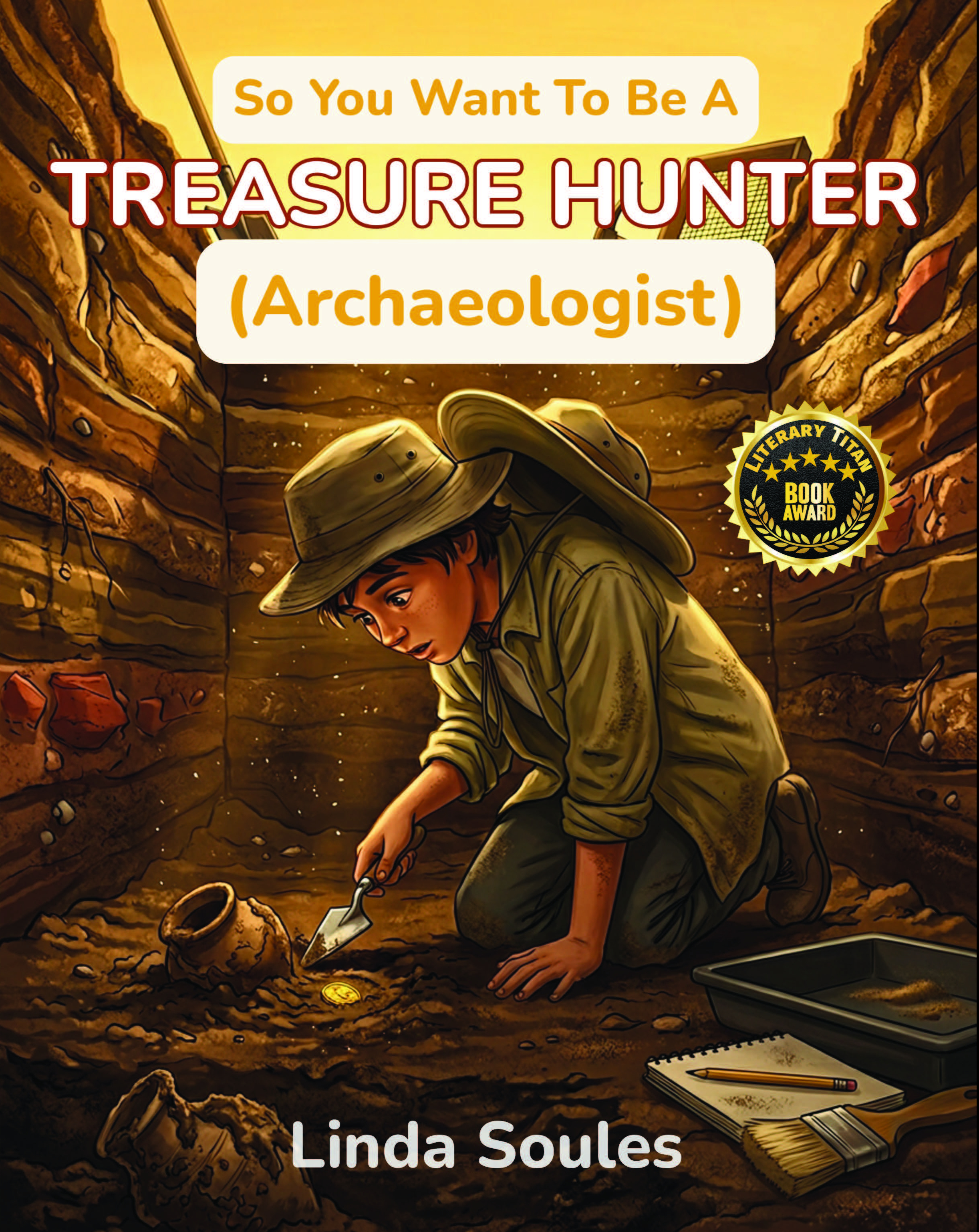
So You Want To Be A Treasure Hunter (Archaeologist)
by Linda Soules
Key Takeaways
Summary
The ground beneath your feet is a layer cake of human history. Everywhere people have lived, they have left traces: building foundations, broken pottery, lost tools, discarded food, and structures eventually buried under soil or later construction. New deposits generally accumulate on top of older ones, so the deepest layers are usually the oldest and the upper layers the youngest. Archaeologists call this principle stratigraphy. Reading the layers is like reading a timeline written in dirt: each change can mark a different moment in the past.
That physical contact with history is one of archaeology’s distinct rewards. An object last held a thousand years ago makes the past tangible, not abstract. Archaeologists sort what they uncover into three broad kinds of evidence. Artifacts are objects people made or used, such as pottery, tools, jewelry, weapons, and coins. Ecofacts are natural remains that reveal diet and environment, including animal bones, seeds, pollen, and shells. Features are structures built into the ground, such as walls, floors, hearths, pits, and burials. Because features cannot simply be carried away, they must be studied where they are found. Taken together, and carefully recorded in place, these clues can show how a community lived, what it ate, how it built, and whom it traded with.
This is what separates an archaeologist from a looter. A looter may dig for an object that is beautiful or valuable, then remove it from the ground. But without knowing exactly where it lay, what layer it came from, or what surrounded it, much of its meaning is lost. A gold coin found loose can tell us roughly what kind of coin it is and when it was made. The same coin found in a particular layer beside a burned wall and destruction debris may help explain when a settlement was destroyed and what happened there. The object matters; its context matters even more.
A broken cooking pot can be more revealing than gold. Imagine finding one still on the floor of a 3,000-year-old house, with charred lentil seeds inside. Those seeds might tell archaeologists what a family ate, what crops they grew, and what they obtained through trade. The pot and its contents preserve an ordinary meal—and a glimpse of the lives that written histories often leave out. Archaeology is not simply a search for objects. It is an attempt to recover stories from the relationships between objects, structures, soil, and natural remains.
On a real excavation, an archaeologist might be assigned a one-meter square and given a pointed trowel designed for removing soil in thin, controlled layers. The work is slow: scrape, observe, and stop when the soil changes color or texture. A shift from sandy brown soil to compacted reddish clay might mark an ancient floor. The trowel is not meant to tear through the ground quickly; it reveals what is there, and the archaeologist develops a careful feel for it through practice. A brush clears the last soil from a find without disturbing it.
Other tools help preserve the evidence. A context sheet records where and how each find appeared. A total station uses lasers to capture three-dimensional coordinates, while the site notebook holds drawings, measurements, and descriptions. A find without a label is only an object; with its location and circumstances documented, it becomes evidence. Archaeologists also use technologies that can inspect a site without immediately digging. Magnetometry detects buried walls, pits, and hearths by measuring variations in the soil’s magnetism. LIDAR uses laser pulses to map the ground, even beneath forest canopy, revealing structures hidden by vegetation. These methods allow researchers to investigate what may lie below the surface while disturbing less of it.
Fieldwork is where discoveries emerge, but laboratories and museum storerooms are where finds are cleaned, catalogued, and analyzed. The excitement of the field is real: a trowel catches on something that is not rock, or a brush reveals a shape nature did not make. Sometimes an archaeologist is the first person in centuries to see or touch an object. But the deeper reward is learning about people whose names and stories never entered written records: the farmer who grew grain, the potter who formed a jar, the parent who cooked a meal, the child who lost a toy, and the builder who laid a wall. Their traces make it possible to tell histories that might otherwise have vanished.
That work can also restore a sense of identity and dignity. Some communities were never represented in written histories, or were described by outsiders who misunderstood or minimized them. Archaeological evidence can offer proof of their presence and of the sophistication of their cultures. The past is not just a sequence of dates or the deeds of rulers; it is made up of people who made choices and lived ordinary lives.
Most excavation, however, is physically demanding and rarely dramatic. A week spent working in a one-meter square might produce only a handful of small, plain fragments. A survey may cover miles without locating a new site, and an entire season may pass without a major discovery. The finds can matter enormously to research even when they would never be displayed in a museum. Staying committed means valuing the careful work itself, not only the possibility of a spectacular moment.
There is also the knowledge that much of the past is already lost. Sites may be bulldozed for highways or shopping centers before archaeologists can study them. Looters can take striking objects while shredding the context that gives them meaning. Conflict can destroy whole sites in a short time. Archaeologists work to save what they can, knowing they cannot preserve everything. Their labor includes paperwork as well as digging: applying for funds, completing reports required for future permits, and publishing discoveries so other researchers can learn from them.
The hardest fact may be that excavation itself destroys the site being studied. There is no way to dig without removing soil and changing the relationships between its layers. Once an object is lifted, the layer it occupied cannot be put back. Every responsible excavation is therefore a kind of controlled destruction: the trowel removes the site, while photographs, measurements, drawings, and written notes preserve a record of it. The archaeologist has one chance to capture what is there before that layer is gone.
This demands restraint at precisely the moment when excitement urges a person to keep digging. A responsible archaeologist stops to photograph, measure, and record before lifting a find. The most essential tool is patience: removing soil centimeter by centimeter and resisting the temptation to hurry. Intellectual honesty matters too, because the most dramatic interpretation is not always the one the evidence supports. And sometimes the best choice is not to excavate at all. Many sites are deliberately left untouched, because future researchers may have tools—such as ground-penetrating radar, LIDAR, or ancient DNA methods—that can answer questions current archaeologists cannot yet ask. The site is not a prize to be claimed. It is an inheritance to be cared for.
That care takes shape in the ordinary rhythm of a field day. At six in the morning, the team gathers for breakfast and a briefing. Yesterday’s unexpected layer has changed the working interpretation of the site, so today’s task is to test that new idea rather than simply continue with the old plan. By seven-thirty, excavation is underway. Soil comes away in measured ten-centimeter levels, and a ceramic fragment appears at a depth of thirty centimeters. Work stops around it. The team photographs the fragment where it lies, records its three-dimensional position, and notes its context number before lifting it. A small object can become evidence only when its place in the site is preserved.
At ten-thirty, the work shifts to processing finds. Pottery is washed, bone is sorted, and each piece is labeled with the number that connects it to its recorded location. This is where scattered discoveries begin to form a pattern: the finds table gathers what the trench has yielded, while specialists look for clues in different materials. At one in the afternoon, the team scans ground that has not yet been excavated, using equipment that can sense buried metal and stonework without disturbing the soil. The resulting map suggests an unexpected shape to the northwest, where the team had not expected to find anything. At four, an archaeologist draws the trench wall in precise scale, recording its layers and profile. The trench will soon be gone; the drawing must preserve what it showed. After dinner, field notes and interpretation continue. A small test trench over the strange shape is planned for the next day.
No one person can make sense of a site alone. A director guides the day’s decisions, while the team divides work according to its needs: some people use trowels, others process finds, and someone may operate the total station to map the excavation precisely. Finds specialists bring focused knowledge of pottery, coins, animal bones, or botanical remains. A physical anthropologist studies skeletal material; a conservator stabilizes fragile objects; and a surveyor maps the site. Students contribute fresh eyes and learn the practices that will carry the discipline forward. Each person may notice something different, and those differences matter.
The collaboration is not limited to formal roles. Throughout the afternoon, one archaeologist may call another over to examine a feature, ask a specialist to date an object, or check where a discovery sat in the trench section. A find that begins as one person’s observation can become a shared interpretation, tested against several kinds of expertise. The team’s conversations are part of the investigation: they help distinguish what the evidence shows from what anyone might wish it to show.
The most important working relationship, however, is with the people descended from those who lived at the site. Their ancestors’ remains and belongings are not simply material for outsiders to extract and study. Good archaeology is done with descendant communities, not on them. A local community liaison helps honor that relationship, but respect also depends on everyday decisions: sharing findings, listening to local knowledge, and making room for community members to take part. A grandmother may explain which plants elders gathered; a child from the village may join the work and become part of archaeology’s next generation. Sometimes an artifact is carefully studied and recorded, then returned. The people whose past is being interpreted belong in the telling and in decisions about what happens to that heritage.
Good fieldwork asks for a particular combination of habits. One is the ability to read dirt—to treat color, texture, and shape as evidence rather than background. A dark line may be ash from a fire; a patch of loose soil may mark where a wooden post rotted away; a change in the ground may signal an old house floor. The archaeologist learns to see time in these details. Layers offer a sequence, but breaks and disturbances matter too: they can show that something happened later and altered an earlier deposit. A soil profile becomes a kind of calendar, its pages visible in the wall of a trench.
Another habit is persistence without drama. Fieldwork can mean heat, cold, mud, and long hours, while a week spent on a one-meter square may produce only a few plain fragments. A survey may cover miles without finding a new site, and an entire season may pass without an especially striking discovery. The archaeologist must record the ordinary piece as carefully as the object that might change an interpretation, because its importance may not be clear at first. The work rewards those who keep showing up and attend to small differences, not only those who are present for spectacular moments.
Intellectual discipline continues after the digging stops. Archaeologists must write and publish what they discover; an excavation that is never described cannot contribute fully to what others know. Writing requires more than listing objects. It must make the evidence understandable: how materials fit together, what a structure’s remains suggest, and where uncertainty remains. A vivid account can help bring a vanished workshop to life, but storytelling must follow the record rather than replace it. The task is to make the past legible without pretending that every question has a definite answer.
The work also requires cultural humility. Archaeologists ask permission before digging and accept that the answer may be no. They plan around the holidays and ceremonies of people who live nearby and share discoveries with descendant families before presenting them to a wider audience. Listening can change what researchers ask, how they conduct a project, and what they understand a find to mean. The ground holds evidence, but it does not give anyone the right to interpret that evidence alone.
The history of archaeology is full of discoveries made not by treasure hunters but by people learning to read unexpected clues. Howard Carter had spent six fruitless years digging in Egypt’s Valley of the Kings when his patron, Lord Carnarvon, agreed to fund one final season in 1922. Just three days into it, a young water-boy clearing sand uncovered a stone step. Twelve more steps led to a sealed doorway. Carter waited three weeks for Carnarvon to arrive from England; then, on November 26, he made a small opening in the inner door. Behind it lay the tomb of Tutankhamun, the boy king who became pharaoh at nine and died at nineteen, more than three thousand years ago. The tomb contained over five thousand objects, from jeweled daggers to a solid gold coffin shaped like the young ruler. Cataloguing them took ten years. Even the fingerprints of the ancient workers who had sealed the doorway remained visible in its plaster.
A remarkable discovery can also begin with an ordinary accident. In Tanzania in 1976, paleontologist Andrew Hill was walking back to camp with Mary Leakey’s team when two visitors began playfully throwing dried elephant dung. Hill ducked, fell face-down, and noticed fossilized footprints in the rock just inches away. Over the next two years, the team traced a trail about twenty-seven metres long, containing roughly seventy prints. Three early human ancestors had walked across wet volcanic ash 3.6 million years earlier, and a later eruption had sealed their tracks. The footprints showed that humans walked upright millions of years before they made tools. Leakey had no college degree; the evidence in the ground carried its own force.
Tatiana Proskouriakoff found a different kind of trace. Born in Russia, she came to America with her family in 1916 and later earned a degree in architecture. When the Great Depression made architectural work difficult to find, she volunteered at the University of Pennsylvania Museum, drawing reconstructions of ruined Maya cities. Her drawings led to an expedition in Guatemala, where she became captivated by Maya inscriptions. Many scholars had assumed the hieroglyphs recorded only numbers and calendar dates. Proskouriakoff saw that dates clustered in ways that matched human lives: births, rulers taking power, victories, and deaths. She identified a symbol for birth and traced the histories of seven rulers across two centuries. Her 1960 paper helped open the way to reading a civilization’s history after more than a thousand years of silence. Her ashes were eventually buried at Piedras Negras, the Maya city she had once reconstructed on paper.
Other clues have unlocked whole systems of knowledge. A French officer discovered the Rosetta Stone in 1799 while digging a fort foundation. The same passage appeared on it in three scripts, including ancient Greek; comparison with the Greek helped scholars decipher Egyptian hieroglyphs over the following twenty years. In China, farmers digging a well in 1974 found a clay head, the first hint of the Terracotta Army: more than eight thousand life-sized soldiers buried over 2,200 years ago to guard an emperor’s tomb, each face distinct. Elsewhere, waterlogged soil has preserved 7,000-year-old wooden wells in the Czech Republic so well that the tool marks of their builders remain visible. Cold deep water has preserved ancient shipwrecks with wooden hulls, cargo, and even rope still recognizable.
Much of the past remains hidden in plain sight. More than half of ancient Rome is believed to lie underground beneath the modern city, and subway or sewer construction can uncover remains and halt work for months. Archaeology is not only about famous tombs or cities, though. A tiny piece of pottery or a stain in the soil may answer questions that monumental finds cannot. The evidence gains meaning when researchers ask what was near it, what layer it came from, and what daily activity it might record.
You can practice that way of looking without a formal excavation. Bury small objects at different depths in a sandbox or pot, then uncover them slowly with a spoon. When you find one, pause to note its depth and position before lifting it. That record connects the object to its setting. Try examining an old coin, toy, or tool at home: when might it have been made, who might have used it, and what does it suggest about life at the time? A clear glass can become a model of stratigraphy: put sand at the bottom, then soil, gravel, and leaves on top, and consider how each layer represents a different period.
You can also survey the world around you. Look for old buildings, foundations, or signs of earlier construction, and research what stood where your school or neighborhood is now. Ask why people might have chosen a place to live: perhaps for water, defense, or trade. Even a shelf at home can become a small exercise in recording. Photograph it before moving anything, sketch a map of where each object sits, then see whether you can restore the arrangement using only those records. These activities train the eye to notice relationships, not just objects.
For anyone drawn to the work, curiosity needs room to grow into experience. The National Park Service’s Archeology Program offers information about field crews, different kinds of archaeology, and a free Junior Archeologist booklet. The Smithsonian’s virtual museum tour lets people explore human origins and world cultures collections, while the American Museum of Natural History’s OLogy site offers interactive mysteries and field-journal exercises. The Archaeological Institute of America hosts local societies and public lectures. Young people can also join real research: Crow Canyon Archaeological Center in Colorado offers middle-school students a week of excavation and lab work, while the Center for American Archeology in Illinois runs summer field schools for high-school students.
The work rewards people who love mysteries but are willing to move slowly, learn continuously, and let evidence shape their ideas. A shard may prove ordinary, or it may alter what researchers thought they knew; either way, it deserves careful attention. Archaeology asks not only what an object is, but what life felt like for the person who left it, and what the evidence can tell us that written records cannot. The author describes archaeologists as time travelers, reaching the past through patience and a willingness to listen rather than impose a story. The gold tomb may command attention, but an unknown woman’s clay cup is no less human or worthy of remembrance. Someday, archaeologists will examine our broken cups, discarded tools, and buried foundations, trying to understand us from the traces we leave behind. Treating the past with care is one way to make sure those future readers can hear our story, too.
Chapter Summaries
The Past Beneath Your Feet
The book reframes the idea of a treasure hunter: the most valuable discoveries are often not gold or jewels, but evidence of everyday life. Human settlements leave layers of foundations, broken pottery, tools, food remains, and collapsed structures. Through stratigraphy—the study of accumulated soil layers—archaeologists read these deposits as a timeline, with older material generally below newer material. The book introduces three kinds of archaeological evidence. Artifacts are objects made or altered by people, such as tools and pottery; ecofacts are natural remains, such as seeds, bones, and pollen, that reveal diet and environment; and features are built structures, such as floors, hearths, and pits, that cannot simply be carried away. Carefully recorded together, these traces can reconstruct the lives of communities that left no written account.
What Archaeologists Do and How They Work
The key difference between an archaeologist and a looter is the purpose of the excavation. A looter removes an object for its value, often destroying the context that gives it meaning. An archaeologist investigates the object’s position and associations. A coin found loose offers limited information; the same coin found in a particular layer beside a burned wall may help establish when a destruction occurred and who lived there. Fieldwork is precise and methodical. Archaeologists excavate small areas in thin levels, watching for changes in soil color and texture. They use pointed trowels, brushes, context sheets, notebooks, and surveying equipment to document each discovery. Technology expands what they can see: magnetometry can detect buried features through variations in soil magnetism, while LIDAR can reveal structures beneath forest cover. The central rule is to record evidence before lifting it, because an undocumented object loses much of its scientific value.
Rewards, Difficulties, and the Irreversible Nature of Excavation
The thrill of archaeology comes from encountering evidence that has remained unseen for centuries—and from recovering stories that written history overlooked. The book emphasizes that archaeology can restore visibility and dignity to people whose lives were rarely recorded: the farmer who grew grain, the potter who made a vessel, or the child who lost a toy. For communities whose histories have been minimized or misrepresented, material evidence can affirm the sophistication and reality of their ancestors. The work is also slow, physically demanding, and often unrewarding in the dramatic sense. A week of careful excavation may produce only a few ordinary fragments, and a field season may yield no major discovery. More difficult still, sites are destroyed by development, looting, and conflict. Excavation itself is a form of controlled destruction: soil layers cannot be put back once removed. The archaeologist’s detailed records preserve what the digging changes, while the decision to leave much of a site untouched protects it for future research.
A Day in the Field, a Team at Work
A sample day follows a team from an early briefing through excavation, finds processing, surveying, section drawing, and evening interpretation. When a ceramic fragment appears, the archaeologist stops to photograph it, record its three-dimensional position, and label it with its context before lifting it. Later, the team washes and sorts finds, scans unexcavated ground for unexpected features, and draws the trench wall because the physical section will not survive the project. Archaeology is collaborative rather than solitary. Directors make excavation decisions, while specialists study pottery, coins, bones, plants, and human remains; surveyors map the site, and conservators stabilize fragile objects. The book especially stresses relationships with local communities and descendant groups. Good archaeology is conducted with people whose heritage is being studied, through shared decisions, respectful scheduling, and sharing results. Sometimes community members contribute knowledge or take part directly in the work.
The Skills and Habits Behind Good Archaeology
An archaeologist needs restraint at the moment of discovery: the right response is to stop, record, and only then remove an object. Stratigraphic imagination—the ability to interpret layers and disruptions as evidence of events over time—is equally important. The work also demands intellectual honesty: researchers must follow the evidence even when the most accurate interpretation is less exciting than a dramatic claim. Physical persistence and cultural humility matter just as much as technical skill. Fieldwork may mean long hours in difficult weather, with no guarantee of spectacular finds. Archaeologists also need to read subtle changes in dirt, write clear and engaging reports, and value ordinary traces such as postholes, ash, or a child’s toy. A discovery is not fully understood or responsibly shared unless researchers respect the people connected to it and include them in telling its story.
Discoveries, Archaeologists, and Clues from the Past
Three biographical stories demonstrate how discoveries can depend on persistence and careful observation. Howard Carter’s final funded season in Egypt led to the discovery of Tutankhamun’s sealed tomb, whose more than five thousand objects took years to catalogue. Mary Leakey’s team investigated fossilized footprints in Tanzania, revealing a trail made by early human ancestors millions of years ago. Tatiana Proskouriakoff challenged the belief that Maya inscriptions recorded only numbers and dates, recognizing patterns that described rulers’ lives and events. The book’s additional examples show the range of archaeological evidence and the insights it can preserve. The Rosetta Stone’s parallel inscriptions helped scholars decipher Egyptian hieroglyphs; farmers digging a well uncovered the Terracotta Army; and waterlogged soil preserved ancient wooden wells with their tool marks intact. Shipwrecks can preserve cargo and wooden structures, while modern Rome still conceals much of its ancient city underground. These cases reinforce the book’s larger point: chance may expose a clue, but patient research makes it meaningful.
Trying Archaeology for Yourself
Young readers are given practical ways to explore archaeological methods without needing a professional dig. They can bury small objects in a sandbox, excavate slowly, and record each object’s depth and position before removing it. They can make a stratigraphy jar to model how layers accumulate, examine an old household object for clues about its maker and use, or walk around their neighborhood looking for older buildings and foundations. The book also encourages readers to investigate the history of the land around them. Asking what stood where a school or home is now, and why people settled near water, trade routes, or defensible ground, turns familiar places into subjects of inquiry. These activities introduce the distinction between simply finding an object and preserving the evidence that makes it useful. The reader is encouraged to approach history through questions, observation, and careful documentation.
Choosing the Work and Continuing to Learn
The book closes by asking whether archaeology might suit readers who enjoy mysteries, can work patiently, and think of history as the lives of real people. Its guiding questions ask how to uncover a story without destroying the evidence, what daily life felt like for those who left objects behind, and what present-day traces future archaeologists might interpret. The author presents archaeology as a way to give voice to people whose names have been forgotten and reminds readers that today’s society will also become a layer in the archaeological record. A glossary explains essential terms, including context, provenance, in situ, excavation, and stratigraphy. The book also points readers toward further books, museum resources, public archaeology organizations, active-dig updates, and youth field programs. Suggested projects—such as photographing and mapping a shelf before rearranging it—make the importance of recording concrete. The final invitation is to treat the past carefully, learn from evidence, and imagine how future people might read the traces we leave behind.
Notable Quotes
The past is not only in a museum. The past is also beneath your feet.
The real treasure is not the object. The real treasure is the story.
A find without a label is an object, but a find with a label is evidence.
The trowel destroys the site, the notebook preserves it.
The most responsible act in archaeology is sometimes to put down the trowel and walk away.
A looter asks what it's worth. An archaeologist asks where it was lying, and why.
The cup is here. She was here. That is enough to begin.
