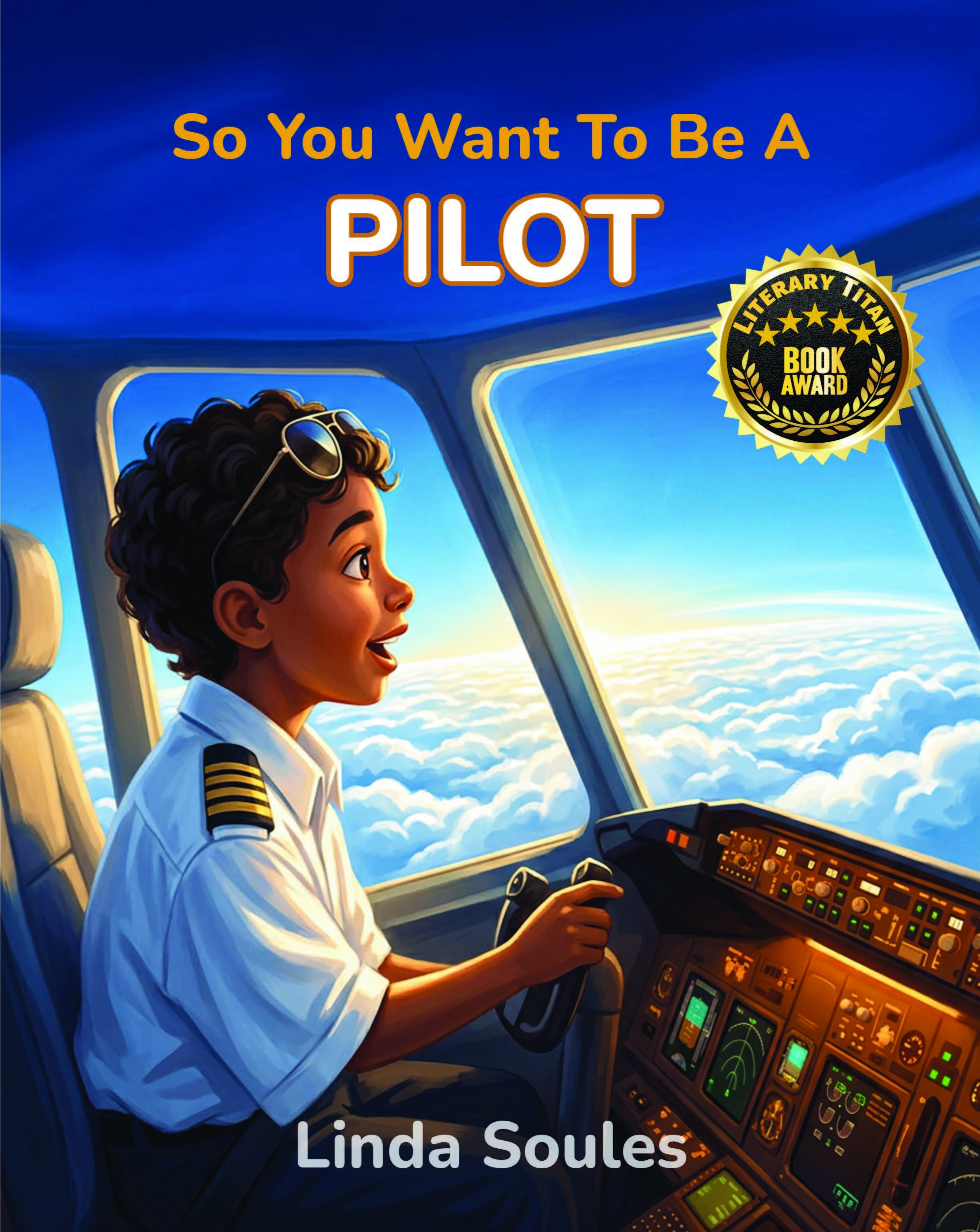
So You Want To Be A Pilot
by Linda Soules
Key Takeaways
Summary
So you want to be a pilot. You imagine sitting in the left seat, advancing the throttles as the engines roar and the runway rushes past. The aircraft gathers speed, the nose rises, and suddenly the wheels leave the ground. Buildings shrink, roads become lines, and fields turn into a patchwork below. The clouds that looked like a ceiling from the ground become a floor as you climb toward a sky bluer than any you have seen before. At 35,000 feet, seven miles above Earth, you are calm—not because flying is simple, but because this is what you have trained to do.
A pilot’s work joins technical mastery with judgment. Knowing what an aircraft can do is only half the task; deciding what it should do as conditions change is just as important. The airplane may weigh 200 tons, yet the pilot must guide it across an ocean and return it to a strip of concrete only 150 feet wide, often so smoothly that passengers barely notice the wheels touch. The achievement is to make something extraordinary look ordinary. And for all the instruments and procedures, the view remains extraordinary: clouds stretching beneath the aircraft, the horizon curving faintly in the distance, and the world far below taking on the look of a map.
The cockpit is a purpose-built workplace, with two seats facing forward and hundreds of switches, buttons, displays, and controls. There are about 600 of them, each with a specific purpose. Pilots learn the panel so thoroughly that, even in turbulence or darkness, they can reach for the right control without searching. Instruments show how fast the aircraft is moving, how high it is, which direction it is headed, and whether it is level or banked. On a clear day, a pilot can compare the aircraft’s position with the visible horizon. Inside cloud or on a dark night, that horizon disappears; instruments become the only reliable guide to which way is up. Flying by instruments alone requires additional training.
The radio is another essential tool. It links pilots with air traffic controllers tracking aircraft over hundreds of miles, with other pilots coordinating routes and altitudes, and with ground teams at airports. Clear, exact language matters because similar-sounding letters can be confused over the radio. Aviation therefore uses a phonetic alphabet: instead of saying “B” or “D,” a pilot says “Bravo” or “Delta.” Every letter has its own word, making names and instructions easier to understand.
The checklist is a tool for safety, not a test of memory. In 1935, a new Boeing aircraft crashed during a demonstration flight because its pilots had forgotten to release a control lock before takeoff. The aircraft was not defective, and the pilots were not incompetent; the plane was simply more complex than any before it, and human memory proved fallible. Aviation’s answer was a written, step-by-step check that critical actions had been completed. Before each flight and at every phase, pilots read items aloud and verify them in order. Even after 10,000 flights, a pilot follows the checklist just as carefully as on a tenth flight. Its repetition is a discipline that helps catch errors before they grow into danger.
Safety also rests on preparation and backup. A wide-body aircraft at cruising altitude can glide for more than 100 miles without engine power. An engine failure does not turn an airplane into a falling rock; the aircraft can still glide, and aviation is designed around the principle of planning for the worst and building systems to manage it. Commercial pilots train for hundreds of hours before carrying passengers, then continue practicing in simulators and rehearsing emergencies throughout their careers. The composed voice passengers hear is the result of preparation intended to make even rare, difficult situations manageable.
The rewards include the views, the mastery, and the responsibility. Pilots may see the Northern Lights as green and purple curtains from 40,000 feet, thunderstorms towering above the clouds and lit from within by lightning, or the Milky Way shining across the night sky over the Atlantic. The procedures and training are the work; the view is a gift. There is also deep professional confidence in learning to handle a complex aircraft and bring it safely to the ground, even when weather worries people watching from below. Above all, pilots carry the trust of hundreds of passengers who may be reading or sleeping behind the cockpit door, relying on the crew to bring them safely to their destination. That trust gives the work meaning.
The difficult moments are demanding partly because they are rare. An instrument can fail mid-flight, weather can force an unexpected diversion, or a situation can arise that does not fit neatly into a training exercise. After a long stretch of routine, a pilot must shift quickly into managing a problem. Weather is the largest variable pilots cannot control. They can study it, respect it, and make decisions around it, but they cannot command it. The job also carries a cost beyond the cockpit: irregular schedules, time away from home, jet lag, and hotel stays where there may be little time for anything but sleep before the next departure. A stable personal life can be difficult to build around a career whose schedule is inherently unstable.
One surprising fact is how little a long-haul pilot may physically handle the controls. On a typical long flight, hands may be on them for only about seven minutes in total: during takeoff, the initial climb, the approach, and landing. Autopilot manages much of the cruise, often more precisely than a person could over several hours. But the pilots are not simply resting. They monitor the aircraft’s systems, fuel, weather, and air traffic instructions, and remain ready to take over whenever human judgment is needed. Autopilot is like cruise control in a car: it maintains the flight, but the pilot remains responsible for what happens. The computer flies; the human watches, interprets, and decides.
Even meals are shaped by safety rules. The captain and first officer are not allowed to eat the same meal, so that if contaminated food makes one pilot ill, the other can remain functional. Radio language is similarly deliberate. “Roger” means a message was heard; “Wilco” means the instruction will be followed. “Mayday,” repeated three times, signals the most serious emergency, while “Pan-pan” indicates an urgent situation that is not life-threatening. “Squawk” tells a pilot to set a transponder code so controllers can identify the aircraft on radar. And despite what films suggest, pilots do not say “over and out”: “over” hands the conversation to someone else, while “out” ends it.
A pilot’s day begins well before the aircraft leaves the ground. At six in the morning, the work is already under way with a review of the route and the weather: winds at altitude, conditions at the destination, and alternate airports in case the planned destination becomes unavailable. The pilot builds a mental picture of the flight, but keeps it provisional. The plan is useful preparation, not a promise that the sky will cooperate.
At seven-thirty comes the preflight inspection. The pilot walks around the aircraft, checking control surfaces, access panels, lights, tires, fuel quantity, and engine intakes. This careful look is the last line of defense on the ground. At eight-forty-five, the aircraft takes off. The first minutes demand intense attention as it accelerates, moves through complex airspace, communicates with approach control, and transitions from visual references to instruments.
By midday, the autopilot is managing the route, but the pilots remain engaged. They monitor fuel, weather ahead, and the aircraft’s systems, watching whether everything is normal and continues to stay that way. At two-thirty, the work shifts to descent and approach. On this particular day, the airport is clear and the weather is better than forecast. The aircraft settles onto the runway with a small sound, a good landing—though every landing has its own character. At three-fifteen, the pilots shut down, complete the logbook, and hand the aircraft over to the ground crew. Then they walk through the terminal among people who may never guess what their working day involved.
No pilot makes that day happen alone. The first officer, or co-pilot, is the captain’s primary partner: cross-checking actions, sharing the flying, and offering a second judgment. A flight dispatcher helps plan the route and fuel; air traffic controllers manage the aircraft’s movements from pushback to parking. Ground crews refuel and service the plane, while mechanics certify that it is airworthy. Flight attendants look after safety and the people in the cabin, and a meteorologist can provide weather information tailored to the precise route and altitude. The passengers, meanwhile, bring the responsibility that gives every decision its weight.
Safety depends not just on the people involved, but on how they work together. Plans and responsibility pass from one person to another, and every handoff is an opportunity to check that the next person has what they need. Clear communication matters because each voice must say what it means without creating confusion. If weather changes suddenly, a passenger needs medical help, or fuel becomes a concern at a distant airport, the pilot is not isolated in the cockpit. Professionals across the operation can contribute information and assistance. A flight is not a solo performance; it is a shared effort in which people coordinate around the safety of strangers.
That effort connects people and places in ways that can be easy to overlook. Pilots carry doctors to medical emergencies, families home for holidays, aid workers to disaster zones, and vaccines to communities that need them. Air routes help stitch modern civilization together, while the safety of each journey depends on training, honest reporting of errors, and continuous learning. Pilots help preserve that culture by treating safety as a shared responsibility rather than an individual feat.
The qualities this work demands begin with situational awareness: knowing where the aircraft is, what its systems are doing, what the weather is doing, and what the next ten minutes may require. That picture must be held and updated as conditions change. A pilot cannot simply settle into the first plan and stop paying attention; the task is to notice when reality no longer matches expectations.
Procedural integrity is just as important. Checklists must be used every time, not only when a pilot is tired or uncertain. Their value lies in their consistency: procedures are not needless bureaucracy but a foundation for safety. Even a highly experienced pilot benefits from treating each flight as deserving the same careful preparation and attention.
Decision-making under uncertainty is another essential skill. Forecasts are not guarantees, and decisions often have to be made with incomplete information and under time pressure. This is where technical knowledge and judgment meet: understanding what the aircraft can do is only part of the question; the pilot must also judge what is wise in the circumstances. Preparation helps make that judgment possible, but it cannot remove uncertainty.
Crew resource management means speaking up, listening to input, disagreeing constructively, and making decisions as a team. A pilot who is technically skilled but unable to work openly with others is less safe than one who welcomes a colleague’s observations. Cross-checking is not a challenge to authority; it is a way to catch what one person may miss.
Some of the most important work, however, happens inside the pilot’s own mind. Unexpected events can trigger tunnel vision, rushing, or the urge to act before thinking. Pilots train to resist those reactions and remain clear when stress makes clarity difficult. Humility matters too. The forecast may promise clear skies while clouds appear ahead; the checklist may be complete while something still feels different. A pilot should trust training without dismissing unease, and be able to say, “Something is not right,” even before the cause is clear. Experience can build that intuition, but it does not make anyone certain about everything.
Precision in communication completes the picture. Pilots learn to say exactly what they mean, neither more nor less, because confusion in the sky can be dangerous. The habits of preparation, awareness, teamwork, and precise speech all depend on remaining alert to what is known—and to what may still be uncertain.
The history of flight is also a history of people who found ways past barriers, tested the limits of what was possible, and turned preparation into action. Amelia Earhart became the first woman to fly solo across the Atlantic, crossing 2,000 miles of open water alone in a small plane amid fog and ice. When she landed in a pasture in Northern Ireland, a farm hand ran over and asked whether she had flown far. “From America,” she replied. After such a vast journey, the answer made the extraordinary sound almost matter-of-fact.
Chuck Yeager, raised in West Virginia, became the first person to break the sound barrier in 1947. He flew the rocket-powered Bell X-1 faster than sound while hiding two broken ribs, afraid that telling anyone would get him grounded. Bessie Coleman faced a different kind of barrier: flight schools in the United States refused to train her because she was Black and a woman. She learned French, went to France, and earned an international pilot’s license in 1921. Back in America, she became the first Black woman pilot in history. She refused to perform before segregated crowds and built a career that challenged the idea that the sky could be closed to her.
Captain Sully Sullenberger’s defining flight came on January 15, 2009. Three minutes after US Airways Flight 1549 took off from New York, geese struck both engines and stopped them. With only ninety seconds to choose a place to land and no airport close enough, Sullenberger brought the aircraft down on the Hudson River. All 155 people aboard made it onto the wings and were rescued. Later, he described a lifetime of practice as depositing small amounts into a bank of experience, then making one large withdrawal when the emergency arrived. The story makes clear that training is not a promise that nothing will go wrong; it is preparation for the moment when something does.
Flight’s safety lessons also appear in details passengers may barely notice. Below 10,000 feet, the sterile cockpit rule prohibits conversation that is not directly about flying, giving the crew’s attention to takeoff and landing. Airplane windows are round because sharp corners in early rectangular windows concentrated stress and contributed to catastrophic failures; rounded shapes distribute that stress more evenly. A New York–London flight follows a curved great-circle route because the shortest path between two points on a sphere appears curved on a flat map. Even the tires are engineered for extraordinary demands: at touchdown they accelerate from rest to about 170 miles per hour in less than a second, and are inflated to roughly six times the pressure of car tires.
The autopilot can keep an aircraft on course with exceptional steadiness, but it cannot judge what a changing situation means. A new weather threat, a warning light, or a revised instruction from air traffic control calls for a human decision. The machine can fly; the pilot must understand and command. Training therefore continues throughout a pilot’s career, through medical examinations, annual simulator checks, and recurrent practice. Preparation is not something completed once before a career begins. It is a continuing obligation.
That habit of preparation can begin well before anyone enters a flight school. A paper airplane offers a way to explore the forces of flight: change its wing shape, add weight to the nose, and notice what happens. Watch the sky and learn to recognize cumulus, stratus, and cirrus clouds; begin reading weather forecasts, since pilots must understand not only what the sky looks like now but what it may become. Making written checklists for schoolwork, packing, or other tasks builds the habit of recording steps and confirming them in order.
An airport visit can reveal the choreography behind each departure: aircraft movements, ground crews at work, and takeoffs and landings arranged in careful sequence. For a more direct test of whether the cockpit feels right, many flight schools offer discovery flights in small aircraft, with an instructor and a chance to take the controls. And looking up is a beginning in itself. Every contrail marks an aircraft carrying a crew through the sky.
The questions pilots ask provide a practical picture of how they think: What is the weather doing now, and what will it be doing along the route? What is the aircraft telling me, and does that match what I expect? If something goes wrong, is my plan ready before I need it? These questions are not a test to pass. They express a mind that stays present, prepares for change, and looks ahead. Loving the sky may be part of the attraction, but so are careful preparation, technical learning, judgment, and responsibility. A person drawn to that combination may find that piloting is a fitting path.
Aviation has its own precise vocabulary. Altitude means an aircraft’s height above the ground or sea level; ATC is air traffic control, the ground-based team coordinating aircraft. The captain is the pilot in command, while the first officer shares the flying and decisions from the other seat. A checklist is a written verification of critical actions, and crew resource management means pilots communicate openly, challenge errors, and make decisions together. The four forces—lift, weight, thrust, and drag—shape every flight. Lift is the upward force created by a wing as air flows over it. A contrail is the white trail of ice crystals formed when engine exhaust meets cold air. The yoke steers an aircraft up, down, left, and right, though some modern planes use a side-stick instead. These words name both the physical work and the shared discipline that make flight possible.
The deeper lesson, the author explains, is that commercial aviation is not safe because pilots are heroes. It is safe because the industry has built a culture that examines failure honestly and shares what it learns. Investigators study accidents; engineers examine broken parts; airlines apply lessons across the profession. Every checklist carries knowledge paid for by an earlier mistake. When passengers fall asleep, their trust rests not on one person alone, but on a system built through a century of learning.
Pilots are keepers of that discipline as well as the people who fly the aircraft. To take a place in the cockpit is to accept its history: to learn thoroughly, prepare consistently, remain humble about what is unknown, and let knowledge become safer practice. Every hour spent flying rests on many more hours of getting ready. That work can begin now.
Chapter Summaries
What If You Were a Pilot?
The book opens by inviting readers to imagine the acceleration of takeoff: the runway rushes past, the aircraft lifts, and the landscape below turns into a map. At cruise altitude, a pilot may be seven miles above Earth, surrounded by a view few people experience. The thrill of flight is real, but the book emphasizes that professional piloting is also a disciplined craft requiring both technical mastery and calm judgment. A commercial aircraft can weigh as much as 40 elephants, yet its pilots guide it across long distances and land it on a comparatively narrow runway. Making this remarkable feat seem ordinary and safe is central to the work. The opening also places aviation in historical perspective: people dreamed of flight for millennia, and the Wright brothers’ first brief flight helped open the way to modern journeys across oceans and continents.
What a Pilot Actually Does: The Cockpit and Its Tools
Pilots use instruments, controls, radio communication, and procedures, but their most important work often involves judgment: interpreting a situation, considering options, and choosing a safe response. The cockpit’s hundreds of switches and displays become familiar through extensive practice, while instruments are essential when clouds or darkness hide the horizon. Radios connect flight crews with air traffic control, other pilots, and airport teams. The checklist is presented as one of aviation’s most important safety innovations. After a 1935 demonstration-flight crash caused by a forgotten control lock, aviation recognized that even skilled people cannot rely on memory alone. Pilots therefore verify critical actions aloud, in sequence, before each flight and at key phases. Training continues throughout a career through simulator exercises, emergency practice, medical checks, and recurring evaluations. These routines make it possible to respond calmly when something unexpected occurs.
The Best, Hardest, and Most Surprising Parts of the Job
The rewards include spectacular views—Northern Lights, thunderstorms seen from above, and stars over an ocean—as well as the satisfaction of mastering a complex aircraft. Yet the book describes the greatest achievement as aviation’s quiet normality: passengers can sleep while hundreds of people travel swiftly and safely high above the ground. Pilots may find meaning in the trust passengers place in them and in the responsibility to honor it. The difficult parts include rare but demanding emergencies, changing weather, irregular schedules, time away from family, and jet lag. One surprise is that on a long-haul flight a pilot’s hands may be on the controls for only a few minutes; autopilot manages much of cruise while pilots monitor systems and remain ready to intervene. Other safety practices include pilots eating different meals so that possible food contamination does not incapacitate both, and using precise radio phrases rather than the movie expression “over and out.”
A Day in the Life and the People on the Flight
A pilot’s day begins with a review of the route, winds, destination weather, and alternate plans. Before departure, the pilot walks around the aircraft to inspect its surfaces, panels, lights, tires, fuel, and engine intakes. Takeoff and the first minutes of flight demand close attention; during cruise, the pilots continue monitoring fuel, weather, and aircraft systems. Descent, approach, landing, shutdown, and logbook tasks complete the sequence. The pilot’s work is supported by a broad team. The first officer cross-checks decisions and shares flying; dispatchers plan routes and fuel; controllers coordinate aircraft; mechanics certify the aircraft; ground crews service it; flight attendants care for cabin safety and passengers; and weather specialists provide route-specific information. Safety arises from the quality of the handoffs and communication among them. When an unexpected issue occurs, the pilot can draw on a network of professionals rather than face the problem alone.
How Pilots Help and the Qualities the Work Requires
Pilots connect people and communities by carrying travelers, doctors, aid workers, families, and essential supplies. The book frames commercial aviation as a major achievement of civilization, sustained by rigorous training, honest reporting, and continuous learning. Pilots are not only operators of aircraft; they help maintain the safety culture that allows the air-transport system to serve people around the world. The essential qualities include situational awareness, procedural integrity, sound decisions with incomplete information, and crew resource management. Pilots must keep track of the aircraft, its systems, weather, and what lies ahead, while following checklists every time. They need to communicate clearly, invite other crew members to speak up, and disagree constructively when needed. The book also highlights less obvious needs: managing stress, resisting tunnel vision and rushed reactions, and remaining humble enough to investigate a concern even before its cause is clear.
Famous Pilots and the Details of Flight
Stories of Amelia Earhart, Chuck Yeager, Bessie Coleman, and Sully Sullenberger show different forms of courage, persistence, and preparation. Earhart’s solo Atlantic crossing and Coleman’s determination to earn a pilot’s license despite racial and gender barriers demonstrate how aviation pioneers challenged limits. Yeager’s breaking of the sound barrier represents experimental flight, while Sullenberger’s Hudson River landing illustrates how decades of practice can prepare a pilot to make a critical decision under pressure. The book adds memorable aviation facts to explain how safety and science shape everyday flying. The sterile cockpit rule limits unrelated conversation below 10,000 feet; rounded aircraft windows distribute stress more safely than the square windows used on early jets; and long-distance flights may follow curved great-circle routes across a spherical Earth. Aircraft tires withstand tremendous forces at touchdown, while autopilot can fly steadily but cannot replace a human decision-maker. Airline pilots continue medical checks, simulator tests, and recurrent training throughout their careers.
Preparing Now and Considering the Career
Readers are encouraged to explore the science and habits of flying long before choosing a career. They can change the shape or balance of paper airplanes to observe the four forces of flight, learn to identify clouds, read forecasts, make and follow checklists, and watch how aircraft and ground crews operate at an airport. A discovery flight or simulator can offer a more direct sense of whether the cockpit feels compelling. The book offers questions that reflect a pilot’s way of thinking: What is the weather doing now and later? What is the aircraft telling me? What is my plan if something goes wrong? It also points readers toward books, museum resources, live air-traffic-control audio, weather reports, flight simulators, and youth aviation organizations. These activities turn curiosity into practical exploration and help young readers decide whether they enjoy the combination of preparation, technical learning, teamwork, and responsibility.
Pilot Words, Aviation’s Lessons, and the Author’s Note
A glossary explains terms such as altitude, air traffic control, autopilot, captain, first officer, checklist, contrail, lift, the four forces, sterile cockpit, and yoke. These definitions introduce the vocabulary pilots use and reinforce the book’s central idea that aviation depends on understanding both the aircraft and the systems around it. The aviation alphabet—Alpha, Bravo, Charlie, and the rest—shows how standardized language helps prevent confusion over radio communications. In the author’s note, Linda Soules argues that commercial aviation is safe not because pilots are superheroes but because the profession investigates failures and shares what it learns. Checklists and procedures reflect hard-won lessons from earlier mistakes. The book closes by presenting piloting as a responsibility inherited from generations of aviation workers: future pilots should learn thoroughly, prepare carefully, remain humble, and respect the knowledge that keeps people safe in the sky.
Notable Quotes
A pilot’s job is to make the impossible look ordinary.
The technical knowledge tells you what the aircraft can do. The judgment tells you what you should do with it.
Not a memory aid. A system. A way of catching errors before they become problems.
The sky is not an enemy. It is a partner. But it demands respect.
The computer flies. The human commands.
Aviation is not a solo performance. It is a conversation between many people who have all agreed, quietly, that the safety of strangers matters more than anything else.
The day they stop training is the day they stop flying.
Learn everything. Be prepared. Be humble. And fly.
