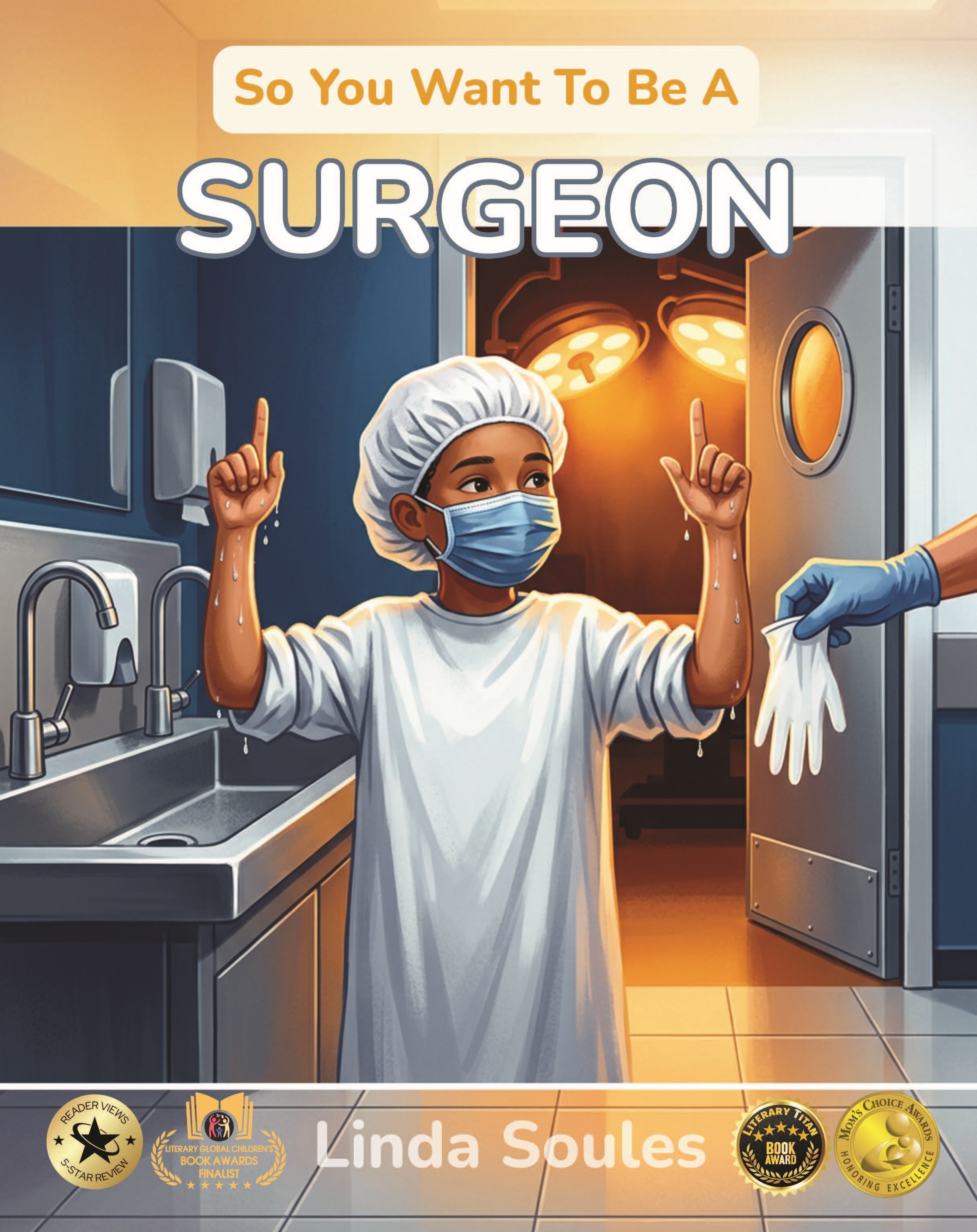
So You Want To Be A Surgeon
by Linda Soules
Key Takeaways
Summary
Imagine entering a room where the lights are bright, the air is cold, and everyone moves with quiet purpose. A patient lies asleep on a narrow table, surrounded by a team, while a surgeon prepares to work inside a living human body. The task can sound frightening, but surgeons do not succeed by being fearless. They rely on knowledge, steady hands, careful preparation, and a plan. Surgery brings science and craft together: a surgeon must understand how the body is built and how it changes when something goes wrong, while also learning to make precise movements with controlled hands. They need to communicate clearly with a team and stay calm when the stakes are high. Above all, they need judgment: knowing when to proceed, when to pause, and how to adjust when the body does not match expectations.
The dramatic operation is only one part of the work. Before surgery, the surgeon works with other doctors to diagnose the problem, examining the patient, reviewing scans, and studying test results. Then comes planning: mapping out the operation, anticipating what the surgeon may find, and considering what could go wrong. Preparation also includes the precise routine of scrubbing, putting on a gown, and gloving so that anything touching the patient is sterile—free of bacteria. During the operation, the surgeon makes the incision and carries out the planned work, whether the procedure lasts half an hour or twelve hours. At the end, they close the incision with stitches, some smaller than a grain of rice. Their work continues afterward, as they check on the patient, monitor healing, and make sure the operation has worked. The cutting itself may account for only about a fifth of the job. Most of the work lies in thinking, planning, preparing, checking, and caring.
Preparation matters as much as the operation. A surgeon reviews images, chooses an approach, and meets with the patient to explain what will happen. For the patient, surgery can be frightening: their body is about to be opened by someone they met only weeks earlier. A patient may need more than a technical explanation; they may need time to ask the question they have been holding back. One experienced surgeon traced her calling to watching her mother, a nurse, close a neighbor’s cut hand. What stayed with her was not the blood but the steadiness of her mother’s hands, each stitch controlled and even, and the way the neighbor’s fear eased. She wanted hands like that. A surgeon who sits beside a patient and answers a last question with patience offers something no instrument can provide: the reassurance of being in steady hands.
Surgeons work in more places than the operating room. They meet patients in clinics, discuss complicated cases with specialists in conference rooms, and care for patients in preoperative areas and recovery rooms. But the operating room is where the team’s routines and surroundings are arranged to support safe, focused work. It is kept cold—about 60 to 65 degrees Fahrenheit—to reduce infection risk and help the team stay alert. Powerful, shadowless lights illuminate the surgical site, and every item is positioned with purpose. Around the site, the team maintains a sterile field: an invisible boundary that unsterilized objects must not cross.
The tools themselves are designed for different, specific tasks. A scalpel makes the initial incision, with precision measured in millimeters. Retractors hold the opening apart so the surgeon can work; forceps grip tissue; clamps control blood vessels. At the end, sutures close the tissue, with materials and thicknesses chosen for what is being repaired and how deep it is. Skillful use matters as much as the design of the instruments. Even a simple stitch demands controlled movement, and the surgeon’s work depends on choosing the right tool and handling it precisely.
The sterile field requires discipline at every moment. Gowns, gloves, drapes, and instruments inside it have been sterilized; anything outside is treated as contaminated. If a hand brushes something beyond the boundary, it must be re-gloved before touching the patient again. This is not a formality. Keeping the field sterile helps protect the patient from infection, and everyone in the room must be alert to the boundary. The overhead light is another carefully designed aid: its even illumination reaches into the wound without leaving dark pockets where something might be missed.
Technology can change how surgeons reach the part of the body they need to treat. In minimally invasive surgery, the surgeon works through tiny incisions with a laparoscope, a thin tube fitted with a camera, and watches the procedure on a monitor rather than looking directly at the surgical site. Robotic surgery uses a similar principle of extending what the surgeon can do: seated at a nearby console, the surgeon moves controls with their own hands, and tiny robotic arms reproduce those movements inside the patient with exceptionally fine reach and steadiness. But the robot does not make decisions or operate on its own. The tool is only as good as the person using it. A master surgeon with a simple scalpel can outperform a beginner with an advanced robot; technology extends skill rather than replacing it.
For the smallest and most delicate procedures, surgeons need to enlarge their view. Tiny blood vessels in an infant’s heart, delicate nerves in an eye, and the fine bones of an inner ear may be too small to see clearly with the naked eye. Surgical loupes—magnifying lenses built into glasses or a headband—make such work visible. They can turn a stitch as fine as a human hair into something the surgeon can place with precision. In the most demanding operations, an operating microscope provides still greater magnification. The smaller the work, the larger the view must become.
That precision is only part of what makes surgery rewarding. Surgeons describe the operating room as a place that demands total presence, much like a stage or a cockpit: decisions and movements must be exact, and when a procedure goes as planned, the result is immediate and visible. There is also the responsibility of being trusted with another person’s body while they are at their most vulnerable. The patient has placed that trust in the surgeon’s hands, with the expectation that those hands will be ready. Technical mastery grows over decades, and every difficult case offers another chance to become more capable.
The reward may be clearest when the patient wakes. A cancer has been removed, an injury repaired, or a problem a child was born with corrected. Then the surgeon goes to speak with the family waiting outside. That walk can carry enormous weight: for the surgeon it follows one operation among many, but for the family it may be the moment they learn what comes next.
The work also asks surgeons to face the possibility that things will not go as expected. A blood vessel may take an unusual route; scar tissue left by an earlier operation can hide familiar landmarks; unexpected bleeding can force a change of plan within seconds. Preparation cannot make the body predictable. Its purpose is to help the surgeon respond: to recognize a complication, stay calm, and decide what to do next rather than letting surprise become panic. That composure takes years to develop and must keep developing throughout a career.
Some operations do not end with the hoped-for recovery. A patient may receive the best possible surgery and still worsen, or a complication may have serious consequences even when no one was at fault. These outcomes stay with surgeons. After difficult cases, teams meet at Morbidity and Mortality Conference to describe what happened, examine why, and learn how to prevent similar problems. The practice depends on people being willing to speak honestly about mistakes and outcomes. A surgeon who cannot admit that something went wrong is dangerous, because learning requires candor. And after a painful case, the surgeon still has to be fully present for the next patient.
A typical day begins before the first operation. At 5:45 in the morning, the surgeon arrives to review the X-rays and scans for the day’s first case; seeing the images beforehand helps the surgeon make better decisions in the operating room. At seven, the surgeon meets with the patient, who is frightened despite having heard the explanation before. The patient saves one final question, and the surgeon answers it completely.
At 7:45, the surgeon scrubs in, following the same timed, methodical sequence. The first operation begins at eight. Music may be playing as the team works, but the surgeon’s attention is fixed on the procedure and on decisions that must be made in real time. By 11:30, the first case is finished. The surgeon speaks with the family about how it went, what was found, and what to expect. They have waited three and a half hours; those twelve minutes of conversation may be the most important part of their day. The final note is written at six. Leaving work behind, even temporarily, is itself a skill.
No surgeon performs an operation alone. The anesthesiologist keeps the patient safely asleep and monitors vital signs without pause. Surgical nurses and scrub technicians prepare the sterile field and learn to anticipate what the surgeon will need. A first assist provides another pair of hands. Their coordination is built through practiced relationships: sometimes an instrument is in the surgeon’s hand before the surgeon finishes reaching for it, and a quiet report of a change in vital signs can alter the next decision.
Safety also depends on routines that leave little to chance. Before the first cut, the team pauses for a time-out, confirming aloud that they have the right patient, the right operation, and the right side of the body. Sponges and instruments are counted in and counted out, so nothing is left inside the patient. After surgery, residents—surgeons in training—care for the patient through the night and call the attending surgeon if something changes. The surgeon is responsible for the quality of the operation, but recovery depends on the whole team.
Surgery can repair what is wrong inside the body, but its help is not limited to dramatic, life-saving procedures. A tumor can be removed, a heart valve repaired, or a cleft palate closed so that an infant can grow up eating and speaking more easily. Just as important is the grandmother whose new hip lets her walk her granddaughter to school, the teenager whose repaired knee lets her return to a beloved sport, or the father who can eat dinner without gallbladder pain. Many operations do not save a life; they give ordinary life back. The procedure may feel routine to a surgeon with years of experience, but it can remain the most important hour in a family’s memory.
To do this work, a surgeon needs concentration that lasts as long as the operation. Four hours of precise work require four hours of precise attention. Hand skills take thousands of repetitions to build, and continue improving over a career. Good judgment requires confidence enough to act when hesitation would be costly, but openness to new information when circumstances change. That confidence must be earned through preparation, not confused with arrogance. A surgeon also needs to remain calm while understanding how much is at stake, and to have the physical endurance to stand for hours with steady arms and precise fingers. Fitness and daily care of the body help preserve that steadiness, especially late in a long operation.
The history of surgery is a history of people who kept working against barriers, sometimes changing medicine without receiving recognition at once. Nina Starr Braunwald was repeatedly told that women did not become heart surgeons. In 1960, she led a team replacing a patient’s failing heart valve with an artificial valve she had designed and built herself, in a landmark operation and one of the first of its kind performed by a woman. She went on to perform thousands of operations and train generations of surgeons.
Vivien Thomas’s path was different. The grandson of enslaved people, he trained as a carpenter, but lost his savings during the Great Depression. At Johns Hopkins, he became a surgical laboratory technician and invented a procedure to help babies born with a heart defect that made their skin turn blue. Surgeon Alfred Blalock performed the operations, while Thomas coached him from the gallery, step by step. The technique saved thousands of lives, yet for decades it was known as the Blalock-Taussig shunt. Thomas eventually received an honorary doctorate from Johns Hopkins, and his portrait joined those of surgeons, the only non-physician on that wall.
Daniel Hale Williams was born in 1856, five years before the Civil War began. After apprenticing as a shoemaker and working as a barber, he entered medical school at a time when few Black Americans could do so. In 1893, without X-rays or antibiotics, he opened a man’s chest and stitched the sac around his beating heart. The patient survived for twenty more years. Williams later founded the first American hospital to treat Black and white patients side by side, as well as the first to train Black nurses. These lives show that surgical achievement can depend on persistence, invention, and skill, even when institutions fail to recognize the person who contributed them.
Surgery’s surprising history continues in the operating room today. The first successful organ transplant was a kidney transplanted between identical twin brothers in Boston in 1954; surgeon Joseph Murray received the Nobel Prize thirty-six years later. Surgeons can also operate on babies still inside the womb. Fetal surgery began in 1981, and surgeons now repair some heart defects and spinal conditions before birth. Before anesthesia became available in the 1840s, speed itself could be a form of mercy: the fastest surgeons could amputate a limb in less than a minute because the patient was awake.
Other operations demand the opposite of speed. In 2001, surgical teams in Singapore worked for about one hundred hours to separate eleven-month-old twin girls joined at the top of the head. Teams rotated so that no one had to operate while tired. Even the name of a familiar instrument reaches back through time: “scalpel” comes from the Latin scalpellum, meaning “small chisel,” and blades made from sharpened obsidian were used more than four thousand years ago. Modern obsidian blades can still be sharper than steel. Today’s students can rehearse procedures on simulators, sometimes using virtual-reality headsets to explore a three-dimensional model of a particular patient’s anatomy before an operation.
A future surgeon does not have to wait for medical school to begin practicing patience and precision. A piece of thick string can become a knot-tying exercise: learn a square knot, repeat it with the other hand, then try it while wearing rubber gloves. With an adult’s help, a needle and fabric can teach the basic rhythm of suturing—straight stitches, spaced evenly and made the same length. Small models, tiny-piece building sets, or carefully folded origami can train hands to work steadily. Anatomy can begin with the body close at hand: feel the pulse at the wrist, identify the radial artery, count the ribs, or discover the twenty-seven bones in a hand. Even washing hands carefully, reaching between every finger and scrubbing for several minutes, makes an everyday task an exercise in discipline. When something becomes difficult, stopping to breathe, focus, and do the next right thing builds a kind of steadiness that matters in any demanding work.
Becoming a surgeon takes much longer than practicing these first skills. The usual path includes four years of college, four years of medical school, and five to seven years of surgical residency, when new doctors operate alongside experienced surgeons and gradually take on more responsibility. Some then spend another one or two years specializing in areas such as heart surgery, brain surgery, children’s surgery, or trauma. From high school, the path can take thirteen to fifteen years. That time is part of the preparation for work in which a patient’s well-being depends on both practiced ability and careful decisions.
The questions worth carrying along the way are not only about technique: What might be found once an operation begins, and how can the surgeon prepare for what was not expected? How can hands stay steady and a mind stay clear when the stakes are highest? What is the safest, most precise way to address the problem? Just as important is knowing when one’s own expertise is not enough and asking someone with different experience to help. A surgeon who recognizes the limits of their competence protects the patient; ego can put safety at risk. Teaching matters too. Passing a skill to the next generation takes more than performing it well—it requires explaining and guiding with care.
And sometimes the most important decision is not how to operate, but whether to operate at all. A patient may be too sick to survive surgery, or an operation may succeed technically without giving that person the life they hope to regain. A family may ask for an attempt when the honest assessment is that it would bring more suffering than benefit. Being able to say, warmly and clearly, that surgery is not the right choice demands courage and humility. The surgeon must weigh not only what can be done, but what is likely to help.
Curiosity can grow through books about anatomy and the life of Vivien Thomas, or through online resources such as Nemours KidsHealth, the University of Texas’s eSkeletons, and animated knot demonstrations. Students interested in health careers can explore HOSA, take a first-aid and CPR course through the Red Cross, or study anatomy through Science Olympiad. The International Museum of Surgical Science in Chicago offers another way to encounter the instruments and stories that shaped the field. Organizations such as the American College of Surgeons explain the specialties and their training paths; ReSurge International supports local surgical teams in low-income countries and provides reconstructive surgery to people who could not otherwise afford it.
The road is long, but its first steps are within reach: learn, practice, ask questions, and keep building judgment alongside skill. Every careful knot or stitch is a small beginning—not a promise that surgery will always be the answer, but a promise to become ready to help when the right answer calls for it.
Chapter Summaries
The Surgeon’s Calling and the Work Behind an Operation
The book introduces surgery as a demanding blend of science, artistry, teamwork, and care. A surgeon needs a doctor’s understanding of the body, an artist’s fine motor control, and a pilot’s ability to communicate and make decisions under pressure. The defining quality is judgment: knowing when to proceed, when to pause, and how to respond when the situation changes. An operation is only one part of a surgeon’s responsibilities. Surgeons assess patients, review scans and test results, plan procedures, prepare in a sterile environment, operate, close incisions, and follow patients through recovery. The book stresses that the cutting itself may be only about twenty percent of the job. Patient conversations matter too: taking time to answer a frightened person’s final question can provide reassurance that technical skill alone cannot.
The Operating Room, Instruments, and Surgical Technology
The operating room is designed for focus and safety: it is kept cool, brightly and evenly lit, and arranged around a carefully protected sterile field. Surgeons also work in clinics, pre-operative areas, recovery rooms, and case conferences. The book describes everyday instruments—including scalpels, retractors, forceps, clamps, and sutures—and explains how each supports a precise part of the procedure. Modern tools can make delicate work possible through tiny incisions or magnify structures too small to see clearly. Laparoscopes provide a camera view, robotic systems translate a surgeon’s hand movements into fine instrument movements, and loupes or microscopes enlarge minute anatomy. But technology does not supply expertise: the book’s central lesson is that tools extend skill rather than replace it. A simple instrument in experienced hands can be more effective than advanced equipment used without mastery.
Rewards, Risks, and the Reality of Surgical Practice
The rewards of surgery come from both mastery and trust. Surgeons may find deep satisfaction in the concentration of the operating room and in steadily improving their craft, which develops over decades. They also hold a uniquely intimate responsibility: patients entrust them with access to their bodies while unconscious, and surgeons must be ready to honor that trust. A successful operation can bring a powerful moment when the surgeon speaks with the waiting family and explains what happened. The work is also emotionally difficult. Human anatomy varies, scar tissue can obscure landmarks, and bleeding or other complications can force a rapid change of plan. Not every outcome is good, even when care is thoughtful and technically sound. Morbidity and Mortality Conferences give teams a structured way to examine difficult outcomes and learn from them. Surgeons must then remain present for the next patient, carrying the emotional weight without allowing it to compromise care.
A Day in the Life and the Surgical Team
A typical day may begin before sunrise with a review of scans, followed by a conversation with the patient, a careful surgical scrub, and hours of focused work. After an operation, the surgeon updates the family, explains what was found, and discusses what comes next. These conversations may be brief compared with the procedure, but for relatives waiting anxiously, they can be the most important minutes of the day. The book also notes that leaving work mentally behind takes practice. No surgeon works alone. Anesthesiologists monitor the patient’s vital signs and keep them safely asleep; nurses and scrub technicians prepare the sterile field and anticipate needs; first assists provide additional hands; and residents help care for patients after surgery. Team members communicate through practiced routines, including instrument and sponge counts. The surgeon is responsible for the operation, but recovery depends on coordinated care across the whole team.
How Surgeons Help and What the Job Requires
Surgery can remove tumors, repair heart valves, correct congenital conditions, and treat injuries, but its impact is not limited to dramatic, life-saving procedures. A replaced hip may let a grandmother walk her granddaughter to school; a repaired knee may return a teenager to a sport; and a gallbladder operation may let a parent eat without pain. Much of surgery, the book argues, is “life-returning”: restoring ordinary activities illness or injury has taken away. The role requires long, steady concentration, highly practiced hands, physical endurance, and confidence grounded in preparation rather than ego. Surgeons also need skills that may seem less obvious: explaining difficult information with warmth and clarity, recognizing when a case exceeds their expertise, and teaching the next generation. The book presents these qualities as complementary. Technical excellence matters, but so do humility, communication, and the ability to make responsible decisions.
History, Surprising Facts, and Ways to Start Practicing
Stories of pioneering figures show how surgical progress has depended on skill and persistence across barriers. Nina Starr Braunwald helped design an artificial heart valve and became a landmark figure in heart surgery. Vivien Thomas, a laboratory technician without a medical degree, developed and taught a procedure that saved babies with a serious heart defect, though recognition came late. Daniel Hale Williams performed an early successful operation on a beating heart and helped establish more inclusive medical institutions. The book adds unexpected details about modern practice: some surgeons use carefully chosen music, teams pause for a spoken time-out before the first incision, and pathologists may examine frozen tissue during an operation to guide the next step. Young readers can begin preparing through knot-tying, sewing evenly spaced stitches, building precise models, learning anatomy, practicing thorough handwashing, and staying calm when tasks become difficult. These exercises do not replace formal training, but they build patience and coordination.
Becoming a Surgeon: Training, Judgment, and Further Exploration
The path to surgery is demanding and lengthy: approximately four years of college, four years of medical school, five to seven years of residency, and sometimes additional specialty training. The book invites readers to consider whether they enjoy biology, hands-on problem-solving, sustained focus, and working under pressure. It emphasizes that aspiring surgeons begin as curious learners, and that the capabilities required for the profession are developed through training and practice. The author’s closing reflection expands the idea of surgical courage. Sometimes the hardest decision is not how to operate but whether an operation would help the patient at all. A technically possible procedure may bring more suffering than benefit, so a surgeon must be willing to explain honestly when surgery is not the right choice. The book concludes with resources for further learning—books, websites, clubs, first-aid courses, and museums—and frames every hour of practice as preparation to care responsibly for a future patient.
Notable Quotes
“The actual cutting? That is maybe twenty percent of the job.”
“The tool extends skill. It does not replace it.”
“The question is not whether something will go wrong. The question is: what do you do when it does?”
“Confidence earned through preparation, not assumed.”
“Ego is the enemy of surgical safety.”
“The surgeon who operates is doing something. The surgeon who chooses not to is carrying the weight of the thing they chose not to do — and that weight is, in its own way, also love.”
