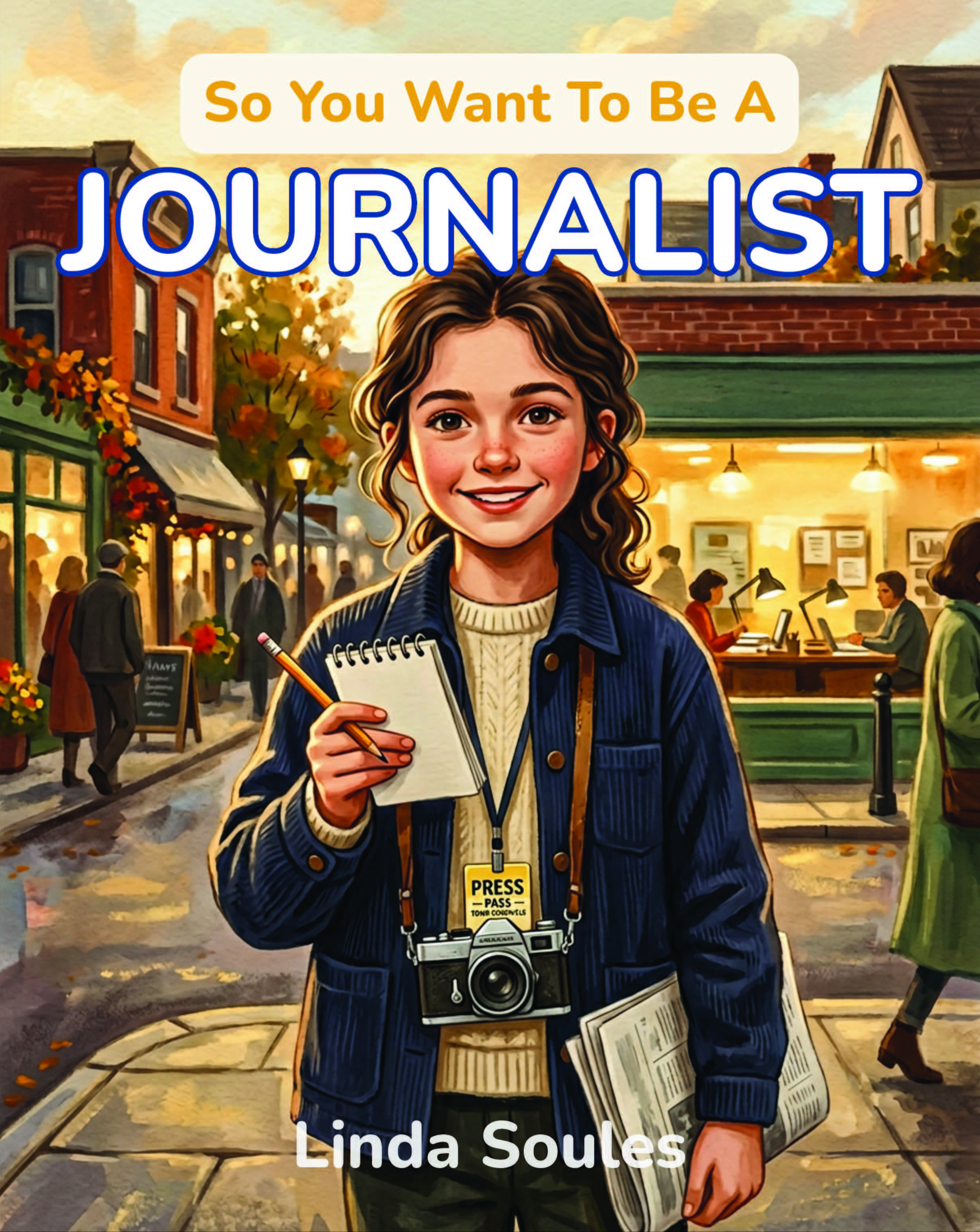
So You Want To Be A Journalist
by Linda Soules
Key Takeaways
Summary
A journalist is a witness on behalf of the public: the eyes and ears of people who cannot be in the room. At a city council meeting, in a courthouse, at the scene of a fire, or across a desk from a powerful official, the reporter sees, asks, listens, and writes things down so others can understand what happened. The job is not to repeat what people say happened, or what would make the most interesting story. It is to find out what is true and explain it clearly to the community.
That public purpose is one reason the First Amendment names a free press alongside free speech, assembly, and religion. A country whose people govern themselves needs people who investigate what is going on. The technology for delivering news keeps changing, from newspapers and radio to websites, podcasts, and newsletters, but the underlying work remains the same: find out what happened, check it, and tell people plainly.
The heart of that work is reporting, not writing. A story usually begins with a small, stubborn question: Why is a school closing? What happened to the money? Who is responsible for a failure? To answer, a journalist makes phone calls, requests records, attends meetings, knocks on doors, and listens to people who know something. The same question may be put to many different people, and their answers are compared. Documents, interviews, and what a reporter sees firsthand can gradually fit together into a reliable account. Sometimes it takes months before the picture is clear enough to publish.
Trust makes this process possible. Journalists do not invent quotes or publish claims they cannot verify. They identify themselves when interviewing people, do not take money from the people they cover, and distinguish news from opinion. They may protect a source who could be harmed for speaking, correct mistakes openly and quickly, and think carefully before publishing information that might hurt someone. These are not empty rules: they help readers judge whether a story deserves to be believed. Even something as small as refusing a source’s offer to buy coffee matters, because it avoids the appearance that coverage can be purchased.
A newsroom is a familiar home base, though many are smaller and quieter than they once were, and some journalists work from home. When major news breaks, reporters still gather together. The work itself often happens elsewhere: in a council chamber, hospital hallway, school board meeting, courtroom, protest, or town hall where residents are asking why their water tastes wrong. Journalists go where the story is. Some spend years on one beat, learning a subject such as sports, food, science, city government, or the courts in exceptional depth. Foreign correspondents cover places far from home; war correspondents work in dangerous conditions. Local reporters, often covering city halls and courthouses, follow decisions that shape daily life.
The reporter’s notebook remains one of the most important tools in the field. A small spiral pad and a pencil can work when a phone battery runs out, and handwritten notes capture what people say while they are still talking. Many veteran reporters keep their notebooks for years, a record of questions asked and stories pursued. Phones are another essential tool: a single story may require dozens of calls, and a reporter must keep asking with patience even after unanswered calls and voicemails.
Public records can reveal what people would rather leave unnoticed. Court filings, budgets, inspection reports, property deeds, and campaign finance reports create paper trails that journalists can request and examine, sometimes under laws such as the Freedom of Information Act. Many important stories begin not with a secret whispered by an insider, but with a document anyone could have read. Audio recorders, often simply an app on a phone, preserve interviews so quotes can be checked word for word. Recording also lets the reporter listen more closely, watch a source’s face, and think of a better follow-up question instead of trying to write down every word.
For many journalists, one of the great rewards is moving from not knowing to knowing. After weeks of reporting, an answer is supported not by rumor or guesswork but by interviews, documents, and observation. The memorable moments can be very specific: a city budget number that suddenly makes sense, an envelope arriving with crucial information, or a source finally returning a call late at night. Patient work can sometimes change something real. An agency may begin fixing a problem it had ignored; someone wrongly convicted may be freed; a neighborhood may discover that a reporter has noticed a danger residents feared nobody else saw.
The work also brings journalists into other people’s lives. Officials, families facing terrible days, and people with secrets or hopes may agree to speak because they want their story told accurately. Being trusted with grief, anger, and private knowledge is a privilege, and it creates a responsibility to listen and report fairly. Journalists also join a long tradition of writers and reporters whose work helped people understand their communities and the wider world.
But sources can lie, sometimes deliberately and sometimes because they believe something false themselves. Taking every claim at face value can lead a journalist to publish an untruth, so skepticism must be applied to every source, including people the reporter likes. Powerful people may try to stop a story through lawsuits, public attacks, or calls to an editor. Publishing carefully checked information even when it angers influential people can be difficult, but the public may need to know what the reporting has uncovered.
The difficulties extend beyond individual stories. Newspapers and broadcasters have less money than they once did, and local newsrooms have closed, leaving communities without reporters at school board meetings or city halls. Journalists may face online attacks, and sometimes attacks in person. Reporting disasters can also take a lasting emotional toll. A reporter who covered a flood said that years later, the smell of wet drywall brought the terrible week rushing back. Good journalists learn to talk through what they have experienced, take breaks, rely on colleagues, and ask for help rather than pretend the work costs nothing.
One surprise is that important stories often begin with material that sounds dull: a county budget, a water inspection report, school board minutes, a lawsuit, or a spreadsheet. Dramatic interviews and scoops happen, but much of journalism means reading another page or sitting through another long meeting because something important may be hidden there. Local reporting is especially consequential: no national outlet can simply replace the reporter who follows a town’s government, schools, and police. Communities without local reporters have repeatedly been found to have more corruption, lower voter turnout, and less public knowledge of what is happening. New, often small and online, newsrooms are beginning to fill some of the gaps, while the records that matter still wait for someone patient enough to read them.
A journalist’s day often moves between the newsroom, the phone, and the documents that may explain a tip. At 7:30 in the morning, the reporter scans overnight news, local police logs, court filings, and work email. Three tips have arrived: one seems worth pursuing, while the other two do not. Knowing which is which is already part of the work. At nine, the newsroom meets with an editor. Reporters describe what they are working on, and the journalist pitches the promising tip, then gets the day to chase it.
By ten, the phone calls begin. Six calls may bring two quick confirmations, three voicemails, and a long conversation with a city official who, off the record, knows more than she can officially say. Another source will talk only while walking his dog, so the interview proceeds at the pace of a slow, sniffing beagle. At 12:30, lunch happens at the desk, alongside a fifteen-page document from a source. Three pages matter. At 1:30, an in-person interview takes place at a coffee shop, the recorder on the table. The reporter begins with easy questions; the harder ones come near the end, after half an hour has given the community leader time to feel comfortable.
At 3:30, the reporter is back at the desk, drafting eight hundred words for the next day’s paper. The opening, or lede, matters because readers decide in its first sentence whether to continue. The reporter reads the draft three times and rewrites the lede twice. At five, the editor fact-checks it with her: they read every quote aloud, confirm every number, and check every spelling. When the editor asks a question the reporter cannot yet answer, she makes one more phone call. At 6:30, the story is filed and appears online, with the reporter’s byline, and will run on the next day’s front page. A byline is both credit for the work and a public responsibility: the reporter is standing behind the facts, and is the person to ask if something proves wrong. At seven, she begins a list of people to call first thing tomorrow. The work does not neatly end when the reporter goes home.
That day depends on colleagues as well as sources. A newsroom is a team: reporters gather information, while editors guide the story, ask difficult questions, and catch a reporter’s blind spots. Copy editors look for typos and lazy sentences. Where they still work, fact-checkers verify claims before publication. Photographers and video journalists tell stories through images, graphics editors make complicated data visible, and the newsroom librarian supplies institutional memory, recalling, for example, what happened the last time the city tried the same thing, back in 1992. Each role helps turn reporting into a story the public can understand and rely on.
Beyond the newsroom are the people a journalist learns to know over time. Some sources are officials whose job is to speak to the press; others are insiders who quietly share what their bosses would rather keep unknown. Some are ordinary witnesses who saw an event and agree to describe it, while experts help reporters make sense of what they are examining. A journalist’s career rests on building relationships with these sources over years, so that they answer her calls because they know she will report carefully and fairly. Trust takes time, and a reporter cannot expect it to appear only when a story suddenly needs it.
The reporter also encounters people whose job is to speak for powerful individuals or organizations, such as press secretaries and spokespeople, as well as journalists from competing publications. Newsrooms may race each other to publish a story first. Yet competition does not prevent collaboration: especially on major investigations, reporters from different publications may work together for months. The story can be too large, or the evidence too dispersed, for one newsroom to pursue alone.
Several qualities hold this work together. Verification must come before belief. Even a source a reporter likes, or a claim that would make a more exciting story if true, needs to be checked. The saying “If your mother says she loves you, check it out” captures the habit: a journalist does not publish a claim merely because someone confident or familiar has said it. Independence matters just as much. Reporters do not take money from the people they cover or promise favorable treatment to gain access. Advertisers, friendships, and political loyalties should not alter the story; a good reporter applies the same toughness to politicians she supports as to those she opposes.
Curiosity must persist after the easy answers run out. Important information may be behind another phone call, another document, or another meeting, and the journalist keeps asking until the picture becomes clearer. But curiosity alone is not enough: the information must be written clearly. A true account that readers cannot understand does not help them. Explaining a budget, a court case, or a scientific discovery in a few hundred readable words is a demanding part of the craft. Courage, too, is required—not as bluster, but as the ability to publish a carefully reported truth even when powerful people or the public may be angry. The journalist’s task is to do so calmly and accurately, without exaggeration.
Some necessary skills are less obvious. Math appears throughout journalism, in budgets, statistics, election results, and scientific studies. A reporter needs to understand percentages, read spreadsheets, recognize a misleading chart, and explain what numbers mean in plain language. A mistake can mislead readers even when no one intended to deceive them. Patience with sources is equally practical: the official who returns a difficult call may be someone the reporter has treated politely and accurately for years, long before she needed anything from them. Relationships built without immediate demands can become the foundation of solid investigative work.
Journalists must also be comfortable being unwelcome. Sometimes they enter rooms where people would rather they were absent, or raise a hand when a press secretary hopes nobody will ask a question. The standard is to be polite and persistent at once: neither rude nor timid. A few awkward minutes may be a small price to pay for asking what needs to be asked, and the reporter’s next call may begin in a room where that question is not welcome.
The history of journalism is full of people who found inventive ways to make hidden realities visible. Ida B. Wells, born into slavery in Mississippi in 1862, became one of America’s most important investigative reporters. After a close friend and two other men were killed in 1892, she began documenting racial violence across the South, gathering records and interviewing witnesses for articles, books, and pamphlets. She continued despite real danger: a mob destroyed her newspaper office in Memphis in an effort to silence her. In 2020, decades after her death, the Pulitzer Prize board awarded Wells a special citation for her courageous reporting. Journalists still study the care with which she built her case.
Nellie Bly, whose birth name was Elizabeth Cochran, demonstrated that reporting could take a journalist into places the public rarely saw. In 1887, she pretended to be mentally ill and had herself admitted to the notorious women’s asylum on Blackwell’s Island in New York. Her articles described cruel conditions from inside, helping lead to a grand jury investigation and major reforms. Two years later, Bly undertook a different kind of assignment: she traveled around the world in less than eighty days, beating the record of Phileas Fogg, the fictional adventurer in Jules Verne’s novel. She completed the trip alone, carrying one small bag, in seventy-two days. She was twenty-five.
Edward R. Murrow brought the danger of war into American homes through the calm precision of his broadcasting. In 1940, he reported from London rooftops during German air raids, describing events to listeners across the Atlantic. Years later, he turned his attention to Senator Joseph McCarthy, whose unfounded accusations were ruining lives. On his television program, Murrow aired a measured report that allowed McCarthy’s own words to reveal the problem. That broadcast helped bring McCarthy’s public power to an end and remains an example of how clear, controlled reporting can challenge a powerful figure.
Gordon Parks told stories with photographs rather than sentences. Raised in poverty in Fort Scott, Kansas, as the youngest of fifteen children, he taught himself photography after buying a camera at a pawnshop. He called the camera his “choice of weapons” against racism and poverty. In 1942, his image of Ella Watson, a Black cleaning woman standing with her broom and mop before an American flag, confronted viewers with the gap between the country’s ideals and its treatment of people. Parks later became Life magazine’s first Black staff photographer, and his photo essays brought the realities of poverty and segregation to millions. Sometimes, a reporter’s most powerful statement is an image.
The news itself has traveled by surprising routes. In 1850, Paul Reuter sent stock prices across a seventy-six-mile gap in telegraph lines using forty-five carrier pigeons. They beat the train by several hours, and the news company he founded, Reuters, still exists. Journalists also rely on a compact set of questions: who, what, when, where, why, and how. If a story cannot answer them clearly, it may not yet be ready. The famous 1948 Chicago Daily Tribune headline declaring “Dewey Defeats Truman” shows the cost of deciding too soon: the paper printed its prediction before the votes were counted, and Harry Truman had actually won.
Newsrooms have their own odd vocabulary and habits. An archive of old newspaper stories is called the “morgue,” though it is really a newsroom’s memory, sometimes holding more than a century of reporting. Interview notes may be written in a reporter’s private shorthand, which can become difficult even for its author to decipher. Restaurant critic Ruth Reichl sometimes used wigs, costumes, and a false name so chefs would treat her like an ordinary diner; she wanted to judge the honest experience, not a specially prepared meal. And in a sports press box, reporters are expected not to cheer, even for their favorite team. While working, they must watch as fair witnesses, not fans.
A young person curious about journalism can begin before choosing a career. Read news from several sources, including outlets that disagree, and notice how they cover the same event differently. Join a school newspaper or start one. Interview someone interesting, prepare questions, listen closely, take careful notes, and write the answers accurately. When you hear a claim, look for an independent source to confirm it. Learn enough statistics to understand percentages and recognize misleading charts, and practice making sentences shorter without changing their meaning. Pay attention to changes and problems in your own neighborhood; knowing a community well can reveal stories outsiders miss.
A journalist might ask: Is this true, or merely what everyone is saying? Who benefits if I believe it, and who does not? What does the public need to know that nobody is telling them? These questions can help someone decide whether the work fits. It may suit a person who is curious about how things function beneath the surface, can listen without interrupting, wants to check dramatic claims, and keeps asking until the answer makes sense. It also helps to enjoy finding clear ways to explain complicated things and to believe that people deserve to know what is happening in their community.
The language of the profession gives names to its responsibilities. A beat is the subject a reporter covers regularly, such as courts or city hall; a correspondent reports on a particular place or topic. A byline names the reporter and signals responsibility for the facts. The lede is a story’s opening, meant to give the most important information first. Fact-checking means confirming claims before publication, while public records are government documents the public has a legal right to see. A source can be a person, document, or recording. “On the record” means a source may be quoted by name; “off the record” describes information that cannot be attributed, and the terms must be agreed on clearly beforehand. The press is the network of news organizations and journalists; the “Fourth Estate” is its role in watching the other institutions of democracy.
For those who want to explore further, the suggested books include Philip Dray’s account of Ida B. Wells, Deborah Noyes’s biography of Nellie Bly, Joyce Grant’s guide to spotting fake news, and Robin Terry Brown’s introduction to how news is made. Young readers can follow Scholastic Kids Press and BBC Newsround, while the News Literacy Project offers lessons for distinguishing reliable reporting from misinformation. The Pulitzer Prizes’ archive makes award-winning journalism available to study. Practical adventures include covering an event from beginning to end, reading a town budget or inspection report, or asking a librarian to find an old issue of the local newspaper. The Student Press Law Center supports young journalists facing censorship; the Society of Professional Journalists publishes a widely used ethics code; and the Committee to Protect Journalists defends reporters threatened or harmed for their work.
Linda Soules writes that she is not a journalist but a reader who has depended on reporters to find out whether bridges were safe, promises were kept, and familiar versions of events were true. She wrote the book to make visible the patient work that is often overlooked: the repeated phone calls, the dull meeting, the document few people bother to read. Her invitation is to keep noticing, asking, recording, and checking—not only in some imagined future career, but now. A community needs people willing to seek the truth and share it carefully. “Nobody will hand you the story,” she reminds young reporters. “They will hand you the version they prefer. Go get the other one.”
Chapter Summaries
Journalism as Public Service
The book introduces journalism as the work of discovering what really happened and sharing the findings with the public. A journalist acts as the eyes and ears of people who cannot attend a city council meeting, enter a courthouse, or question a powerful official themselves. The work is rooted in persistent curiosity: asking why, listening carefully, and assembling enough evidence to make a reliable account possible. The author connects this responsibility to democracy and the First Amendment’s protection of a free press. Journalism’s formats change—from newspapers and broadcast media to websites, podcasts, and newsletters—but its central purpose remains the same: find out what is true, check it, and explain it plainly. Reporting is the patient work behind the finished story, not simply the act of writing.
Reporting, Newsrooms, and Tools
A story may start with a modest question—why a school is closing or where public money went—but answering it can require weeks of calls, interviews, records requests, and careful comparisons. The reporter tests claims against other sources, distinguishes what is confirmed from what remains uncertain, and gradually builds a publishable account. Ethical practice underpins this process: journalists verify information, identify themselves, avoid conflicts of interest, protect vulnerable sources when appropriate, correct errors, and weigh the public interest against possible harm. Journalists work from newsrooms and from the field, covering settings such as courts, schools, protests, government meetings, and disaster scenes. Some specialize in a beat; others report from abroad or cover dangerous conflicts. Their tools range from the durable pocket notebook and phone to audio recorders and public records. Government documents—including budgets, inspection reports, court filings, and campaign-finance records—can expose important facts that no insider has revealed, making patient document reading a core reporting skill.
Rewards, Difficulties, and the Surprising Work
One of journalism’s central rewards is moving from uncertainty to knowledge through evidence rather than rumor. Reporters may remember the moment a budget discrepancy finally made sense, a source returned a long-awaited call, or a carefully reported story prompted an agency to address a problem. They are also entrusted with people’s grief, anger, hopes, and private experiences; treating that trust with care is a meaningful part of the work. The job also demands skepticism because sources can be mistaken, self-interested, or dishonest, and powerful people may try to block publication through pressure or public attacks. Journalists can face online harassment, physical danger, unstable funding, and the emotional toll of covering disasters and human suffering. The author stresses that courage does not mean feeling no fear, and that reporters need breaks, colleagues, and support. A further surprise is that important journalism often looks uneventful: the revealing clue may be buried in a long meeting or an apparently boring document. Local reporting is especially vital, and its disappearance can leave communities without oversight of the institutions closest to them.
A Day in a Journalist’s Life
A sample workday shows how reporting moves between planning, source contact, document review, interviews, writing, and verification. A reporter begins by scanning news, police logs, court filings, and tips, then pitches a promising lead to an editor. The day may include unanswered calls, a long conversation with an official, a source willing to talk only while walking a dog, and a fifteen-page document from which only a few pages prove important. Later, an in-person interview gives the reporter time to build rapport before asking harder questions. Drafting involves repeated revisions, especially to the opening paragraph, or lede. Before publication, the reporter and editor check every quote, number, and name—and make another call if a question remains unresolved. The byline is both credit and accountability: it identifies the person standing behind the reported facts. The day may end with a story filed, but follow-up work continues into tomorrow.
Colleagues, Sources, and the Public
Journalism depends on teamwork. Reporters gather information; editors challenge assumptions and shape stories; copy editors improve accuracy and clarity; fact-checkers verify claims; photographers, video journalists, and graphics editors communicate through images and data. Newsroom librarians preserve institutional memory, helping reporters understand what happened before. Outside the newsroom, sources can include officials, insiders, witnesses, experts, and ordinary community members. Reliable relationships develop over time through fair, careful reporting. The book explains journalism’s practical public benefit: informed readers can make better decisions about matters such as school votes, public spending, neighborhood safety, and infrastructure. Reporting can also create a watchdog effect even before a story is published: officials may repair a problem or open a meeting once they know someone is asking questions. As the “fourth estate,” the press helps hold government and other powerful institutions accountable. Its deeper purpose is not merely to entertain or confirm existing opinions, but to help communities see themselves clearly.
Qualities and Skills Journalists Need
The book identifies verification, independence, persistent curiosity, clear writing, and courage under pressure as central qualities. A journalist should check even claims made by people she likes, avoid favors or promises that could compromise coverage, and apply scrutiny fairly across political and personal lines. Persistence matters because meaningful information may emerge only after another call, document, or meeting. Clarity matters because accurate information that readers cannot understand does little good. Aspiring journalists also need practical abilities that may be less obvious. Math and statistical literacy help them assess budgets, polls, election results, scientific studies, and potentially misleading charts. Patience builds sources who may become valuable years later. Comfort being unwelcome helps a reporter remain polite but persistent when asking questions people would rather avoid. These skills are introduced as habits to practice, not traits a person must already possess perfectly.
Journalism’s Pioneers and Curious History
Profiles of four influential journalists show how reporting can take different forms. Ida B. Wells documented racial violence at great personal risk and continued after a mob destroyed her newspaper office. Nellie Bly went undercover in a notorious asylum, helping prompt reforms, and later traveled around the world in 72 days. Edward R. Murrow reported from wartime London and used a careful television broadcast of Senator Joseph McCarthy’s own words to challenge his abuses. Gordon Parks used photography to confront racism and poverty, becoming Life magazine’s first Black staff photographer. A collection of fun facts reveals journalism’s inventiveness and its recurring lessons. Reuters began with Paul Reuter’s carrier pigeons; the Five W’s and an H provide a basic checklist; and the Chicago Daily Tribune’s premature, incorrect 1948 election headline demonstrates the cost of failing to verify. Other examples include newspaper archives nicknamed “the morgue,” restaurant critic Ruth Reichl using disguises to experience restaurants as ordinary customers, and reporters’ efforts to protect the identity of “Deep Throat.” Even sportswriters’ rule against cheering in the press box illustrates the importance of independence.
Getting Started and Deciding Whether It Fits
The book offers concrete ways young readers can begin practicing. Read news from several sources, including outlets that approach issues differently, and notice differences in emphasis and description. Join or start a school newspaper, interview someone and listen more than you speak, take careful notes, and seek independent confirmation for claims. Learn basic statistics, practice shortening paragraphs without losing meaning, and pay attention to changes and unanswered questions in your own neighborhood. A short set of questions encourages readers to ask whether a claim is true, who benefits if it is believed, and what the public needs to know. The career may suit someone who is curious, patient, skeptical, attentive to others, persistent without being unkind, and interested in making complicated information understandable. The invitation is not limited to future professionals: young people can already practice the habits of noticing, asking, checking, and communicating.
Language, Further Learning, and the Author’s Invitation
A glossary makes professional vocabulary accessible, defining terms such as beat, byline, correspondent, fact-checking, lede, source, scoop, public records, and the fourth estate. It also explains distinctions that matter in real reporting, including on-the-record and off-the-record conversations. These definitions connect the book’s ideas to the routines and responsibilities of working journalists. The resources section recommends biographies, news-literacy books, youth news outlets, journalism organizations, and practical activities. Readers can cover a school event, examine a local budget or inspection report, explore historical newspapers, or seek help from organizations that defend student press rights and journalist safety. In her note, Linda Soules explains that she wrote as a reader who depends on reporters’ unseen work. She urges young people who recognize their own curiosity in the book to keep asking questions, write down what they learn, verify it, and tell others what is true.
Notable Quotes
The writing is the last step. The reporting is the job.
A journalist is a witness on behalf of the public.
The pencil is humble, but it has caught more important stories than any gadget ever invented.
A claim that cannot survive a second source is not a fact yet; it is a guess wearing a costume.
The big difference between a good journalist and a great one is often the willingness to sit through one more long, boring meeting, and to read one more page of one more spreadsheet, just in case the thing that matters is hidden in there.
Being honest in this work does not mean being fearless.
Nobody will hand you the story. They will hand you the version they prefer. Go get the other one.
