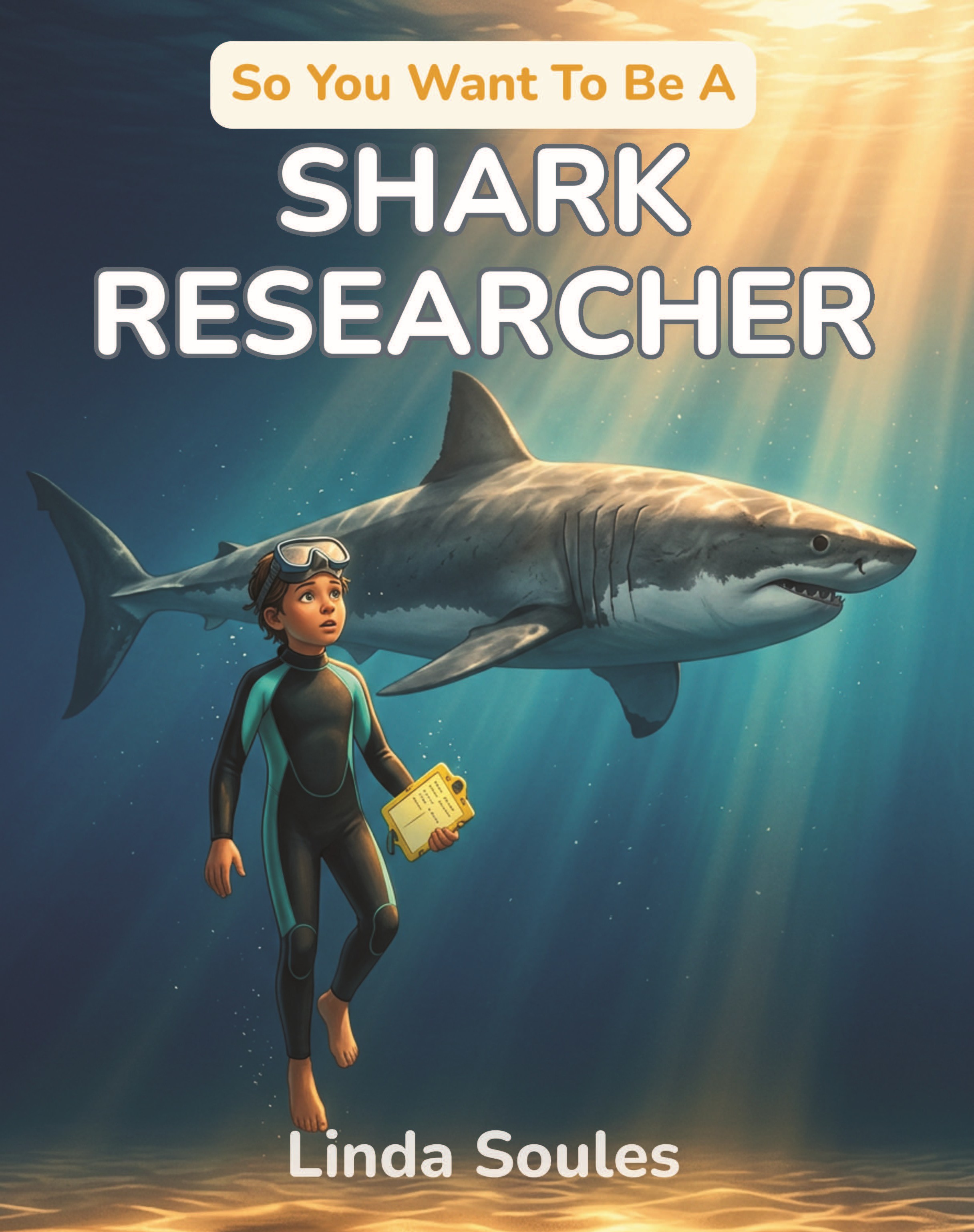
So You Want To Be A Shark Researcher
by Linda Soules
Key Takeaways
Summary
A shark researcher studies how sharks live, hunt, move, and change in number over time. The work matters because sharks are apex predators: they sit at the top of marine food chains, and the ecosystems around them are shaped by their presence. By catching sick or slow fish, sharks help keep fish populations healthy. They can prevent any one species from taking over, and they recycle nutrients through the ocean. When sharks disappear, the effects can spread through the food web. Since the ocean produces more than half the oxygen people breathe, damage to ocean ecosystems reaches far beyond the water.
There are more than 500 shark species, from whale sharks as long as a school bus that feed on plankton to lanternsharks smaller than a forearm that glow in the dark. Yet sharks are in serious trouble. Humans kill approximately 100 million each year, for their fins, for sport, and as accidental bycatch in fishing nets. In an average year, sharks kill fewer than ten people worldwide. The scale of the danger is therefore badly misunderstood: people pose a far greater threat to sharks than sharks pose to people.
Research offers a way to replace fear and myth with evidence. Scientists investigate where sharks go, how they behave, and how their populations are faring, then use what they learn to help make the case for protecting them. Some track sharks across ocean basins; others observe them directly, study footage from drones and underwater cameras, or analyze tissue and physiology in laboratories. A population cannot be protected well until it is understood, and careful research helps reveal what sharks need and what might happen if they are lost.
Much of the work takes place in the ocean, from warm tropical reefs to cold temperate open water. Researchers may work at the surface, underwater, or from a vessel that serves as their base. Long hours watching the sea and waiting for a fin to appear—or for an acoustic receiver to detect a tagged shark—are part of the job, even when no dramatic encounter occurs. When a shark does arrive, researchers must observe closely while taking care not to disturb its behavior.
Technology makes it possible to study animals that cannot be followed constantly. An acoustic tag sends out a unique coded pulse every few seconds. Underwater receivers moored around a region detect the signal, allowing researchers to build a picture of a shark’s movements over months or years. A pop-up satellite tag stores data, then releases after a set period and floats to the surface, where it sends that information to a satellite. Instead of needing someone to watch a shark continuously, researchers can attach a device that costs a few hundred dollars and let it collect information over time.
Other tools gather information without capturing a shark. A biopsy pole can take a tiny skin sample from an animal passing by, providing DNA data while the shark remains free. A BRUV—a baited remote underwater video system—records sharks that investigate bait. The camera works without a person in the water, and its footage can contribute to population data. Researchers also use photo identification: distinctive dorsal fins are recorded in a database, because each fin is as individual as a fingerprint. Comparing photographs can reveal that a shark seen today is one already observed years earlier, without catching or tagging it.
Stereophotogrammetry offers another way to measure sharks without touching them. Researchers mount two cameras at a known distance apart and photograph a shark from above. The geometry of the paired images allows them to calculate its body measurements. Together, these methods let scientists study movement, identity, genetics, and size while minimizing disturbance to the animals.
A day on the water begins before the first dive. At six in the morning, the vessel departs, and the transit becomes time for a team briefing. Researchers review the dive objectives, which species they expect to encounter, the data-collection protocol, and the behavior procedures for each likely species. Careful preparation helps make sure that, when the work begins, everyone understands what to do.
At eight, the first dive is underway. Visibility is good, and a shark appears at the edge of sight. The researcher holds still, because stillness reads differently to a shark than movement. The heart rate rises, as it does at this moment, but attention must stay on the animal and the work. Being in the water with a large predator demands composure: observations must be made and equipment operated even while the body registers the intensity of the encounter.
By ten thirty, the team is carrying out a tagging operation. The shark has been in the area long enough, and the practiced procedure moves quickly: a tag applicator pole, the precise placement point on the dorsal fin, and confirmation that the tag is in place. Within seconds, the shark is gone. The briefness of the moment is balanced by the possibility that the tag will reveal the animal’s movements long after the boat has left.
At one in the afternoon, the work shifts to the deck and the data must be entered. Each shark is logged with its unique fin-identification photograph, estimated size, depth, and a note about its behavior. Those details become part of a database that can follow individuals across years or even decades. At three, researchers review underwater video, compare fins with the identification library, mark new individuals, and discuss behaviors that may need interpretation.
The vessel returns to the dock at six, but the data from the day may not be available right away. A satellite tag is expected to release and begin transmitting in approximately ninety days. Until then, the team does not know where that shark went.
That uncertainty is part of a job whose rewards come from attention, discovery, and the chance to make evidence matter. Researchers describe a lasting affection for the more than five hundred shark species, not just the famous great white. A whale shark can grow as long as a school bus while feeding on plankton; a lanternshark is smaller than a forearm and glows in the dark; a goblin shark can thrust its jaw forward to catch prey. Discovering the lives of these lesser-known animals gives researchers fresh questions to pursue, and the privilege of meeting a shark in its own environment is never treated as ordinary.
The work can also produce a particular kind of satisfaction because its results are measurable. A shark can be tracked over years, and evidence about its movements or population can help defend a proposed marine protected area. A conversation can correct a misunderstanding, while accumulated data can sometimes change a law. That possibility does not make the work easy or guarantee quick results, but it gives researchers a direct connection between careful observation and practical consequences.
Working in the water with a large shark demands ongoing management of fear. Experience gives researchers more context, but it does not make them indifferent: they are still sharing the water with an animal larger, faster, and better adapted to it. Their nervous systems may be registering danger even as they must operate a camera, observe behavior, and record reliable information. Composure is not the absence of awareness; it is the ability to remain attentive and work carefully under pressure. Researchers also carry the weight of knowing that sharks have existed for hundreds of millions of years, while human activity has placed them in serious danger within a remarkably short time.
A different hardship waits on shore. Public misunderstanding can frustrate researchers throughout their careers: news and entertainment often encourage fear, and conservation arguments may meet resistance in communities where that fear is deeply established. It can be wearing to study animals of real importance while contending with a cultural story that works against the evidence. The surprise is that sharks themselves are older than the world most people imagine around them. They predate dinosaurs by more than two hundred million years and survived all five great mass extinctions. Their basic body plan has endured for roughly 450 million years, long before trees, land vertebrates, or flowers existed. Seeing a shark can therefore feel like encountering an ancient design that remains at home in the present.
No researcher does this work alone. Vessel crews make fieldwork possible at the surface, while dive teams share the water. Tagging specialists handle particular procedures; molecular ecologists interpret DNA for clues to ancestry and population health; data analysts work through long-term tracking records. Researchers also rely on people outside the scientific team. Fishers and maritime communities encounter sharks regularly and hold observations that formal studies may not capture. A commercial fisherman who has watched the same bay for forty years might describe population changes that months of surveys would miss. The strongest researchers seek that knowledge rather than treating local experience as irrelevant.
Those relationships matter because science must reach people whose choices affect sharks. A town meeting with residents who remember a nearby attack may influence policy more directly than a published paper, especially when a researcher listens and answers questions with care. Trust has to be earned in rooms where the facts may be persuasive but the feelings are not. Researchers must also communicate with a wider public whose impressions often come from movies and alarming news stories, rather than from the animals’ actual lives. The science that reveals how sharks move, breed, and use their environments can make protection possible; communication helps turn that knowledge into public understanding and support.
Good research begins with the discipline of observing without unnecessarily changing what is being observed. Non-invasive approaches are both ethically important and scientifically useful: disturbing an animal can alter the behavior a researcher hopes to understand. Practical ability matters just as much. Shark researchers work in water and on boats that pitch and roll, sometimes in challenging weather, so they need diving competence, awareness of sea conditions, and the ability to handle small craft safely. They also need precise species-level identification. Recognizing one shark from another in limited visibility, or distinguishing individuals by the details of a fin, determines whether the information gathered is meaningful.
Statistical literacy is another essential skill. Tracking records, population estimates, bycatch rates, and observations collected over many years all require careful analysis. A persuasive conservation argument often depends not on a dramatic story but on a number that has been measured and interpreted correctly. And even the best analysis depends on steady attention in the field: a researcher must be able to think clearly and keep collecting data while a large animal moves nearby.
Some needs become clear only with time. Much of the work follows a long horizon: a conservation effort may take years to show an effect, and a newly deployed tag may not provide useful information for months. Researchers must stay committed when results arrive slowly. They also need curiosity about all five hundred-plus species, including the obscure ones that attract little attention but still need scientific understanding. Finally, they need the unexpected skill of public communication. A classroom, a news interview, or a gathering in a fishing town can require the same clarity and composure as fieldwork, while asking the researcher to meet fear and skepticism directly.
That curiosity becomes especially important when research reveals how slowly many shark populations can replace themselves. A population may be reduced by fishing within a decade, yet take a century to recover. Sharks often grow slowly, mature late, and bear few young, so they cannot rebound quickly from losses. The spiny dogfish offers a striking example: its pregnancy can last up to two years, longer than that of any other known vertebrate. When a species reproduces at that pace, even a short period of heavy fishing can have consequences that last for generations. Recovery is not simply a matter of stopping the harm and waiting a season or two.
This slow life history makes the patient parts of research essential. A single survey cannot show whether a population is thriving or dwindling, and one tagged shark’s journey cannot describe every member of its species. Researchers need observations collected repeatedly, across years, and interpreted in the context of what is known about the animals’ growth, breeding, and movements. The delay can be difficult: a result may arrive long after the fieldwork that produced it, and a protected population may show no obvious improvement for years. Still, those records can reveal changes that a brief visit would miss and provide a firmer basis for decisions about how sharks are treated.
The questions researchers ask are often deceptively simple: What is the shark doing, and how can anyone find out without changing its behavior? What does this animal’s role tell us about the ocean it inhabits? Answering them requires attention to individual differences as well as species-wide patterns. Sharks are not interchangeable markers on a map. Some can be recognized by distinctive fins, and individuals followed over time may become known to researchers by name. A photograph taken once can give scientists a way to identify that animal again and ask new questions about its life in the years that follow.
The animals’ senses also open windows onto a world humans cannot experience directly. Ampullae of Lorenzini, tiny organs on a shark’s snout, detect the weak electrical fields generated by living things. That ability can help a shark locate prey hidden beneath sand, even when sight would offer no useful clue. The sensitivity is extraordinary: sharks can detect an electrical field of five billionths of a volt per centimeter. They also read water pressure through the lateral line, a row of sensors along the body. To understand how a shark finds food or navigates its surroundings, researchers must study not just where it goes, but the signals it may be responding to.
Some species appear to use the Earth’s magnetic field to navigate across thousands of miles of open ocean and return to precise locations. That possibility raises questions about how they sense direction and what happens when people alter the places on which their lives depend. Even apparently familiar behavior can lead to new discoveries. Several shark species display biofluorescence, absorbing one wavelength of light and emitting another. Green or blue patterns can appear underwater in ways invisible to human eyes. Biofluorescence in catsharks was discovered only in 2014, a reminder that researchers are still uncovering basic facts about animals that have been in the oceans for hundreds of millions of years.
What sharks eat can tell another part of the story. Stomach-content analysis helps scientists understand where an animal fits in a food web, but modern researchers may use a stomach pump or chemical tracers rather than dissecting a shark. The aim is to gather useful evidence while allowing the animal to swim away unharmed. The contents can also expose problems beyond the shark itself. Tiger sharks have been found with license plates, tires, boat cushions, and drums in their stomachs. In such cases, what is inside an animal can reveal pollution entering the ocean in ways that a beach survey alone might not show.
A shark researcher must also distinguish a meaningful pattern from an incomplete or misleading impression. Correct species identification matters: telling a sandbar shark from a dusky in limited visibility can determine whether a record contributes reliable information. So can statistical literacy. Tracking detections, population estimates, bycatch rates, and observations accumulated over decades must be turned into evidence that can support a claim. Sometimes the decisive contribution of research is not a dramatic image or an encounter at sea, but a number that clarifies how many animals remain, where they travel, or how a fishing practice affects them.
That evidence matters because the public story about sharks has often been built from fear rather than observation. A shark’s investigation of something unfamiliar may feel threatening to the person in the water, while the animal’s behavior can be consistent with curiosity or with sampling potential prey. Researchers have to explain that distinction without dismissing the fear people feel. The purpose is not to pretend that a large wild animal is harmless, but to replace the idea of malicious intent with a clearer understanding of its behavior. Accurate information can make conservation arguments more persuasive, especially where people’s impressions have been shaped by sensational accounts.
The stakes reach beyond one animal or one encounter. Sharks help keep food webs balanced, and their decline can alter the relationships among species throughout an ecosystem. The evidence researchers collect about breeding, movement, and population trends helps explain what may be lost when sharks disappear. But scientific findings do not automatically become public understanding or policy. They have to be communicated in forms people can use, whether that means explaining a research result in plain language or making clear why a long series of measurements matters. A question about one shark’s movements may ultimately connect to a much larger question: what kind of ocean remains when its oldest predators are no longer there in sufficient numbers?
The history of shark research is shaped by people willing to keep asking questions, often in places where few others were looking. Eugenie Clark, known as “The Shark Lady,” began her career in the late 1940s, when women and Japanese-American scientists faced barriers in marine science. She persisted, founded Mote Marine Laboratory, and dove with sharks for seventy years, making her final dive at age ninety-two. Her lasting influence came not only from what she learned, but from repeatedly showing people these animals as they truly were, rather than as frightening figures in a story.
Samuel Gruber, affectionately called “Doc Gruber,” built a different kind of legacy through patience. For nearly half a century he studied lemon sharks in Bimini, creating the longest continuous study of one shark population anywhere in the world. His work helped make lemon sharks far less mysterious, while the students he trained went on to shape shark science themselves. A long-running study can do more than gather information about animals: it can train generations of researchers to ask better questions and carry the work forward.
Melissa Cristina Márquez has focused on shark populations along the coasts of Central and South America, where long-term research programs are often scarce. She has documented sharks in places many researchers overlook and published in both English and Spanish so that scientific findings and conservation arguments can reach local communities. When a crocodile bit her while she was filming a documentary, journalists wanted to focus on the attack. Márquez used interviews to redirect attention to the larger problem: industrial overfishing was taking a far greater toll on the region’s sharks. Her work shows how a researcher can turn public attention from a dramatic personal incident toward the pressures affecting entire populations.
The animals themselves keep offering new questions. More than five hundred shark species inhabit the oceans, from whale sharks, which can grow as long as a school bus while feeding on plankton, to tiny lanternsharks that glow in the dark. Goblin sharks can thrust their jaws forward to capture prey, while catsharks include species that fluoresce in colors people cannot see without special equipment. Biofluorescence in catsharks was discovered only in 2014, a reminder that even basic features of familiar groups may still be unknown. Researchers who look beyond the best-known species may find that the most revealing discoveries come from animals that rarely attract headlines.
Some sharks become recognizable individuals to the scientists who study them. A distinctive fin can allow researchers to identify a shark in photographs and follow it over many years without capturing it. The great white called Deep Blue and the whale shark called Luiz are among the animals researchers have tracked by name. Each sighting can add to a record of where an individual goes and how it changes over time. Fossils offer another route into shark science: megalodon, the largest shark known to have lived, reached nearly sixty feet, and its enormous teeth still wash up on beaches. For some curious children, a fossil tooth found on shore may be the first clue that draws them toward research.
Sharks also possess abilities that make human instruments seem blunt by comparison. Their electroreception can detect extraordinarily weak electrical fields, helping them sense prey hidden beneath sand. Some species use Earth’s magnetic field to navigate thousands of miles across open ocean and return to precise locations. Their diversity includes strange and beautiful adaptations still being explored, and every new observation can sharpen the picture of how a species lives. The appeal of the work is not limited to dramatic encounters with famous sharks; it lies in discovering what an animal can do and understanding how that ability fits into its life.
Their biology also helps explain why shark populations can be so vulnerable. Spiny dogfish may carry their young for up to two years, the longest known pregnancy of any vertebrate. Sharks generally grow and reproduce slowly, so losses can accumulate quickly while recovery takes far longer. That pattern, known as a slow life history, is one reason a population may be depleted within a decade yet need many decades—or even a century—to recover. Understanding reproduction is not simply a matter of satisfying curiosity: it helps researchers assess how much pressure a population can withstand and what protection it may need.
A future researcher can begin well before setting foot on a research vessel. Choose one shark species and learn its habitat, diet, threats, and place in its ecosystem. Visit an aquarium and watch closely: notice how a shark moves, holds its body, and interacts with other fish. Careful observation near any water can build the habits of a field biologist. Record what you see, describe it precisely, and return to the same place so that repeated notes can reveal patterns that a single visit would miss. Learning to identify species is another useful step; differences in body shape, teeth, and fin position matter when an observation is being turned into scientific data.
Preparation can also mean acting on what is already known. Share accurate information when someone repeats a frightening misconception, reduce plastic use, or write to a representative, fishery, or hotel to ask what it is doing to protect sharks. Citizen-science projects offer another way to take part. OCEARCH makes tracking data available to the public, allowing people to follow tagged sharks and see where research animals travel. Reading about shark biology—including electroreception and the lateral line, which senses water pressure—can turn interest into more informed questions. A young person need not wait for a formal research job to begin paying attention or contributing.
For those who want to go further, organizations such as Mote Marine Laboratory and the Bimini Biological Field Station show how research communities grow from sustained work. Mote, founded by Clark in 1955, continues in Sarasota, Florida, and Bimini’s Sharklab has welcomed volunteers from around the world to help catch, measure, and release sharks. The path into this field begins with curiosity, but it asks for persistence, careful observation, and a willingness to keep learning about animals others may misunderstand. A child who watches a shark and wants to know more is already practicing the essential first act of research: looking closely. The questions are waiting, and the ocean still holds mysteries for the next generation to pursue.
Chapter Summaries
1. What Shark Researchers Study—and Why Sharks Matter
Shark researchers investigate how sharks live, hunt, move, and change in number. Because sharks are apex predators, they influence the balance of the marine ecosystems they inhabit. The book counters the popular image of sharks as movie monsters by explaining their ecological importance: they help keep prey populations healthy, prevent one species from dominating, and contribute to the movement of nutrients through ocean food webs. Since the ocean produces more than half the oxygen people breathe, damage to marine ecosystems can affect the whole planet. The book emphasizes the imbalance between human fear and actual harm. People kill about 100 million sharks annually through finning, sport fishing, and accidental bycatch, while sharks kill fewer than ten people worldwide in an average year. Researchers gather evidence to replace sensational stories with a clearer understanding of shark behavior and conservation needs. Their work matters because populations cannot be effectively protected until scientists understand where sharks go, how they reproduce, and what pressures they face.
2. Fieldwork, Research Tools, and a Day on the Water
Shark research takes place in varied settings, from tropical reefs to cold open water, and often starts aboard a research vessel. Waiting, watching the surface, and checking acoustic receivers are routine parts of the job alongside more dramatic dives. Researchers use acoustic tags that transmit signals to underwater receivers, satellite tags that send stored data after floating to the surface, and biopsy poles that collect small samples without capturing a shark. BRUVs—baited remote underwater video systems—record sharks without requiring a person to remain in the water. Other methods let researchers identify and measure sharks with minimal disturbance. Distinctive dorsal fins can be photographed and matched over time, much like fingerprints; paired cameras can measure a shark’s body through stereophotogrammetry. A typical day might include a team briefing, a dive, a quick tagging operation, detailed data entry, and video review to identify individuals and interpret behavior. Some results arrive much later: a satellite tag may not transmit until months after deployment, making patient recordkeeping essential.
3. The Rewards, Hardships, and Surprises of the Work
One of the job’s greatest rewards is encountering the astonishing diversity of more than 500 shark species. Researchers may study the enormous plankton-eating whale shark, a tiny glowing lanternshark, or a goblin shark whose jaw projects forward to catch prey. Fieldwork can bring researchers close to large wild animals and allow them to follow individual sharks across years or even ocean basins. The work can also produce visible conservation results: strong data may support a marine protected area, correct a damaging misconception, or contribute to a change in law. The same encounters require serious emotional and practical discipline. Researchers must manage real fear while observing, recording measurements, or operating equipment beside an animal that is larger, faster, and better adapted to the water. They also face frustration from sensational coverage and deeply rooted public beliefs that obstruct conservation. The book’s surprising perspective is that sharks are not merely ancient animals: their basic body plan has endured for approximately 450 million years. It also explains that shark behavior is often curious rather than malicious, and that a great white’s bite-and-release behavior may reflect sampling something unfamiliar.
4. Teams, Communities, and the Human Impact of Shark Science
A shark researcher’s work depends on many collaborators. Vessel crews and dive teams make field operations possible; tagging specialists deploy tracking devices; molecular ecologists study DNA; and data analysts process long-term records. Fishers and maritime communities are important partners too. Their decades of experience can reveal local changes that formal surveys may miss, and researchers who listen respectfully can build trust and improve the value of their findings. The book argues that communicating with the public is part of the science, not an optional extra. Most people form their views of sharks through movies and alarming news stories, while conservation measures depend in part on public understanding and support. Researchers may need to answer questions at town meetings, talk with fishing communities, or explain evidence to people who remember a frightening encounter. Their findings can make shark protection possible, but the knowledge must travel beyond journals and laboratories to influence attitudes and policy.
5. The Qualities and Unexpected Skills a Shark Researcher Needs
Strong shark researchers combine scientific care with practical competence. They need to observe without unnecessarily changing an animal’s behavior, identify species accurately even in limited visibility, and understand statistics well enough to interpret tagging records, population estimates, and bycatch rates. Diving ability, small-boat skills, and awareness of sea conditions are also essential: reliable research is only useful if the team can collect it safely. The less obvious requirements are patience, enduring curiosity, and public communication. Shark populations recover slowly, so a researcher may work for years before seeing meaningful changes. A lasting interest in less-famous species matters because conservation needs extend beyond the handful of sharks people already recognize. Researchers also need to explain findings clearly in classrooms, local media, and coastal communities. The book presents composure around large animals as a skill built over time rather than an absence of fear.
6. Shark Researchers, Remarkable Discoveries, and the Animals Themselves
The profiles of Eugenie Clark, Samuel Gruber, and Melissa Cristina Márquez show different ways to shape the field. Clark, known as “The Shark Lady,” pursued marine science despite barriers facing women and Japanese-American scientists, founded Mote Marine Laboratory, and continued diving into her nineties. Gruber studied lemon sharks in Bimini for nearly half a century and trained generations of researchers. Márquez has documented sharks in under-researched parts of Central and South America and published in English and Spanish so conservation knowledge can reach local communities. The book’s facts deepen readers’ sense of shark biology and vulnerability. Sharks can detect extremely weak electrical fields, and some use Earth’s magnetic field to navigate. Spiny dogfish pregnancies can last up to two years, reflecting the slow reproductive pace that makes shark populations difficult to restore after losses. Researchers can recognize individual sharks across long periods from photographs, while stomach-content studies can also offer clues about pollution. Together, these examples show how basic scientific curiosity can uncover unexpected behavior and provide evidence for conservation.
7. Preparing to Become a Shark Researcher
Readers are encouraged to start building the habits of a scientist now. They can learn one shark species in depth, visit an aquarium and observe how animals move, keep systematic notes during repeated visits to a beach or other natural area, and learn to identify several species. The book also recommends joining citizen-science efforts such as OCEARCH’s shark-tracking projects, reading about shark biology, reducing plastic use, and writing to representatives or organizations to advocate for protection. The career invitation is grounded in curiosity and responsibility rather than a promise of constant adventure. A future researcher should want to understand an animal that others misunderstand, gather evidence honestly, and speak up for its protection. The glossary introduces concepts such as acoustic telemetry, ampullae of Lorenzini, bycatch, finning, and slow life history, while the further-reading and organization lists offer routes to keep learning. The author’s closing message stresses that conservation work often takes years to bear fruit, but long-term research and communication can help protect sharks and the ecosystems that depend on them.
Notable Quotes
“I stopped breathing — not from fear. From reverence. I felt like I was in the presence of time itself.”
“We are not afraid of the right thing.”
“The shark is older than everything — and it has outlasted everything.”
“A population can't be protected until it's understood.”
“The researchers who last in this field stay curious about the unfamous — the species nobody makes a movie about, the ones the conservation argument still has to be made for.”
“Most of what a shark researcher plants, someone else harvests. That is not a reason to stop planting. It is the reason planting matters.”
