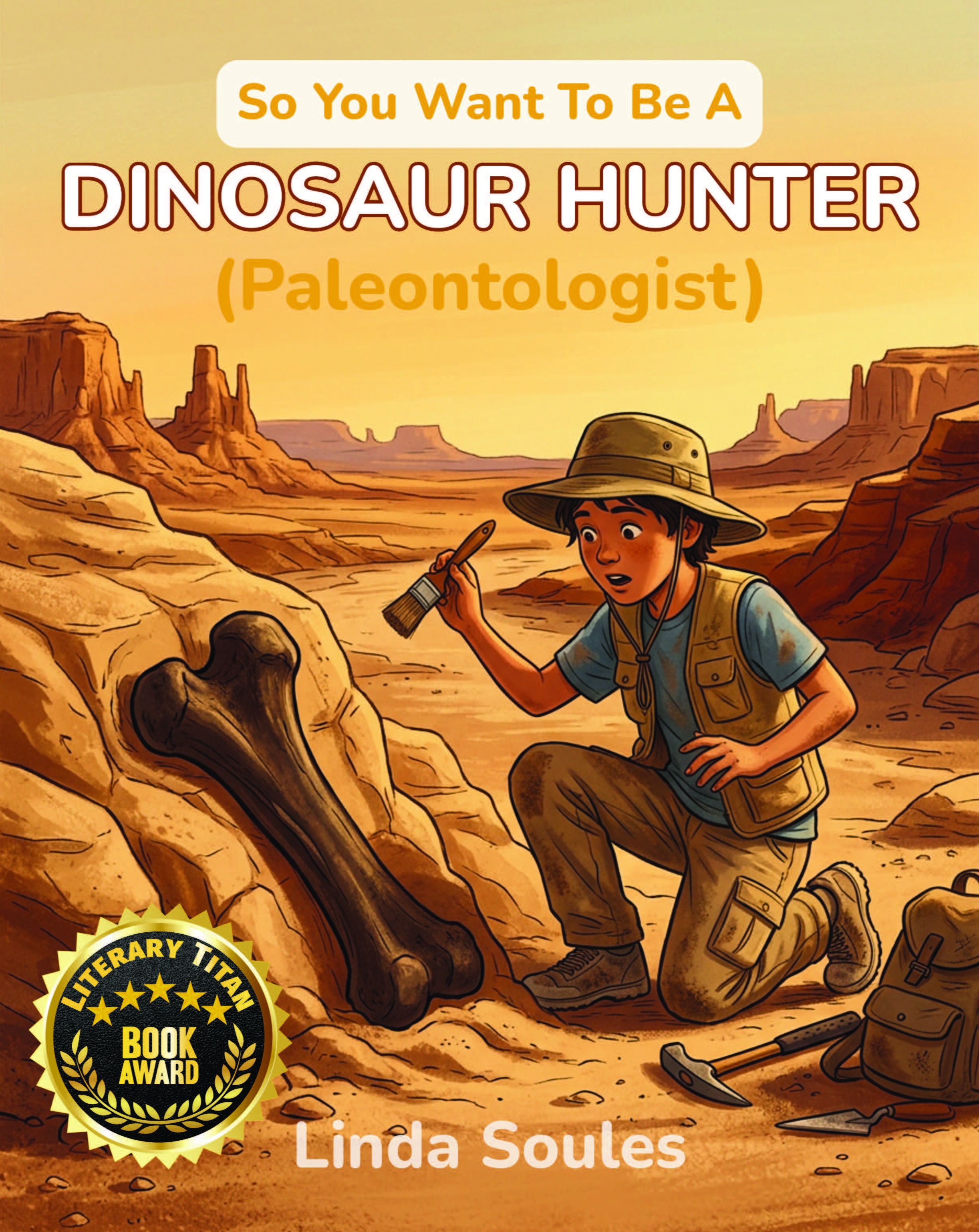
So You Want To Be A Dinosaur Hunter (Paleontologist)
by Linda Soules
Key Takeaways
Summary
The work of a paleontologist begins long before a fossil reaches a museum case. In the field, the first task is finding places where ancient rock formations are exposed at the surface, then reading the geology to identify layers likely to contain fossils. A promising landscape may be searched systematically, with attention fixed on the rock itself. The crucial clue can be subtle: a curve, texture, or patch of color that seems out of place. Paleontologists call the trained ability to notice that mismatch the “fossil eye.” Once developed, it can make an ordinary-looking stretch of rock full of possible clues.
Recognizing a fossil is only the start. Excavation proceeds slowly because the fossil is fragile, and the rock surrounding it—the matrix—can hold evidence that would be lost if the specimen were removed carelessly. Paleontologists use small tools to expose the fossil a little at a time, sometimes clearing rock grain by grain. Before a piece is taken out, they document exactly where it lies and how it is positioned. Its location and geological context are part of the scientific evidence, not merely details about where it was found. Once the fossil is removed, that relationship to the surrounding rock cannot simply be recreated.
The fieldwork is followed by a different kind of investigation in the laboratory. There, fossils are prepared, analyzed, measured, and compared with specimens already known to science. The questions are detective work: what does this fossil represent, what species might it belong to, how old is it, how is it related to other animals, and what kind of environment did it inhabit? A fossil may be a fragment rather than a complete skeleton, so careful comparison helps researchers understand what the piece can—and cannot—show. The interpretation depends on evidence gathered both in the ground and at the lab bench.
Modern tools can reveal features that the surface alone does not show. CT scanners, like those used in hospitals to look inside human bodies without cutting, can examine the interior of a fossil. They may reveal structures such as nasal passages and brain cavities, as well as growth patterns preserved in bone. These findings can help turn an apparently familiar specimen into a source of new information. When research establishes a new species, documents a behavior, or challenges an existing explanation of evolution, the importance lies not only in the object itself but in what it changes scientists can understand.
Paleontologists move between two very different working environments. One is the field site: an outdoor place where fossil-bearing rock is visible at the surface. Such sites may lie in eroded sedimentary hills and badlands in Montana, Argentina, or Mongolia. The work takes place in an exposed landscape, where dust and weather are unavoidable and the surface of the rock demands close attention. The other environment is the preparation laboratory, an indoor space built around careful, precise work. Here, fossil material is cleaned, stabilized, and studied, often at a bench under magnification.
A single specimen can take months to prepare fully. Its surrounding rock must be removed without damaging the fossil, so the preparation is as much a matter of restraint as action. Museums and universities connect the field and laboratory: they provide an institutional home where fossils can be studied, cared for, and stored. The collections behind public displays are often much larger than what visitors see. Drawer after drawer holds catalogued specimens that researchers around the world may consult, making a museum collection an ongoing resource for scientific study.
The tools used in the field range from heavy equipment for opening rock to fine instruments for working close to bone. A rock hammer is short and heavy, with a flat face at one end and a pick at the other; it can break open rock and expose fossil material. Chisels of different sizes remove matrix in controlled amounts. As the work approaches delicate bone, paleontologists turn to finer tools such as brushes, dental picks, and awls, which allow them to clear away rock without applying the force used to open a larger piece. A hand lens helps examine details on site.
When a significant fossil is ready to be moved, it may be protected in a field jacket. Strips of burlap soaked in plaster are applied over the fossil and the surrounding rock, forming a protective casing for transportation. The jacket helps preserve the specimen as it is carried away from the site. Some fossils are so large that helicopters are needed to lift them out. The plaster-and-burlap method has been used for more than a hundred years because it works: rather than exposing a fragile fossil to the risks of transport, it surrounds the specimen with protection.
In the preparation laboratory, pneumatic scribes—small vibrating tools powered by compressed air—remove the last matrix from bone. The work is performed under magnification, with a steady hand and sustained concentration. A slip can take only a second, yet destroy evidence that has survived for millions of years. Once a specimen is clean, researchers can make a mold by pressing liquid silicone or latex against its surface. The mold captures fine details of texture and structure. Casts made from it allow several institutions to study the same find at once, while the irreplaceable original can be kept safe.
Navigation and recording tools matter just as much as hammers and picks. Geological maps, compasses, and GPS devices help paleontologists move across remote terrain and document the precise position of each find. That position is recorded in three dimensions before excavation continues. The fossil’s exact place in the ground is scientific data, and careful notes, measurements, and photographs preserve the context that later analysis will need. The tools, from a field map to a laboratory scribe, serve the same purpose: to reveal what the fossil can tell without losing the evidence in the process.
Even with careful work, the moment of discovery can be startling. A patch of ordinary-looking rock turns out to be bone, and the paleontologist realizes that no human being has seen it before. The find may have waited in darkness for millions of years; recognizing it can make deep time feel suddenly close. Later, preparing and assembling a specimen brings a different reward: bit by bit, an animal emerges from stone. And when children stand wide-eyed before a skeleton that a paleontologist helped prepare, the work’s wonder becomes something shared.
The excitement sits alongside long, uncomfortable days and slow progress. Fossil-bearing rock often lies in remote, arid country, where the sun is fierce and shade is scarce. Field crews may spend hours on their knees, advancing only centimeters at a time, and work on a major find can last weeks or months. The dramatic landscape is real; the labor is often painstaking and unglamorous. Funding adds another kind of difficulty. Expeditions, crews, laboratories, and specimen transport all cost money, so paleontologists write grant proposals explaining what they plan to study and why it matters. Competition is intense, and important research may go unfunded. Some scientists spend years trying to finance an expedition that never happens. Persistence means continuing to care and try through delays and setbacks, not simply waiting patiently for a discovery.
A surprising feature of the work is that an initial discovery does not require a university degree. Sue Hendrickson, a self-taught fossil hunter, found Sue, the most complete Tyrannosaurus rex ever discovered, on a South Dakota hillside. In 2014, four-year-old Wylie Brys found bones of a previously unknown dinosaur species at a construction site near his Texas home. Ranchers in Montana have also noticed fossils emerging from eroding hills. Professional expertise is crucial for excavating and interpreting a specimen responsibly, but noticing something unusual can begin with attention and access to the right place. Nor is the age of discovery over: scientists name a new dinosaur species about every two weeks, and the museum specimens represent only a small portion of the dinosaurs that once lived. There is a further surprise in the present: birds are dinosaurs, belonging to the theropod lineage that includes Tyrannosaurus and Velociraptor. Non-avian dinosaurs disappeared sixty-six million years ago, but their avian relatives survived and diversified into roughly ten thousand species.
A field day begins early because the light is good and the exposed bone is waiting. At 5:30 in the morning, breakfast is quick. By 7:00, excavation is underway, moving from broader work to increasingly fine attention near the fossil. As the morning advances, the find is photographed, measured, and mapped in three dimensions before anything is removed; its context would be lost if it were not recorded. After lunch, the paleontologist writes up the morning’s observations, updates the site map, and considers what a small fragment might reveal. Later comes preparation of material excavated earlier, a slow task that demands care because it cannot simply be undone. After dinner, the crew reviews and annotates the day’s photographs. Notes made in the field may become the foundation of a scientific paper years later.
That day depends on a team. Field crews coordinate to protect and remove large specimens, while fossil preparators clean and ready them for study. Museum curators care for collections; geologists help explain the rocks; and graduate students contribute energy and new ideas. Peer reviewers and international collaborators bring the wider scientific community’s knowledge to bear. Paleoartists use scientific findings to reconstruct animals in paintings and sculptures, helping make the past visible to people who may never handle a fossil themselves.
The work also serves people beyond the research community. Paleontologists reconstruct ancient ecosystems from remains and traces such as bones, teeth, and footprints, helping explain how life evolved and how species responded to mass extinctions. That history gives context for changes affecting life on Earth today. Dinosaurs can also be a child’s first doorway into science: a fascination with one creature can grow into a desire to ask questions, examine evidence, and learn. Sharing discoveries clearly helps keep that doorway open for the next generation.
The work calls for a distinctive mix of qualities. Patient visual attention helps a paleontologist notice a color, texture, or shape that does not belong with the surrounding rock. Excitement must be balanced by rigorous skepticism: the more thrilling a find seems, the more carefully it needs to be examined. Curiosity across geology, chemistry, physics, biology, and computing can reveal more from the fossils already known. So can comfort with uncertainty. Interpretations are not permanent; new evidence can transform what scientists think they understand. Paleontologists must be willing to revise their ideas rather than protect them.
Some essential abilities may be less obvious. Geology is a first language for anyone who wants to know where fossils are likely to occur: layers of rock record the conditions of the world when they formed. Communication matters too, because a discovery’s significance is not limited to specialists; explaining what it shows in a way that carries wonder to a child is part of sharing the science. And preparation requires a kind of artistic patience: hundreds of hours may go into revealing a specimen, with focused, delicate work needed to avoid damaging evidence preserved for millions of years. These skills meet in the same person who can study a fossil closely, question what it means, and help others understand why it matters.
The invitation to keep exploring leads to books, online collections, and real places where young fossil enthusiasts can see how paleontology works. National Geographic Kids Ultimate Dinopedia, by “Dino” Don Lessem, offers information on more than six hundred dinosaurs, including reports from paleontologists in the field. Cheryl Blackford’s Fossil Hunter tells the story of Mary Anning and her discoveries, pairing the account with photographs, maps, and pages from Anning’s journals. Abby Howard’s graphic novel Dinosaur Empire! travels through the Mesozoic with a retired paleontologist as guide, while the Smithsonian’s visual encyclopedia presents more than a hundred species and photographs of fossils. Kathleen V. Kudlinski’s Boy, Were We Wrong About Dinosaurs! focuses on how scientific understanding changes when new evidence emerges—a reminder that revision is not a failure of science but part of how it works.
Several museum websites make it possible to follow discoveries and investigate particular animals from home. The American Museum of Natural History offers articles about fossils and dinosaur eggs, as well as a paleontologist answering questions from children. London’s Natural History Museum has a directory where more than three hundred dinosaurs can be searched by name, time period, habitat, or diet, with illustrations, sizes, and help pronouncing their names. National Geographic Kids provides profiles and videos, and updates its coverage as new species are discovered.
There are also ways to participate beyond reading. The National Park Service offers a free Junior Paleontologist program, with an activity booklet that can be completed and mailed in for a badge. Some museums invite visitors to dig at active quarries. At the Wyoming Dinosaur Center, newly uncovered material remains with the museum, while the finder’s name is recorded in the bone registry. A young investigator can also look into the fossils of their own state, since every state has a fossil record and most have an official state fossil. The Paleontological Society’s Code of Fossil Collecting is worth consulting before picking up specimens, while the Society of Vertebrate Paleontology offers junior membership to students aged fourteen to seventeen. Museums such as the American Museum of Natural History provide camps and courses, and the Paleontological Society supports field trips and classroom programs.
The book’s larger invitation to children is echoed in the way its career series was conceived. Linda Soules began with a practical question: what would she want to put into a curious child’s hands? Her answer was not a conventional career guide, but something closer to a conversation—a welcoming introduction to work that might capture a young person’s imagination. The aim is to take children seriously by showing not only the appealing parts of a profession, but also its quiet routines, difficulties, and unexpected demands. Children, Soules argues, recognize when writing speaks down to them; the books are meant to meet them as thoughtful people capable of engaging with the real texture of a working life.
The series is intended for ages ten to fourteen, but its books are designed to remain useful across a wider span. Younger children, around eight or nine, may first respond to the illustrations and particular passages, with a parent or teacher helping turn those interests into conversation. Readers aged ten to twelve are often ready to explore the details independently and imagine themselves in the work. For teenagers, the books can serve as a resource for more serious career exploration, while adults may discover unexpected facts and subjects to discuss with children. The intention is for the books to be things children can grow into, rather than out of.
Soules describes the research behind the series as drawing on firsthand accounts, current reporting, historical sources, and fact-checking. She also explains that the illustrations are AI-assisted, and is explicit about the care involved: images are directed, refined, and often substantially edited rather than simply generated and placed on the page. Because the ethical questions around AI-assisted art continue to evolve, she says she selects tools with attention to training data and creator compensation. The goal is to make the visual world of each book vivid while being transparent about how it was made.
At the heart of the series is the hope that a child will encounter a job that feels genuinely compelling and quietly think, “maybe me.” A page shared between a child and an adult might lead to a conversation neither expected, and a book might accompany a young person through years of wondering, learning, and imagining what they could become. The catalogue ranges widely: alongside careers such as dinosaur hunter, geologist, astronomer, and marine biologist are jobs in art, medicine, engineering, sport, public service, and entertainment. Readers can explore what a documentary filmmaker does, how a puzzle maker works, or what it means to be a cave explorer, drone pilot, or search-and-rescue worker. The growing series treats curiosity itself as a starting point, offering many different doors into the world of work.
The history of paleontology includes people whose discoveries changed science, even when they did not receive recognition at the time. Mary Anning was a working-class girl in early nineteenth-century England who searched dangerous coastal cliffs for fossils to help support her family. She discovered the first complete ichthyosaur, the first plesiosaur, and a pterosaur—finds that became some of the most important in the history of the field. Yet scientists who bought her discoveries published them under their own names. Because she was a woman, she was excluded from the Geological Society and denied lasting credit during her lifetime. She kept hunting anyway. Later generations began to restore her place in the story of paleontology: at its beginning.
Roy Chapman Andrews brought a different kind of adventure to the field. In the 1920s, he led expeditions into Mongolia’s Gobi Desert and returned with the first dinosaur eggs ever discovered. His flair for dramatic exploration helped introduce the desert and its ancient secrets to people around the world. Some have called him the real-life inspiration for Indiana Jones. Jack Horner, meanwhile, grew up in Montana with severe dyslexia, which made school painful, but became one of the twentieth century’s most important paleontologists. He found the first evidence of dinosaur herding and parental care, and later advised the filmmakers behind all the Jurassic Park movies. His story shows that struggling in one area does not prevent someone from doing extraordinary work in another.
The discoveries themselves can overturn familiar ideas. Fossils of dinosaurs have been found on every continent, even Antarctica, whose climate once supported large land animals. A Tyrannosaurus rex could bite with an estimated force of 12,800 pounds per square inch, compared with about 150 for a human. In 1861, the Berlin Archaeopteryx fossil preserved feathers so clearly that scientists could see individual barbs. Although the word “dinosaur” was coined by Richard Owen in 1842, people had previously explained enormous fossil bones as belonging to giants, dragons, or animals from Noah’s flood. Rare “mummy” fossils have preserved skin, allowing researchers to study hadrosaur scales and texture under microscopes. These glimpses remain exceptional: the conditions required for fossilization are so particular that most creatures that ever lived will never be found as fossils.
A young person interested in the field can begin with the ground nearby. Learn to distinguish sedimentary, igneous, and metamorphic rocks; fossils form in sedimentary rock, so recognizing it is a useful first step. Collect interesting rocks or fossils, label each specimen, and examine it with a magnifying glass. A small backyard excavation can provide practice in method: mark out a square with string, dig carefully, and record every find, even if nothing prehistoric appears. A nature journal is another way to build habits of observation, sketching and describing what you notice. Learning Latin and Greek roots can make scientific names and classifications easier to understand, while visits to natural history museums offer the chance to study individual specimens closely and, at some museums, watch technicians working in preparation labs.
There are also ways to explore beyond home. Books such as National Geographic Kids Ultimate Dinopedia introduce hundreds of dinosaurs and report on current discoveries. Fossil Hunter tells Mary Anning’s story, while Boy, Were We Wrong About Dinosaurs! shows how evidence changes scientific understanding. The American Museum of Natural History’s dinosaur pages, London’s Natural History Museum Dino Directory, and National Geographic Kids’ prehistoric-life resources offer articles, searchable profiles, illustrations, and videos. The National Park Service provides a free Junior Paleontologist activity booklet and badge program. Some museums take visitors to active quarries; at the Wyoming Dinosaur Center, a new find remains with the museum, with the visitor’s name entered in the bone registry. Looking up local formations and a state fossil can reveal that ancient life has a history close to home. The Society of Vertebrate Paleontology offers junior membership to people aged fourteen to seventeen, and the Paleontological Society shares field trips, classroom programs, and guidance on responsible fossil collecting.
The questions that guide paleontologists are invitations to look beyond the object itself: What story is locked inside this rock, and how can it be read without destroying it? What did the creature’s life and world actually look like? What new questions does the fossil open? A possible future paleontologist may be someone who loves pursuing a subject in depth, can stay with a small task for an hour, enjoys being outdoors in heat, wind, mud, or bugs, and likes delicate work with their hands. A detective’s instinct helps turn a bone into a clue about what happened, when, and why. So does wonder—the feeling that a rock carries the weight of time.
A few specialist words help name what the work reveals. A coprolite is fossilized dung, valuable because it can show what an animal ate. Matrix means the surrounding rock that must be removed without damaging the fossil. Strata are layers of rock, each preserving a record of conditions at a particular time. Radiometric dating uses radioactive elements in rock to determine age, while taxonomy is the system for classifying and naming organisms. A specimen may be a single fossil or sample, but it can become the starting point for a much larger account of ancient life.
The author describes paleontologists as people who hold objects older than anything else on Earth and ask who lived, how, and what their remains can tell us. Such work is a form of respect for the long chain of life that eventually produced humanity. If the deep past inspires wonder, a career devoted to questions that may take decades to answer is one possible path. Fossils still wait in rock on every continent, including pages of Earth’s story no one has yet read. To seek them is to become a witness to life’s full sweep, and to understand more clearly both the fragility of that history and one’s own brief place within it.
Chapter Summaries
What a Dinosaur Hunter Does
The book introduces paleontology as the study of ancient life across billions of years, with dinosaurs only one part of a much larger subject. Paleontologists use fossils—from bones and teeth to pollen, plants, insects in amber, and footprints—to reconstruct not just individual creatures but the environments and ecosystems in which they lived. The book presents fossils as clues in an immense record of life and emphasizes the perspective gained by considering humanity’s small place in that history. The work begins in the field, where scientists read exposed rock formations and search for material that looks different from the surrounding stone. Developing a “fossil eye” means learning to recognize subtle changes in color, texture, or shape. Once a find is located, the scientist documents its position and excavates it carefully; later, laboratory preparation, measurement, comparison, and tools such as CT scanners help reveal what the fossil represents. Each stage turns a physical remnant into evidence about species, age, anatomy, and evolutionary relationships.
Field Sites, Laboratories, and Tools
Paleontologists move between two contrasting settings. Field sites are often remote landscapes where fossil-bearing sedimentary rock is exposed, including dusty badlands and eroded hills. Preparation laboratories are controlled spaces where specialists clean and stabilize specimens, sometimes working under magnification for months on a single fossil. Museums and universities connect these environments: they house collections, support research, and make specimens available to scholars beyond what visitors see in exhibition halls. The tools reflect the need to balance force with precision. Hammers and chisels expose or remove rock, while brushes, awls, dental picks, and hand lenses support finer work. A significant specimen may be protected in a plaster-and-burlap field jacket for transport; in the lab, pneumatic scribes remove matrix a little at a time, and molds and casts let researchers study details without risking the original. Maps, compasses, and GPS devices also matter because a fossil’s exact three-dimensional position is scientific evidence that cannot be recovered once the specimen is removed.
Discovery, Difficulty, and Surprises
The most exhilarating moment may be recognizing that an ordinary-looking rock contains bone. For the discoverer, the find is a first encounter with something that has remained hidden for millions of years—a connection the book describes as a “handshake across deep time.” The work also offers the satisfaction of gradually preparing and assembling a skeleton and of sharing that discovery with museum visitors, especially children seeing a fossil display with wonder. The rewards come with hard realities. Excavations can mean long days kneeling in hot, dry, remote terrain, with progress measured in centimeters and major finds requiring weeks or months of work. Expeditions and laboratories also depend on funding, so scientists spend time writing competitive grant proposals and may face delays or abandoned plans. Yet discoveries are not reserved for professionals: the book recounts Sue Hendrickson’s discovery of the famous T. rex specimen and four-year-old Wylie Brys’s discovery of bones from a new species. It also notes that new dinosaurs are still being named regularly—and that birds are living theropod dinosaurs, so the dinosaur lineage continues today.
A Day at Work, a Team, and a Public Purpose
The sample workday shows how much of paleontology is methodical documentation. A field morning may start at dawn, move from broad excavation tools to fine brushes and dental picks, and include applying consolidant to keep exposed bone from crumbling. Before a fossil is removed, the team photographs it, measures it, and records its precise position. Later, researchers update site maps, examine fragments, prepare previously excavated material, and annotate photographs and field notes that may eventually support a scientific paper. The work is shared among field crews, fossil preparators, museum curators, geologists, graduate students, peer reviewers, international collaborators, and paleoartists. Together they excavate, preserve, interpret, and communicate discoveries. The book explains that this research helps people understand evolution, ecosystems, and how life has responded to mass extinctions—knowledge that gives context for changes affecting life today. Communicating the science matters too: dinosaurs can be a child’s first doorway into sustained curiosity, and paleontologists help keep that doorway open.
The Qualities and Skills the Work Requires
The book identifies patient visual attention as a foundation of the profession: paleontologists must notice small clues that others might dismiss. They also need rigorous skepticism, especially when a discovery is exciting, because reliable conclusions require careful examination rather than enthusiasm alone. Curiosity across disciplines is essential, as researchers draw on geology, biology, chemistry, physics, and computing to ask new questions of fossils. Other crucial strengths include storytelling and comfort with uncertainty. Scientists need to explain discoveries clearly to people beyond the research community, while recognizing that interpretations can change when new evidence appears. Some less obvious requirements are a strong grasp of geology—the rock layers help reveal where to search—public communication skills, and the focused, almost artistic patience needed for delicate preparation. The book presents patience as active work: careful attention, persistence, and a willingness to continue through slow progress and setbacks.
People and Discoveries in Paleontology
Short biographies show how paleontology has been shaped by people with different paths into the field. Mary Anning, a working-class fossil hunter in nineteenth-century England, made major discoveries including a complete ichthyosaur, a plesiosaur, and a pterosaur. Although others published some of her findings and institutions excluded her, the book recognizes her central contribution. Roy Chapman Andrews brought international attention to expeditions in Mongolia’s Gobi Desert and the discovery of dinosaur eggs. Jack Horner’s story offers a different lesson: despite severe dyslexia that made school difficult, he became an influential paleontologist, found evidence of dinosaur herding and parental care, and advised the Jurassic Park films. Alongside these lives, the book offers facts that expand the reader’s picture of prehistoric life: dinosaur fossils have been found on every continent, including Antarctica; fossilization preserves only a small fraction of past life; Archaeopteryx feathers are visible in exceptional detail; and rare skin impressions can preserve information about dinosaur appearance. The glossary defines key terms such as matrix, strata, radiometric dating, taxonomy, and coprolite, giving readers language for understanding the science.
Getting Started and Imagining the Future
The book gives aspiring paleontologists practical ways to begin. Readers can learn to distinguish sedimentary, igneous, and metamorphic rocks; start and label a rock or fossil collection; use a magnifying glass; create a small excavation grid; visit a natural history museum; and keep a journal with sketches and precise observations. It also encourages learning Greek and Latin roots, reading about fossil hunters, exploring museum and scientific websites, and checking what fossils have been found in one’s own region. A series of questions helps readers assess whether the career suits them: Do they enjoy concentrating on details, working patiently, being outdoors in uncomfortable conditions, handling delicate tasks, and treating bones as clues to a larger story? The author’s closing note frames paleontology as a long conversation with deep time and encourages readers to keep asking questions. The book’s larger message is that curiosity can begin with a child picking up a rock, and that the fossil record remains open to new discoveries.
Notable Quotes
A paleontologist is a time traveler. Not with a machine.
Every bone is a sentence. Every skeleton is a chapter. Every dig site is a library buried under millions of years of rock.
The thought that follows — that you are the first human being to see this, that this bone has been in the dark for millions of years and you found it — is one of the most vivid experiences that scientific fieldwork offers.
Being patient in this job doesn't mean just sitting around. It means keep going, keep trying, keep caring, even when it's hard.
The age of dinosaurs never ended. You’re living in it.
The fossil record is the Earth's autobiography. Go read it.
Every paleontologist was once a kid who picked up a rock and wondered what was inside it.
