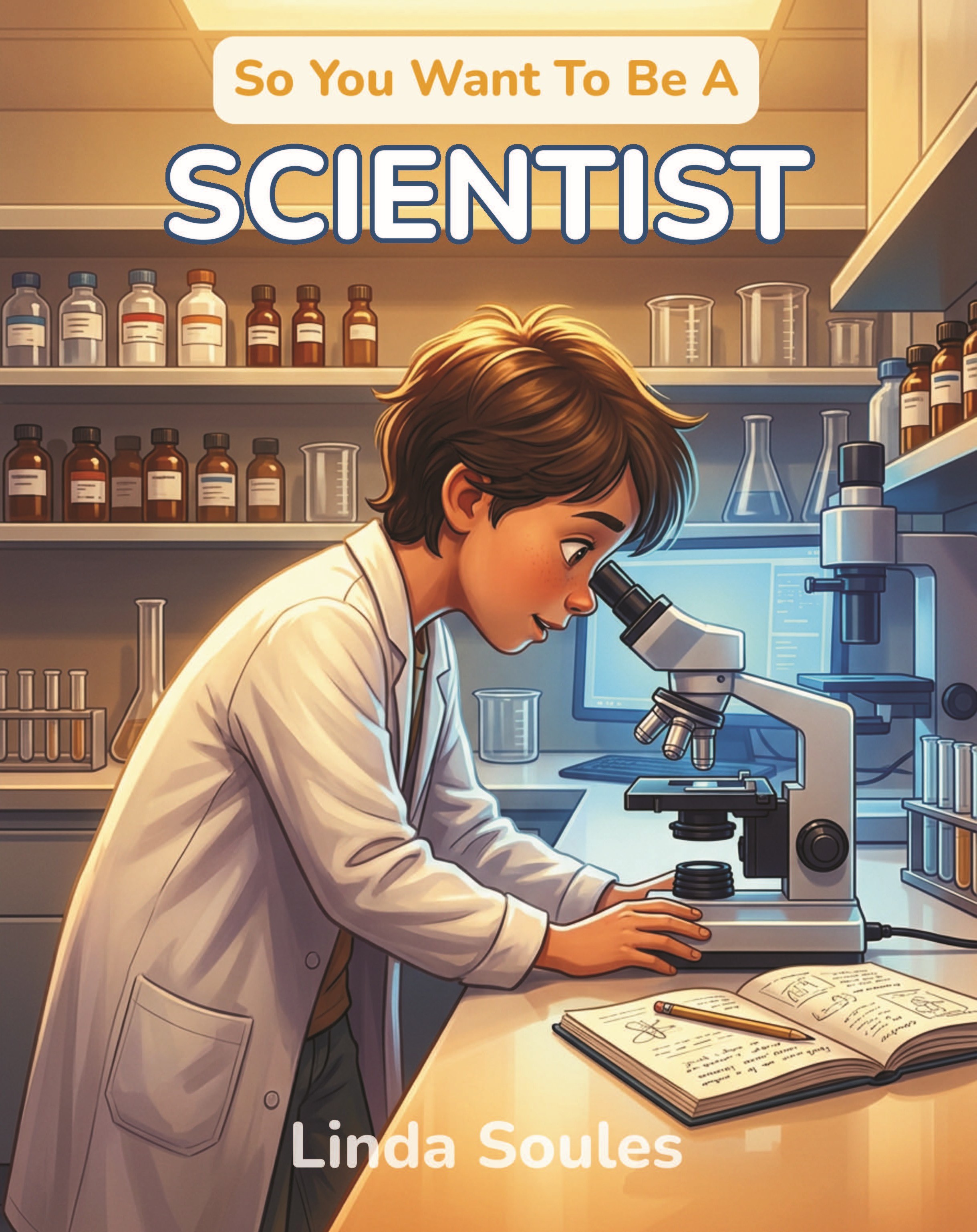
So You Want To Be A Scientist
by Linda Soules
Key Takeaways
Summary
A scientist’s work can begin with something as ordinary as a line of ants. Follow it to see where it leads, mix two things just to watch what happens, or keep asking “why?” after an adult has run out of answers: these are all beginnings of scientific inquiry. Scientists notice something odd and resist looking away. The question might come from mold appearing where it should not, chocolate melting in a pocket, or a tree that seems isolated. The essential ingredients are curiosity, patience, and a record of what you observe—not a lab coat or a degree.
Questions can open onto almost anything. Why do birds fly in V formations? What makes ice slippery? Why do we dream? How can a seed find its way up when it is planted in darkness? In a seed, tiny grains of starch are heavier than the surrounding cells, so they settle under gravity. The root grows toward where the starch settles, while the stem grows away. Even when planted upside down, a seed sends its root down and its shoot up. Scientists investigate biology, chemistry, physics, geology, ecology, and the brain, but what unites them is a habit: following evidence, including when it leads somewhere unexpected. Each scientist contributes a piece to questions too large for one person to answer alone.
The daily work is usually less dramatic than a sudden flash of discovery. Scientists read what others have found, design experiments, run them—often more than once—then analyze the data, check for errors, consult colleagues, and write results for others to assess. A single result may be misleading, so repeated tests help show whether a pattern is dependable. Before starting, a scientist identifies the precise question and forms a hypothesis: a specific, testable prediction about how something works. The hypothesis guides the experiment, while careful measurement and accurate records make it possible to judge what the evidence actually says.
Sometimes an unexpected observation redirects the work. Alexander Fleming left a petri dish out overnight and found that mold had grown while bacteria around it died. Rather than dismissing the spoiled dish, he asked why; the answer led to penicillin, a medicine that has saved hundreds of millions of lives. Percy Spencer noticed that a chocolate bar melted in his pocket when he stood near a radar machine. His question about what had happened helped lead to the microwave oven. In 1965, chemist Stephanie Kwolek was trying to make a strong new plastic when a batch came out thin and cloudy instead of thick and clear. Though others urged her to discard it, she tested it. Spun into fiber, the material proved five times stronger than steel. It became Kevlar, used in bulletproof vests. What looked like a failed batch became a discovery because she investigated instead of throwing it away.
Forest scientist Suzanne Simard likewise followed a result that changed how trees appeared to be connected. In 1997, she injected harmless dye into a fir tree in a British Columbia forest. Days later, the dye appeared in another tree thirty feet away, and then in others. Microscopic fungal threads linking their roots formed an underground network through which trees shared food, water, and warning signals about insect attacks. The discovery, sometimes called the “Wood Wide Web,” depended on looking beneath the surface at relationships that had gone unnoticed for centuries.
Scientists work wherever their questions take them. A bench scientist may work in a research laboratory, with sturdy tables designed to withstand chemical spills, shelves of chemicals, and ventilated hoods that draw dangerous fumes away from the air people breathe. The bench is arranged around the experiment underway, with tools placed for the particular procedure. Field scientists work in the environments they need to study—remote forests, rocky outcrops, or mountain summits. The settings differ, but both kinds of work depend on organizing observations around evidence: measuring carefully and recording what happens.
A scientist’s most basic tool is the hypothesis, because it defines what is being tested before the equipment is used. Instruments extend the senses: microscopes reveal what the naked eye cannot see, pipettes measure tiny volumes precisely, and centrifuges spin samples to separate their components. Lab notebooks, data sheets, and computer databases preserve observations and measurements. Statistical software helps determine whether a result reflects a genuine pattern or random variation. Peer review is another essential tool, though it is not a piece of hardware: other scientists critically examine work before publication, helping catch problems and keep scientific claims accountable.
A working day illustrates how those tools and habits fit together. At eight in the morning, the scientist updates the lab notebook, noting what happened the day before, what it might mean, and what the day’s test will address. This permanent record helps make the work reproducible. At nine, the experiment is set up: variables are controlled and equipment calibrated. The prediction and the reasoning behind it are written down in advance, so an apparently confirming result does not simply get mistaken for proof.
By 11:30, a lab meeting brings the research group together. One researcher reports a result that does not fit her hypothesis, and the team spends forty minutes discussing it. The mismatch may be the week’s most interesting clue. At one, the scientist reviews newly published research; science is an ongoing conversation, and researchers need to know what others have already said. At three, data analysis reveals a number that looks unlike the rest. Rather than immediately treating it as a discovery, the scientist marks it and plans to repeat the experiment the next day. One unusual number is a reason to look again. At five, writing begins. Trying to explain the finding clearly may expose what remains unclear, and that uncertainty becomes part of the work to be done.
One of research’s greatest rewards is the instant when the evidence reveals something no one knew before. A pattern emerges, a result holds up, and for a brief moment the scientist is the only person who knows this new fact about the universe. The feeling is not simply pride in being right. It is the pleasure of discovering how the world works, and of realizing that the finding may become one small piece of knowledge others can use.
The path to that moment is often long and discouraging. Most experiments do not produce the answer a scientist hopes for, and sometimes years of work lead only to the conclusion that one possibility is not the right one. That is still useful: a failed test can close a door and sharpen the next question. Thomas Edison tried more than six thousand materials before finding a suitable lightbulb filament. He tested bamboo, human hair, beard hairs from his assistants, and many kinds of metal. The filament that finally worked lasted 1,200 hours. Edison said he had not failed; he had learned that six thousand materials did not work. Research asks scientists to find meaning in results that can feel like no result at all.
Even a finding that looks convincing once may not appear again. When researchers tried to repeat published experiments, about six out of ten psychology studies did not fully work, and fewer than half of the cancer research studies did. That does not make science pointless; it shows why one study is a clue rather than final proof. Confidence grows when other people test the same question and the evidence accumulates. The process can be frustrating in other ways, too. Reviewers may identify serious problems in a paper, requiring months of additional work, and a revised paper can return with fresh concerns. Rejection after a long wait is familiar to scientists, and repetition does not make it pleasant. Research is messier than the polished account in a published paper suggests: the real route twists through mistakes, false starts, and redirections.
That uneven progress is shared work. A research group may include a principal investigator, postdoctoral researchers, graduate students, lab technicians, and undergraduate assistants, with scientists at other universities contributing expertise the group lacks. Reviewers examine work before publication; funders provide the resources that make research possible; and science writers help explain discoveries beyond the lab. Researchers also depend on those who came before them, because each new study stands on knowledge left by earlier generations. The scale of this cooperation can be striking: the paper announcing the discovery of the Higgs boson had 5,154 authors, whose names took three pages to list. Scientific progress can resemble a relay race in slow motion, with each person carrying a question a little farther before passing it on.
The benefits reach far beyond researchers. Science has helped produce medicines and vaccines, engineering that makes structures safer, technology that connects people, and the knowledge behind clean water. Weather forecasts, built from patterns in data gathered over many years, can warn families about hurricanes. Science also changes how people understand their place in the world: the atoms in our bodies were made inside stars that exploded billions of years ago, and all humans share 99.9 percent of their DNA. Yet many important questions remain open. Scientists are still asking how the brain creates consciousness, what dark matter is, how nonliving chemicals became the first living cell, and whether life exists elsewhere in the universe. They also investigate why some children become sick more easily than others, or why music gives some people goosebumps. A question without an answer is not a dead end; it can be the beginning of research.
For that work to deserve trust, a scientist’s character matters as much as intelligence. Researchers must report what they found, not what they wanted to find; admit what remains unknown; and avoid making claims stronger than the evidence allows. They need to describe their work so clearly that someone else can repeat it, and share discoveries so other people can examine and build on them. Some questions take decades, and a scientist may contribute only one piece to a puzzle that will not be completed in their lifetime. Doing the work can mean accepting that kind of partial achievement. It also takes persistence beyond the experiment itself: research costs money, so scientists spend substantial time asking governments and foundations to fund it, often receiving no and trying again. Clear writing matters throughout, because a discovery that cannot be communicated cannot become part of shared knowledge.
Scientists in history show how differently curiosity can be put to work. Marie Curie moved to Paris because women could not attend university in Poland. She worked in a converted shed with a leaking roof after the Sorbonne failed to provide proper laboratory space. She discovered two elements and won Nobel Prizes in two different fields, a distinction no one else has achieved. Carrying radioactive samples in her pockets and storing them in her desk, she did not know how dangerous prolonged exposure could be. The research she produced with those samples ultimately saved many lives. Carl Sagan, by contrast, made a point of bringing science to the public. His television series Cosmos reached 500 million viewers. In 1990, he persuaded NASA to turn Voyager’s camera toward Earth as the spacecraft departed the solar system. From four billion miles away, the planet appeared as a tiny pale blue dot, a reminder of how small and precious our home is. Tu Youyou led a team searching ancient Chinese medical texts for clues to treating malaria. A reference to sweet wormwood in a 1,600-year-old book led her to artemisinin, a treatment that has saved millions of lives; she tested it on herself before offering it to anyone else. She received the Nobel Prize in Medicine in 2015.
Scientific work also has details that sound almost unbelievable. Newton invented calculus because he needed a mathematical tool that did not yet exist. At CERN, protons are accelerated to 99.9999991 percent of the speed of light, and time passes more slowly for them than for clocks on Earth. Curie’s notebooks from the 1890s remain radioactive enough that they are kept in lead-lined boxes and require protective equipment to view. DNA from a single human cell would stretch about six feet if uncoiled; across the body’s 37 trillion cells, it would reach the Sun and back more than 60 times. The fruit fly Drosophila melanogaster, whose name means “dark-bellied dew-lover,” has helped win six Nobel Prizes. And bacteria found in 250-million-year-old salt crystals have been revived in laboratories, after lying dormant since before the dinosaurs.
The habits of science are not reserved for people with laboratories or advanced degrees. They can begin with an ordinary day and a blank notebook. Write down one thing you noticed and one question it raises; date each entry so you can follow how your thinking changes. Then try a small experiment. You might freeze different liquids, compare how quickly sugar dissolves at different temperatures, or see whether a plant grows faster in sunlight or shade. Before testing, write down what you predict. Afterward, compare the result with your expectation. The point is not to guess correctly, but to find out what the evidence shows.
You can also take part in research scientists are doing right now. Through the Cornell Lab of Ornithology’s eBird, volunteers count birds. Galaxy Zoo invites people to classify galaxies, and iNaturalist helps track wildlife. These citizen science projects use observations from people outside professional research teams, and the information volunteers gather contributes real data to real studies. A phone or notebook can become a way to help answer questions about the living world and the universe.
Questions can lead farther when you look for what is already known. A library book, a reliable internet source, a teacher, or another person with knowledge may help you find an answer—and finding it is part of the adventure. You can also choose one subject that makes you eager to learn more: bugs, rocks, stars, cells, robots, weather, dinosaurs, or mushrooms. Read deeply, pay attention, and become the person who knows a remarkable amount about it. Biographies of scientists can show that their lives, not just their discoveries, were shaped by curiosity, stubbornness, and a willingness to be wrong—qualities you can practise now.
To decide whether science might fit you, notice the questions you are drawn to. Do you love asking questions, especially ones nobody can answer yet? Do you need to understand why, not just what? Are you willing to let the truth take you somewhere you did not expect? A scientist’s instinct is to hear “Why do you want to know that?” and answer, “Because nobody knows yet. And I want to be the one who finds out.” The essential questions are not only about the world but about your own response to it: Is this true, or merely what I expected? What evidence could prove me wrong, and have I honestly looked for it? What question has no one thought to ask—and what might its answer change?
Curiosity, however, is not the only responsibility that comes with scientific knowledge. Science is a powerful way to understand the world, but its power can be used to help or to harm. Chemistry produces medicines and poisons; physics gives us electricity and weapons. Biology can cure disease, but it has also been misused by people claiming that some human beings matter less than others. Scientific knowledge does not arrive with a conscience built into it. The conscience belongs to the people who create and use it.
That is why the finest scientists ask more than “Can we do this?” They also ask, “Should we?” They report what they actually find, even when the result is inconvenient, unexciting, or at odds with what they hoped. They acknowledge what they do not know, rather than exaggerating what they do. They share their discoveries, even when keeping them secret might be easier or more profitable. Knowledge is not simply an individual scientist’s possession; it belongs to the wider human community, including those who will build on it in the future. Careful, honest work is a responsibility to everyone who may be affected by what science reveals.
There are many ways to take the next step. For readers who want more stories, The Girl Who Drew Butterflies by Joyce Sidman tells how Maria Merian challenged the belief that insects came from mud by raising caterpillars and drawing what she observed. Hidden Figures: Young Readers’ Edition by Margot Lee Shetterly introduces the Black women mathematicians at NASA whose calculations helped put astronauts into space. Steve Sheinkin’s Bomb explores physics, spies, and the difficult question of whether a scientific achievement should be pursued. The Scientists in the Field series follows researchers studying subjects such as wolves, volcanoes, and elephants; The Octopus Scientists by Sy Montgomery is one possible starting point. Andrea Beaty’s Questioneers books, beginning with Ada Twist, Scientist, offer younger children stories about asking, building, and designing.
For news and practical projects, Science News Explores publishes accessible reporting for readers ages nine to fourteen. Science Buddies offers more than 1,200 free project ideas, with procedures searchable by subject, difficulty, time, and cost. The Exploratorium’s Science Snacks provides more than 300 hands-on activities using inexpensive household materials and explains how they work. A school science fair can give a question room to grow; Society for Science lists affiliated regional fairs. Skype a Scientist connects families, classrooms, and libraries with working researchers for free question-and-answer sessions. University open houses, museum collection tours, astronomy club star parties, and public lab days offer chances to see where research happens and ask scientists about their work.
Organizations make further participation possible. Society for Science runs the Thermo Fisher Scientific Junior Innovators Challenge for students in grades six through eight, as well as the Regeneron Science Talent Search and Regeneron International Science and Engineering Fair for high school students. Local 4-H STEM programs offer activities such as rocketry, robotics, and environmental science for young people ages five to eighteen. SciStarter lists thousands of research projects seeking volunteers, searchable by topic, location, and age. The invitation is simple: keep noticing, keep asking, and keep looking for evidence. Every scientist was once a child who wondered why and refused to settle for “just because.” The questions still waiting for answers belong to whoever is curious enough to pursue them.
Chapter Summaries
Curiosity, Questions, and What Scientists Do
The book opens by telling young readers that they may already be practicing science whenever they follow ants, mix ingredients to see what happens, or keep asking why. Being a scientist is less about owning a lab coat than about noticing something puzzling and pursuing an answer. Science spans subjects from biology and geology to physics and the brain, but its shared habit is following evidence—even when it points somewhere unexpected. The example of a seed sensing gravity shows how a seemingly ordinary question can lead to a precise explanation of how roots and shoots grow in opposite directions. Most scientific work is careful, repetitive, and collaborative: researchers study earlier findings, design experiments, repeat tests, analyze data, check for errors, and write results for others to evaluate. Discoveries can also begin with accidents or apparent failures. Alexander Fleming investigated mold that killed bacteria; Percy Spencer wondered why a chocolate bar melted near radar equipment; and Stephanie Kwolek tested a cloudy polymer mixture others wanted to discard, eventually producing Kevlar. Suzanne Simard’s experiments tracing materials between trees revealed an underground fungal network connecting forest life. These examples show how disciplined curiosity can turn anomalies into discoveries.
Workplaces, Tools, and the Working Day
Scientists work wherever their questions take them. A laboratory may have sturdy benches, chemical supplies, and ventilated hoods, while field researchers work in forests, mountains, or geological sites. What unites these settings is a commitment to careful measurement and record-keeping. The book emphasizes that a scientist’s most important tool may be an intellectual one: a specific, testable hypothesis that defines what an experiment is meant to discover. Physical tools extend the senses and make precise work possible. Microscopes reveal what the eye cannot see, pipettes measure tiny amounts, and centrifuges separate sample components. Notebooks, databases, and statistical software preserve and assess the evidence, while peer review gives other scientists a chance to identify weaknesses before work is published. A sample workday illustrates these habits: updating a lab notebook, calibrating equipment, discussing puzzling results with colleagues, reading recent papers, checking an unusual measurement through repetition, and writing up findings. Even the difficulty of explaining a result clearly can help reveal whether the researcher truly understands it.
The Rewards, Difficulties, and Surprises of Research
One of science’s greatest rewards is the moment a pattern becomes clear and a researcher is briefly the first person to know a new fact about the world. The work also has practical and profound consequences: scientific investigation supports vaccines, weather warnings, clean water, safe bridges, and medicines, while showing how humans are connected to one another and to the wider universe. The discovery of the Higgs boson, credited to a collaboration of thousands of authors, illustrates that modern science is often a group achievement rather than a lone genius’s breakthrough. The book is candid that most experiments fail to produce the expected result, and that such outcomes are part of how science works. Edison’s thousands of tests for a suitable lightbulb filament illustrate the persistence research requires. Peer review can add further frustration through long waits, requested revisions, or rejection. Research is also messier than published papers often suggest: hypotheses change, false starts accumulate, and unexpected results redirect projects. Repeating published experiments does not always produce the same result, so one study is best understood as a clue rather than final proof. Confidence grows through repeated testing, debate, and revision.
People, Public Benefit, and Scientific Character
Science depends on networks of people: principal investigators, postdoctoral researchers, graduate students, technicians, undergraduate assistants, outside collaborators, peer reviewers, funders, and science communicators. Ideas can change direction when a teammate notices something unexpected or a student asks a question no one else considered. The book compares this collective process to a relay race, with each person carrying a question a little farther and passing it on. Scientists contribute to both practical understanding and unanswered questions, from how consciousness arises to what dark matter is and whether life exists beyond Earth. To do this well, they need more than technical skill. The book highlights welcoming failed results as interesting, telling the truth even when inconvenient, describing methods clearly enough for others to repeat, sharing knowledge, and finding purpose in work that may take decades. It also points out unexpected career demands: writing frequently, applying for money to support research, and asking not only what the data show but why the world works as it does.
Scientists in History and Surprising Facts
Profiles of Marie Curie, Carl Sagan, and Tu Youyou show different ways scientists have shaped knowledge and public life. Curie overcame barriers to education and research, discovered two elements, and won Nobel Prizes in two fields. Sagan brought astronomy and scientific wonder to a broad audience through Cosmos and helped make the distant universe feel personally meaningful with the famous image of Earth as a pale blue dot. Tu Youyou drew on an ancient Chinese medical text to identify sweet wormwood as a clue to artemisinin, an important malaria treatment, and tested the approach on herself before using it on others. A collection of science facts reinforces the book’s message that the world is stranger than it first appears. Newton developed calculus to solve problems he faced; CERN accelerates protons to nearly the speed of light; and Curie’s notebooks remain radioactive enough to require protective handling. The text also describes the length of DNA packed into cells, the role of fruit flies in genetic research, and bacteria revived from ancient salt crystals. Together, the histories and facts encourage readers to see scientific knowledge as a mix of imagination, painstaking investigation, and surprising evidence.
Getting Started and Deciding Whether Science Fits
The book offers practical ways for young readers to begin immediately. It recommends keeping a dated science notebook with one observation and one question each day, trying simple experiments with household materials, and writing down a prediction before testing it. Readers can also contribute to real research through citizen-science projects such as counting birds, classifying galaxies, or recording local wildlife. Choosing a subject that genuinely fascinates them—whether bugs, rocks, stars, weather, or robots—and learning it deeply can build the habits of a future scientist. Three questions help readers examine scientific claims: Is this true, or merely what I expected? What evidence could prove me wrong? What question has not yet been asked, and what might its answer change? The book suggests that people who enjoy asking unanswered questions, want explanations rather than just facts, and are willing to let evidence change their minds may find science a satisfying career. Its glossary introduces concepts such as controls, data, falsifiability, hypotheses, null results, replication, and scientific theories, giving readers a vocabulary for further exploration.
Science, Responsibility, and the Invitation to Explore
In a closing note, author Linda Soules argues that scientific knowledge is powerful but not automatically good. Chemistry can create medicines or poisons; physics can provide electricity or weapons; and biological ideas have been misused to justify treating people unequally. Science does not supply its own conscience, so scientists must consider not only whether something can be done, but whether it should be. The author presents honesty, care, and sharing knowledge as ethical responsibilities alongside curiosity and technical ability. The book ends by inviting readers to begin now rather than waiting for adulthood. It points them toward biographies, books, science websites, hands-on activities, science fairs, conversations with working researchers, and organizations that support youth and citizen-science projects. The series’ closing material frames career exploration as an ongoing conversation for children, families, and teachers, with books intended to grow with readers as their interests develop. Its central encouragement is simple: ask questions, write down what you notice, test your ideas, accept being wrong, and keep investigating.
Notable Quotes
Every question is a door. Science is the key.
What drives scientists is curiosity in its purest form — not the desire to appear knowledgeable, but the actual need to know.
The work that accomplished this looked, on the morning she did it, like a failure.
This is not a flaw in the system. This is the system. Science works because of failure.
One experiment is the start of an answer, not the answer itself.
The four most exciting words in science are not “I have found it.” They are: “That’s funny — what happened?”
The conscience belongs to the scientist.
Be wrong. Be wrong again. Be wrong in a new and interesting way. And then, one day, be right — and change the world.
