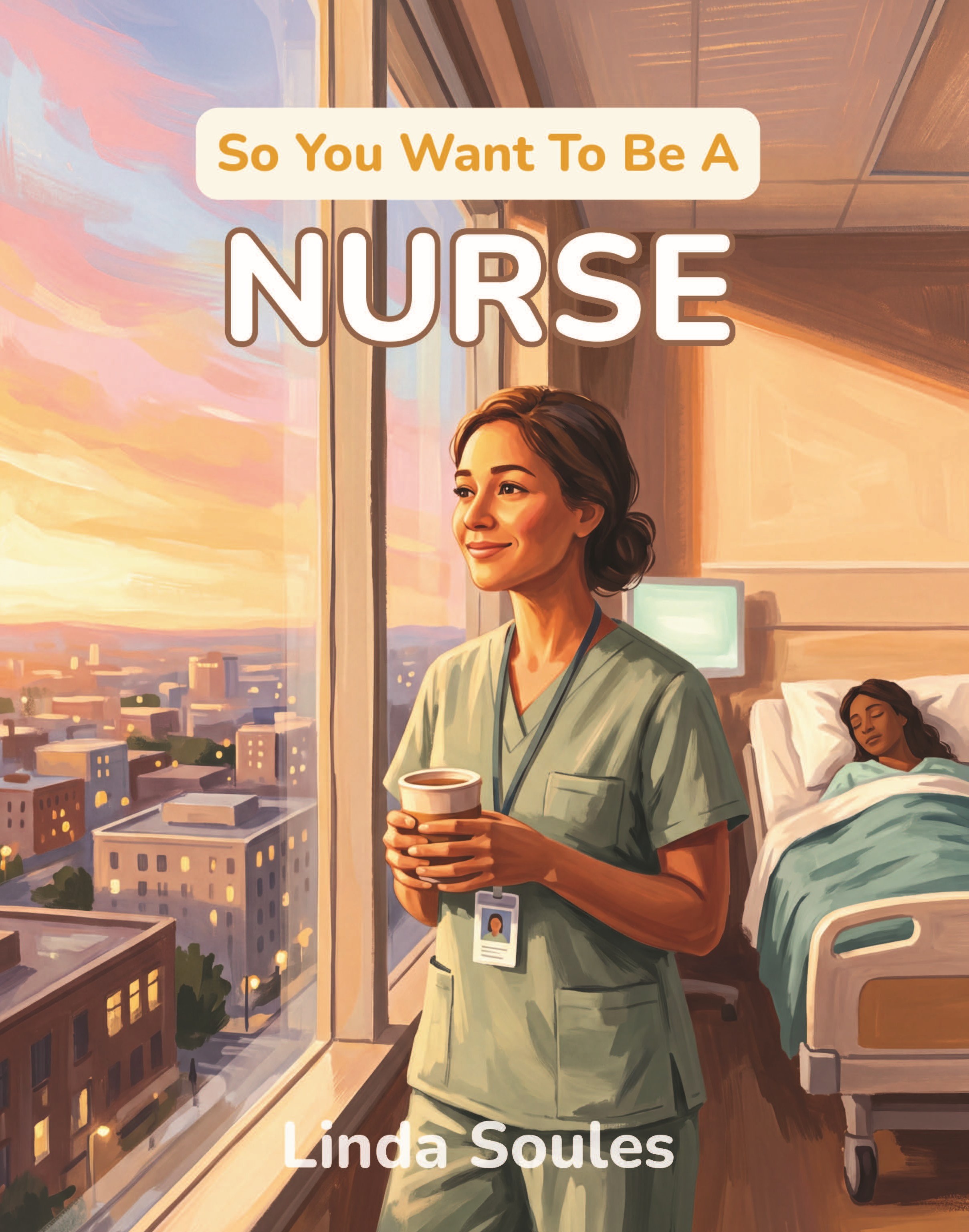
So You Want To Be A Nurse
by Linda Soules
Key Takeaways
Summary
A nurse’s work begins with paying attention. In a hospital, doctors may examine a patient, make decisions, and move on, but nurses stay at the bedside around the clock. That puts them in a position to catch changes early: breathing that has become faster, a fever beginning to climb, a child who no longer wants to play, or a grandmother more confused tonight than she was this morning. Monitors help, but trained eyes, ears, and even a nose can notice what a machine cannot. Spotting a small change and acting quickly can save a life.
Twelve-year-old Maya is ready to go home with a new inhaler for asthma. Before she leaves, her nurse watches her use it. Maya shakes the inhaler, presses the button, and breathes in, but the nurse sees that she pressed too early. Most of the medicine has landed on her tongue instead of traveling into her lungs. The nurse demonstrates the steps slowly: breathe out, begin a slow, deep breath in, press the inhaler as she breathes, and hold her breath while counting to ten. Then comes the test: “Now you teach me.” This is teach-back. When Maya can explain the directions in her own words, the nurse knows she understands them. Her dad saves the steps on his phone, and Maya declares that her stuffed bear needs a lesson, too. A few careful minutes may help keep her out of the emergency room.
Nursing is not simply assisting doctors; it is an independent, science-based profession with its own training and license. Nurses give medicines, clean and bandage wounds, start IVs, measure vital signs, and watch how patients respond to treatment. They may help someone walk after surgery, eat while weak, or wash when illness makes that difficult. They also advocate for patients, speaking up for people who are too sick or frightened to speak for themselves. And some care is as simple as a warm blanket or sitting beside someone who is lonely. Patients may remember the blanket long after they have forgotten the medicine; sometimes holding a hand matters more than anything on the care plan.
Nurses approach care in a process much like a scientist testing an idea. They assess by asking questions, checking vital signs, and looking, listening, and feeling for changes. They plan with the patient and the rest of the team, provide the care, and keep checking whether it is working. If it is not, they adjust the plan. Much of this work is unseen by visitors: nurses double-check doses, watch for side effects, and write careful notes so the next nurse knows what happened. Doctors often look at those notes first. A nurse may wake a patient in the night to take a temperature because trouble does not wait until morning. If a patient worsens, the nurse can call a rapid response team, which rushes to the bedside within minutes.
Close observation depends in part on having enough time. In one large study, each additional patient on a nurse’s assignment was associated with about a seven percent higher chance that a surgery patient would die within a month. When nurses can watch carefully, more patients go home. The work also has a visible uniform history: nursing schools once had distinctive caps, folded in particular ways to show where a nurse had trained. Most hospitals dropped them by the 1980s because they collected germs and caught on curtains and equipment. Today, nurses wear scrubs, sometimes color-coded so patients can identify who is providing care.
Hospitals contain many kinds of nursing. Emergency nurses care for whoever comes through the door and use triage to decide who needs attention first, so chest pain takes priority over a stubbed toe. Intensive care nurses watch the sickest patients, sometimes just one or two. Labor and delivery nurses support births; pediatric nurses care for children; operating room nurses help keep conditions sterile; and recovery room nurses watch patients wake from anesthesia. Nurses also work in clinics, doctors’ offices, nursing homes, rehabilitation centers, and hospice programs. Some hospital nurses work three twelve-hour shifts a week, meaning a weekend might fall on Tuesday.
Other nurses work far from a hospital ward. School nurses help students manage asthma, diabetes, and other needs, and may distract a nervous child during a poke by asking them to blow out pretend birthday candles. Flight nurses treat patients aboard helicopters and airplanes; in the Australian outback, the Royal Flying Doctor Service lands on cleared airstrips to reach cattle stations hours from a hospital. Military nurses serve on ships and in field hospitals. Camp nurses handle bandages and splinters, cruise ship nurses care for passengers at sea, and home health nurses visit people in their living rooms. Informatics nurses design hospital computer systems, while telehealth nurses answer calls and video visits, including worried parents seeking help about a fever at two in the morning. Forensic nurses care for people hurt by crimes and collect evidence; psychiatric nurses support people with mental illnesses; travel nurses take short-term assignments where extra help is needed.
Nurses rely on equipment, but tools do not replace judgment. Vital signs include heart rate, breathing rate, blood pressure, temperature, and the amount of oxygen in the blood. A fingertip clip measures oxygen by shining light through the skin, making the finger glow red. A bedside monitor tracks measurements continuously and alarms when something goes wrong. Still, nurses count breaths themselves, feel for a pulse, and check skin color and alertness. A screen cannot explain why someone simply does not look right.
Before giving medicine, nurses check the five rights: the right patient, drug, dose, route, and time. A barcode system adds another safeguard: the nurse scans the patient’s wristband and the medicine label, and the computer warns if they do not match. An IV, or intravenous line, is a thin tube placed in a vein to deliver fluids and medicines directly into the bloodstream. Starting one takes skill, especially in a baby with tiny veins. The IV pump controls how quickly the medicine flows, sometimes at only a few drops an hour. Nurses program it, check the insertion site for swelling, and track each bag that goes in.
At shift change, one nurse gives another a handoff report. In a few minutes, the outgoing nurse explains what happened, what changed, what to watch for, and what still needs to be done. Many nurses walk from room to room together so patients can take part. The handoff is like a relay race: the baton is everything one nurse knows about each patient.
One of the happiest moments in nursing is discharge day: a patient who arrived struggling to breathe walks out of the hospital, or a baby born months early leaves the incubator for home. When one tiny NICU graduate went home, the nurses made a graduation cap and lined the hallway to wave as the baby’s parents cried with relief. Nurses are also present at the moments before surgery and through long nights with worried families. They say they never get used to being trusted so deeply.
A good team can make demanding shifts feel less lonely. Nurses cover for each other, save snacks for colleagues on the night shift, and celebrate small victories together. Thank-you cards on a break-room wall may help someone through a hard day; years later, former patients sometimes return just to say hello. A few come back as nurses themselves, including former NICU babies who now care for infants in the kind of incubator that once held them. Patients may tell a nurse things they would not tell anyone else—how much pain they are in, or what frightens them most. Feeling safe enough to speak honestly helps the nurse give better care.
The work also offers steady demand and many ways to shape a career. Hospitals and clinics need nurses, and nurses can change specialties, move to new places, or choose full-time, part-time, or night work. In the United States, half of registered nurses earn more than about $97,500 a year; nurse anesthetists, who put patients to sleep for surgery, generally earn more than twice that. Pay differs across countries, but the range of possible roles is broad.
Still, nursing can wear down both body and spirit. Nurses stand for hours, lift and turn patients, and care for people who may be bleeding, vomiting, or unable to control their bowels, while protecting their dignity. Shifts can stretch past twelve hours, and meals may be missed. Some nurses eat holiday dinner from a plastic container at three in the morning. They care for people in pain, frightened families, and patients who may not survive. After comforting relatives, a nurse may have to walk into the next room and continue working. Some cry on the drive home.
There are dangers, too. Health care workers face more workplace violence than people in most other fields, sometimes from patients who are confused, hurting, or angry. Training and security measures help, and nurses learn to protect themselves while caring for the person in front of them. Gloves, masks, and gowns help guard against germs. Understaffing makes everything harder. California was the first U.S. state to set legal limits on how many patients a hospital nurse could care for; Oregon passed a similar law in 2023, and two Australian states have limits as well. During the COVID-19 pandemic, about 100,000 registered nurses left the profession. Those who stay say supportive colleagues, time to rest, and someone to talk with after difficult shifts can make a difference.
Nursing’s influence reaches far beyond the bedside. The United States has more than five million registered nurses, over four times as many as doctors. Nurses run units, manage budgets, lead research, and serve on hospital boards. In more than half of U.S. states, nurse practitioners can run their own practices without a doctor supervising them, bringing care to people in rural areas and small towns. NASA’s first group of astronauts included nurse Dee O’Hara, who checked their blood pressure and drew their blood before every Mercury, Gemini, and Apollo launch. Psychiatric nurse Eddie Bernice Johnson became the first nurse elected to the U.S. Congress in 1992 and served for thirty years.
Nursing’s history has been shaped by people who used observation and evidence to change care. Florence Nightingale, who loved mathematics despite her wealthy English parents’ hopes that she would marry and host parties, cared for soldiers during the Crimean War in the 1850s. Her rounds with a Turkish lantern helped earn her the name “the Lady with the Lamp.” When she examined army records, she found that preventable disease in dirty, crowded hospitals killed far more soldiers than battle wounds. She made circular charts that displayed the deaths clearly, helping persuade the British government to improve hospitals and army barracks. In 1860, she founded a nursing school in London that became a model for others.
During the Civil War, Dorothea Dix led Union Army nurses under strict rules about their age and appearance. In World War II, 77 American Army and Navy nurses captured in the Philippines spent nearly three years as prisoners. Despite hunger and scarce supplies, they continued caring for thousands of fellow prisoners; all survived, and they became known as the Angels of Bataan. Today, technology changes the job: robots fetch supplies, virtual nurses watch and speak with patients remotely, and some hospital care takes place at home. Machines may grow smarter still, but recognizing fear, loneliness, or that someone is simply not themselves will still take a person.
There are several ways to enter the profession. Some people begin as certified nursing assistants, or CNAs, after a course that can take only weeks. Licensed practical nurses, or LPNs, train for about a year. To become a registered nurse, students earn either a two-year associate degree or a four-year bachelor’s degree, then pass the NCLEX-RN licensing exam in the United States or Canada. Nursing students study subjects such as anatomy, chemistry, and how medicines work. They practice on lifelike mannequins that can breathe, talk, and even give birth, then care for real patients during clinical placements with an experienced nurse beside them. At graduation, a pinning ceremony may mark the start of a career. Further study can lead to roles such as nurse practitioner, nurse midwife, or nurse anesthetist, as well as work in teaching, research, or leadership.
Even the work has details outsiders may not expect. Medical maggots, raised in germ-free labs, eat dead tissue from wounds while leaving healthy skin alone. Leeches can remove pooled blood after surgeons reattach a finger or ear, and nurses keep careful track of every one. Experienced nurses may recognize some infections by smell; one kind of bacteria can make a wound smell sweet, like grape juice. Many nurses also swear that saying the word “quiet” brings a sudden rush of work, though the belief has no scientific basis. And scrub pockets can hold tape, scissors, wipes, pens, stickers for brave children, and a forgotten granola bar.
Imagine a registered nurse on a busy twelve-hour day shift with four patients. At 6:45 in the morning, the night nurse gives a room-to-room report about a man recovering from surgery, a teenager with pneumonia, a grandmother with a broken hip, and a seven-year-old who needs IV antibiotics. By 7:30, medicines are being given and checked. The child announces that his IV pole is named Steve and deserves a sticker, so Steve gets one. Later, the nurse helps the grandmother take her first steps with a walker. Ten feet takes ten minutes, but she is proud of herself.
Near midday, the postoperative man’s heart rate rises, his breathing speeds up, and he seems confused. The numbers are not alarming yet, but the nurse recognizes that the changes together may signal danger and calls the rapid response team. They find early sepsis and treat it in time. After a late lunch, the nurse sits with the teenager and his frightened mother to explain pneumonia and what to expect. By late afternoon, the man is stable, and his wife thanks the nurse for noticing. Before leaving, the nurse finishes charting—after losing three pens—and gives the night nurse a careful report, including the latest news about Steve.
Nurses use shortcuts to communicate, but words that save time must still be understood. “STAT” means immediately; “NPO” means nothing by mouth; and “Q4” means every four hours. To “ambulate” is to walk, while “emesis” means vomit. Nurses even use a plastic tray placed inside a toilet to measure urine, because the amount can reveal how the body is working. “Code brown” is informal slang for a major poop accident, and “sundowning” describes increased confusion in some older patients as evening approaches. Because a shortcut can be misread, hospitals often ask nurses to write risky abbreviations out in plain language.
Behind every nurse is a team, and good care depends on knowing how to work with all of it. Doctors diagnose illnesses and decide on treatment, relying on nurses to report how patients are actually doing. Pharmacists check medication orders; respiratory therapists help patients breathe; physical and occupational therapists help people move, dress, and return to daily life. Dietitians plan meals, chaplains offer spiritual comfort, and interpreters make communication possible across languages. Certified nursing assistants help with bathing, eating, and moving, often spending more time in patients’ rooms than anyone else. Charge nurses organize a shift, while social workers help families with problems such as insurance and finding a ride home. Housekeepers, transporters, and laboratory technicians are essential, too. Some hospitals even have dogs with their own identification badges, making rounds to visit patients who need a furry friend. A good nurse knows that every member of the team helps people get better.
Patients and families belong at the center of that team. They can tell nurses what a chart cannot: what is normal for someone, what frightens them, and what matters most. When a daughter says her mother “doesn’t seem like herself,” she is sharing important information. Families can also bring familiar pieces of home, such as a grandfather’s favorite blue coffee mug or a child’s dinosaur pajamas. These small comforts help people feel like themselves while they are sick, and nurses can teach families ways to continue helping after a patient returns home.
Some of nursing’s most powerful care looks nothing like medicine. In 1978, a hospital in Bogotá, Colombia, had too few incubators for its premature babies. Doctors tried placing each baby skin to skin on a parent’s bare chest, tucked inside the parent’s shirt like a joey in a pouch. The babies stayed warm, fed well, and often went home sooner. Nurses around the world now help parents hold newborns this way, known as kangaroo care. Nurses also protect health beyond a single bedside. Public health nurses track outbreaks and run vaccination clinics. In 2020, New York critical care nurse Sandra Lindsay received a COVID-19 vaccine on live television, becoming widely recognized as the first person in the United States vaccinated outside a clinical trial. By being vaccinated publicly, she hoped to reassure others that it was safe. Nurses have long gone wherever care is needed: in the 1920s, nurse-midwives rode horseback through creeks and snow in the Kentucky mountains to reach mothers and babies in isolated places.
The qualities that make nursing possible begin with close observation. Skilled nurses learn what is normal for each patient and notice what has changed: a pause in breathing, a shift in skin color, or a sudden loss of appetite. Sometimes a nurse senses trouble before any number changes, and that feeling deserves a closer look. Nurses must also balance compassion with boundaries. They care deeply, but need ways to protect their own hearts and return to work: walking after a difficult shift, talking with a teammate, or leaving work worries in a locker before driving home.
In a crisis, a nurse must stay calm enough to think and act quickly. Emergency practice helps make the steps familiar even when alarms are blaring and hearts are pounding; patients and families often look to the nurse’s face to judge how frightened they should be. Courage matters, too. If something seems wrong, a nurse may need to challenge a doctor’s confidence and clearly explain what they see, what it might mean, and what help they need. Saying, “I’m worried. Please come look at this patient now,” can save a life.
Careful attention also protects people from preventable mistakes. Nurses check names, allergies, medicines, and IV rates; they may ask patients to state their full name and birthday repeatedly because two people on the same unit can share a name. Math is part of the safety work. Nurses calculate doses based on weight, convert units, and set IV rates. A misplaced decimal can make a dose ten times too large, which is why nurses write 0.5 rather than .5, and why a second nurse may check calculations for dangerous medicines. Strong writing matters just as much: the medical record must describe clearly what happened, because other clinicians—and sometimes courts—rely on it. Precise notes say what the nurse actually observed, rather than simply calling something “bad.” Physical stamina is needed for hours of standing, bending, and moving patients. Nurses learn safer ways to lift, use equipment such as ceiling lifts, and take water or a snack whenever the opportunity comes.
Nursing has been shaped by people who persisted when doors were closed. Susie Walking Bear Yellowtail, born on Montana’s Crow Reservation in 1903, became the first Crow registered nurse. After seeing elders struggle to explain pain to doctors who did not speak their language, she traveled among reservations to report on Native health care, advocated for traditional healers, and founded the first professional association of Native American nurses. Mary Seacole, born in Jamaica in 1805, learned healing from her mother and treated cholera and yellow fever. The British War Office refused her offer to nurse in the Crimean War; suspecting racism, she went anyway at her own expense, opening a hotel and store near the front and tending wounded soldiers, who called her “Mother Seacole.”
Mary Eliza Mahoney spent years working as a cook, janitor, and laundry worker before training at a Boston hospital. In 1879, she became the first African American in the United States to complete professional nurse training. She later helped establish an organization for Black nurses. Lillian Wald, moved by the illness and poverty she encountered in a New York apartment building, began caring for families in their homes and built the Henry Street Settlement. Her work helped create public health nursing, and her advocacy led to the first public school nurse in the United States in 1902.
Luther Christman kept pursuing nursing despite being barred from some programs and rejected by the Army Nurse Corps because he was a man. In 1967, he became the first man to serve as dean of a U.S. nursing school and later helped found a national organization for men in nursing. Kofoworola Abeni Pratt, who trained in London after her father discouraged her from nursing, returned to Nigeria and rose from being denied a senior post to leading nursing at a major teaching hospital. She became Nigeria’s first Nigerian Chief Nursing Officer. Ildaura Murillo-Rohde, a Panamanian-born psychiatric nurse, studied how culture shapes care and earned a PhD in 1971. When the American Nurses Association rejected her proposal for a Hispanic nurses’ group, she founded one herself.
Preparation can start well before nursing school. Learning how the heart, lungs, and immune system work, practicing pulse and breathing counts, and taking science and math seriously all build useful foundations. So do talking with people of different ages, listening closely, and practicing teach-back: explain something, then ask the other person to show or describe it. Staying calm can be practiced when a sibling scrapes a knee; observation can be sharpened by keeping a journal of small changes in people, animals, or plants. Washing hands carefully for at least twenty seconds is another habit nurses rely on.
Nursing may fit someone who notices when others seem unlike themselves, stays calm or wants to learn how, is curious about the body, follows careful steps, and speaks up when something feels wrong. It also requires getting one’s hands dirty and facing hard days with support from colleagues, rest, and honest conversation. For someone drawn to caring for people and noticing what others miss, nursing can be one path among many: paramedics, child life specialists, pharmacists, therapists, social workers, and elder companion caregivers also help people in meaningful ways. Somewhere tonight, a nurse is noticing a change, offering comfort, or helping a family feel less afraid. The next person to give that kind of care may be you.
Chapter Summaries
What If You Were a Nurse?
The book opens with the central idea that nurses stay close to patients, often noticing changes before anyone else. A faster breathing rate, rising fever, confusion, or a child who suddenly stops playing can be an early warning. Nurses combine trained observation with questions, listening, and physical checks; machines provide useful measurements, but they cannot replace a person recognizing that a patient simply seems different. A story about twelve-year-old Maya shows how small interventions can have lasting effects. Her nurse watches her use an asthma inhaler, notices that she is pressing it too early, and demonstrates the correct technique. The nurse then asks Maya to explain and demonstrate it herself—a practice called teach-back. The episode introduces nursing as both practical care and patient education: noticing a problem, addressing it, and making sure the patient can manage safely after leaving the hospital.
What a Nurse Actually Does—and Where Nurses Work
Nursing is presented as its own profession, with specialized education, science, and licensing—not simply a doctor's assistant role. Nurses give medicines, dress wounds, start IVs, measure vital signs, help patients move and eat, and monitor how people respond to treatment. They also advocate for patients, especially when illness or fear makes it hard for someone to speak up. Comfort matters too: a warm blanket or a steady presence can be meaningful care. Nurses assess, plan, act, and reassess, while documenting what they see and communicating changes to the care team. When a patient’s condition worsens, a nurse may call a rapid response team. The book surveys the many settings and specialties where nurses work. Hospital roles include emergency nursing and triage, intensive care, labor and delivery, pediatrics, operating rooms, and recovery rooms. Beyond hospitals, nurses work in schools, clinics, nursing homes, rehabilitation and hospice programs, patients’ homes, and telehealth. Other less familiar paths include flight, military, camp, cruise-ship, forensic, psychiatric, informatics, and travel nursing. The range shows that nursing can suit people drawn to very different patients, environments, and rhythms of work.
The Tools of the Trade
Nurses use equipment to gather information and deliver care, but the book stresses that tools need human judgment. Vital-signs monitors track heart rate, breathing, blood pressure, temperature, and blood oxygen; nurses also count breaths, feel pulses, and observe a patient’s appearance and alertness. A monitor can sound an alarm, but it cannot interpret every sign that something is wrong. Medication scanners, IV pumps, and handoff reports illustrate how nursing combines precision with teamwork. Before giving medicine, nurses check the five rights: right patient, drug, dose, route, and time. Barcode scanning adds another safety check, while IV pumps control how quickly fluids and medicines enter the bloodstream. At shift change, nurses exchange a concise report about what happened, what changed, and what still needs attention. The handoff is compared to passing a relay baton: the next nurse needs the knowledge that makes continued care safe.
The Best and Hardest Parts of the Job
Many nurses describe helping a patient go home as one of the most rewarding moments. The book pictures a premature baby leaving the hospital after weeks in an incubator, with nurses lining the hallway to wave goodbye. Nurses also support people at vulnerable milestones—before surgery, through frightening diagnoses, and during long nights with families. Trust is central: patients may share pain or fears they have not told anyone else, and feeling safe can help them communicate honestly. Team bonds, thank-you cards, and former patients returning to visit can sustain nurses through difficult shifts. The work also has real costs. Nurses lift and turn patients, stand for long hours, work nights and holidays, and may miss meals. They care for people who suffer or die, face workplace violence and infection risks, and can experience burnout. The text connects safe care to staffing: a study found that each additional patient in a nurse’s assignment was associated with about a 7 percent higher chance that a surgery patient would die within a month. It notes efforts to establish staffing limits, the toll of the COVID-19 pandemic, and barriers that have kept qualified students out of nursing school. A supportive team, time to rest, and someone to talk with after hard days are described as important protections.
Nursing’s Reach, History, and Future
Nursing has a larger influence on health care than many people realize. The book notes that the United States has more than five million registered nurses—over four times as many as doctors—and that nurses lead units, manage budgets, conduct research, and serve on hospital boards. In more than half of U.S. states, nurse practitioners can run practices without physician supervision, bringing care to communities that may have few other providers. Nurses have also worked in unexpected roles: Dee O’Hara helped care for NASA’s early astronauts, and psychiatric nurse Eddie Bernice Johnson served in Congress for thirty years. Florence Nightingale’s story shows how observation and evidence can change systems. During the Crimean War, she found that preventable disease killed more soldiers than battle wounds. She used striking statistical diagrams to make the evidence clear to decision-makers, helping drive improvements in sanitation and hospital conditions, and later founded a nursing school. The book also traces nursing’s past through Dorothea Dix, the imprisoned “Angels of Bataan,” and the evolution from reused needles and hospital dormitories to barcode systems, robots, virtual nursing, and hospital care at home. Its forecast is that technology will keep changing, but recognizing fear, loneliness, and subtle human changes will still require people.
The Road to Becoming a Nurse
Readers learn that nursing has multiple entry points. A certified nursing assistant course may take only a few weeks, while licensed practical nurse training takes about a year. In the United States, registered nurses generally complete either a two-year associate degree or a four-year bachelor’s degree and pass the NCLEX-RN licensing exam. Other countries have their own degree and registration pathways. These routes allow people to begin with different levels of training and continue developing their careers. Nursing education combines classroom study, simulation, and supervised experience with real patients. Students study subjects such as anatomy, chemistry, and medicines; practice skills on sophisticated mannequins; and learn during clinical placements beside experienced nurses. Graduation may include a pinning ceremony, and later possibilities include leading a unit, teaching, research, or advanced practice as a nurse practitioner, midwife, or anesthetist. The practical lesson is that becoming a nurse takes both academic preparation and experience caring for people.
A Nurse’s Day: Unexpected Details and Everyday Language
A fictional 12-hour shift makes the job concrete. The nurse receives a handoff on four patients, checks vital signs and medicines, helps a grandmother take her first steps after surgery, and notices that a recovering patient is becoming confused and breathing faster. Although the numbers are not yet alarming, the nurse calls a rapid response team; the patient has early sepsis, caught in time because the nurse recognized a pattern. The shift also includes teaching a frightened teenager and parent about pneumonia, eating a late lunch, documenting care, and passing detailed information to the night nurse. Alongside the serious work, the book introduces medical shorthand and the humor nurses use to get through busy shifts. Terms such as STAT, NPO, Q4, ambulate, and emesis come from clinical practice, while “code brown” is slang rather than an official alarm. It also shares unusual treatments and observations: sterile medical maggots can remove dead tissue, leeches may help save a reattached body part, and experienced nurses may recognize certain infections by smell. These details make nursing vivid while underscoring that careful communication matters—especially since risky abbreviations can be misunderstood.
The Nursing Team and How Nurses Help People
Nurses work within a broad team that includes doctors, pharmacists, respiratory and physical therapists, occupational therapists, dietitians, chaplains, interpreters, CNAs, charge nurses, social workers, technicians, transporters, and housekeepers. Each person contributes to a patient’s recovery. Patients and families are essential team members as well: they can explain what is normal for someone, what worries them, and what comforts them. A family member who says that a patient “doesn’t seem like herself” may provide information no chart can capture. Familiar objects and routines can also help protect a patient’s sense of self. Care extends beyond hospital treatment to families and whole communities. Kangaroo care—placing a premature baby skin-to-skin on a parent’s chest—began as a practical response to a shortage of incubators in Bogotá and is now used widely to help newborns stay warm and thrive. Public health nurses track outbreaks and support vaccination; critical care nurse Sandra Lindsay received a COVID-19 vaccine publicly to reassure others. The book also recalls nurse-midwives traveling by horseback through Kentucky’s mountains to reach mothers and babies. Across these examples, nursing means adapting care to people’s circumstances and taking it wherever it is needed.
The Qualities and Skills of a Nurse
The book identifies qualities that help nurses provide safe, humane care: sharp observation, compassion with boundaries, calm in a crisis, courage to speak up, and attention to detail. Nurses learn what is normal for each patient so they can recognize meaningful changes. They must be compassionate without taking every sorrow home, practice emergency responses so they can act under pressure, and respectfully challenge a plan when something seems wrong. Double-checking a patient’s identity, allergies, and treatment is not busywork; it can prevent serious harm. The practical skills are broader than many young readers may expect. Nurses use math to calculate weight-based doses and IV rates, and write leading zeros—0.5 rather than .5—to reduce the risk of decimal errors. Clear charting lets other clinicians understand exactly what happened; vague observations are less useful than specific descriptions. Physical stamina matters too, so nurses learn safe patient-moving techniques and use equipment that protects their backs. The chapter’s message is that nursing ability can be built through practice, careful habits, and reflection—not just through a naturally caring personality.
Role Models, Preparing Now, and Deciding Whether Nursing Fits
Profiles of nurses from different backgrounds show how the profession has changed through persistence and advocacy. Susie Walking Bear Yellowtail fought for better Native health care and culturally respectful treatment; Mary Seacole cared for soldiers after being refused official service; and Mary Eliza Mahoney became the first African American in the United States to complete professional nurse training. Lillian Wald developed community and school nursing, Luther Christman challenged restrictions on men in the field, Kofoworola Abeni Pratt rose to lead nursing in Nigeria, and Ildaura Murillo-Rohde championed culturally informed care and Hispanic nurses. Their lives illustrate that nursing can improve care not only one patient at a time but through institutions and communities. For readers considering the career, the book offers ways to begin now: learn how the body works, practice measuring a pulse and breathing rate, talk with people of different ages, teach something and check whether the learner understood, build calmness, take science and math seriously, keep an observation journal, and wash hands thoroughly. A self-check asks whether the reader notices when people change, listens well, can follow careful steps, and is willing to speak up. The book also points toward related careers—such as paramedic, child life specialist, pharmacist, therapist, and social worker—so readers can explore different ways to help.
Notable Quotes
“Noticing those small changes and acting on them quickly is one of the most important things a nurse does.”
“Sometimes holding a hand matters more than anything else on the care plan.”
“On most shifts, a nurse can name at least one person who is better off because of what they did.”
“If it wasn't charted, it wasn't done.”
“the rarest and purest form of generosity.”
“Somewhere tonight, a nurse noticed something just in time.”
