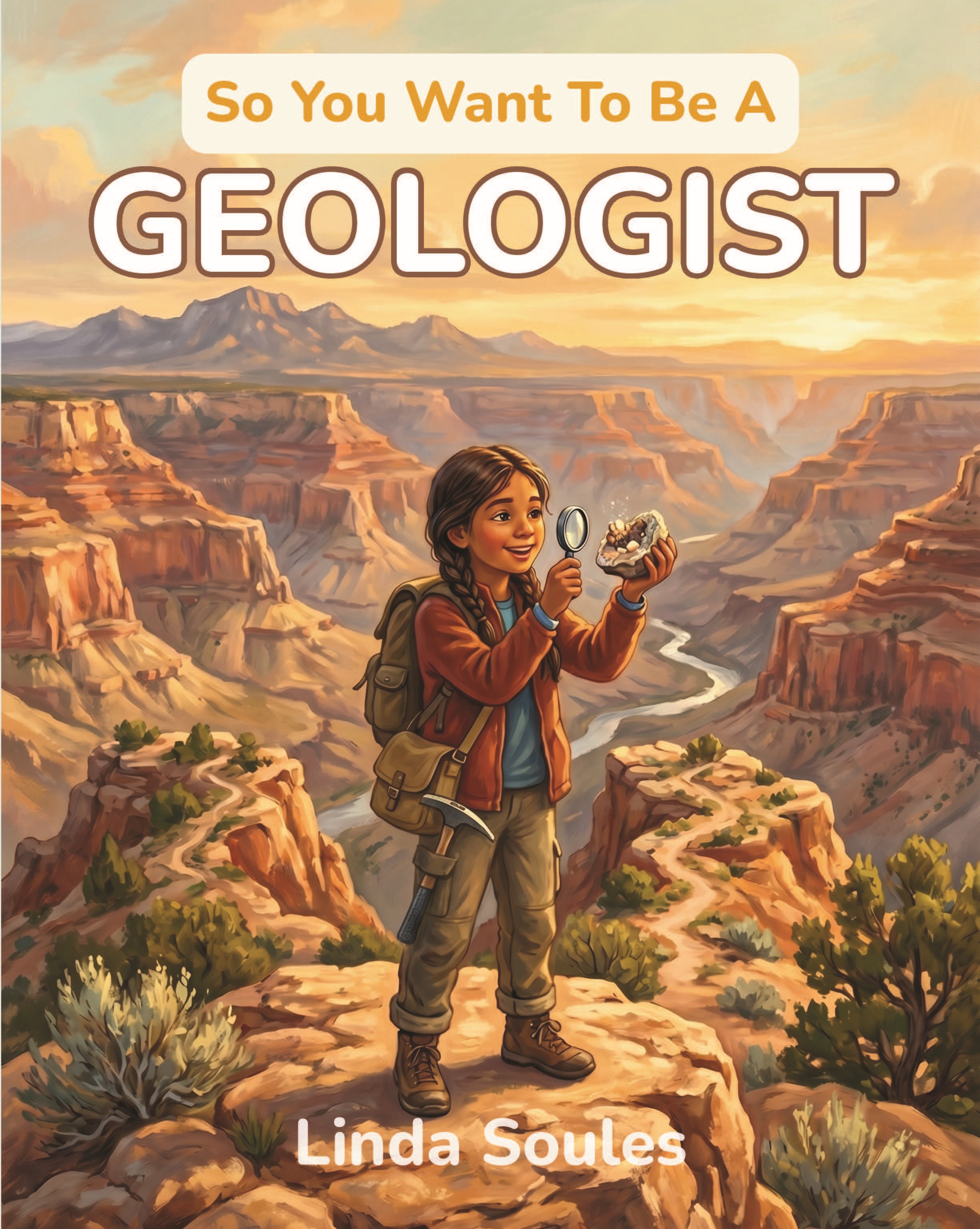
So You Want To Be A Geologist
by Linda Soules
Key Takeaways
Summary
Pick up a stone and look closely. A geologist could work out where it came from, how it formed, and roughly how old it is; with curiosity and training, you could learn to do the same. Where other people see a mountain and admire the view, a geologist wonders what happened first, what came next, and how long each change took. The work is a way of seeing Earth as both a place to investigate and a history recorded in stone. One day might mean mapping rock layers in a canyon; another, looking for groundwater, tracing metals used in phones and bridges, or studying a volcano to help warn nearby communities.
Geology literally means the study of Earth, but its central challenge is to read the planet’s history from evidence it never wrote down. People have wondered about rocks and earthquakes for ages, yet geology as a science is only about 250 years old. Its great insight is deep time: Earth is about 4.5 billion years old, far older than people once imagined. To picture that scale, compress Earth’s entire history into one calendar year. Dinosaurs arrive in mid-December and disappear the day after Christmas; every human who has ever lived fits into the final half hour of December 31. Rivers carve canyons grain by grain over millions of years, while mountains rise and wear away so slowly that their changes are almost impossible to see. A cliff is not merely scenery, but a moment in a story still unfolding.
Geologists work backward to reconstruct that story and forward to apply what they learn. Field mapping begins with walking the land and observing outcrops, places where bare rock emerges through soil. A geologist records the kinds of rock, the order of their layers, their angles, and where they are folded or broken by faults. Small clues—a colored band, a tilted layer, the boundary between two rocks—can suggest whether the place was once a sea, river, desert, or chain of volcanoes. These interpretations must follow the evidence, even when it overturns an expectation. The same knowledge has practical uses: understanding folded layers can help locate water, oil, or minerals; mapping faults can show where earthquake danger is greater; and recognizing old landslide deposits can help identify hillsides where building would be unsafe. Geology joins the reconstruction of the past with decisions that affect the present and future.
That broad work includes many specialties. Field geologists map landscapes; mineralogists and petrologists study minerals and rocks; paleontologists investigate fossils and ancient life; volcanologists study volcanoes, while seismologists focus on earthquakes. Hydrogeologists study groundwater, and economic geologists look for minerals and energy resources. Geochemists examine the chemistry of Earth materials, while planetary geologists read rocks on the Moon and Mars. Engineering and environmental geologists assess whether land is safe and help protect its health. Geographers study Earth’s surface and how people live on it; geophysicists use physics to investigate the interior. The wider term “geoscientist” can include these related fields.
Because Earth is everywhere, geologists work in remarkably varied places. Many spend time in mountains, canyons, deserts, on coastlines, or near glaciers and volcanoes, where rocks are exposed for close study. Outdoors can be the laboratory itself, and a workday may involve reaching a ridge few people have examined. But geology is also done in labs, where rock slices are examined and ages measured, and at computers, where specialists build three-dimensional models of the underground. Employers include universities, government surveys that map regions and monitor hazards, mining, energy and water companies, engineering firms, and museums. Some geologists map unexplored caves, work aboard ships drilling deep into the ocean floor, or collect ice cores from ice sheets. Others use computer screens to study the ground below city streets. Planetary geologists apply the same methods to the surfaces of other worlds.
The basic field kit is simple but revealing. A rock hammer breaks or pries open a stone, exposing a fresh surface that has not been weathered by sun and rain. A hand lens magnifies small crystals and grains that can tell a rock’s story. Geologists use these tools repeatedly, but a map and specialized compass help them understand a much larger area. A geologic map shows the kinds of rocks beneath the ground and the direction their layers tilt. The compass measures that tilt precisely, helping turn the angle of a distant cliff into evidence about how the landscape was bent or broken.
In the laboratory, a rock can be cut into a slice so thin that light passes through it. Under a special microscope, minerals show colors that help identify what they are and how they formed. Other lab methods measure radioactive atoms in rocks. Those atoms change into different atoms at steady rates, functioning like clocks; by measuring the changes, geologists can estimate a rock’s age, sometimes across millions or billions of years. Field observations suggest a story, and laboratory analysis can test and refine it. Yet tools alone are not enough. Geologists also need the imagination to picture a vanished ocean where a desert lies today, or a plain gradually becoming a mountain. Spread across the span of outstretched arms, Earth’s history places the first living things before the left elbow, the dinosaurs near the right fingertips, and all human history in a sliver thinner than a fingernail.
Every rock belongs to one of three main families. Igneous rocks form when molten rock cools: slowly underground, it may become speckled granite; cooling rapidly at a volcano can produce glassy obsidian. Sedimentary rocks form as layers of sand, mud, or shells build up and become pressed into stone over immense periods. Nearly all fossils are found in this family, so layered cliffs can preserve successive records of ancient environments. Metamorphic rocks are transformed by heat and pressure deep underground: mud can become slate, and limestone can become marble. These families are not fixed endpoints. Rock can be worn into sediment, compressed into stone, buried and melted, then eventually rise and change again. This continuing transformation is the rock cycle.
Beneath the crust, Earth is layered too. The crust is the thin, cool outer shell on which we live. Below it lies the vast mantle, hot rock that flows extremely slowly, more like honey in winter than water. Farther down, the outer core is liquid metal. At the center is a solid inner core, a ball of metal kept solid by the immense pressure of the planet above it, though its temperature is as hot as the Sun’s surface. We stand on this thin skin, with all those hidden layers beneath our feet.
For a geologist, some of the best places on Earth are not vacation destinations but workplaces. The day’s route might lead into a canyon, over a mountain ridge, beside a glacier, or toward the rim of a volcano. There is a particular pleasure in reaching ground few people have studied closely and beginning to work out the story held in its rocks. On a clear morning, with wind moving over a beautiful landscape and a hammer in hand, you can be alone with the evidence and the work of understanding it.
The Earth gives clues through more than sight. A rock’s ring when tapped may reveal a hidden crack; near a volcano, a rotten-egg smell can signal sulfur. A geode may feel strangely light and sound hollow, hinting at the crystal-lined space concealed inside an ordinary-looking lump. Learning to knock on rocks and listen is part of the training. You may do it while other adults look at you strangely, and eventually you may not care.
The deeper reward is discovering something true about how the world is built. A geologist might read a cliff correctly, work out a rock’s age, or find water beneath land where a community needs it. A map may guide scientists for generations; a fault discovered near a city may help protect people; a mineral deposit may supply materials used in homes. The variety keeps curiosity alive, too. Volcanoes, glaciers, groundwater, deserts, gemstones, fossils, and rocks on distant planets all offer new questions. Understanding one rock can reveal several more mysteries waiting to be explored.
But Earth’s record is incomplete. Rock is worn away, buried, melted, and crushed, and whole stretches of its history can disappear. Geologists must reconstruct events from fragments, like detectives working with only some of the clues. Often the most honest answer is that the evidence suggests a particular explanation but cannot make it certain. That careful qualification can be difficult when people want a simple, definite answer.
Fieldwork can be demanding as well as beautiful. Long hikes under brutal heat, heavy packs of samples, pouring rain, biting insects, sunburn, blisters, and weeks of camping far from comfort may all be part of the job. Loose rock, flash floods, and rough terrain can pose real dangers. Progress is slow: a careful map may take a whole field season, and laboratory work and writing can take longer still. There is even a familiar joke that geologists climb a mountain with light packs and come down bent under the weight of all the interesting rocks they could not leave behind.
A geologist must also be willing to have an explanation challenged. Findings are presented to other scientists, who examine the evidence and may argue for a better account. Sometimes a discovery overturns an idea that has been accepted for years. That can sting, but correction is how the science becomes more reliable. The goal is not to defend a favorite theory; it is to understand what the rocks actually show. The responsibility can be especially serious when a judgment affects public safety. An assessment of whether a slope is safe, a fault likely to rupture, or a volcano close to erupting may influence people’s lives. Warn too often and people may stop listening; wait too long and they may not have time to get out. Geologists must be cautious, honest, and humble about what the evidence can and cannot say.
One of the most startling things a geologist learns is that the ground beneath us is not truly still. Earth’s outer shell is broken into enormous plates that drift slowly across the surface, carried by hot, churning rock below. The movement is almost too gradual to notice, yet powerful enough to reshape the planet. Continents now separated by oceans were once joined; the Atlantic is widening; and India continues to press into Asia, pushing the Himalayas higher. The idea that continents move, now called plate tectonics, is relatively recent. People alive today were taught in school that the continents did not move.
At plate boundaries, rocks can catch as plates grind past each other, strain, and then suddenly slip. That jolt is an earthquake. Where hot rock rises through cracks, it can form volcanoes. Many earthquakes and volcanoes cluster along plate edges, tracing the seams of the moving shell. Once you understand this, a mountain range becomes a slow collision, an earthquake a sudden release of built-up strain, and a volcano a route for Earth’s inner heat to reach the surface. Even beach sand is part of a long transformation, made from ground-down mountains and shells and eventually destined to become rock again.
The movement of the planet also connects geology to everyday life. A phone contains metals and rare elements taken from particular places in the ground; concrete, glass, salt, tap water, and much of the energy used at home depend on materials geologists help locate. The work beneath civilization is easy to overlook, but someone has to find out where the ground keeps what people need.
A field day may begin at 7:30 in the morning, before the heat builds. After coffee from a camp stove, you check the weather and the day’s plan, then study a map to decide which outcrops to visit. You pack a hammer, hand lens, notebook, sample bags, water, sturdy boots, and sun protection. If you slept in the desert, you turn your boots upside down and shake them before putting them on: a scorpion or spider may have chosen them for shelter. The air is cool, the light golden, and the landscape ahead is still unread.
By eight, you are examining the first outcrop. You note the rock layers, their colors and angles, and how one layer meets another. You break a fresh surface, inspect it closely, sketch what you see, record the tilt, and label each sample so its exact location is not lost. Sometimes a geologist even licks a rock: wetting its surface can make grains and colors easier to see, while rock salt gives itself away by taste. As you move from outcrop to outcrop, the map grows. Layers bend, tilt, and break along faults, and a vanished landscape—a sea, perhaps—begins to take shape.
After lunch in the shade, you tackle the more difficult outcrops. One puzzling rock may refuse to fit your emerging explanation. Rather than forcing it into place, you look again and let the evidence change your mind. Back at camp in the late afternoon, you lay out the samples, check their labels against your notes, and write up the day’s observations while they are fresh. Later, a lab day may bring thin rock slices beneath a microscope and tests to measure their ages. An office day may involve finishing a geologic map, building a three-dimensional model, answering an engineer’s question about a slope, and writing findings others can check and use.
Although a geologist may spend hours alone reading rocks, the work depends on other people. In the field, teams share observations and watch out for one another in rough country; four eyes may notice what two miss. Geologists compare maps and debate what an unusual outcrop means, while students and field assistants learn alongside them and bring questions of their own. In laboratories, technicians and specialists prepare samples and operate instruments that measure age and chemistry with a precision no person can achieve by sight alone.
Geologists also work with engineers deciding whether the ground can support a building, bridge, or dam, and with city officials planning for earthquakes, floods, and landslides. Paleontologists, geographers, climate scientists, and oceanographers contribute expertise where their fields meet. Energy, mining, and water companies need to understand what lies underground. And the public matters most of all: people living on the land being studied may depend on its water, resources, or safety.
Sometimes that responsibility becomes immediate and visible. In 1991, Mount Pinatubo in the Philippines, quiet for about five hundred years, began showing signs of unrest. Geologists detected small earthquakes, rising gas, and swelling ground. They publicly warned that an eruption was coming, and tens of thousands of people left their homes. Pinatubo then erupted in one of the largest eruptions of the previous century, burying places where people had lived. Most evacuees eventually returned to ordinary lives. When geological warning works, its success can look like nothing happened at all.
Other contributions are quieter but just as important. Geologists find groundwater for communities and help protect it from pollution and overuse. They guide searches for energy, geothermal heat, and metals needed for cleaner energy, and investigate underground places where carbon can be stored. By reading ancient climates preserved in ice cores, seabed mud, and coral, they help establish what the planet’s climate was like before the present changes. Learning how Earth works can make geologists caretakers of the place people depend on.
The work calls for relentless curiosity: wondering why one rock is red and another black, or how a seashell reached a mountain. A love of the outdoors helps, because important observations may require long hikes in difficult weather. Patience matters, too. Maps take time, and reliable answers may take longer. Sharp, honest observation means recording what is actually there, not what a geologist hoped to find—and being willing to abandon a favorite explanation when the evidence disagrees. Spatial imagination is equally useful: a geologist must picture what lies beneath a flat surface, or reconstruct how layers were folded and changed over time.
Some necessary skills surprise aspiring geologists. Chemistry and physics explain how minerals form, how radioactive atoms reveal a rock’s age, and how earthquake waves travel through Earth. Math helps with the measurements and interpretations. Clear writing and map-making turn observations into findings that scientists, engineers, and communities can understand and use. In remote terrain, self-reliance and good judgment are essential: a geologist must prepare for weather, carry enough water, know the terrain, and make calm decisions when conditions change.
The history of geology shows how patient observation can transform what people believe. In eighteenth-century Scotland, farmer and naturalist James Hutton watched rivers wear down rocks and deposit sediment. He recognized that ordinary processes, repeated over immense stretches of time, could shape mountains and valleys. At Siccar Point, he saw tilted layers overlain by younger rock and understood that a vast interval separated their formation. His observations helped establish that Earth was far older than a few thousand years. Hutton’s insight gave geology its deep perspective: “We find no vestige of a beginning, no prospect of an end.”
Mary Anning reached major discoveries without formal schooling. Born in 1799 in Lyme Regis, England, she helped support her poor family by selling fossils found in the cliffs. At twelve, after her brother discovered a strange skull, she spent a year excavating the rest of the animal: the first ichthyosaur skeleton recognized by science. She later found the first complete plesiosaur and the first British pterosaur. Scholars initially doubted these unfamiliar creatures, and for much of Anning’s life, better-known men received credit for discoveries she had made. Her work helped reveal that entire forms of life had existed and disappeared long before people.
Inge Lehmann, a Danish scientist, discovered the solid inner core without ever seeing it. She examined seismograms recording earthquake waves and noticed arrivals that could not be explained if Earth’s core were entirely liquid. Her painstaking analysis led her to conclude that a solid metal center lies within the molten outer core. In 1936 she published the finding in a paper titled simply “P′.” Lehmann’s discovery depended on careful reasoning from evidence other people had overlooked, and she continued working into her nineties.
Earth itself keeps producing surprises. The inner core, though roughly 5,000 degrees, is slowly freezing as pressure turns liquid metal solid. Pumice can float because bubbles trapped in rapidly cooled volcanic lava make it unusually light. Western Australian zircons, about 4.4 billion years old, are tiny surviving records from nearly the planet’s beginning. In Mexico’s Naica mine, crystals grew to the length of school buses. Lightning can melt sand into glassy tubes called fulgurites, while the longest mountain range on Earth lies hidden beneath the oceans. Even pencil “lead” and diamonds are both carbon, arranged differently. And Mars rovers act as robot geologists, sampling and photographing rocks to investigate whether the planet once had rivers, lakes, or life.
A future geologist can begin with a rock collection. Use a field guide and hand lens, notice each sample’s color, layers, crystals, and weight, and keep a notebook recording where it came from and what you wonder about it. Look closely at road cuts, riverbanks, cliffs, and even the stone used in buildings. Visit museums, caves, canyons, beaches, and parks; learn to hike, camp, and use a map and compass. Earth science, chemistry, physics, and math are valuable preparation—not because anyone must be perfect at them, but because each class adds a tool for understanding the planet.
The questions that guide a geologist are simple to ask and difficult to answer: How did this get here, and how long did it take? What does the evidence show, and what is it not telling me? What is happening deep below where I can see? If picking up an interesting rock, noticing details, imagining a long puzzle, and seeking the true answer sound appealing, geology may fit. A rock club, gem-and-mineral show, museum, or university geology department can offer field trips and chances to ask an expert about a find. Young explorers can try the National Park Service Junior Paleontologist badge, while the U.S. Geological Survey offers learning activities, maps, and current earthquake and volcano information. The Smithsonian’s GeoGallery lets visitors explore mineral specimens, and professional groups such as the Geological Society of America and the American Geosciences Institute offer ways to learn about geoscience careers.
The invitation is not only to study ancient stones, but to see the present more clearly: the apparently still ground is changing, and the quiet landscape is part of a story still unfolding. Learning to read that story can lead to beautiful places, difficult questions, and work that helps people find what they need and live more safely. Every rock is a story, waiting for someone curious enough to look closely.
Chapter Summaries
What If You Were a Geologist? — Reading Earth’s Story
The book introduces geology as the study of Earth and geologists as detectives who read the planet’s history in rocks. Rather than seeing a mountain only as scenery, a geologist asks what happened first, what followed, and how long each change took. Field mapping, groundwater exploration, mineral searches, and volcano monitoring are different expressions of the same habit: using evidence in the present to understand how the Earth formed and how it is changing. A central concept is deep time. Earth is roughly 4.5 billion years old, a scale difficult to imagine until it is compressed into a calendar year: dinosaurs appear in mid-December, while all human history occupies only the final half-hour of December 31. This perspective turns landscapes into records of ongoing change. The book also explains that geology combines historical investigation with applied work, from reconstructing ancient environments to identifying hazards and resources. Its guiding rule is to follow the evidence, even when it overturns an expectation.
What a Geologist Actually Does — A Field of Many Specialties
Geology looks in two directions. Historical geology interprets rock layers, outcrops, folds, and faults to reconstruct past environments and events. A geologist may infer that a place was once a sea, river, desert, or volcanic region from small clues such as the angle of a layer or the way two rocks meet. Applied geology uses this understanding to locate groundwater and minerals, assess earthquake zones, and identify places where landslides or other hazards may threaten communities. The book emphasizes that “geologist” covers a wide range of careers. Field geologists map landscapes; mineralogists and petrologists study minerals and rocks; paleontologists investigate fossils; and volcanologists and seismologists focus on volcanoes and earthquakes. Hydrogeologists study groundwater, economic geologists locate resources, and planetary geologists examine rocks beyond Earth. Engineers and environmental geologists apply Earth science to construction and land protection. Whatever the specialty, reliable conclusions begin with close observation and a willingness to be surprised.
Where Geologists Work and the Tools They Use
Because Earth is everywhere, geologists work in a remarkable variety of places: canyons, mountains, deserts, coastlines, glaciers, caves, ocean-drilling ships, laboratories, offices, and even on projects involving the Moon and Mars. Fieldwork is only one part of the profession. In laboratories, geologists examine thin slices of rock and measure their ages; at computers, they build maps and three-dimensional models of underground structures. Employers include universities, government surveys, museums, engineering firms, and companies working with water, energy, and minerals. The classic field tools are a rock hammer, which exposes a fresh surface, and a hand lens, which reveals grains and crystals. Geologic maps show the rocks beneath the ground and the orientation of layers, while specialized compasses measure their tilt. In the lab, microscopes reveal mineral structures, and radioactive dating uses atoms that change at predictable rates to estimate a rock’s age. Yet the book argues that a geologist’s most powerful instrument is an imagination trained to picture landscapes changing over millions of years.
The Three Kinds of Rock and What’s Inside the Earth
All rocks belong to three broad families. Igneous rocks form when molten material cools, whether slowly underground as granite or rapidly at the surface as obsidian. Sedimentary rocks form from accumulated and compressed layers of sand, mud, and shells; their strata preserve a sequence of past conditions, and many fossils occur in them. Metamorphic rocks have been transformed by heat and pressure, as when mud becomes slate or limestone becomes marble. These rock types are not permanent categories in a one-way sequence. Through the rock cycle, mountains erode into sediment, sediment becomes rock, buried rock may be heated or melted, and transformed material can eventually return to the surface. The book then takes readers downward through Earth’s structure: the thin crust, the slowly flowing hot mantle, the liquid-metal outer core, and the solid inner core. The inner core remains solid despite its extreme heat because of the immense pressure exerted by the rest of the planet.
The Best Parts of the Job
For people who love the outdoors, geology can mean working in places of extraordinary beauty: hiking into canyons, climbing mountains, camping beside glaciers, or studying volcanic landscapes. A field geologist learns to interpret more than what is visible. The sound of a hammer on a rock can expose a hidden crack; a geode may sound hollow; and a fresh surface can reveal details weathering has concealed. The author uses these examples to show how observation becomes a practiced, hands-on skill. The work also offers the satisfaction of contributing to reliable knowledge and solving practical problems. A map may guide scientists for decades, a discovery of groundwater may help a dry community, and a geological assessment may protect a city. Geology’s scope keeps curiosity alive: a person can study volcanoes, fossils, glaciers, minerals, oceans, or other planets. The book’s central promise is that each answer tends to open up new questions, giving a curious geologist a lifetime of investigation.
The Hardest Parts of the Job
Earth’s geological record is incomplete. Erosion, burial, melting, and crushing remove evidence, leaving geologists to reconstruct events from fragments. This makes uncertainty part of the work: an honest geologist must distinguish what the evidence supports from what it cannot establish. Fieldwork can also be physically demanding, involving long hikes, heavy samples, extreme weather, insects, rough terrain, and time away from familiar comforts. Careful mapping and analysis may take months or years rather than producing quick answers. Geologists must also be prepared for their interpretations to be challenged. Colleagues check maps and arguments, and new discoveries can overturn long-held explanations. The book presents correction as a strength of science: it is better to revise an idea than cling to one that is wrong. In hazard work, the stakes can be especially high. Decisions about unstable hillsides, faults, and volcanoes can affect lives, so geologists need humility, care, and clarity about both the evidence and its limits.
The Most Surprising Thing: A Moving Planet
The ground may feel permanent, but Earth’s outer shell is broken into enormous plates that move slowly across the planet. Plate tectonics explains how continents that are now separated were once joined, why the Atlantic Ocean is widening, and why the Himalayas continue to rise as India pushes into Asia. Where plates grind and slip, earthquakes occur; where molten rock rises through openings, volcanoes form. Many earthquakes and volcanoes cluster along plate boundaries. This realization changes how ordinary landscapes appear: mountains become evidence of collision, beaches contain material worn from older rocks and shells, and apparently still ground becomes part of an active system. The chapter also highlights how deeply civilization depends on geology. Phones require metals and specialized elements; buildings need stone, concrete, and glass; communities need water and energy. Geologists help identify where such materials are found and understand the ground on which people live.
A Day in the Life
A field day begins early, often with a check of the weather, route, and equipment. A geologist carries a hammer, hand lens, notebook, sample bags, water, and protective gear, then visits outcrops to observe layers, measure their tilt, make sketches, and collect carefully labeled samples. The landscape gradually becomes a puzzle: one outcrop reveals a layer’s direction, another shows a bend, and a fault may explain how the sequence was broken. When a rock does not fit the developing interpretation, the geologist investigates rather than forcing it into the existing story. The day continues after leaving the field. Samples may be sliced and examined under a microscope or sent for dating, while the observations are turned into maps, models, and reports. An office day might also involve answering an engineer’s question about a slope or consulting with a colleague about an unusual sample. The chapter stresses the importance of accurate notes and labeling: observations that are poorly recorded can undermine later analysis. Fieldwork, laboratory work, and communication all contribute to a finished geological account.
The People Geologists Work With and How They Help
Although geology often involves solitary observation, it is collaborative work. Field partners improve both safety and interpretation, while students and assistants help gather information and learn field methods. Laboratory technicians and specialists prepare samples and run precise instruments. Geologists also work with engineers, city officials, paleontologists, climate scientists, oceanographers, and people involved in water, energy, and mining. Their work ultimately affects the public, especially communities living on the land being studied. One example of geology’s life-saving potential is the 1991 eruption of Mount Pinatubo in the Philippines. Geologists observed earthquake swarms, rising gas, and ground deformation, warned that an eruption was likely, and helped persuade tens of thousands of people to evacuate before the volcano erupted. Geologists also locate and protect groundwater, investigate resources needed for energy systems, and study ancient climate records in ice, seabed mud, and coral. Much of their success is invisible: when a hazard is anticipated and disaster avoided, the absence of tragedy may receive little attention.
Qualities and Skills a Geologist Needs
The book identifies curiosity as the engine of a geological career: geologists want to know why rocks differ, how shells reached mountains, and what lies beneath the surface. A love of the outdoors helps, since much fieldwork takes place in difficult conditions. Patience is equally important because Earth processes and geological investigations unfold slowly. Sharp, honest observation enables geologists to record what is actually present, while spatial imagination helps them picture hidden structures and reconstruct how a landscape changed. Some less expected skills matter too. Chemistry and physics explain how minerals form, how radioactive dating works, and how earthquake waves travel. Clear writing and map-making turn discoveries into information other people can use. Fieldwork also demands self-reliance and good judgment: geologists must plan for weather, carry enough water, understand terrain, and make sensible decisions far from help. These abilities can be developed gradually through study and experience rather than needing to be mastered in advance.
Geologists in History and Surprising Earth Facts
Three scientists illustrate different ways of reading Earth’s evidence. James Hutton used observations of erosion and rock layers, including the striking formations at Siccar Point in Scotland, to argue that Earth was far older than people had assumed. Mary Anning, a self-taught fossil hunter who grew up poor, discovered important marine reptile fossils, including an ichthyosaur and a complete plesiosaur, despite receiving little recognition during her lifetime. Inge Lehmann studied earthquake records and inferred that Earth has a solid inner core inside its liquid outer core, drawing a major conclusion about a place no one could directly observe. A collection of geological facts underscores the planet’s variety. Pumice can float because it traps air; ancient zircon crystals preserve evidence from near the beginning of Earth’s history; and lightning can fuse sand into glassy tubes called fulgurites. The same element, carbon, makes both pencil graphite and diamond, arranged differently. Geologists have also studied enormous caves of crystals, underwater mountain ranges, and rocks on other worlds. These examples reinforce the book’s larger message: careful attention to seemingly ordinary material can reveal extraordinary histories.
Getting Started, Exploring the Career, and Looking Further
Readers who want to explore geology can begin with simple habits: collect rocks, use a hand lens or field guide to identify them, observe road cuts and riverbanks, and keep a notebook recording where each rock was found and what questions it raises. Hiking, camping, learning maps and compasses, and visiting museums, caves, canyons, beaches, and parks build useful experience. Earth science, chemistry, physics, and math provide important foundations, while reading about deep time stretches the imagination needed to understand geological change. The book offers questions that guide geological thinking: how did something get here, how long did it take, what does the evidence show, and what remains unknown? A short self-assessment invites readers to consider whether they enjoy outdoor exploration, patient puzzles, close observation, and learning about Earth. The glossary introduces essential terms such as fault, outcrop, magma, strata, and plate tectonics, while the author’s closing note frames geology as a way of seeing the present as dynamic rather than finished. Further books, websites, clubs, badges, and public identification events give aspiring geologists concrete next steps.
Notable Quotes
“A geologist is a scientist of the Earth, and a detective of deep time.”
“The rocks remember, and a trained geologist knows how to ask them.”
“The evidence comes first.”
“The field finds the story. The lab proves it.”
“Nothing is permanent. Everything is on its way to becoming something else, and most people never notice. The geologist gets to watch.”
“Every rock is a story. Go read one.”
