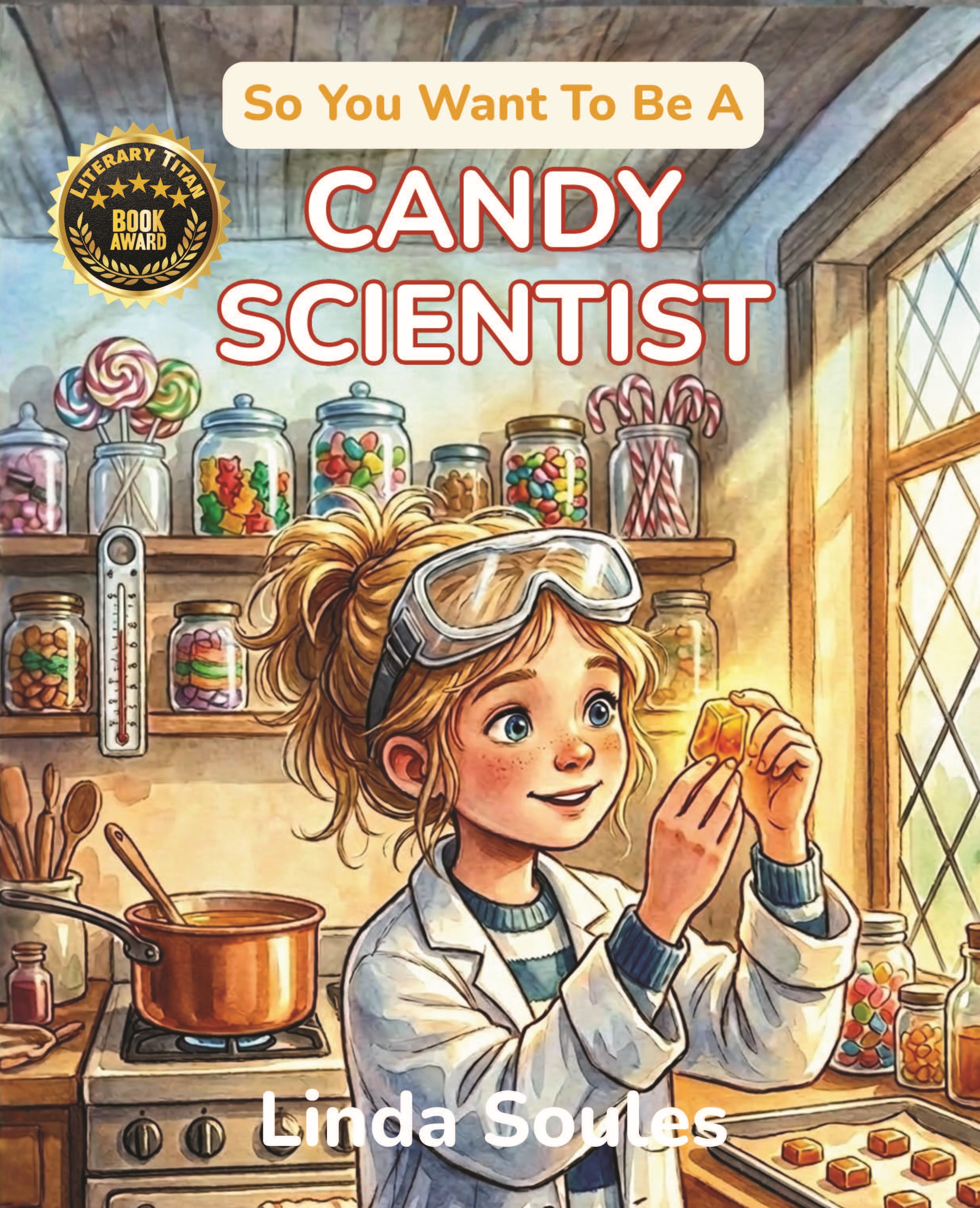
So You Want To Be A Candy Scientist
by Linda Soules
Key Takeaways
Summary
So, you want to be a candy scientist. The work begins with a puzzle hiding in something familiar: almost every candy starts with sugar. A clear lollipop, chewy caramel, smooth fudge, fluffy marshmallow, and brittle toffee may look and feel completely different, but their differences come from what happens to the sugar. Heat it gently and it can stay soft enough to fold into fudge. Heat it further and it firms into caramel; heat it still more and it can cool into a hard, clear sheet that snaps like glass. Stir at the wrong moment, or cool it too slowly, and the result can turn grainy or cloudy. Sometimes a few degrees are enough to change the candy entirely.
For a candy scientist, the thermometer is a map of possibilities. Each temperature helps determine what the sugar will become, and understanding those changes lets a scientist aim for a chosen texture and reproduce it batch after batch. The job is to invent and improve recipes by combining chemistry, careful tasting, and creativity. But a recipe cannot work only in the lab. It also has to taste the same every time, remain good for months on a shelf, and hold up whether it is sold on a hot summer beach or a freezing winter sidewalk.
The scientist’s first big question is what structure the candy should have. In crystalline candy, sugar molecules arrange themselves into regular, repeating patterns. Fudge contains millions of crystals, but they are so tiny that the tongue cannot distinguish them individually; that fine structure makes the fudge feel smooth. Rock candy is built in the opposite way: its crystals grow slowly over many days until their glittering geometric edges are visible. Temperature and stirring help control crystal size, as do ingredients such as corn syrup or butter. These can interfere physically with crystals connecting into larger structures.
Other candies are amorphous, or glassy: their sugar molecules are disordered, trapped in a random arrangement instead of an orderly crystal. A lollipop is hard, transparent, and glass-like because its sugar has formed a true glass, with a structure as jumbled as window glass, though made of sugar rather than sand. To preserve that clear state, the candy must cool quickly and remain undisturbed. Stirring or vibration can trigger crystallization, making the glass turn cloudy. Caramel may sit between the two extremes, combining crystal and glass. A candy scientist must understand where a candy belongs on this spectrum, because structure determines whether it is smooth, faceted, clear, or brittle.
Flavor, too, can be made through careful control. Heating sugar can create caramelization: the sugar browns and develops the deep, golden sweetness of caramel. When heat brings sugars together with proteins, the Maillard reaction produces the browning aromas familiar from toast, toasted marshmallows, and roasted coffee. These reactions create hundreds of new flavor compounds, which candy makers can use to develop tastes such as buttery caramel, toasted almond, and golden honeycomb. Heat can create flavor, but it can also destroy it. Delicate ingredients may not survive a candy’s high cooking temperature, so the scientist must know when to add them.
Consider saffron caramel. The sugar is cooked to the firm-ball stage, then cream and butter are folded in to add richness. If saffron threads go in too early, the high heat destroys their delicate floral aroma. The first batch fails. In a new attempt, the scientist waits until the caramel has come off the heat before adding the saffron. The warmth that remains helps release its flavor without burning it away. The difference comes from knowing the ingredient as well as the temperature: add saffron to the heat and its aroma dies; add it to the warmth and it blooms.
Candy scientists work in places that combine a kitchen with a science lab. Cooking machines heat sugar to exact temperatures, roll and shape it, or dispense equal amounts into molds. Testing equipment then checks whether the result matches the target. A refractometer measures how much sugar is dissolved in the mixture. A texture analyzer measures how hard or chewy the candy is, while a spectrometer checks its color. These tools help a scientist make the same treat reliably, so it tastes the way people expect wherever and whenever they buy it.
The production factory is where a recipe made in a small lab has to prove itself on a much larger scale. A flavor first developed one batch at a time may need to be produced by the thousands every hour. Yet a recipe that works with one kilogram of ingredients can behave differently when the factory makes a thousand at once. The candy scientist adjusts the recipe and troubleshoots until the huge batches match the small ones. The factory is warm from the cooking machines, sweet-smelling, and filled with humming, moving equipment—busy, but not messy.
Precision begins with a thermometer that measures single degrees. Sugar changes within narrow temperature ranges, so even a small difference can affect the final candy. The refractometer provides another important reading: Brix, the amount of sugar dissolved in the mixture. That number helps predict what the candy will become as it cools, from soft caramel to hard candy.
Texture equipment turns descriptions such as “hard,” “chewy,” and “sticky” into measurements. A probe presses into a piece of candy, and the machine records how much force the candy resists. But the instrument cannot tell the whole story. A tasting panel of coworkers assesses what the candy actually feels like. They may rate firmness, chewiness, and springback—the speed with which a candy bounces back after a bite. They taste samples blind, without knowing which is which, so prior expectations do not influence their scores. The machine tells scientists what it can measure; the tasters tell them what they can feel.
A water-activity meter measures loose water in the candy, the moisture not locked up by sugar. That hidden water affects how long a candy stays fresh and safe. Test pieces can then be placed in a humidity cabinet, where controlled heat and dampness imitate conditions such as a long truck ride or a steamy summer. Together, measurements and tasting reveal whether a candy can maintain its intended texture, flavor, and quality on the journey from factory to store shelf.
That careful work has its rewards: few ingredients can be transformed as dramatically as sugar. The same plain substance can become hard candy, toffee, caramel, fudge, marshmallow, or nougat, and each result reflects a different scientific choice. A gummy bear’s chewiness comes from gelatin proteins tangling into a network; a lollipop’s hardness comes from sugar locked into a glassy state; Pop Rocks fizz because carbon dioxide trapped in sugar bursts free when the candy dissolves. Caramel’s chew depends on precise heating, while cotton candy’s airy cloud forms as liquid sugar is spun into fine threads. For a candy scientist, the pleasure lies in understanding how these changes happen—and in being the person who can make them happen on purpose.
The science also serves an experience people may never stop to analyze. A candy’s soft first bite, its buttery richness, or the way a hint of salt brightens sweetness can all be designed deliberately. The scientist may think about temperatures and ingredients, but the person eating the result simply enjoys it. Candy can bring comfort or make an ordinary day feel special: a peppermint from a grandparent, a bag shared at the movies, a Halloween bowl, or a sweet at the end of a difficult day. Creating something dependable that gives people that small pleasure is a meaningful part of the work.
The challenge is that “almost right” is not always good enough. A tiny change in cooking can send a candy toward a different texture: hard candy can become something else if it gets too hot, fudge can turn grainy instead of silky, and marshmallow can become rubbery if the gelatin is slightly off. Close attempts are common, so persistence matters. A scientist must be willing to learn from a batch that misses the target and try again.
Scaling up can be even more puzzling. A recipe that succeeds in a small pot may behave differently when a factory makes a thousand pounds. The ingredients and instructions may look unchanged, yet the huge batch comes out wrong in a way the recipe does not explain. The scientist has to investigate, changing one thing at a time until the cause emerges. That detective work can be frustrating, but the moment the explanation clicks is deeply satisfying. Even unsuccessful batches contribute clues about where the successful recipe is hiding.
The job holds surprises, too. Sugar can take at least seven distinct forms, including hard candy, fudge, caramel, toffee, fondant, rock candy, and spun sugar. Chocolate adds another crystal puzzle: cocoa butter can harden into six different crystal shapes, but only Form V gives chocolate the glossy surface, clean snap, and smooth melt people expect from a well-made bar. Tempering—the carefully controlled heating and cooling of chocolate—is designed to produce that form, even though the scientist cannot see the crystals directly and must judge the outcome.
Pop Rocks offer a different combination of chemistry and physics. Their tiny pockets of carbon dioxide are trapped inside hard sugar glass under pressure; when saliva dissolves the candy, the gas bursts out with a crackle. And the sharpness of sour candy is not simply another flavor. Citric and malic acids, also found in lemons and green apples, create the sting that makes people pucker. Those acids can wear down tooth enamel, and the “melting” sensation comes from their reaction with the tongue’s sensitive surface. What seems like a simple treat can be a vivid experiment in the mouth.
A working day might begin at eight in the morning with a lab coat and goggles, and a gummy that needs to hold its shape in hot-weather countries. A previous version used more gelatin to keep the candy firm, but at room temperature it became stiff. The question is how to make it stable in heat without making it unpleasantly firm under ordinary conditions. By nine-thirty, five test recipes are underway, each with a different balance of gelatin and pectin. They are cooked to the same temperature, poured into the same mold, and chilled for the same amount of time. Changing only the ratio makes it possible to identify what caused the difference.
At twelve-thirty, the gummies are tested for texture. A probe presses each piece, and the force appears on a screen; the third batch comes closest to the goal, springy rather than stubborn. At two, four coworkers taste the recipes without knowing which is which, scoring firmness, chewiness, and springback. When their judgments match the machine’s result, the team has stronger evidence for choosing a winner. At four, that recipe goes into cabinets set to hot, warm, and cool conditions. It will take two weeks to learn whether the candy can withstand the journey to a store. The day ends with notes detailed enough for someone else to repeat the work. Tomorrow, the process begins again.
No one carries out that work alone. A research-and-development team may include food scientists and chemists, a sensory scientist who designs tasting panels, a safety expert who checks ingredients and labels, a process engineer who works out how to make the product by the ton, and a buyer who finds and secures the right ingredients. Factory specialists may reveal problems the lab could not anticipate. The formula is discussed at the tasting table, taken to the production floor, and revised when new information comes back. An unexpected observation from someone outside the scientist’s specialty may be the clue that moves the project forward. Children, too, provide an important final test: their faces can reveal the truth about a candy in a single bite.
The responsibility behind the pleasure is substantial. Food science helps detect hidden germs, keep food from spoiling during long journeys, and ensure that package labels accurately describe what is inside. Careful ingredient checks matter especially to people with allergies and to families relying on the information on a package. Safety has to come before an interesting new ingredient or process, particularly when a product may be eaten by millions.
To do the work well, a candy scientist needs to understand chemistry as a culinary language, connecting what happens at the molecular level with the texture likely to result. They must also put sensory observations into useful words: not merely “too chewy,” but an explanation of what may be happening in the gelatin’s protein network. Curiosity encourages them to test a new gelling ingredient or a different ratio, while careful experimental thinking helps them learn from the result. They must think about factory production from the start, not only about what works in a small lab. And throughout every experiment, safety remains the first requirement.
The history of candy science includes people who cared not only about sweetness, but also about what was safe, practical, and possible. American chemist Harvey Wiley spent decades investigating food additives, even organizing experiments in which volunteers ate suspect ingredients to reveal which ones were dangerous. His work helped bring about the Pure Food and Drug Act of 1906, establishing protections that made food and candy safer and required honest labeling.
Milton Hershey tackled a different puzzle: how to make milk chocolate that would not spoil, even though fresh milk could turn sour. Through years of trial and error, he developed the Hershey process, helping transform chocolate from a European luxury into a five-cent treat. First sold in 1900, his chocolate became a familiar product, while Hershey also used his fortune to establish a school for orphaned children that still operates today. More recently, senior color chemist Rebecca Robbins helped a worldwide team create a natural blue food color from red cabbage. Her work shows that a candy’s appearance is not merely decoration: color shapes what people expect before they taste.
Everyday sweets conceal more surprises. Chocolate is designed to melt near body temperature: cocoa butter stays solid in your hand but turns liquid at about 93 degrees Fahrenheit, just below the warmth of your mouth. Cotton candy, by contrast, is almost all air. A spinning machine pushes melted sugar through tiny holes, drawing it into threads thinner than a human hair; a whole puff contains only about a spoonful of actual sugar.
Color can influence taste so strongly that a green-apple candy dyed bright red may seem like cherry to many people. And white chocolate poses a naming puzzle: it comes from the cocoa bean, but contains cocoa butter, sugar, and milk without the brown cocoa solids that define chocolate under strict rules. Marshmallows carry another remnant of the past in their name. Ancient Egyptians made a sweet treat from honey and sap from the marsh-mallow plant’s root; today’s fluffy candies use gelatin instead. The shiny coats on jelly beans and candy corn may come from confectioner’s glaze, or shellac, a food-safe resin produced by the lac bug.
Even a sour candy’s sharpness has a scientific explanation. Citric and malic acids, also found in lemons and green apples, create the sting that makes sour candy pucker. That acidity can wear down tooth enamel, and the tangy sensation comes from acids reacting with the tongue’s sensitive surface. A small piece of candy can be a surprisingly vivid encounter with chemistry.
Curiosity can turn those observations into experiments. With an adult’s help, you can make sugar glass by dissolving sugar in water, heating it without stirring after it boils, and watching a candy thermometer reach 300 degrees Fahrenheit. Pour the hot mixture onto a greased baking sheet, then let it cool completely without touching it. The result is clear, hard, and snappable, much like a lollipop. Because hot sugar can cause serious burns, this experiment must be done with adult help.
To grow rock candy, dissolve as much sugar as possible in hot water, making a supersaturated solution. Pour it into a jar, suspend a string from a pencil so it hangs in the liquid, and wait three to seven days. Crystals gradually form along the string, making an otherwise invisible process visible. Chocolate offers another investigation: compare a piece stored at room temperature with one that was melted and then solidified in the refrigerator. The properly tempered chocolate should break with a clean snap, while the other may bend or crumble. The difference comes from the arrangement of cocoa-butter crystals.
You can also investigate a candy without cooking anything. Read its ingredient list and look for the source of sugar, the ingredients that shape its texture, its flavorings, and any acids. Gelatin, starch, and corn syrup each offer clues about how a candy was made. This kind of reverse engineering begins with questions: what is happening to the sugar, and how does temperature change it? How might you create a texture, color, or flavor experience no one has encountered before? How can a product be both scientifically precise and genuinely delightful?
Those questions may lead toward a career, especially if you enjoy asking why one candy snaps while another stretches, and what changes inside an ingredient as it cooks. A candy scientist combines exactness with invention, following a question through experiments and tasting, then asking again when the result is surprising. The work calls for attention not only to the candy itself but to the people who will eat it: the product must be safe, and its package must accurately describe what is inside.
For anyone eager to explore further, books such as Candy Experiments and The Science Chef offer hands-on activities, while the Exploratorium’s Science of Candy explains what happens to sugar at different cooking stages. A factory tour, a conversation with a baker or chocolatier, or a science-fair test of whether stirring affects fudge can make the questions tangible. Universities including Wisconsin and Penn State offer confectionery science training, and the American Association of Candy Technologists supports people entering the field.
There is a temptation to think serious science belongs only to medicine, rockets, or other grand challenges, and that candy is too frivolous to deserve a scientist’s care. But candy has comforted children, marked celebrations, and brightened ordinary days across generations. Making a small, widely shared pleasure safe and dependable is meaningful work. The larger lesson extends beyond confectionery: careful attention can make even a small delight matter. Taste thoughtfully, stay curious, and take seriously the work of making people happy.
Chapter Summaries
What If You Were a Candy Scientist?
The book introduces candy science through a surprising idea: many candies begin with the same basic ingredient, sugar, but become radically different because of how the sugar is treated. Temperature is especially important. Small changes can shift a batch from a soft confection to caramel or a brittle, clear candy, while poor timing or cooling can make it grainy or cloudy. A thermometer therefore serves as a map of possible textures, helping scientists reproduce a desired result rather than relying on luck. Candy scientists invent and improve recipes, combining chemistry with taste and creativity. Their formulas must do more than work once in a lab: they need to taste consistent across batches, remain appealing for months, and survive different climates. The chapter frames the job as both precise and imaginative—understanding what ingredients do, then using that knowledge to make a specific experience happen on purpose.
What Candy Is Made Of—and How the Work Gets Done
The book explains two fundamental structures in candy. In crystalline candy, sugar molecules form organized patterns; tiny crystals give fudge its smoothness, while slowly grown, large crystals make rock candy visibly sparkly. Temperature, stirring, and ingredients such as corn syrup or butter influence crystal growth. In amorphous, or glassy, candy, sugar molecules are trapped in a disordered structure. Lollipops and hard candies stay transparent when cooled quickly and left undisturbed; agitation can encourage crystals and cloud the candy. Some sweets combine both structures, so a scientist must control where a product falls on the crystal-to-glass spectrum. Flavor creation is another part of the science. Caramelization transforms heated sugar, while the Maillard reaction occurs when sugars and proteins brown together, producing the aromas associated with toast, roasted coffee, and toasted marshmallows. The saffron-caramel example shows how timing matters: adding saffron too early can burn off its delicate aroma, while adding it after the caramel leaves the heat lets residual warmth release its flavor. Candy labs use cooking equipment alongside tools such as refractometers, texture analyzers, spectrometers, water-activity meters, and humidity cabinets to measure composition, texture, appearance, and shelf stability.
The Rewards, Challenges, and Surprises of Candy Science
One of the job’s greatest pleasures is watching one ingredient become many different experiences. The book links familiar treats to distinct scientific principles: gelatin networks give gummies their chew, sugar glass makes lollipops hard, pressurized carbon dioxide creates Pop Rocks’ fizz, carefully cooked sugar gives caramel its texture, and centrifugal force spins cotton candy into threads. A candy’s softness, flavor, and finish can all be designed, so the person eating it can simply enjoy the result without needing to think about the precise decisions behind it. The work also demands patience. A small error in temperature or ingredient balance can turn silky fudge grainy or make a marshmallow rubbery. Scaling a recipe from a small pot to a factory-sized batch is especially challenging because large equipment and quantities can change how the mixture behaves. Scientists investigate by changing one variable at a time, learning from each unsuccessful batch. The chapter also highlights unusual phenomena: cocoa butter has six crystal forms, but only Form V gives chocolate its desirable shine, snap, and melt; Pop Rocks hold carbon dioxide inside sugar glass; and sour candy’s sharp sensation comes from acids such as citric and malic acid.
A Day in the Lab and the People Behind the Candy
A sample workday follows a scientist trying to improve a gummy for hot-weather markets. The first version is too firm, so the scientist prepares five test recipes that vary only in the ratio of gelatin to pectin while keeping cooking temperature, mold, and chilling time constant. A texture analyzer measures the results, and a blind tasting panel evaluates firmness, chewiness, and springback. The best candidate then goes into cabinets set to different temperatures for longer-term stability testing. Detailed lab notes make it possible for colleagues to repeat the result exactly. Candy development is collaborative. Research-and-development teams may include food chemists, sensory scientists, safety experts, process engineers, and ingredient buyers. A formula can look complete on paper but reveal a new problem on the factory floor, so information must move continually between the lab and production. Consumers—especially children—provide a final reality check. The book emphasizes that ideas often emerge when someone outside a scientist’s specialty notices what the rest of the team has overlooked.
Helping People and Building the Skills for the Job
Candy scientists contribute both to pleasure and to public well-being. Food science helps prevent contamination, protect people with allergies, extend shelf life, and ensure labels accurately describe what a product contains. Candy also has a place in everyday human rituals: a treat shared at a movie, a peppermint from a grandparent, or a sweet offered after a difficult day. The author presents dependable delight as a worthwhile outcome of careful work. The most important qualities include understanding chemistry well enough to predict how ingredients will behave, describing sensory experiences precisely, putting safety first, and designing recipes with factory production in mind. Curiosity matters too: scientists need to test new ingredients and follow unexpected results. The job also involves less obvious considerations, such as making candy withstand shipping and storage, composing contrasting or harmonious flavors, and thinking about color and shape as part of the experience. A successful candy must meet scientific, practical, and sensory goals together.
Candy Science Through History and Everyday Facts
Profiles of Harvey Wiley, Milton Hershey, and Rebecca Robbins show how food science can affect safety, access, and design. Wiley’s advocacy helped drive the Pure Food and Drug Act of 1906, establishing protections around food and labeling. Hershey used years of experimentation to develop milk chocolate that would not spoil as quickly, helping make chocolate more affordable; he also used his fortune to support a school for orphaned children. Color chemist Robbins helped develop a natural blue coloring from red cabbage, illustrating that candy’s appearance is the result of scientific choices as well as decoration. The book’s facts extend the science into familiar treats. Cocoa butter lets chocolate melt just below mouth temperature; cotton candy consists mostly of air and very fine sugar threads; and color can influence what people think they taste. White chocolate lacks cocoa solids, marshmallows take their name from a plant once used in sweets, and some glossy candies use food-safe shellac derived from lac-bug resin. These examples encourage readers to look past a candy’s surface and ask what ingredients and processes create its properties.
Try Candy Science—and Imagine the Career
Readers are encouraged to start investigating candy with simple observations and experiments. They can examine whether a candy is crystalline or glassy, identify possible texture agents on an ingredients label, and ask what gives a product its chew, sourness, or fizz. With an adult’s help, they can make sugar glass by heating sugar syrup to the hard-crack stage, or grow rock-candy crystals from a supersaturated solution. Comparing properly tempered chocolate with chocolate that has been melted and chilled offers a hands-on lesson in crystal structure. The book closes by inviting curious readers to consider the career and to keep asking questions about how temperature changes sugar and how to create new textures, colors, and flavors. Its glossary explains essential terms such as Brix, caramelization, emulsification, gelatin, pectin, sugar stages, and tempering. Further reading, websites, factory tours, science-fair projects, interviews with food makers, and professional organizations offer ways to explore the field. The author’s closing message is that careful attention to small pleasures is meaningful work, and that curiosity can begin with something as simple as a thermometer and a piece of candy.
Notable Quotes
“A candy scientist learns to read sugar the way a musician reads music.”
“The science serves the senses.”
“Every candy you eat is a science experiment that has already been performed.”
“Nobody makes a candy alone.”
“The best ideas almost always arrive sideways — from someone outside your own specialty noticing the thing you walked right past.”
“The trick is learning how to ask. Start with a thermometer.”
“So taste carefully. Stay curious. And never let anyone tell you that making people happy isn't serious work.”
