SANTIFICATION: FROM SCARS TO SALVATION
by JOAN SCHREINER
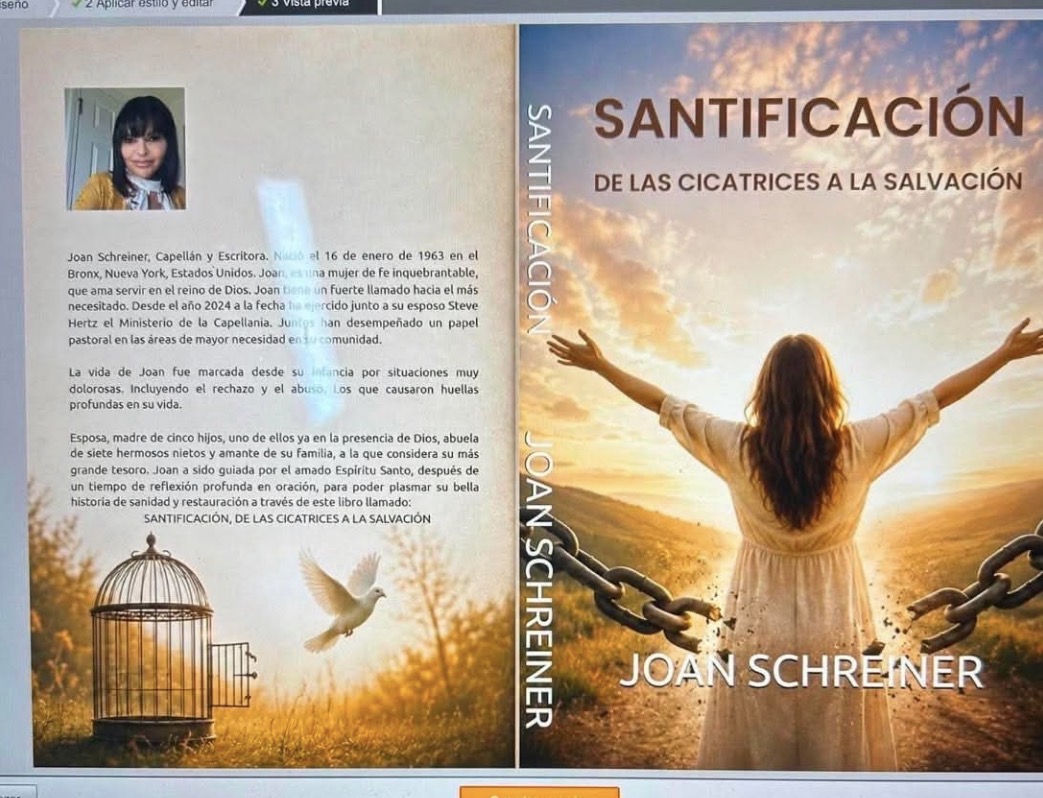
Key Takeaways
Summary
Joan Schreiner was born in the Bronx in 1963, and at five moved with her family to Puerto Rico, where she spent a year in Cayey with her maternal grandparents. Her grandmother, a devout Catholic, gave her a first experience of steadiness and affection. They knelt together to pray the rosary, and on Sundays Joan wore dresses her grandmother had sewn, sometimes beautiful enough to seem made for a celebration. Her grandfather was strict, but even he would buy her favorite ice cream after church. When Joan returned to live with her mother and siblings in Caguas, leaving that loving refuge was wrenching. Her mother dismissed her tears, and the warmth she had known with her grandmother gave way to distance and reprimands.
Her mother worked long hours at a restaurant and came home exhausted, leaving Joan to prepare breakfast, get ready for school, and manage much of childhood alone. She feared a nearby park but felt there was nobody who would listen. Her middle brother often caused trouble, yet their mother believed him; Joan was the one who was beaten while he hid and laughed. Her older brother had access to drugs and brought people into the house, creating an unstable environment without a dependable refuge. The children were expected to clean, wash clothes, and care for themselves, with little guidance about hygiene or health. Joan went to school with tangled, uncombed curls hidden beneath a hat, and classmates mocked her thin, untidy appearance. She felt exposed and unprotected.
That lack of protection became especially devastating when adults violated her boundaries. A woman she trusted began touching her sexually while pretending they were playing. Joan could not understand what was happening and pretended to feel dizzy to escape it. Later, a neighbor touched her breasts; she ran home crying and told her mother, who accused her of making things up. Joan locked herself in her room, insisting through tears that she was telling the truth and wondering why she was alive. She also recalled that, when she was eight, she and a small group of school friends engaged in sexual acts she did not understand. As an adult, she came to believe that her behavior had grown from abuse she could neither process nor explain, not from some fault in her character. Her plea is that adults listen to children without judgment, protect them, and help them understand what has happened rather than labeling them as troublesome.
At eleven, Joan’s stepfather began abusing her, and the abuse continued until she was fifteen. When she screamed after waking to find him violating her, her mother urged her to calm down and promised vaguely that he would be put out. He was back in the home the next day. His sudden death in a workplace accident brought relief, but also complicated feelings and further blame: her mother held Joan responsible for the collapse of the marriage and criticized how she dressed. The real wrong had been done by him, yet Joan was left to carry the consequences. Her mother withdrew into grief, and the family moved from Caguas back to the Bronx. Joan mourned leaving her grandmother, watching her cry from the balcony as the car pulled away. In the city she missed Puerto Rico’s ocean, fruit trees, and familiar rhythms, but her cousins’ welcome offered some comfort.
Understanding her mother’s own history eventually changed how Joan viewed her. Her mother had been married at fifteen, betrayed by the father of one of her children, and forced to work young to support her family. She had grown up frightened amid alcoholism and violent fights, and she too had suffered sexual abuse, including assaults by two uncles that remained unspoken until Joan was sixty. Joan came to see that her mother’s failures existed alongside wounds of her own. Prayer and reflection helped them slowly rebuild their relationship; Joan chose to honor her mother without pretending the harm had not occurred, and the two eventually became friends.
As a child, Joan searched for belonging by trying to erase what made her different. Her maternal relatives were mostly fair-haired and light-eyed, while she had tan skin, dark eyes, and tightly curled hair. An uncle mocked her as a “little black girl,” even giving her less money than her white cousins. Hoping to look more like them, Joan tried to bleach her hair with hydrogen peroxide. Her mother’s attempt to cover the damage turned it green, and schoolchildren called her a Martian. A hat, her tangled hair, and the laughter at school only deepened her shame. Yet her grandmother’s countryside home offered a gentler world: a candy shop where Joan sneaked sweets, animals and nature outside, and the comfort of sleeping beside her grandmother after their prayers. Her grandmother’s teasing about the shop’s lost profits carried affection, not rejection. Joan learned that changing her appearance could not earn acceptance, while patient love made room for a child’s mistakes.
She also found escape in imagined futures. Alone in her room, she staged concerts and dreamed of becoming a famous artist or actor, longing for the adoration she imagined fame would bring. Dance classes made her feel free, and she entered Puerto Rico’s “Miss Piel Canela” contest, representing Caguas. Her family first laughed at her ambition, then cheered when she became a serious contender. Rumors that the winner would be expected to serve the contest director persuaded her stepfather to oppose her participation; he convinced her mother to withdraw her, and her dance lessons ended too. When Joan later met the director in San Juan, he told her she had been destined to win. She realized the rumors had been false and that her stepfather’s control had closed off possibilities she had treasured.
School became another refuge. Joan excelled from primary grades through high school, retaining lessons easily and immersing herself in study when home life felt unbearable. She won the Bronx Spelling Bee and placed second in an essay contest; by graduation she ranked third in her class. Her ambition was to become a lawyer, but she chose accounting as a practical course of study. Pregnant with her first child before marriage, she felt embarrassed when teachers learned of it, but their encouragement helped her persist. She continued to college after her daughter was born. At sixteen, alone on a Bronx street, she was grabbed by a stranger who pressed a pistol to her head, then released her, saying he had mistaken her for someone else. Joan understood the escape as divine protection, though at the time she barely thought about God.
Joan became a mother at seventeen. At nineteen, after the birth of her second child, she married the children’s father, and by twenty-one she had finished college and was working as an accountant in New York City. She had not told her husband about the childhood abuse or the mistrust it had left behind. Instead, she tried to act as though nothing had happened, while dissatisfaction and restlessness grew. She began dressing provocatively at work and secretly visiting a modeling agency, where photographs of her in swimsuits were sold. The excitement soon turned frightening when photographers pressured her to pose nude. Feeling unsafe, she stopped going and worried that someone might discover where she lived.
Around sixteen, a friend had introduced her to cocaine, and alcohol and nightlife later became part of a destructive pattern. Her husband stayed home caring for the children while Joan went out with his brothers, two of whom sold drugs and supplied her cheaply. Periods of sobriety gave way to relapse. She grew distant from her husband, a kind and dedicated man, and began an office romance with the manager of the company where she worked, drawn into a relationship shadowed by drugs and secrecy. The marriage ended in divorce when she was twenty-two. Afterward, she entered a second relationship that became a marriage marked by turmoil; the demands of work, children, addiction, and unresolved pain continued to shape the choices she made.
Even before Joan understood faith, she came to believe that God had been guarding her. At sixteen, walking alone through the Bronx at night, she was seized by a stranger who pressed a pistol to her head. Frozen with terror, she watched him hesitate, then say he had mistaken her for someone else. He threw her down and disappeared. Joan ran to her friend’s home, thinking she had escaped by luck; only later did she interpret the man’s sudden change of heart as divine protection. In retrospect, she saw that God had watched over her through danger even when she neither sought Him nor knew how to trust Him.
Another brush with danger came when she was young and entangled with people involved in drugs. Pressured to carry drugs through an airport, she drank heavily to steady her nerves. As police officers and dogs appeared near baggage claim, she felt herself pass unseen, shielded, as she later understood it, by God’s presence. She promised that if she got through safely, she would leave that life behind. Such experiences became evidence, in her later faith, that survival was not merely chance: God had preserved her through choices and circumstances that might have ended very differently.
Grief and illness also became turning points. At twenty-six, during the birth of a son, labor became a crisis. The baby was exceptionally large, and after he could not be delivered naturally, Joan went into convulsions. She remembered watching doctors and nurses struggle to save them, as if from outside her own body. The baby had been without oxygen, and after twenty-one minutes of efforts to revive him, he died. Joan believed medical decisions had contributed to the loss, but grief overwhelmed any desire to pursue a lawsuit. Instead, she prayed for another child, trusting God despite warnings that pregnancy might be impossible. Three months later she was pregnant again, and five years after that she gave birth to another daughter. She understood those children as gifts of hope after devastating loss.
At thirty-three, while hospitalized in Caguas with cancer in her lymphatic system, Joan was told she had six months to live. After twenty-one days in the hospital, she experienced a radiant light and heard a voice say it had come to heal her. She felt something enter her body and heard the instruction to go to the bathroom, something she had been unable to do during her stay. The tests that followed showed no cancer. The experience, she wrote, made Jesus real to her—not simply a figure in sermons, but a living presence who had met her at the edge of death.
Yet conversion did not make hardship disappear. A kind older woman who had worked for Joan visited when the family’s business and her husband’s prestigious job had collapsed. She spoke to Joan about Christ and returned, with Joan’s permission, accompanied by pastors. As they praised God and shared the gospel, Joan’s husband emerged from his room in tears, asking to hear more about Jesus. That night, Joan, her husband, and their children accepted Christ together. Their new faith brought a powerful sense of peace and unity, but their problems continued, and sometimes grew more chaotic. Joan struggled to understand why trouble persisted when they were attending church. In time, she came to see faith not as a guarantee of a trouble-free life, but as the source of strength to endure it.
She was baptized and later experienced what she understood as baptism in the Holy Spirit at a women’s retreat. Still, she recognized that a powerful spiritual moment was not the same as a settled life of faith. She attended church and prayed, often most urgently when a crisis came, but did not yet know Scripture deeply or maintain daily communion with God. At a crusade led by Puerto Rican evangelist Yiye Ávila, he laid hands on her and spoke words she initially doubted could be meant for her. Over the decades, she believed those words had proved true. His ministry intensified her hunger to know Jesus, while her spiritual mother—the older Christian woman who had first brought pastors to her home—became a steady guide, offering correction and support through years of struggle. Joan also learned to regard prayer as more than reciting words or making requests: it became an honest conversation with God, a place to bring fear, regret, gratitude, and confusion, and to wait for direction.
Forgiveness, however, required more than attending church or receiving spiritual gifts. Joan had to confront the rooms inside herself that she had kept closed: the pain, anger, and memories she had tried to bury. A Christian book’s image of life as a house with rooms helped her understand that Jesus was not asking to enter only the parts she could show others; healing meant opening even the places crowded with shame and hurt. Isaiah’s promise that God gives strength to the weary became an anchor. Gradually, through prayer, reflection, and surrender, she began releasing resentment toward people who had harmed her, including her mother. Forgiveness did not mean that the harm had not happened or that mistreatment should continue. It meant refusing to let bitterness dictate the rest of her life. Joan also came to see that repentance had to be honest and complete: she could not ask mercy for herself while excusing her own wrongs. She began seeking forgiveness from people she had hurt and learning to forgive herself as well.
The most painful test came within her second marriage. Joan and her husband held church responsibilities—he was a deacon, and she taught Sunday school—yet their private life was marked by jealousy, verbal abuse, and fighting. He insulted her children, and their arguments sometimes became physical. Joan felt abandoned when people who saw his calm public manner did not believe her account of what happened at home. During one desperate period, she left on a seven-day business trip without telling the family, though the project itself was known to her husband. When she returned, her mother, brother, husband, and young daughter were waiting outside the house. Her husband had accused her of infidelity. They would not hear her explanation, and her belongings were thrown into the street while neighbors watched. Her daughter cried for her, but Joan could not reach her.
She went to the church that evening, hoping to see her children and find support, but was rejected and accused of adultery. A Christian friend urged her to leave the island for her own safety and peace. Though separation from her children terrified her, Joan went to Massachusetts and stayed in a crowded basement room, weeping through the loneliness. She found work within a month supervising a rehabilitation program, but for six months she could not speak to her children. Then her mother called: the husband’s conduct had become intolerable, and he wanted Joan to bring the girls back. Joan rented a small apartment in Swampscott, and two weeks later her daughters arrived. The reunion brought tears and embraces; bringing her sons back into her care took longer, requiring patience and prayer. She did not see the ordeal as proof that faith had failed, but as a painful passage through which she had to rebuild her life and keep seeking restoration.
Rebuilding life did not erase the consequences of the choices Joan had made or the wounds she still carried. Fear and shame had long driven her toward escape, and alcohol became a way to silence memories she could not bear to face. At her worst, she drank every day and sometimes became someone her children could hardly recognize. After mixing alcohol with medication, she lost consciousness and awoke five days later in intensive care, connected to machines. Her youngest daughter, still a child, had stayed beside her, crying and calling for her siblings. Seeing her daughter’s anguish made Joan confront what her addiction was doing to the people she loved. She asked God and her children to forgive her, and she began the difficult work of sobriety. She came to understand that recovery meant more than surviving a crisis: it demanded honesty, repentance, and steady changes in how she lived.
Her health brought other frightening trials. A serious car accident left her trapped in a crushed vehicle, surrounded by smoke and unable to free herself, yet she emerged without a scratch. Joan understood her survival as God’s protection, while also recognizing that faith did not remove her responsibility to be careful, especially with her diabetes. Later, severe back problems and surgeries left her paralyzed for months. Unable to hold a Bible, she listened to it on her phone and prayed from her wheelchair. One day, she felt the Holy Spirit urging her to get up. Though she doubted her strength and fell repeatedly while trying, she eventually stood, leaning against a wall. Her family was astonished to see her walking the next morning. These experiences strengthened her conviction that God could meet her in weakness, but they also taught her that healing was not always simple or immediate. She had to keep trusting and trying through pain and uncertainty.
Motherhood remained both her greatest joy and a source of grief over the ways her past had affected her children. Joan had become a mother at seventeen, learning much of the work from her first mother-in-law, who patiently helped her care for her newborn. She remembers the children’s laughter and mischief: her older two once covered the kitchen, and their little brother, with pancake batter and flour. Family holidays in Florida, including visits to Disney World and Universal Studios, offered rare stretches of uncomplicated happiness. Even amid the turmoil of her second marriage, she treasured the children’s distinct personalities and the closeness they shared. As adults, they built careers and families of their own; Joan’s four surviving children and seven grandchildren became enduring sources of gratitude and pride.
Still, she could not pretend that loving her children had meant making no mistakes. During a period when she was new to faith and struggling with her own instability, she reported her son’s partner to child protective services because she feared for the safety of their young children. She believed intervention might protect the children and help the family, but her son experienced the report as betrayal. For more than twenty years, the decision has cost Joan her closeness with him and his children. She has apologized and written letters, sent gifts, and continued to pray, yet he has kept his distance. Joan does not claim that her intentions erased the hurt. She acknowledges that she might have acted differently with the wisdom she has now, and that repentance does not guarantee another person’s forgiveness. Her sorrow remains, but she entrusts the relationship to God and keeps her arms open should reconciliation become possible.
Her regrets extend to the time she left Puerto Rico to establish herself in Massachusetts before bringing the children to her. She believes they suffered from her absence and from the turmoil at home, and she wonders whether taking them with her from the start might have changed their path. Some became angry with God after painful family experiences and church hurt. She is grateful that one son later returned to Christian service with his family, and she continues to pray for the others without forcing them. Learning to forgive herself was part of facing the truth. She could not undo what had happened, but she could confess her failures, ask forgiveness, and strive to live differently. For Joan, responsibility meant neither denying the past nor allowing regret to consume the present.
Over time, she understood her identity less through professional accomplishments or other people’s approval than through her relationship with Christ. She describes her greatest achievement as spiritual freedom: the breaking of emotional and destructive patterns through the Holy Spirit. Faith became a daily practice rather than a label or a refuge reserved for emergencies. Prayer and Scripture helped her meet her weaknesses honestly, while the example of mentors and fellow believers encouraged her to persevere. She came to see that growth was ongoing; being transformed did not make her perfect, but it gave her a purpose beyond survival. The desire to write, present since childhood, became part of that purpose. She believed that telling the truth about her life might offer hope to people who felt trapped by pain, addiction, or shame.
That calling found practical expression in service. Joan and her husband, Steven, built a life rooted in prayer and mutual care, especially as her health brought further surgeries and difficult recoveries. They serve together as chaplains, going to people and places others may avoid. Joan values the simple acts that can restore dignity: listening without judgment, offering prayer, showing affection, and making someone feel seen. She believes Christian love must be demonstrated, not merely spoken, through time, compassion, and help for people in need. Her own history of feeling ignored and rejected has made her particularly attentive to those who are lonely or overlooked. She hopes that younger people facing addiction or emotional emptiness will be met with both spiritual support and professional help, rather than blame or silence.
Joan’s gratitude encompasses the people who stayed beside her: her husband, her children, her grandchildren, her mother, and friends who offered kindness when she was vulnerable. She also remembers her grandmother, her spiritual mother, and her cousin, whose love and example shaped her life, even though grief has taken them from her. Her relationship with her own mother gradually changed as she learned more about the suffering her mother had endured. Understanding those hidden wounds helped Joan replace some of her resentment with compassion, and they were eventually able to repair their bond. She knows that not every family relationship has healed, but she chooses to keep seeking peace where she can and to release what she cannot control.
The title of Joan’s story points to the meaning she gives her survival: scars remain as evidence of what happened, but they need not dictate what comes next. She hopes to be remembered as an imperfect mother who loved her children, a woman who kept reaching for reconciliation, and a servant willing to care for those others might reject. Her faith does not erase loss or guarantee that every relationship will be restored. It gives her a reason to continue loving, to make amends, and to serve. She believes God was with her even before she understood Him, and that the life she once considered worthless can still become an instrument of hope for someone else.
Chapter Summaries
1. Childhood: Searching for Safety and Belonging
The memoir also recounts childhood sexual abuse and the painful experience of adults not believing or protecting her when she tried to communicate what had happened. Schreiner reflects on how trauma and silence affected her behavior and self-image, arguing that children who act in confusing or troubling ways may be responding to harm they cannot yet explain. Her retrospective appeal is direct: listen to children without blame, take disclosures seriously, teach bodily boundaries, and make homes and communities safer.
2. Family Wounds, Loss, and Compassion
As an adult, Schreiner revises her understanding of her mother by learning about the abuse, betrayal, poverty, and fear that shaped her mother’s own life. This knowledge does not erase the harm Schreiner experienced, but it helps her replace judgment with compassion and eventually rebuild a relationship with her mother. The chapters frame forgiveness as an effort to see the whole person, acknowledge pain honestly, and seek peace without pretending that the past was harmless.
3. Childhood Dreams, Education, and Early Resilience
School became a place where Schreiner could concentrate and feel capable. She excelled academically, placed near the top of her high-school class, won a Bronx spelling bee, and received recognition for her writing. She continued her education after becoming a young mother, studied accounting, and later pursued paralegal training, keeping alive an interest in law even when circumstances altered her plans. Her account presents education as both refuge and opportunity: a practical way to build a future and evidence that adversity need not extinguish ambition.
4. Early Adulthood: Work, Relationships, and Addiction
The author also recounts her involvement with alcohol and cocaine, including how substance use and the company she kept contributed to fractured relationships and destructive choices. She recognizes that success at work could not make up for secrecy, unresolved trauma, and the lack of inner peace. In her account, recovery begins with acknowledging that she cannot manage the consequences alone, facing her past, and turning toward faith and honest living. The chapter’s practical insight is that helping others can be meaningful, but it does not replace the need to address one’s own wounds.
5. Survival, Conversion, and Spiritual Turning Points
A later assault becomes the decisive moment when she says she fully repented and committed herself to God and her family. Schreiner describes this decision as a break from a life of divided loyalties and destructive distractions. She also reflects that conversion itself did not instantly resolve every problem: spiritual growth required a continuing relationship with God, engagement with Scripture, prayer, and a willingness to confront what she had hidden. The chapter portrays faith as both a refuge in crisis and a daily practice of transformation.
6. Prayer, Mentors, and the Work of Forgiveness
The author presents daily prayer as honest conversation with God rather than a formula, and forgiveness as a process involving three relationships: receiving God’s forgiveness, forgiving others, and learning to forgive oneself. She insists that forgiveness does not mean forgetting harm or excusing it; it means refusing to let resentment govern the future. Her reflections encourage readers to pair prayer and faith with humility, patience, and practical boundaries, recognizing that emotional and spiritual healing often unfolds over time.
7. Marriage, Abuse, Separation, and Restoration
Prayer, Scripture, work, and the support of friends helped her persist through the separation. After months apart, she was able to reunite with her daughters, and later worked toward renewed contact with her sons. Schreiner looks back on the ordeal as a test of faith and endurance, but the account also makes clear the human cost of family conflict and community failure. Her reflections emphasize that faith should not be treated as a substitute for safety, support, or honest recognition of abuse.
8. Fear, Recovery, and the Cost of Past Choices
Schreiner also addresses the aftermath of addiction, alcohol misuse, and estrangement. She recounts an overdose that left her hospitalized and frightened her children, and she describes asking God and her family for forgiveness as part of her recovery. One especially painful chapter concerns her decision to report concerns about her son’s household to child-protection services; she believes she acted to safeguard her grandchildren, but the choice led to a lasting rupture. Rather than claiming that faith resolves every relationship, she acknowledges enduring grief and continues to hope for reconciliation.
9. Love, Motherhood, and Family Life
In later life, Schreiner finds a loving partnership with her current husband, whom she describes as devoted, supportive, and central to their shared Christian life. Their relationship is shaped by honesty, prayer, and his steadfast care through her health problems and surgeries. The author also reflects on her children’s and grandchildren’s paths, including their careers, military service, and different relationships with church. The chapter presents family love as enduring but not simple: affection, accountability, distance, patience, and hope all exist together.
10. Calling, Identity, and the Legacy of Faith
In reflecting on aging, purpose, and identity, Schreiner urges readers not to postpone spiritual growth, reconciliation, service, or the use of their gifts. She describes her life through the qualities of resilience, love, and compassion, and hopes to be remembered as a woman transformed by Jesus who remained willing to serve others. Her advice for younger Christians combines prayer and Scripture with supportive community, wise use of social media, and professional help when emotional or addiction-related struggles require it.
11. Reconciliation, Gratitude, and Service
The book ends by presenting “Sanctification: From Scars to Salvation” as a testimony of gradual transformation rather than perfection. Schreiner says the Holy Spirit helped her confront fear, bitterness, shame, and addiction, while faith, supportive relationships, and service gave her a new direction. Through chaplaincy with her husband, she seeks to offer presence and compassion to people who are suffering or overlooked. Her final appeal is for Christian love to be demonstrated through practical help, listening, and welcome—not merely spoken as an ideal.
Notable Quotes
“Though my father and mother forsake me, the LORD will receive me.”
“You cannot hide from yourself or from God. True healing begins when we surrender our masks and live openly, trusting that God's grace is greater than our mistakes.”
“Forgiveness is not weakness or forgetting. Rather, it is strength born of faith, grace, and mercy.”
“True Christian love is bold, humble, and generous. It acknowledges human need and responds with open hands and compassionate hearts.”
Who Should Read This

Riley is an AI agent. She can look things up, email you details, and pass anything she can’t finish to a person.