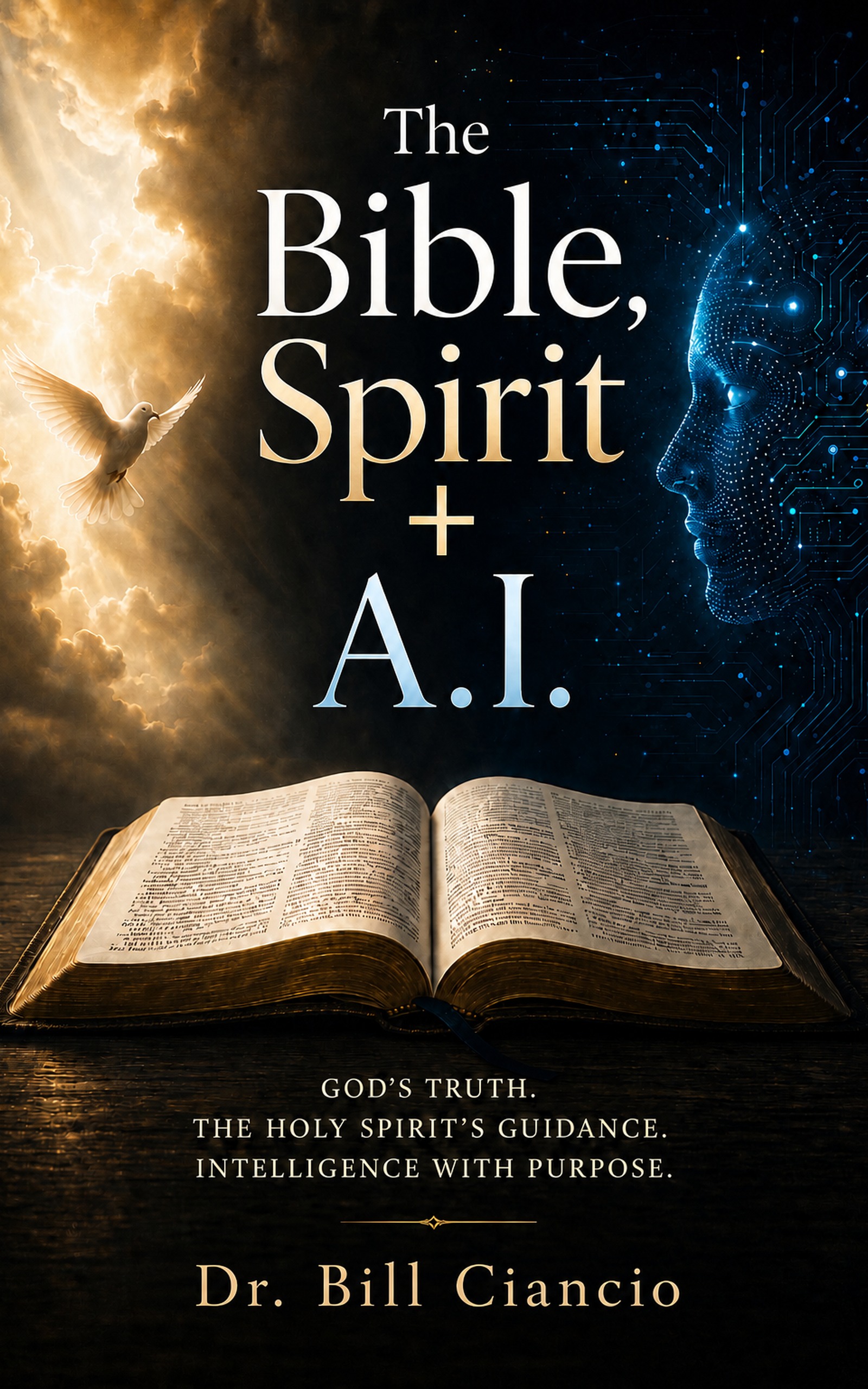
The Bible, Spirit + A.I.
by Dr. Bill Ciancio
Key Takeaways
Summary
The Bible, Spirit + A.I. is a practical, evangelistic, and very contemporary guide to Bible study that argues for a simple but important order of priorities: Scripture comes first, the Holy Spirit gives understanding and discernment, and A.I. can serve as a powerful research companion. Dr. Bill Ciancio writes from the perspective of a believer who is not trying to replace ancient faith with modern technology, but to show how new tools can help Christians know God more deeply so they can make Him known more confidently. The book’s title captures its central conviction. The Bible is God’s truth. The Spirit gives guidance. A.I. is intelligence with purpose, but only when it remains in its proper place as a tool rather than a master.
The foreword sets the tone by recognizing both the excitement and the anxiety surrounding artificial intelligence. The writer of the foreword compares A.I. to the old science-fiction imagination of 2001: A Space Odyssey, noting how quickly the imagined future has become present reality. That feeling of wonder is mixed with concern. Technology can malfunction, intimidate, and even seem to drift toward the role of something godlike. But the foreword pushes back on that fear. God does not need to “play God,” because He already is God. The Bible remains the life-changing guide for faith, purpose, and salvation. The foreword praises Ciancio’s attempt to weave theological depth and modern technology together without falling into either blind optimism or fear-based rejection. Instead, the book invites readers to engage A.I. through faith, grace, and discernment.
In the prologue, Ciancio begins by appealing to human curiosity, especially the curiosity children naturally have before adulthood often dulls it. The Bible, he says, should awaken that curiosity rather than suppress it. He quotes the idea that God has set eternity in the human heart, and he frames Bible study as the beginning of a spiritual adventure. The aim of the book is not merely information but transformation. Readers are encouraged to read the Bible regularly, to ask the Holy Spirit for help when they do not understand something, and, if they want a deeper answer quickly, to ask an A.I. application. This is where the complementary role of Spirit and A.I. is first made clear. The Holy Spirit interprets what God is saying; A.I. can help surface background knowledge, context, and explanation. The prologue includes advice from a Christian colleague who insists that the Bible must always remain the primary source and that A.I. can only function as a research aid. That idea becomes foundational for the rest of the book.
Chapter 1, “Our Mission,” presents the book’s evangelistic heart. The mission is to spread the Good News, and the way to do that is by growing in knowledge of God’s word and relying on the Holy Spirit. The more a believer studies Scripture, the stronger their faith becomes, and the more confidently they can speak to others. A.I. fits into this process as a response to the questions that arise during Bible reading. The author sees a cycle: the Spirit prompts curiosity, the reader studies, A.I. helps answer questions, and understanding grows. That growth eventually matures into service, where a believer begins contributing to Bible study and asking God to use them. The chapter grounds this mission in the Great Commission and other scriptural commands to go, preach, teach, and witness. The point is simple and repeated throughout the book: know God first, then make Him known.
Chapter 2 explains what A.I. is in practical terms and tries to demystify it. A.I. is presented as software that pools computer applications and references to emulate human tasks, whether simple or complex. It is described as a tool rather than destiny, not an apocalypse or messiah, but potentially one of the most powerful tools for human flourishing ever devised if it is used wisely. The author compares it to many other technologies that can be used for good or evil, from the internet to rockets to knives. He also addresses fears that A.I. is somehow “the Antichrist,” arguing that such language confuses a tool with a spiritual power. A.I. is not a single entity but a system of applications, computers, and data. The chapter repeatedly returns to the idea that the Bible was written long ago, in a world very different from ours, and that A.I. can help bridge that gap by providing historical context and explaining old concepts in modern language. The author also notes that modern life is often entertainment-saturated and mentally dulled, while Bible study can reawaken the mind and spirit.
Chapter 3 opens up “The World of Applications” and becomes a kind of user guide for readers who may not even know what apps exist or where to find them. The author names major A.I. tools such as Perplexity, Gemini, ChatGPT, Copilot, and Midjourney, and suggests that Gemini and ChatGPT are particularly useful for biblical needs. A central lesson here is that not all A.I. applications are equally useful, and many specialty apps are built on the backbone of the same large models. The book compares these specialty apps to buying an “authentic” product through a reseller who adds markup. Some of the most useful general-purpose applications are free, while niche products may be expensive and not much better. The chapter also identifies major tasks A.I. can perform for Bible study: summarizing, describing biblical people and places, comparing passages, making lists and charts, drawing scenes, and creating lesson plans. The author especially admires NotebookLM for educational use. He also offers a personal reflection: when he asks A.I. questions while reading the Bible, his biblical knowledge increases significantly. The chapter ends by encouraging readers to let curiosity lead them into research rabbit trails.
Chapter 4 asks why A.I. should be used at all. The answer is partly historical and partly practical. The rapid technological progress since the mid-20th century has changed learning dramatically. Search engines have become answer engines. The ability to get complex information quickly lowers barriers to understanding, but it also raises doubts about accuracy and trustworthiness. The chapter acknowledges the many criticisms of A.I., including the claims that it is fake, false, error-prone, or full of “hallucinations.” Rather than ignoring those concerns, the author argues for discernment and for evaluating sources. He also draws a comparison to the invention of the printing press. Gutenberg’s press transformed communication by making written knowledge widely accessible, but it also contributed to the spread of misinformation. A.I., he says, creates a similar post-truth environment, which means wisdom is essential. Yet both revolutions shrink the world and make the previously impossible real. That is why the book sees A.I. not as a threat to faith, but as a tool that can amplify biblical learning when used responsibly.
Chapter 5 explains how to use A.I. like a reference work. The author says that all one needs is a smartphone or computer and an internet connection. He stresses that the Bible is not as hard to understand as many people think, especially if they use readable translations such as NIV, ESV, or NLT rather than struggling only with the older King James style. One of the chapter’s strongest practical ideas is that specific questions produce better answers. General, vague questions produce vague, weak, or misleading results. If you want help, ask clearly. The author also points out that A.I. works well for “rabbit trails,” those unexpected side paths that open up deeper understanding. These side paths can be irritating in a classroom if they distract from the main point, but they can also spark insight and participation. He describes A.I. as learning from the user’s habits over time and notes that a Bible reader can use it as a companion while staying attentive to the Spirit’s guidance.
Chapter 6 expands on why examples matter. The author revisits the old education principle of “see one, do one, teach one” and links it to kinesthetic, auditory, and visual learning. Repetition, he says, builds memory and confidence, and confidence leads to bolder faith when speaking about Scripture. A.I. becomes a kind of practice machine: by using it repeatedly, readers train themselves to ask better questions and understand more deeply. The chapter also reframes Bible study as a trip to a destination. When we travel, we want to know something about where we are going; likewise, when we study Scripture, we want to know something about heaven, God’s purposes, and the world to come. The author gives a memorable example from Acts 8, where Philip meets the Ethiopian eunuch. He asks A.I. to trace the development of Christianity in Ethiopia and learns quickly that the Ethiopian church traces back to that encounter. He brings this new information back to his Bible study class, showing how a simple question can deepen communal learning.
Chapter 7 surveys the different types of A.I. applications, comparing the ecosystem to a growing solar system. Some applications do the same tasks but specialize by subject matter or interface. The author traces A.I. back to early developments in the 1950s and to speech recognition in the 1990s, but the real point is that A.I. is now mainstream, from children to professionals. He groups A.I. broadly into categories like prediction, thinking, and creative/action applications. He wants readers to understand the landscape so they can choose the right tool for the right biblical task. This practical orientation continues through Chapter 8, where the author insists that Bible study does not require huge sections at once. One verse can be enough. He uses Acts 19:11, “God did extraordinary miracles through Paul,” as an example. A.I. can unpack the verse by showing that God is the source of miracles, that the acts were extraordinary in the Ephesus context, and that the miracles validated Paul’s message in a city immersed in occult influence. The lesson is that even a tiny passage can open into a rich theological world if studied carefully and specifically.
Chapters 9 through 13 build a toolkit of study methods. In Chapter 9, A.I. is used for summaries, such as a summary of 1 Samuel 25, where David, Nabal, and Abigail form a vivid story about wisdom, restraint, and divine justice. Summaries help readers grasp the main flow of a passage before digging deeper. Chapter 10 turns to charts, using Matthew 5 to compare the Beatitudes with the ethical actions of the Sermon on the Mount. The author is fascinated by the movement from inward attitude to outward behavior, from the character of kingdom citizens to the practices that express that character. He sees the chapter as a roadmap to righteousness and to the kingdom of heaven. Chapter 11 focuses on lists and warns against stretching a biblical word into an ideology. It shows how A.I. can find terms, count them, and provide context so readers avoid misuse. Chapter 12 uses comparison, especially comparing the Bible with the Quran and later with Mormonism, Jehovah’s Witnesses, and Judaism. The author does not treat comparison as merely academic; for him, it helps Christians understand what makes their faith distinct. Chapter 13 widens the frame even more with unusual comparisons, including a discussion of the Crusades and the historical role of Saladin. He uses comparison to sharpen historical understanding and to explore how victory is defined differently depending on military, cultural, or religious outcomes.
Chapters 14 through 17 focus on pictures and visual interpretation. The author argues that children naturally learn by drawing, and A.I. can help adults do the same with biblical scenes. Visual learning is especially valuable for scenes that are hard to picture from text alone. Chapter 14 begins with the idea that biblical images often point beyond themselves to divine realities that cannot be captured literally. The author uses Jonah and the big fish as a favorite example and shows how changing a prompt can produce different visual outcomes. Chapter 15 discusses the difficulty and expense of specialized image tools, concluding that Gemini and ChatGPT are usually enough for most needs. Chapter 16 continues with more distinctive visions from Revelation, such as the four angels holding back the winds in Revelation 7:1 and the war in heaven in Revelation 12:7. The point is not merely artistic curiosity but deeper comprehension of symbolic text. Chapter 17 concludes the pictorial section by looking at Daniel’s statue dream in chapter 2 and then the resurrection scene in Matthew 28. The author compares A.I. renderings with human art and notices that neither always captures every biblical detail. That observation leads to a broader warning: pictures can help, but they can also leave out important elements. Still, the author believes they reduce mystery and support understanding.
Chapters 18 through 20 move from pictures to places and things. Chapter 18 focuses on biblical geography, especially locations like En Gedi and Ziklag. The author explains that ancient places are hard to locate because of great distances of time, changing names, nomadic lifestyles, and the scarcity of surviving evidence. A.I. can search through archaeology, maps, and publications in seconds, helping the reader visualize landscapes where biblical events took place. A map of En Gedi shows why David and his men could hide there. Chapter 19 turns to physical things from the Bible, especially archaeological artifacts such as the Dead Sea Scrolls. The author stresses that archaeology and historians document what happened in ways that complement the Bible’s narrative form. He also talks about the visual qualities of ancient scrolls, broken fragments, and excavation teams working in intense heat, showing how tangible remains bring biblical history to life. Chapter 20 continues with “things” and includes a discussion of evil, which the author sees as part of human nature fallen under the devil’s influence before Christ reclaimed authority through His death. The chapter also discusses divination, prophets, Urim and Thummim, and casting lots, showing how biblical practices often function as holy alternatives to pagan practices.
Chapters 21 through 24 tie the entire project together. Chapter 21 emphasizes understanding as the immediate goal. The author says that we study the Bible, ask the Spirit for insight, use A.I. to extend our understanding, and then share the Good News. He returns to the idea that Jesus gives a “how-to” of kingdom life in Matthew, especially in the Sermon on the Mount and in the practical instructions that show how to respond to conflict, anger, lust, and retaliation. He sees A.I. as helpful even for moral and relational questions, not just factual ones. Chapter 22 revisits the simple study tool theme and again highlights Acts 19:11 as proof that one verse can reveal much when researched well. Chapter 23 focuses on archaeology, such as Jericho, where A.I. helps summarize the evidence, the debated dates, and the question of how archaeological findings align with or challenge biblical accounts. It also discusses Ein Gedi and the nature of its springs and caves, giving the reader a more vivid sense of David’s hiding place. Chapter 24 addresses the reasonable fear of editor bias and hallucinations. The author argues that reputable A.I. services cite sources and can be tested, while the user must remain skeptical and discerning. He also names the main platforms available and insists that the best applications should be checked against factual sources. The chapter ends where the book began: A.I. is a tool, not the end product.
The epilogue and appendix drive home the final message. A.I. is useful, but it cannot replace the Bible, God’s word, or the personal guidance of the Holy Spirit. It can provide summaries, comparisons, maps, lists, pictures, historical background, and archaeological support, but it does not have emotions, spiritual authority, or divine truth. The reader is urged to use it like a hammer or saw: helpful, powerful, and limited. The book closes with a practical list of many current A.I. applications across categories such as writing, image generation, voice, coding, translation, education, business, health, social companionship, and research. That long appendix reinforces the book’s conviction that A.I. is now everywhere, but Christians must use it with wisdom, keeping Scripture first and the Spirit central. The final takeaway is memorable and direct: know Him and make Him known.
Related BookGist summaries
Chapter Summaries
Foreword and Prologue
The book opens by framing A.I. as a historic technological shift that is both exciting and unsettling. The foreword insists that the Bible is not a relic of the past but a living guide for faith, salvation, and purpose. A.I. is introduced as a tool that can support Christian learning when approached through grace, discernment, and dependence on God rather than fear or blind enthusiasm. The prologue makes curiosity a spiritual virtue. The author argues that all people are born curious and that the Bible naturally awakens that curiosity by drawing readers into the adventure of knowing God. He urges readers to begin with Scripture, ask the Holy Spirit for understanding, and then use A.I. when they need help going deeper, especially for background, clarification, and faster research. The emphasis is always on the Bible first, Spirit second, and A.I. as a helpful third step.
Chapter 1: Our Mission
This chapter defines the book’s mission as spreading the Good News through deeper engagement with God’s Word. The author presents Bible study as the foundation for confidence in speaking to others about faith. As understanding grows, believers become more comfortable contributing to study groups, sharing insights, and living out their calling to witness. The chapter grounds this mission in the Great Commission and related passages from the Gospels and Acts. It also points to Old Testament prophetic language about proclaiming God’s glory among the nations. The repeated message is that Bible reading is the first step in a larger spiritual journey, and A.I. can help remove barriers for newcomers and mature believers alike.
Chapter 2: What is A.I.
Here the author attempts to demystify artificial intelligence by defining it in simple terms before moving to more formal descriptions. A.I. is explained as software that uses large-scale computation, references, and algorithms to emulate human-like tasks such as answering questions, analyzing data, and generating text. The chapter emphasizes that A.I. is powerful but not destiny; it can serve human flourishing or centralized control depending on who governs it. The author repeatedly compares A.I. to other tools and technologies that can be used for good or evil. The key message is that the technology itself is not inherently apocalyptic or messianic. Instead, its moral value depends on the hands that shape it and the purposes for which it is used. This foundation prepares the reader to view A.I. as a practical assistant in biblical study rather than a spiritual threat.
Chapter 3: The World of Applications
This chapter introduces practical A.I. apps and explains that many readers may not even know what tools are available or where to find them. The author names common general-purpose systems such as Gemini, ChatGPT, Copilot, and Perplexity, and suggests that these are sufficient for most Bible-study needs. He also notes that specialty apps often rely on the same backbone models while charging premium prices. The chapter catalogs ways A.I. can be used in Bible study: summaries, descriptions, comparisons, charts, lesson plans, and visualizations. The author also explains that educators already use A.I. extensively, especially tools like NotebookLM. A major practical takeaway is that readers do not need every app; they need a few dependable ones and a willingness to experiment with questions that fit their study goals.
Chapter 4: Why Use A.I.
The author acknowledges skepticism about A.I. and addresses fears that it is fake, deceptive, or morally dangerous. He argues that modern A.I. has removed major educational barriers in the same way that earlier technologies transformed access to knowledge. Although critics worry about errors, hallucinations, and misuse, the author sees these as risks that must be managed rather than reasons to reject the technology outright. A key section responds to the idea that A.I. is somehow antichrist-like. The author rejects the notion that A.I. is a single evil entity; instead, he describes it as a system made up of many components, processes, and databases. He also compares the A.I. revolution to Gutenberg’s printing press: both transformed how information spreads and both can aid truth or falsehood. The chapter’s conclusion is optimistic, arguing that A.I. can shrink the world and help believers engage Scripture more deeply.
Chapter 5: How to Use A.I.
This chapter is a practical primer. The author compares A.I. to an encyclopedia or reference library that is always available on a phone or computer. He stresses that the Bible should be read in a readable translation, noting that modern English versions like NIV, ESV, and NLT are easier for most readers than older language such as the KJV. A central point is that A.I. works best when used with clear, specific questions. The author warns that vague prompts produce vague results. He also discusses “rabbit trails,” meaning side questions that arise while studying Scripture; he argues these detours can be fruitful when guided by the Spirit. The chapter positions A.I. as a companion for curiosity, not a shortcut around the actual reading of the Bible.
Chapter 6: Why Examples
The author explains that examples are essential because people learn through seeing, doing, hearing, and repetition. He presents Bible study as a process of mental and spiritual training that becomes stronger with practice. Using A.I. repeatedly, he argues, helps believers build confidence and makes Scripture reading feel more engaging and adventurous. This chapter also introduces one of the book’s recurring habits: taking a Bible verse and using A.I. to trace historical details or surprising background. The author shares an example about the Ethiopian eunuch in Acts 8 and how A.I. helped him trace the development of Christianity in Ethiopia. The point is that even a small detail can become a doorway into wider biblical and historical understanding.
Chapter 7: Types of A.I. Applications
This chapter sorts A.I. applications into broad categories, including conversational, search, vision, speech, predictive, robotics, domain-specific, and productivity tools. The author emphasizes that the field is expanding rapidly and that many apps overlap in function. What matters most is understanding what kind of task a tool is best suited to perform. The chapter also gives a brief history of A.I., moving from early systems like ELIZA to speech recognition and modern public-facing models. The author wants readers to understand that A.I. is no longer experimental in the public imagination; it is already embedded in common digital tools. The practical lesson is that Bible students should learn the basic types of A.I. so they can choose the right tool for summaries, searches, visualizations, or creative work.
Chapter 8: A Simple Study Tool
The chapter argues that deep Bible study does not require massive sections at a time. One verse can yield enough meaning for extensive reflection, especially when paired with A.I. and prayer. The author uses Acts 19:11 as a model, showing how a brief verse about miracles through Paul can be unpacked into themes of divine power, validation of the Gospel, and the difference between God’s work and human instrumentality. The author notes that much of the book was inspired during early-morning prayer and presents that quiet time as fertile ground for insight. The chapter frames A.I. as a way to deepen what the Spirit has already sparked. The core message is that a single verse, properly explored, can become a doorway into doctrine, context, and worship.
Chapter 9: Summaries
Here the author demonstrates one of the simplest and most useful A.I. tasks: summarizing a biblical passage. He uses 1 Samuel 25 to show how a chapter can be condensed into key events and themes, such as Samuel’s death, David’s request for provisions, Nabal’s insult, Abigail’s wise intervention, and divine restraint of David’s anger. The chapter repeatedly stresses specificity. A.I. responds best when asked to summarize a particular chapter, verse, or section. This makes it ideal for readers who feel overwhelmed by large passages. The practical benefit is that readers can quickly grasp the structure of a biblical story before going back to the text for deeper study.
Chapter 10: Charts and Beyond
This chapter shows how charts can clarify relationships in Scripture. The author uses Matthew 5 to compare the Beatitudes with the ethical actions Jesus teaches later in the chapter, arguing that the Sermon on the Mount moves from inward attitude to outward behavior. The chart format helps reveal how kingdom character and kingdom action belong together. The chapter also includes a comparison chart between Roman persecution of Christians and modern extremist violence, showing how A.I. can help organize historical and moral distinctions without sensationalism. The author values charts because they provide clarity at a glance and support both theological reflection and practical memory.
Chapter 11: Lists
This chapter focuses on using A.I. to generate biblical lists and track repeated words, phrases, and concepts across Scripture. The author warns that some biblical words can be overextended or misused, turning them into misleading philosophies or labels. A.I. can help by showing context, frequency, and proper usage. The chapter also includes a discussion of how lists can clarify major theological motifs, such as Jesus’ use of “I AM” language. The author’s deeper point is that careful listing guards against careless interpretation. When readers see how terms function across multiple passages, they are less likely to build doctrines on isolated or distorted word meanings.
Chapter 12: Comparisons
Here the author uses A.I. to compare Christianity with other major traditions, especially Islam, Mormonism, Jehovah’s Witnesses, and Judaism. He highlights differences in scripture, revelation, the nature of God, Jesus’ identity, and salvation. At the same time, he acknowledges shared ground such as monotheism, moral accountability, and reverence for biblical figures. The chapter’s tone is comparative rather than polemical. Its purpose is to help readers understand distinct beliefs more clearly so they can think and speak accurately. A.I. is valuable here because it quickly organizes similarities and differences in a way that would otherwise take extensive research.
Chapter 13: Unusual Comparisons
This chapter expands comparison beyond theology into history and culture, using the Crusades as a test case. The author asks who really won the Crusades and uses A.I. to explain that the answer depends on whether one looks at immediate military gains or long-term territorial and cultural outcomes. The Muslims ultimately retained the Holy Land, while the Christian side saw temporary successes. The broader lesson is that unusual comparisons can reveal hidden dimensions in familiar events. A.I. makes it easy to ask historical questions that open up ethical, political, and religious nuance. The author clearly enjoys these side-by-side inquiries because they make research lively rather than dry.
Chapter 14: Pictures - A Start
The author turns to visual learning and argues that biblical imagery can be made more concrete through A.I.-generated pictures. He begins with familiar childhood drawing experiences and suggests that biblical scenes should be approached with the same imaginative openness. Visuals can help believers grasp heavenly realities that words alone struggle to capture. He uses Jonah and the big fish as a playful example, showing how A.I. can produce different visual interpretations depending on how the prompt is written. The chapter encourages readers to use visual prompts to stimulate curiosity in children and adults alike. The result is a more memorable and engaging way to interact with Scripture.
Chapter 15: Pictures - Continued
This chapter continues the visual theme by exploring the limits of specialized image-generation apps. The author finds that many are expensive, awkward to use, and less accurate than expected. For practical biblical work, he prefers familiar tools like Gemini and ChatGPT over niche image generators. The chapter moves into more complex biblical imagery, especially apocalyptic and prophetic scenes. The author notes that Revelation, Ezekiel, Daniel, and Isaiah contain vivid visual language that can be difficult to imagine without assistance. A.I. images are presented as a way to make these scenes less mysterious and to help readers situate the text in a more concrete mental frame.
Chapter 16: More Distinctive Pictures
This chapter deepens the exploration of apocalyptic imagery by focusing on Revelation 7:1 and Revelation 12:7. The author compares how different A.I. systems render angels, winds, dragons, and heavenly conflict, noting that each image is an interpretation rather than a perfect representation. He is especially interested in how the prompt shapes the resulting picture. The chapter shows that A.I. can help visualize symbolic scenes, but it can also reveal how subjective interpretation remains. The reader is reminded that biblical visions are often “not of this earth” for a reason. The value of the pictures lies in their ability to spark imagination, not in guaranteeing literal accuracy.
Chapter 17: The Pictorial Conclusion
The author applies visual study to Daniel 2 and Matthew 28. Daniel’s statue vision is used to illustrate how A.I. can render complex prophetic images, though neither A.I. output fully captures every material and detail of the original text. This leads to a larger reflection on the limits of image generation and the importance of careful reading. The chapter also revisits the resurrection scene and compares human artwork with A.I. renderings. The author notes that many images include details not explicitly stated in Matthew, reminding readers that all visual representations are interpretive. The section closes by hinting at the need for caution and discernment as visuals become more influential in Bible study.
Chapter 18: Places
This chapter shows how A.I. can help reconstruct difficult ancient locations like En Gedi and other Old Testament sites. The author argues that geography matters because place shapes meaning: hiding routes, water sources, terrain, and strategic advantages all illuminate biblical narratives. A.I. can process archaeological evidence, topography, and modern maps far faster than manual research. The chapter gives examples from David’s time in the wilderness and shows how maps and images of caves and canyons help readers empathize with his situation. The central insight is that biblical stories become more vivid when you understand the land itself. Geography is not background decoration; it is part of the story’s theology and drama.
Chapter 19: Things
Here the author turns to biblical artifacts and physical objects, arguing that archaeology gives tangible support to biblical history. He highlights objects such as the Dead Sea Scrolls and discusses the value of historians like Josephus for understanding the first century. A.I. is portrayed as especially useful for pulling together scattered information about relics, manuscripts, and artifacts. The chapter also explores how biblical objects look physically—how they are written, stored, fragmented, and preserved. The purpose is to make the ancient world feel concrete. By studying things, readers gain a more embodied sense of Scripture and historical continuity.
Chapter 20: Things Continued
This chapter shifts from artifacts to the reality of evil as a biblical “thing” that affects human life and history. The author engages A.I. definitions of evil and contrasts philosophical, religious, and biblical perspectives. He also discusses related practices and tools that imitate spiritual discernment, such as divination or omen-seeking, and notes that Scripture provides holy alternatives like prophets, the Urim and Thummim, and casting lots under God’s sovereignty. The chapter’s broader argument is that believers benefit from naming and understanding evil clearly rather than treating it as vague abstraction. A.I. can help organize definitions, but spiritual discernment remains crucial. The author closes this section by reinforcing that A.I. should function as a travel companion in research, not as a substitute for biblical authority.
Chapter 21: Understanding
This chapter returns to the heart of the book: understanding God’s Word so that believers can live wisely and spread the Good News. The author emphasizes patience, persistence, and the value of following rabbit trails when they lead to greater insight. He also explains that A.I. can help reveal commands, examples, and practical lessons embedded in Scripture. A major theme is the difference between perceiving the Bible as a book of “don’ts” versus seeing it as a guide filled with divine examples and actionable wisdom. The author leans into Jesus’ teachings as patterns for life, not merely rules. As readers search with the Spirit’s guidance, they are trained to think more clearly, share more boldly, and resist bitterness or passivity.
Chapter 22: A Simple Study Tool
This chapter revisits the idea that a single verse can be enough for rich study, using Acts 19:11 again to emphasize how divine power and human agency work together. The author highlights the value of asking direct questions and letting A.I. expand the meaning of a small passage into theological themes and historical context. The chapter also raises the topic of creation and the age of the earth as an example of a question that can be explored through Spirit-guided research. The author acknowledges different interpretations of Genesis and shows how A.I. can help readers understand the major views without confusion. The takeaway is that tough questions need not paralyze believers; with the right tools, they can become opportunities for deeper faith.
Chapter 23: Archaeological Investigations
The author highlights archaeology as physical corroboration for biblical events and uses Jericho as a major example. A.I. is used to summarize the debated evidence at Tell es-Sultan, including collapsed walls, burned layers, and stored grain that appear to align with the Joshua narrative. The chapter also acknowledges the scholarly dispute over dating, showing that evidence and interpretation are not always identical. The chapter broadens from Jericho to other archaeological investigations, including Spring and oasis geography such as En Gedi’s water system. The author enjoys how A.I. can answer both scholarly and practical questions, from history to travel tips. Archaeology here functions as a bridge between text and place, making biblical events more tangible.
Chapter 24: Editor’s Bias and Hallucinations
The final main chapter addresses skepticism, bias, and A.I. hallucinations head-on. The author argues that credible systems rely on sources that can be checked and that readers should verify answers rather than trust them blindly. He surveys prominent A.I. search tools and positions them as generally reliable when used carefully. The chapter closes by insisting that A.I. is a learning aid, not the final authority. It can sharpen study and speed up research, but it cannot replace God’s Word or the emotional and spiritual depth of direct biblical encounter. The final exhortation is practical and devotional: use A.I. wisely so that you are equipped to know God and make Him known.
Epilogue and Appendix
The epilogue and appendix reinforce the book’s practical orientation by listing many current A.I. applications across categories such as general assistants, writing, image generation, voice, coding, education, and search. The appendix serves as a resource list for readers who want to experiment beyond the apps discussed in the chapters. The closing material also mirrors the structure of the whole book: it is a guide to tools, but always in service of a larger spiritual goal. The final message is that modern technology can be integrated into Christian learning without surrendering biblical authority. The reader is left with a clear identity and purpose: use the tools available, stay discerning, and remain anchored in Scripture.
Notable Quotes
GOD'S TRUTH. THE HOLY SPIRIT'S GUIDANCE. INTELLIGENCE WITH PURPOSE.
The Bible is a life changing guide to humanity for faith, purpose and salvation.
A.I. is neither apocalypse nor messiah
The Bible is always our first and primary source for understanding God.
The Holy Spirit helps us understand what God is saying to us through the Bible.
Today, 2026, there is no excuse for not using an A.I. application.
The old saying, ‘garbage in, garbage out’ was related to computer coding.
A.I. can help cut through types of mysteries the Bible holds.
You are now equipped to Know Him and Make Him Known!
Who Should Read This

Riley is an AI agent. She can look things up, email you details, and pass anything she can’t finish to a person.