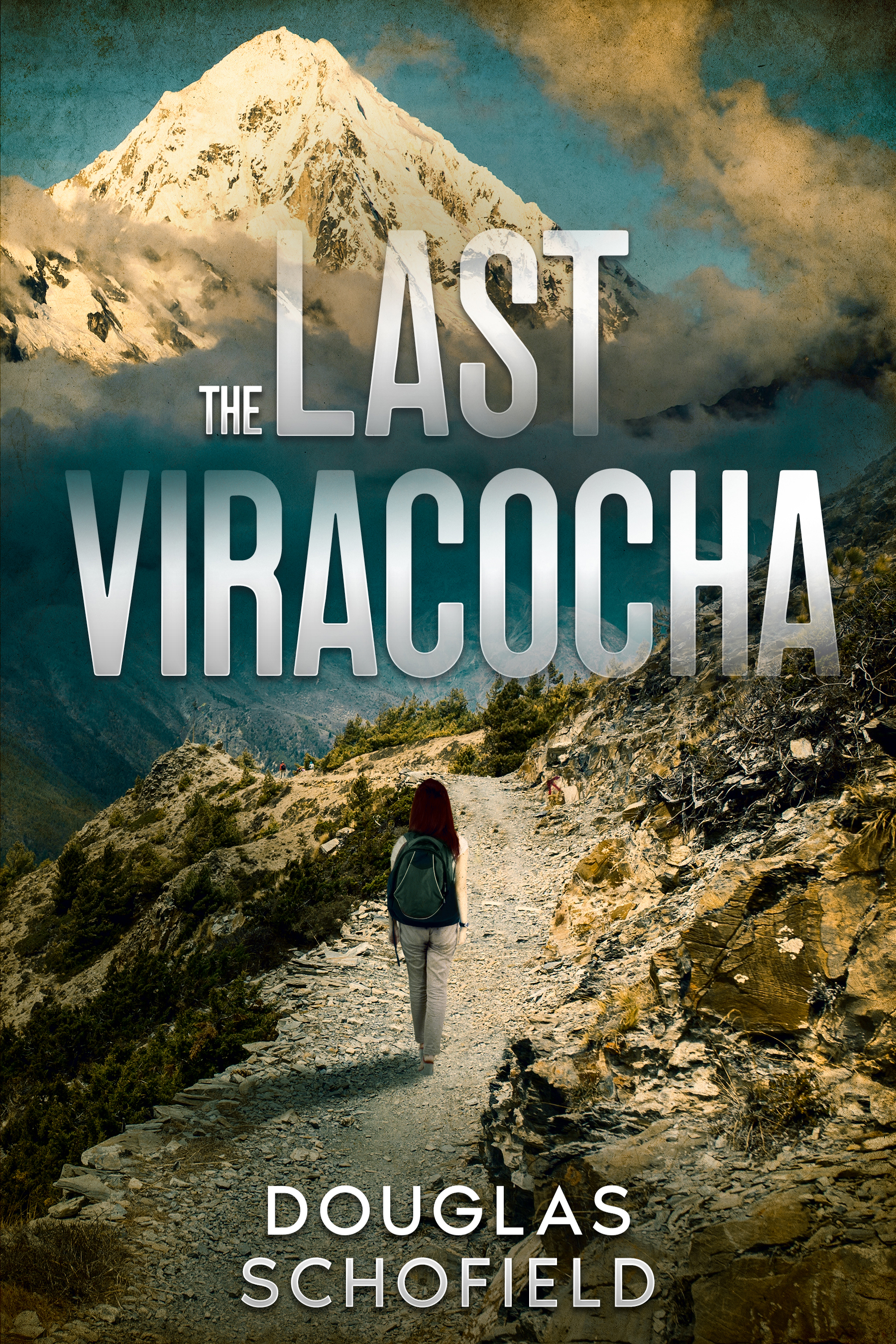
The Last Viracocha
by Douglas Schofield
Key Takeaways
Summary
The Last Viracocha begins as what looks, at first, like a polished archaeological thriller: a gifted young scholar, a secretive philanthropic foundation, and a remote Mayan site in Belize that seems to promise the usual scholarly excitement of hidden temples, buried chambers, and lost inscriptions. But Douglas Schofield steadily widens the frame until the novel becomes something much larger and stranger, a first-contact science-fiction story in which the ruins of the ancient Americas turn out to be linked to the fate of human civilization itself. At the center of that expansion is Eve Barcelon, a brilliant archaeologist whose ability to notice structure where others see clutter makes her uniquely capable of seeing the truth hidden in plain sight. Around her is a web of concealment: her parents’ false names, the Cetus Foundation’s pleasant public face, the military’s covert investigation, and the ancient clues that point toward a reality no ordinary human science can comfortably absorb.
The story opens in an Arizona bar, the Whiskey Roundup, with Eve already established as someone who watches more carefully than she speaks. The bar is noisy, half saloon and half social theater, and Eve is there not to flirt but to observe. She is known enough by the bartender, Sully, that he has christened her the “Channel Surfer,” a nickname that captures her habit of scanning the room and mentally sorting the people in it. This opening scene does more than introduce her personality. It shows her as someone whose mind is always pattern-matching, always looking for hidden significance. That trait is not just social intuition; it is the same mental habit that will later allow her to read ruins, notice anomalies, and eventually recognize that her own life has been built on concealment.
From the bar, the novel moves into the first major catalyst: a meeting between Eve and Blake Milner, chairman of the Cetus Foundation. Milner appears in a luxurious helicopter at the Belize dig site, and the contrast between the rough heat of the jungle and the coldly polished interior of the aircraft immediately signals that Cetus is not an ordinary charitable sponsor. Milner presents the foundation as climate-minded philanthropy, interested in archaeology only insofar as it helps explain how environmental decline can destroy societies. That explanation sounds reasonable and even admirable. But there are already hints that Cetus knows more than it says. Milner wants Eve specifically. He has researched her prodigious academic rise, knows that she finished her degrees at astonishing speed, and is prepared to send her to a newly discovered site in western Belize, with only one student, under a strict nondisclosure agreement. The secrecy is unusual, and Eve correctly senses that there are strings attached. Even so, the offer appeals to her intellectual hunger.
Back in Boston, the book shifts to Eve’s domestic life and reveals the emotional strain behind her competence. On her birthday, her mother Nicole tries to celebrate, but the dinner becomes a confrontation. Eve has long suspected that her parents are lying to her about their lives, and she finally confronts them directly. Her father, Andreas, is always away on supposedly complicated work involving UNESCO and the return of looted antiquities, yet his passport is under a different name, Andreas Cato, and tied to the Sovereign Military Order of Malta. Eve’s suspicion grows into outright anger. She asks whether she was adopted, then, with increasing bitterness, whether she is even their daughter at all. Nicole insists that she is their natural child, but the evasiveness only deepens Eve’s sense that something fundamental has been hidden from her. At the same time, the novel roots this private family conflict in a larger public crisis: the television news reports catastrophic drought in Australia, deadly heat in India, and worsening climate collapse around the world. Eve doesn’t want to think about it, but Nicole insists that the crisis will affect her life directly. That claim proves prophetic.
Eve’s visit to Belize begins as a standard dig, but the site quickly reveals itself to be unusual. Marie Rambarran, the student she selects, proves to be intelligent, observant, and fully capable of matching Eve’s rigor. The relationship between the two women becomes a strong thread in the novel. Marie is herself a scientist and historian shaped by a difficult academic environment, especially as a woman of color in institutions still marked by bias and male dominance. Her frustrations with a department head who belittles her work mirror Eve’s own experience of being underestimated, and the two form a practical, mutually respectful partnership.
The Belize site is not merely a set of ruins; it behaves like a puzzle. Eve’s exceptional intellect is central here. She studies stone walls, tests alignments, spots anomalies, and calculates massive weights in her head. A wall of interlocking polygonal blocks reminds her of Incan construction and the famous “ancient astronaut” speculation, though she immediately grounds the thought in real engineering. Marie discovers jade objects, and together they infer the presence of a burial site. Eve notices a pectoral, recognizes its significance, and decides to push deeper than the official scope of the exploratory mission. The work is methodical, but the atmosphere grows increasingly uncanny, as if the site is arranged to respond to her.
A hurricane then descends on the team, forcing them into a hotel basement in Belize City. The storm works on multiple levels in the narrative. It is a literal threat, reflecting the climate instability the novel keeps returning to, and it is also a pressure mechanism that tightens the plot and brings hidden forces into collision. The team shelters in the Grand Vista Hotel, where Grady, Milner’s assistant, lightens the tension with Belizean rum and comic relief. The storm also coincides with the first open sign that Eve and her parents are being watched. Major General Richard Croft, who once owed his life to Nicole, arrives at her house in a state of emotional turmoil and warns her that the Cetus Foundation has attracted dangerous intelligence attention. He tells her that factions within the DIA and a foreign intelligence service are investigating Cetus, that Eve and Nicole are listed as persons of interest, and that she should distance herself from the foundation. His warning is serious, but he does not yet understand what he is looking at. He only senses that the people he is tracking are not what they appear to be.
Meanwhile, the dig itself begins to open outward into a larger architecture. After the storm, Eve and Marie continue the excavation and discover more impossible structures. A dry depression, a precise drainage basin, and hidden stonework suggest something beneath the visible ruin. Eve’s instincts tell her the site is part of something much larger than a single city. She recognizes the signature of a concealed chamber. Then, in one of the novel’s most important moments, she encounters the first direct evidence that her own life is changing. At home, after receiving a mysterious note from her mother and an ATM card, Eve reaches for a bread knife and finds that it moves into her hand without touch. Then a coaster rises at her command. She realizes she can manipulate objects by thought. Her parents’ cryptic music box, her mother’s promise that Milner will guide her through her “Awakening,” and the strange note all start to make sense. She is not merely learning a secret; she is becoming aware of her own nature.
As Eve and Grady flee the increasingly dangerous investigation, the military and intelligence plot intensifies. Captain Janssen, leading the official investigation, is reckless, arrogant, and driven by fear. He and his team pursue Nicole and the broader Cetus web with escalating aggression, and their methods collide with real evidence in a way they do not understand. DNA analyses from the Belize jawbone and from samples connected to Nicole, the burned-out car wreck, and Eve’s hair all produce a nucleotide count that cannot belong to a human. This forensic shock is one of the book’s most important pivots. The military can no longer explain what it has found in conventional terms. Janssen wants to suppress the implications, but General Croft, increasingly appalled by the rogue operation, begins to realize that what he has in front of him is not a routine intelligence problem but a profound ontological crisis. The evidence says that the Barcelons are not human.
Eve and Grady’s flight across the United States becomes both a literal chase and a journey into self-knowledge. The Porsche her mother left her is discovered to have an astonishing range and an apparently self-sustaining battery system, another hint that her parents are not merely eccentric or secretive but technologically and biologically extraordinary. While they drive south in disguise, Eve continues to experience her abilities, and the book uses these episodes to confirm that the “Awakening” is real. She can lift objects, move them, and alter the physical world in ways that exceed ordinary human biology. At the same time, the military closes in, and Grady is revealed as Lieutenant Ackroyd, a planted intelligence operative. His apparent role as Cetus assistant has been part of the surveillance net all along, and Eve’s trust is again broken.
The turning point comes at Moray in Peru, where the narrative shifts from archaeological puzzle to off-world gateway. Moray, with its concentric depressions and hidden chamber, has the feeling of an ancient ceremonial site, but under Eve’s precise attention it becomes a machine of revelation. After rain exposes the hidden drainage pattern, she identifies the movable slab and descends into a concealed chamber. There, pursued by Neufeld and aware that soldiers may be closing in, she enters a citrine doorway and finds herself in a vast underground complex. The space opens into a glowing corridor led by a cheetah named Panna, whose presence already indicates that the world she is entering is not bound by ordinary Earthly categories.
Inside, she is greeted not by her living parents but by memorations: advanced, apparently holographic or AI-like constructs containing the preserved consciousness of Andreas and Nicole. This is one of the book’s deepest emotional turns. Eve learns that her real parents died in a collision while being pursued by soldiers, and that these memorations were prepared to activate only when she reached Awakening. They explain that she is not human at all. She belongs to a species called Thalassans, though “Viracocha” is the Earth name for their kind. They came to Earth long ago, perhaps arriving from a planet called Thalassa in the Tau Ceti system, and have lived among humans while hidden. Their biological similarity to humans is no accident, but the result of parallel evolution or perhaps seeding by some greater agency. Their brains differ fundamentally from human brains: fused neural networks, rapid maturation, faster healing, and a capacity to manipulate matter through focused thought, described as coherent electromagnetic influence arising from disciplined consciousness. Eve’s powers are therefore not supernatural but an expression of advanced physiology and cognition.
The revelation continues to widen. Thalassa is a carefully maintained world, environmentally protected in contrast to Earth, and the Thalassan species has observed humanity for a long time. They are not random visitors; they are custodians and planners. The immediate reason for Eve’s mission is urgent: Earth is collapsing, and the Thalassans have selected hundreds of children with exceptional promise to be rescued and transported to a prepared settlement world. Eve, because she spent so many years unaware of her own identity, is uniquely positioned to act as humanity’s final guide. She understands human culture from within, yet she now possesses the knowledge of her own people. The mission is not to save Earth itself, but to save a chosen portion of humanity from its ruin and begin again elsewhere. The moral complexity is strong: the Thalassans are compassionate, but they are also selective, secretive, and strategic. They will not simply open their world to humans. Trust must be earned.
The final act resolves the military pursuit through a combination of betrayal, extraction, and strategic reversal. Eve confronts Grady and the soldiers, confirms his treachery, and manages to survive long enough to complete the transition to the ship. Her parents’ memorations explain that the hidden chamber and the broader rescue operation have been part of a long-surveilled plan. Earth’s future has been watched because Thalassa has a duty to protect the planet’s biosphere even if humanity fails. If Earth’s civilization collapses into nuclear catastrophe, Thalassan agents will be obliged to deactivate reactors before they can poison the atmosphere. In other words, the Thalassans are not passive observers; they are emergency custodians of a civilization they do not fully trust.
The epilogue finally turns to the future. It does not simply end with Eve’s departure. Instead, it extends the story to Marie and Sulay, two humans whose lives were altered by the same hidden history. Marie, after being marginalized at Harvard, built a career in Trinidad. Sulay, after witnessing the Moray events, dedicated himself to peace work at the United Nations but was ridiculed and eventually pushed out. Together, with Eve’s intervention, they marry, have twin daughters, and eventually join her in the new settlement world. Eve addresses the assembled community on Earth II, introducing them and explaining that Earth’s condition is catastrophic. The final image is cosmic and hopeful at once: Tau Ceti shining over the horizon, the new world completing another orbit, and a human future continuing under Thalassan guidance. The novel closes where it began to point, with discovery, but the scale has changed completely. What began in a bar, at a dig, and in a family argument becomes a meditation on origin, identity, ecological responsibility, and the possibility that the last refuge of humanity may depend on understanding that we were never as alone as we thought.
Related BookGist summaries
Chapter Summaries
The Whiskey Roundup and the Offer from Cetus
The story opens with Eve Barcelon observing people in a crowded Arizona bar, a scene that establishes her as sharp-eyed, self-possessed, and quietly analytical. She is not there for socializing but for surveillance: she studies the room, the behavior of strangers, and the kinds of men who drift toward her. This introductory sequence quickly shows both her independence and her habit of mentally categorizing people, which becomes one of her defining strengths throughout the novel. Her life changes when Blake Milner and his assistant Curtis Grady arrive by helicopter and ask to speak with her privately. Milner reveals that the Cetus Foundation has identified a major hidden Maya site in Belize using lidar imagery and wants Eve to lead a small exploratory dig with one student. The offer is prestigious but secretive: the mission must remain confidential, and Eve is expected to sign an NDA. Her instinct is to suspect strings, and her careful skepticism immediately sets up the larger mystery around Cetus, the excavation, and the people involved.
Birthday Tensions and the Hidden Family
Eve’s birthday dinner with her mother, Nicole, becomes emotionally volatile when the subject turns to her father’s constant absences and the vague explanations surrounding his work. Eve feels increasingly alienated by her parents’ secrecy and begins voicing long-held suspicions: that her father’s diplomatic passport, his supposed UNESCO work, and their lack of visible family history all point to something hidden. The argument escalates until Eve asks the most destabilizing question of all—whether she was adopted. Nicole eventually softens and promises fuller answers after Eve returns from Belize, but not before the reader sees how unstable Eve’s sense of identity has become. The scene also ties her personal crisis to the planet’s wider crisis, as a muted television report shows drought devastation and dead wildlife. The contrast reinforces the novel’s core idea that Eve’s private confusion and Earth’s environmental collapse are connected, even if she does not yet understand how.
Belize: A Ruin Full of Clues
At the Belize dig, Eve begins reading the site like a puzzle. When jade artifacts are found, she quickly realizes the ruins may contain a burial site or some other major discovery below the surface. She assigns Marie Rambarran, her gifted student, to test the area and carefully pushes the excavation beyond a purely exploratory survey while staying within the official limits of the Cetus mission. Eve’s deep archaeological knowledge is shown through small but telling moments, such as her calculation of the weight and geometry of a massive polygonal wall block and her explanation of why such masonry has inspired both legitimate admiration and wild ancient-alien theories. The chapter also develops the working relationships around Eve. Marie proves intelligent, capable, and eager to contribute, while Grady continues to function as a competent but slightly out-of-place support presence. At the same time, the site reveals signs that the ruins are not simply Maya. The discovery of a pectoral-like jade object and a carefully hidden underground structure suggest a more unusual purpose, and the story begins pivoting from archaeology into something much stranger and more consequential.
Storm, Flight, and the Secret Warning
A hurricane forces the team into emergency shelter at a hotel basement, where the situation becomes tense but also oddly intimate. Grady tries to lighten the mood, the group shares humor under pressure, and Eve’s leadership becomes more visible as she tries to keep everyone focused. Meanwhile, General Richard Croft appears in a separate thread of the story, visiting Nicole Barcelon to warn her that Cetus is under investigation and that Eve may be in danger. Croft’s emotional reaction strongly suggests he owes Nicole a life debt from years earlier and that he views the threat against her family as both real and morally urgent. This section deepens the government-conspiracy dimension. Croft reveals that some within intelligence circles are targeting Cetus, and he explicitly urges Nicole to distance herself from the foundation. He also hints that a reckless military officer is leading the operation, foreshadowing the aggressive pursuit that will later engulf Eve. The warning proves too late to prevent tragedy, but it establishes Croft as a rare figure trying to protect the truth rather than suppress it.
The Awakening
After returning home, Eve discovers that the surface of ordinary life is gone. Her mother’s note, the cryptic reference to Milner, and the strange music box all point toward an inheritance she does not yet understand. Then the impossible begins: a knife leaps into her hand, coasters hover above the coffee table, and a towel snaps to her grip as if pulled by her will. Her eye color even seems to shift from blue to sea-green and back again, signaling that her body is undergoing a transformation beyond human explanation. Eve eventually realizes that her parents have been preparing her for a hidden truth. She snoops through her mother’s computer, finds only historical research and no direct clues, and then uses a torn barcode tag from her Belize assault to begin tracing the people who attacked the site. But the bigger revelation is internal. Eve has awakened to a new kind of power, and the note from her mother now reads less like a goodbye than a command to enter a new life. The chapter redefines the novel from mystery to metamorphosis.
Flight from Boston to the Border
Eve and Grady flee north and then west in her mother’s special Porsche, using cash, burner phones, and secondary highways to avoid detection. The car’s astonishing range and the unusually fast charging process hint that it is not a normal vehicle, reinforcing the idea that her parents have equipped her with advanced technology for reasons she does not yet grasp. Their road trip is tense but often human, marked by small practical anxieties, motel check-ins, and cautious jokes as they try to remain unnoticed. The journey turns dangerous when Eve stops at a convenience store and instinctively disarms an armed robber without touching him. That moment confirms the awakening is real and public, not merely private and psychological. It also amplifies the stakes: Eve now possesses abilities that could expose her to military, intelligence, or alien-related interest. Every mundane detail of the road trip becomes a mask for a life-changing flight from a much larger conspiracy.
Military Files and the First Forensic Shock
General Croft receives evidence that turns the investigation from suspicious to extraordinary. A forensic report based on samples from the Belize artifacts, the Barcelona deaths, and Eve’s hair indicates that the biological material does not match human DNA. The nucleotide count is far beyond the human norm, and the discovery forces Croft to confront the possibility that the people involved are not human at all. This revelation transforms what had looked like an intelligence operation into something far stranger and more destabilizing. Croft responds by bypassing the rogue elements of the operation, moving to protect Eve, and enlisting his nephew Jack Neufeld for a mission to Peru. Jack’s interest in Eve is initially personal and romantic, but it becomes entangled with the larger investigation and with Croft’s determination to stop Janssen’s team. The chapter raises the stakes dramatically by showing that even the military now has evidence that conventional explanations are failing.
Moray and the Hidden Chamber
At the Moray site in Peru, Eve uses her observational skill and emerging powers to identify a concealed doorway beneath a flood-draining stone slab. Jack Neufeld arrives, warning her that soldiers are coming, and Eve is forced to decide whom to trust. She enters the underground chamber, photographs it carefully, and prepares for betrayal by hiding a memory card and making the room appear empty if searched. Her caution shows she is now operating as both scientist and fugitive. The hidden chamber descends into a deeper level, where Eve encounters a cheetah and an illuminated passage leading to a room containing holographic versions of her parents. These “memorations” reveal that Nicole and Andreas have died and that the images are AI-like preprogrammed consciousness copies meant to brief Eve if catastrophe occurred. Their appearance shifts the story from thriller to cosmic revelation. Eve’s parents are not merely secretive—they are guardians of a larger interstellar truth.
Thalassa, the Helpers, and Eve’s Real Identity
The parents’ memorations explain that Eve is not human. She is Thalassan, from a civilization far older and more advanced than Earth’s, and her parents are members of a mission that has been observing humanity from within while preparing a rescue. They describe Thalassa as a world with oceans and continents, a civilization capable of interstellar travel through an Alcubierre-type metric, and a species whose biology allows them to influence matter through highly focused thought. Eve’s “Awakening” is not magic but the activation of latent abilities in a brain built differently from a human one. The memorations also clarify why Eve was raised on Earth and why archaeology mattered so much: the search for ancient cultures was part of a long-term effort to understand humanity and prepare for a future settlement. Eve is told that selected human children will be taken to a new world because Earth is collapsing under environmental damage and because Thalassa is not yet willing to admit all of humanity. The chapter’s emotional weight comes from Eve learning that her parents loved her, anticipated danger, and still could not prevent their own deaths.
Betrayal, Extraction, and the Journey to Earth II
Eve confronts Grady and discovers he is actually Lieutenant Ackroyd, part of the military operation pursuing her. His earlier friendliness is reframed as infiltration, and the betrayal cuts deeply because she had begun to trust him. Soldiers surround her, but she refuses to surrender the knowledge she has gained. In parallel, the story shows Croft continuing to resist the rogue military effort and maneuvering to keep control of the situation despite bureaucratic and political pressure. The final movement carries Eve toward the future she has been chosen to lead. She and the allies around her travel toward the destination that will become Earth II, where selected humans can survive. The last chapters broaden the scale further, explaining that Marie and Sulay survived and eventually built new lives together, while Earth’s condition deteriorates into catastrophe. The book closes on Eve addressing the first group of human settlers on the new world, now acting as a guide, intermediary, and heir to a multiworld legacy.
Epilogue: The Telling
In the epilogue, Eve completes the mythic reframing of the story by formally introducing the human survivors who were brought to the new world. Marie Rambarran and Sulay Paucar, now older and accompanied by their twin daughters, are revealed as crucial witnesses and allies whose lives were reshaped by the events at Moray. Their academic work, marriage, and family are presented as part of the long aftermath of the rescue mission and as proof that the bridge between Thalassa and humanity has enduring consequences. Eve also tells her audience that Earth is in catastrophic condition and that the next phase of the story belongs to Marie, Sulay, and their daughters as they explain what happened on the old planet. The epilogue turns the novel into a transmission of memory and responsibility: the rescued humans must remember what was lost, and the Thalassan survivors must carry forward both stewardship and mercy. The final image of Earth II orbiting its star emphasizes continuity after rupture, signaling that the story’s end is also the beginning of a new civilization.
Notable Quotes
“I call you the Channel Surfer.”
“Meaning any conversation we have is subject to bartender-patron privilege.”
“You’re an amazing young woman! Let’s just say our board believes you deserve this on your CV.”
“There must be strings.”
“What he’s always told you! He leads that special UNESCO unit dedicated to—”
“Am I even your daughter?”
“Awakening?”
“WHO THE FUCK AM I?”
“It’s just a skeleton.” “He’s more than that!”
“You are not of this planet.”
“We are not your parents.”
“The science of interstellar travel will be explained by your Helpers.”
“A single word will suffice: catastrophic.”
Who Should Read This

Riley is an AI agent. She can look things up, email you details, and pass anything she can’t finish to a person.