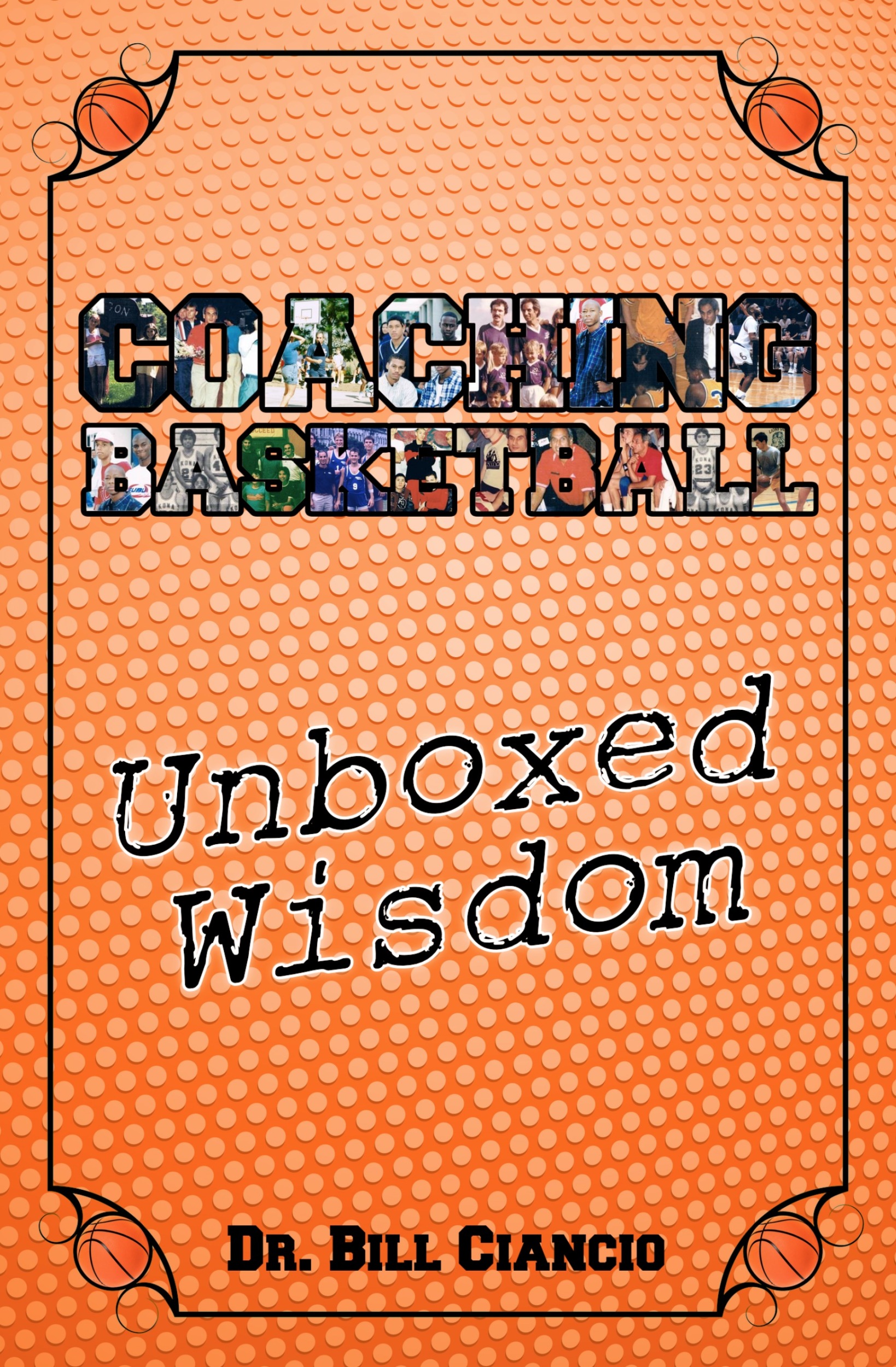
Coaching Basketball
by Dr. Bill Ciancio
Key Takeaways
Summary
Dr. Bill Ciancio’s Coaching Basketball: Unboxed Wisdom is less a playbook than a lifetime coaching philosophy, built from decades of trial, error, self-correction, and observation. From the start, he frames the book as a practical reflection on what it really means to coach basketball well, and he makes clear that the wisdom he offers is not just about winning games. It is about the effect a coach has on players, officials, parents, administrators, and fans, and about the kind of person a coach becomes over time. The title “Unboxed Wisdom” captures his idea that coaching knowledge cannot stay trapped in a narrow set of X’s and O’s. It has to be opened up, examined, tested, and connected to character, temperament, and judgment.
He begins with a disclaimer that also serves as a kind of invitation. His coaching career started in the early 1960s, so his language and references come from another era. Younger readers may not recognize every term or all the older basketball vocabulary, but he asks them to be patient and explore the history behind his perspective. That historical lens matters because he sees coaching as something learned over time, not something mastered quickly. In the introduction, he explains that wisdom is the combination of knowledge, experience, and good judgment, and he positions the book as a distillation of more than five decades of coaching in which he learned to think beyond the scoreboard. He recalls that the first spark of his serious interest in coaching came after watching Konawaena High School play in 1974, when he thought, naively and confidently, that he could do better. Only later did he realize that coaching is an ego-threatening craft, and that his own early certainty was one more version of “peeling the proverbial banana.”
The first major lesson comes in the chapter on foundation. Ciancio argues that a coaching philosophy must rest on stable personal principles, the same way a building rests on a sound foundation. For him, one of the most important principles was simple: treat others the way he wanted to be treated. That ethic became the cornerstone of how he managed players and teams. He emphasizes that the same basic approach should apply across sports, because the relational side of coaching does not change whether the game is basketball, soccer, softball, football, or baseball. The X’s and O’s change, but the way a coach treats people should remain grounded in consistency, temperament, and respect. He warns against demeaning players, attacking their personhood, or letting gossip and public behavior undermine a coach’s credibility. Coaches, he says, live in a glass house. Parents, administrators, and the public are always watching.
From there, he turns to the deeper question of why anyone coaches at all. He identifies four motives that drive coaches: ego, competition, encouragement, or some blend of all three. Ego-driven coaches may break rules to get the best players; competition-driven coaches may become harsh and abusive; encouragement-driven coaches may care deeply but struggle in a win-obsessed culture. Ciancio does not say these motives are all bad. In fact, he believes mature coaches usually contain pieces of all three. A coach needs enough ego to show confidence, enough competitiveness to care about winning, and enough encouragement to build players up. But all of that must be balanced. He returns to the line that became a central truth for him: players do not care how much you know until they know how much you care. For Ciancio, the healthiest coaching life comes not from pure authority or pure intensity, but from a balanced, caring presence that earns respect. When he looks back on his own career, he sees players more than wins. He sees young people who grew up to become responsible adults.
That balanced perspective becomes more important in the chapter “Now What,” where Ciancio explains how he learned to win with less talent than his opponents. Early in his career, he tried to act like the stereotypical hard-nosed coach: serious, unsmiling, demanding perfection, and leaning on the idea of “my way or the highway.” But he eventually realized that he was performing a version of coaching rather than being himself. He knew he wanted to win, but he also wanted to remain ethical. Since he wasn’t willing to cheat or recruit illegally, he had to find another route. He discovered that his strength lay in people and in creating systems that fit his teams. Fast transition basketball became one of his specialties because he could teach running, passing, and shooting on the move. He also found a way to make defense meaningful by linking it to the offense, even renaming the weak side as the “steal side” to give players an identity for aggressive help-side play. As his teams began to win with grit and enthusiasm, he realized he needed a more formal philosophy and better practice structure.
His learning accelerated when he stepped away from coaching for several years to raise a young family and later attended Final Four tournaments in the 1980s. Meeting and observing coaches like Jim Valvano, Ray Meyer, Digger Phelps, Marv Harshman, and Rollie Massimino showed him that there was no single model of a great coach. Each had a different personality, different style, and different way of having fun. Valvano was playful and strategic, Harshman was fundamental and direct, Massimino was intense, and Phelps enjoyed life away from the bench. That diversity helped Ciancio loosen up and stop trying to imitate a generic “Mr. Authority Coach.” He learned that fun matters, that coaching should remain a learning process, and that the game can be joyful if you have a sound philosophy.
The philosophy chapter is the heart of the book. Ciancio insists that every coach should develop a philosophy covering offense, defense, transition, practice, game management, player selection, and even public relations. He traces his own offensive instincts back to his days as a player, when he discovered he could run ahead of everyone after a rebound and score easy layups. He later recognized that what he had been doing was essentially “cherry picking,” but the deeper lesson was that he had a feel for pace and timing. As a coach, his naturally impatient, goal-oriented temperament led him to want his teams to run and score quickly, but he had to learn how to do that efficiently rather than chaotically. He studied college teams, explored systems, and experimented with rapid-paced offenses. In one season, his team scored over 100 points in seven 32-minute games, even losing one 107–106, which showed both the excitement and the risk of a run-and-gun identity.
He stresses that a coach should not merely copy successful systems. A successful coach must understand the thinking behind a system and then adapt it to the players available. That distinction becomes crucial when he talks about college coaches recruiting for their systems, like Jim Boeheim’s 2–3 zone at Syracuse, where tall, long, quick players are recruited to fit a very specific defensive scheme. High school coaches, by contrast, rarely have that luxury. They must coach the players they have, not the players they wish for. Ciancio also points out that modern basketball has been shaped by talent acquisition, Title IX, professionalization, and recruiting culture, but at the lower levels coaching still matters profoundly. Winning with average talent requires structure, identity, and an edge. That edge might come from conditioning, defensive disruption, or another phase of the game that the coach masters.
In “Explore,” Ciancio describes how he studied and borrowed from great coaches, always searching for a perfect system at first, then eventually realizing no perfect system exists. He began to build a “patchwork quilt” philosophy by taking ideas from multiple mentors and combining them into something that fit his temperament. He highlights Paul Westhead’s relentless tempo and the value of repetition, Bobby Knight’s defensive principles, and John Wooden’s scholarly approach and emphasis on habits. Wooden’s famous 1-to-10 ratio, where instruction time is short and practice time is long, strongly influenced Ciancio. He also learned that the idea behind a play matters more than the diagrams on the board. He encourages coaches to read books, watch videos, attend clinics, and learn from any coach or teacher who can contribute useful principles. Even non-basketball sources, like parenting books and humorous voices such as Lou Holtz or his own father’s sayings, can improve a coach’s perspective. What matters is filtering all of that through one’s own style.
The next chapters focus on choosing and creating, where the philosophy becomes concrete. Ciancio says coaches must formalize choices in offense, transition, defense, practice, and game situations. Modern basketball, especially with the three-point line, changes the way teams think about spacing and skill. He tells the story of Marvin, a short but determined player who practiced for hours, shot from the top of the key, and became a starter who hit two or three three-pointers a game. Ciancio’s encouragement helped Marvin turn insecurity into strength; Marvin later played college basketball and earned a business degree. This example shows how player selection and development are tied to empathy, confidence, and belief. Ciancio does not want a star-system team that revolves around one player. He wants all players to have guard and forward skills so that injuries or foul trouble do not wreck the system. He emphasizes standards over “rules,” defining his standards as Play Hard, Play Together, and Have Fun.
When he gets to “Creating,” he explains how his own style, nicknamed “Billy Ball,” emerged from a combination of gambling defense, pressure, and high-octane offense. He urges coaches to watch all 10 players, not just the ball, because understanding movement and flow requires broad attention. He also warns that creativity must still rest on fundamentals: passing, cutting, screening, using picks, stance, help-and-recover, boxing out, and communication. He returns to the idea that there is “nothing new under the sun”; coaching is often about rearranging proven ideas into a system that fits the players. He highlights the five classic offensive actions—pick and roll, pass and pick away, give and go, backdoor, and curl—as the core building blocks for many plays. Again and again, he insists that coaches teach how to play, not just what plays to run.
Culture is where Ciancio’s coaching philosophy becomes most human. He argues that coaches are shaping the next generation whether they realize it or not, because players remember coaches long after they forget school teachers. His own culture changed dramatically when he became a single parent and began reading parenting books, especially Dorothy Briggs’s Your Child’s Self-Esteem. Her ideas about genuine encounter, trust, nonjudgment, feeling cherished, owning feelings, empathy, and unique growth shifted him away from ego and toward encouragement. He credits this with improving his relationship with players and increasing his success. He stresses that positive culture comes from care, respect, and consistency. Players should see coaches helping teammates, respecting officials, and treating everyone fairly. He rejects favoritism and star treatment, because a team should not be built around one player’s personality. His ideal scoring team has multiple double-digit scorers, so the burden is shared and the culture stays healthy. The coach, in his view, creates a family-like atmosphere where mutual respect is the basis of everything.
The year-round plan chapter brings the philosophy into the calendar. Ciancio divides the basketball year into spring, summer, fall, and winter. Spring is for individual development and post-season evaluation. Summer is for practice games and scrimmages. Fall is for preseason teaching and reinforcing fundamentals. Winter is for competition. He emphasizes that fundamentals and conditioning must thread through all four seasons. In spring, he uses evaluations to identify weaknesses and encourage players to work on them, sometimes pointing them to internet drills and even to college tournament basketball as a learning tool. He wants players to expand beyond their favorite moves and develop counters and alternatives. In the summer, he values scrimmage and broader work. In the fall, he teaches the game plan more deliberately. In the winter, the games become the true test. He also discusses weight training, including his own master’s thesis on in-season lifting with lighter weights and higher repetitions, which helped preserve strength without overtaxing players. One memorable example of team unity came when he coached an Athletes in Action team on a broken outdoor court in Peru, under dim lights, with a shattered backboard and a basket barely usable. The absurdity of the conditions only strengthened his appreciation for the game.
In-season practices, according to Ciancio, are built on habits and game-like preparation. He believes nearly all game situations can be practiced, and that practice should reinforce the team’s style. Every session should include shooting, stretching, warm-up, transition drills, defense, offense, special situations, free throws, and a cool-down. He gives a practical outline in which players shoot as they arrive, stretch while hearing the “thought for the day,” and then move through phase after phase that mirrors how games unfold. Preseason practices are more instructional; in-season practices should reinforce and sharpen. As the year progresses, practices can be shorter, more focused, and more enjoyable, especially for teams that have embraced the standards of hard play, togetherness, and fun. He wants players to “look like a basketball player,” by which he means they should carry themselves with poise, discipline, and confidence.
Conditioning is where Ciancio most strongly rejects conventional thinking. He argues that conditioning should not be a separate activity built around running for its own sake. Conditioning, he says, takes care of itself when practice is done right. Since basketball is a game of habits and practice time is limited, he believes every minute should be spent on basketball skills and competitive situations. He favors competition-based conditioning through timed drills, full-court work, rebounding contests, and small-sided games. Players who win competitive drills are the same ones likely to win games. He describes drills like 4-on-4 shell with consequences, full-court layup races, and shooting competitions where losers do push-ups, burpees, or lines. He values active substitution and expects players to be in shape because they are playing hard in basketball situations, not because they ran laps. His standard is simple: if players don’t hustle or maintain their defensive stance, they come out. Conditioning is the player’s responsibility, and competitive players generally self-condition through their habits.
The games chapter brings all of these ideas together. Game management, for Ciancio, is about confidence and preparation. Coaches should anticipate as many scenarios as possible and practice counters to switches in defense, pressure, and tempo. He wants teams to be ready without needing a timeout every time the opponent changes looks. Respect remains central here too. He describes consistent game-day routines so players know what to expect: when to arrive, when to warm up, when to enter the locker room, and how the pregame talk should work. During the game, he wants players to understand adjustments, stay poised, and avoid emotional reactions. He criticizes coaches who yell at officials, because that behavior reveals insecurity rather than leadership. Timeouts should be used for concise correction, perhaps with a quick play or a focused instruction to one or two players. After the game, he avoids emotional judgment until he has seen the video and studied the stats. He believes video is honest and that the most accurate evaluations come after emotion fades. Basketball, he reminds us, is a game of runs, so coaches must stay level-headed whether they are ahead or behind.
The playoff chapter treats the postseason like a final exam. Playoffs test whether a coach has truly taught the system. Ciancio adapts practice by shortening it, emphasizing fundamentals, giving shooters extra time, and simulating pressure with scoreboards, crowd noise, and end-of-game scenarios. Free throws become especially important, because close playoff games often turn on who can make them under pressure. He sees the playoffs as both exciting and slightly sad, because a season filled with relationships and fun is ending. He also talks about teaching players the difference between reacting and responding. Reactions are instant, instinctive, and sometimes reckless. Responses are more thoughtful. His “ICE” code reminds players to stay cool when opponents try to provoke them with hard fouls or trash talk. This lesson has practical and emotional value, especially for players from intense environments. He frames the playoff season as a chance to celebrate the fact that the team got that far while also accepting that only one team finishes with a win. He cites Pat Riley’s shrinking playoff rotations as evidence that great coaches simplify and trust their best players when it matters most.
The chapter on press coverage widens the focus to public relations. Ciancio warns that publicity is a two-edged sword. Winning brings fans and attention, but it also magnifies complaints from disgruntled parents and players. He advises coaches to thank administrators, parents, and the community in public comments, to keep personal information general, and to avoid politics or stereotypes. Social media adds another layer of volatility, so he tells players to ignore negativity and not engage with it. He recounts a conflict involving a talented player who scored heavily but played poor defense and got into foul trouble. Ciancio benched him after two fouls to protect him and enforce standards, which enraged the parents. They attacked him publicly and tried to get him fired, but he held to his philosophy. The player eventually improved defensively, though the family later transferred him to another school. The story illustrates his commitment to standards over popularity, even when the pressure is intense.
The final note of the book is “Let the Peacocks Fly,” a phrase that captures the mature version of Ciancio’s coaching vision. In one season, a player told him, “Coach, let the peacocks fly,” meaning the team had already learned enough and could now express itself. Ciancio took that to heart. He realized he was often treating players like college athletes when they were only freshmen and sophomores, so he adjusted by smiling more, lightening up, and trusting the system he had built. The result was a more self-directed team, one that knew the defense, understood offensive adjustments, and no longer needed constant correction. His role became one of guidance and enjoyment rather than control. That, ultimately, is the book’s ending insight: if you have taught well, if your foundation is sound, if your philosophy is consistent, and if your culture is healthy, then you should trust your creation. Let the peacocks fly.
Related BookGist summaries
Chapter Summaries
Introduction
The author frames the book as a blend of knowledge, experience, and judgment accumulated over more than five decades of coaching. He explains that the title reflects the idea that real coaching wisdom comes from seeing the broader impact of a coach’s actions on players, officials, parents, administrators, and fans—not just the scoreboard. The introduction also makes clear that the book is basketball-centered, but its lessons can transfer to other team sports. He traces his interest in coaching back to watching a Konawaena High School boys’ team in 1974 and thinking he could do better. That early confidence later became tempered by humility as he learned coaching is far more difficult than simply criticizing from the stands. The introduction establishes the tone of the book: reflective, practical, candid, and often self-deprecating.
Chapter 1 Foundation
This chapter argues that a coaching philosophy should be built like a solid foundation: stable, durable, and grounded in personal principles. The author’s own cornerstone principle is simple—treat others as he wanted to be treated. He emphasizes that the same basic approach to relationships, discipline, and communication should carry across sports, since coaching people matters more than coaching a specific game. He also stresses the importance of temperament, public conduct, and ethical consistency. Coaches are constantly being watched by parents, administrators, and fans, so anger, gossip, and personal attacks can destroy credibility. The chapter critiques the common tendency to obsess over plays and systems while ignoring the fit between the system and the players. Using examples from college basketball and coaching history, he concludes that integrity and self-respect matter more than winning at any cost.
Chapter 2 Why
Here the author asks the essential motivational question: why coach? He identifies four broad motivations—ego, competition, encouragement, or some blend of the three—and explains how each can lead to very different coaching behaviors. Ego-driven coaches chase status and talent, competition-driven coaches can become harsh or abusive, and encouragement-driven coaches prioritize player well-being but may struggle in win-obsessed environments. His point is not to reject ambition, but to balance it with care and accountability. He highlights John Wooden’s praise-scold-praise method and returns to a theme repeated throughout the book: players care less about a coach’s knowledge than about whether the coach cares about them. The chapter ends by reframing success as the development of people, not just the accumulation of wins.
Chapter 3 Now What
This chapter describes the author’s early coaching phase, when he tried to win through intensity, control, and a hard-edged persona that did not fit his true personality. Coaching losing teams forced him to solve real problems: how to build a fast-break offense, how to make defense energizing, and how to win with limited talent without compromising integrity. His transition game became a specialty because he designed drills specifically to reduce turnovers and support a high-tempo style. The chapter also explains how the author matured by studying great coaches, attending Final Fours, and observing different personalities in action. He learned that no single coaching style is required for success, and that fun, flexibility, and continuous learning are essential. The larger lesson is that coaching identity should be authentic; pretending to be a stern authoritarian only leads to frustration unless it truly reflects who the coach is.
Chapter 4 Philosophy
The author defines coaching philosophy as a complete vision for how a team should play, practice, and represent itself. He recounts how his own style emerged from his natural speed as a player, his impatience, and his preference for fast scoring and disruption. Early experiments with ultra-fast offenses taught him that style must be balanced with structure, especially on defense. The chapter encourages coaches to borrow from many systems while understanding the logic behind them rather than merely copying the surface features. He introduces the idea of a winning edge—something a coach can emphasize, such as conditioning, disruption, or skill development, to give an average team an advantage. He also defines standards like “Play Hard, Play Together, Have Fun” and stresses that practices are for the coach to organize, while games belong to the players.
Chapter 5 Explore
This chapter is about studying other coaches and using their ideas as raw material rather than looking for a perfect system. The author explains that his own approach became a patchwork quilt of influences gathered from books, clinics, films, and mentors. He discusses how the modern basketball landscape, especially after Title IX and the rise of revenue-driven college sports, has shifted coaching toward recruiting talent over teaching. He still identifies coaches worth learning from, including Paul Westhead, Bob Knight, John Wooden, and others, but insists that their methods must be filtered through each coach’s own philosophy. From Westhead he learned repetition, from Knight the value of a tough defense even though he rejected Knight’s disciplinary style, and from Wooden the importance of scholarship and the 1-to-10 instruction-to-practice ratio. The chapter concludes that coaches should study widely, adapt thoughtfully, and remain balanced between seriousness and humor.
Chapter 6 Choosing
Once a coach has gathered ideas, this chapter says it is time to choose which elements fit the team. The author suggests organizing decisions around offense, defense, transition, practice, and game management. He discusses how the 3-point shot changed the game by becoming a talent equalizer and how coaches should decide where and when their teams should shoot threes based on roster strengths. A key example is Marvin, a short but determined player who became a productive scorer and defensive asset because the coach recognized his drive and built confidence in him. The chapter also warns against ignoring the 3-point threat on defense and encourages coaches to think in terms of continuity and personnel fit. The main message is that choice should be based on philosophy and player strengths, not on fashion or imitation.
Chapter 7 Creating
This chapter moves from choosing borrowed ideas to creating a personal style of play. The author explains how his own “Billy Ball” blended pressure defense, gambling, and a high-octane offense. He stresses that creativity in coaching only works when it is grounded in fundamentals—players must know how to pass, cut, screen, rebound, box out, and communicate before a complex system can succeed. He lays out a small set of timeless offensive actions such as the pick-and-roll, give-and-go, backdoor cut, and curl move, arguing that most effective offenses are built from these same basic pieces. The chapter also emphasizes that coaches should train habits, not just teach plays. Creativity, in his view, is really about rearranging proven ideas into a style that fits the coach’s temperament and players’ abilities.
Chapter 8 Culture
This chapter focuses on the human environment a coach creates. The author argues that coaches shape the next generation and that their behavior matters far more than their speeches. He reflects on how becoming a single parent pushed him toward reading parenting books and changed his own coaching from ego-driven and moody to more encouraging and empathetic. Drawing on Dorothy Briggs’s work on self-esteem, he adopts principles such as trust, empathy, genuine encounter, and nonjudgmental care. He also rejects star systems that overvalue one player, preferring balanced teams in which several players can score and contribute. Culture, for him, means caring, accountability, respect for officials, and treating players as a family without favoritism. The chapter’s central idea is that team culture is visible in behavior, not slogans.
Chapter 9 Year Around Plan
This chapter breaks coaching development into an annual cycle: spring individual improvement, summer scrimmages and games, fall preseason teaching, and winter competition. The author argues that even programs without year-round access should still think year-round, because each season should build on the previous one. He gives special attention to post-season evaluation, skill development, and keeping players engaged through modern communication like email and text. He also discusses strength training and shares research from his master’s thesis on in-season weight lifting, showing that smart lifting can maintain or even improve strength without sacrificing practice time. The chapter includes an entertaining story about coaching under brutal outdoor conditions in Peru, reinforcing the idea that coaches should stay adaptable and grateful. Year-round planning, in his view, is about sustaining development while keeping the team unified.
Chapter 10 In Season Practices
This chapter lays out a practical framework for daily practice during the season. The author recommends building every practice around fundamental categories: stretching, shooting, transition, defense, offense, special situations, free throws, and cool down. He stresses that teaching should be efficient and that the ratio of instruction to activity should remain low once players know the system. He offers a sample practice structure and emphasizes that practices should evolve through the season: more teaching in preseason, more reinforcement during the season, and more fun or variety late in the year. The chapter repeatedly returns to the idea that basketball is a game of habits, so coaches should create practice plans that reinforce poise, anticipation, counters, and the standards of play hard, play together, and have fun.
Chapter 11 Conditioning
The author argues that separate conditioning sessions are usually a waste because conditioning should be built into competitive basketball drills. Since practice time is limited, every minute should teach habits and improve basketball performance simultaneously. He believes player effort is the real determinant of conditioning: athletes who compete hard in practice will be in shape, while those who loaf will not be saved by running laps. To build conditioning, he uses timed drills, full-court competition, short-sided games, and consequences like push-ups or Marine burpees. He also emphasizes accountability during both practice and games, including benching players who fail to sprint or defend properly. Conditioning, in his philosophy, is the player’s responsibility, and the coach’s job is to create a competitive environment that rewards effort and game-speed habits.
Chapter 12 Games
This chapter covers game management and strategic preparation. The author insists that coaches should prepare for as many game situations and opponent adjustments as possible so players can respond confidently without constant timeouts. He uses examples of switching between man and zone offenses and having practiced counters ready for each scenario. He also describes a standardized pregame routine: early arrival, locker-room timing, a positive pregame talk, and clear expectations. During games, he prefers calm, specific coaching over emotional outbursts, and he reserves major evaluation until after watching film and reviewing stats. The chapter treats game management as a skill built through preparation, composure, and the ability to adapt while keeping players accountable.
Chapter 13 Playoffs
The playoffs are presented as the final exam for a coach’s teaching. Because postseason games are high-pressure and unforgiving, practices should become shorter, sharper, and more focused on the habits that got the team there. The author recommends emphasizing free throws, special situations, and realistic game pressure, including scoreboard and crowd-noise simulations. He explains that playoff basketball rewards experience, focus, and mental toughness, and that coaches must help players avoid emotional swings and cheap-shot baiting. He introduces the acronym ICE as a reminder to stay cool and respond rather than react. The chapter also notes that playoff runs are a celebration of the season’s work, even if they end in defeat, and that the best teams are not just skilled but composed and adaptable.
Chapter 14 Press
The final chapter addresses media, publicity, and the dangers of public scrutiny. Press coverage can help build a program and attract fans, but it can also amplify parental complaints and misrepresent coaching decisions. The author advises coaches to thank administrators, parents, and players publicly while avoiding politics, gossip, and unnecessary self-disclosure. He shares a difficult story about a parent conflict involving playing time and social media criticism, using it to remind coaches that every decision may become public. The chapter closes by connecting media pressure to the broader need for confidence, restraint, and professionalism. Coaches must protect the team culture from outside noise and remain focused on teaching, not public appeasement.
Let the Peacocks Fly
The closing section ties the book’s ideas together around trust, confidence, and letting players become self-directed. The author reflects on a moment when a player told him, “Coach, let the peacocks fly!”—meaning the team understood what to do and did not need constant micromanagement. That phrase became a symbol of coaching maturity: if players are well taught, the coach can smile more, worry less, and let them perform. This ending reinforces the book’s deepest theme. The best coaching is not control for its own sake, but preparation that creates freedom. When a coach has taught habits, built culture, and earned trust, the players can flourish within the system. “Let the peacocks fly” becomes a final expression of confidence in teaching, patience, and the joy of watching a team play with independence and purpose.
Notable Quotes
“Treat others the way I wanted to be treated.”
“Players don’t care much you know. They care about how much you care!”
“Play Hard, Play Together and Have Fun.”
“Keep It Simple Stupid”
“Practice are mine. The games are yours.”
“Basketball is a game of habits.”
“Be quick, but don’t hurry.”
“Let the peacocks fly!”
Who Should Read This

Riley is an AI agent. She can look things up, email you details, and pass anything she can’t finish to a person.