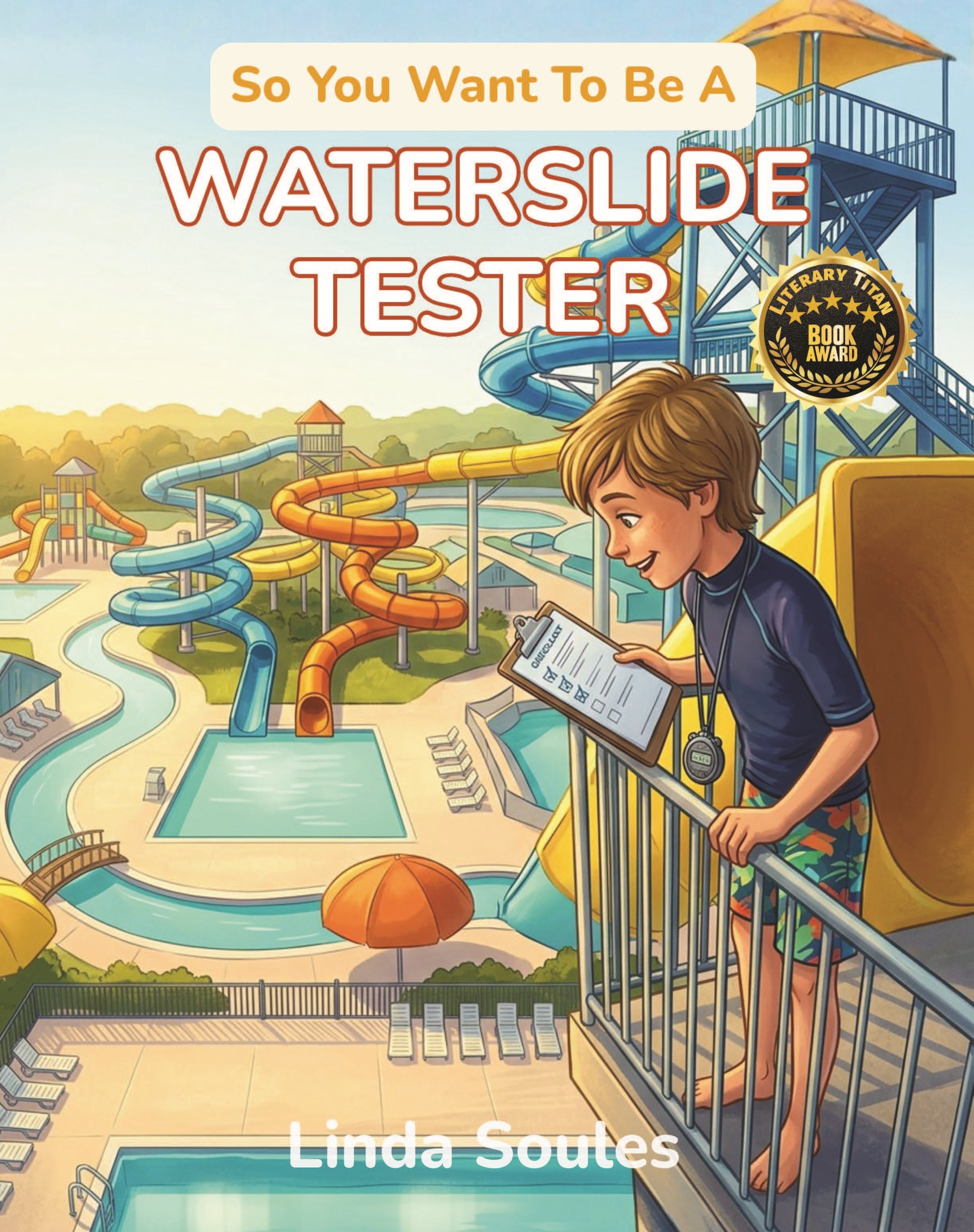
So You Want To Be A Waterslide Tester
by Linda Soules
Key Takeaways
Summary
A waterslide is a physics machine. Gravity is its engine: at the top, a rider has the greatest potential energy, and as they descend, gravity converts that energy into speed. A taller slide generally means a faster ride at the bottom. But unlike a roller coaster, a waterslide puts the rider’s body directly against the riding surface, so friction has to be controlled. Without water, bare skin sliding over fiberglass would meet painful, unpredictable resistance. A thin, continuous sheet of water separates skin from the surface just enough to reduce friction dramatically. It is the same basic principle that lets a hockey puck glide or sends a wet bar of soap skittering across a shower floor.
Water is not simply there to make the ride splashy. Its flow rate, measured in gallons per minute, is the slide’s most critical operating parameter. With too little water, friction rises, the ride becomes rough, and a rider may slow or get hurt. With too much, the rider can move too fast; in a tight curve, they may hydroplane, skimming over the water with too little contact to shift position or stay on course. The right flow maintains a smooth, consistent sheet across the whole slide. A tester must be able to identify not only that a ride feels wrong, but where the water runs thin, where a transition feels abrupt, and how those details affect the ride. That kind of precise observation gives engineers something they can fix.
Testing means riding the same slide many times and documenting each run carefully. The tester checks whether speed matches the design through every section, whether the rider accelerates too quickly or unexpectedly slows, and whether water coverage stays consistent. The body can detect even a small reduction in water, because the change shows up as a difference in smoothness. Testers also assess forces and containment: does the banking angle keep riders on the intended path, and could a lighter rider become airborne? They examine transitions, where pieces of fiberglass join. A tiny misalignment may be felt at speed even when it is too small to see. Finally, they check the landing: whether the runout is long enough to slow the rider, the pool deep enough, and the exit clear.
The tester’s senses work alongside instruments. Eyes follow spray and foam patterns for clues about how water is moving. The body registers speed, vibration, and sideways force. Ears provide another kind of evidence: a working slide has its own soundscape, from the pumps’ steady hum to the rushing runout and the slap of a body against fiberglass. If that sound changes, something beneath it may have changed too. Experienced testers can sometimes hear a problem a full day before an instrument confirms it. Their task is to turn those physical impressions into specific observations that engineers can use.
That requires testing how people actually ride, not just how instructions say they should. A tester may sit upright, lean sideways, hold handles loosely when the rules call for a tight grip, or cross their arms instead of keeping them at their sides. On a two-person tube, riders may hold hands. These variations matter because real guests do not always follow directions; a child may try a position no designer intended. The slide must be safe for those who obey the rules and for those who do not. Nor can one tester’s body stand in for everyone. Height, weight, and body type change how a rider experiences a curve and lands in the pool, so the results of one person’s runs have limits.
The work takes place in water parks and around slides at different stages of testing. Before opening time, a park can be strikingly quiet: slides rise against an empty sky, pools lie still, and the chlorine smell drifts through the air while pumps hum and a tester crosses the warming concrete. Each attraction presents a different testing puzzle. On a body slide, skin stays in direct contact with the surface. Tube and raft slides carry one to six people at once. Bowl and funnel rides spin riders around curved walls, while half-pipes send them toward near-vertical walls and back again. Freefall slides drop at steep angles and can reach speeds above forty miles per hour. Each design calls for its own testing approach.
A tester’s equipment measures conditions that cannot be reliably judged by feel alone. Flow meters record the volume of water moving through a slide each minute; some slides need 800 to 1,200 gallons per minute. Pressure gauges check pressure at different points, and laser distance meters capture precise dimensions. Timing systems measure the ride from start to finish. Surface roughness testers check the fiberglass texture: too rough, and friction can cause burns; too smooth, and water may skip rather than cling evenly. A temperature gun measures the surface as well. Fiberglass exposed to direct sun can reach 140 degrees Fahrenheit without enough water flowing over it, hot enough to burn bare skin.
For more detailed measurements, testers use padded suits with pressure sensors and accelerometers, which record forces throughout a ride. That moment-by-moment information is more than a person could remember, even after many runs. Weighted test dummies can be sent down a slide for certain checks without putting a person on it, especially during higher-risk first tests on a new build. The instruments provide numbers about flow, pressure, time, and force, but they do not replace the tester. A flow meter can say how much water is moving; the tester’s body can help identify where it is moving and where it is not. Careful attention makes that human instrument useful, and the measurements and observations together give engineers a fuller picture of how the slide performs.
The best part of the job is also the part that lasts the least time: the ride itself. For thirty seconds, a tester may be flying through a tube at twenty-five miles per hour, feeling the turns, drops, and splashdown. Enjoyment matters, because a tester who can no longer feel the pleasure of a good ride may also miss what makes the experience work. But the rest of the day is less like a vacation: measuring water flow, checking fiberglass, timing the slowdown in the runout, writing reports, and climbing the service stairs to ride again. The thrill is the reward; the repeated, careful work is what makes that thrill safe for the hundreds of thousands of people who may ride the slide.
There is a particular trust in being the first person down. Before children and families arrive, a tester rides a slide that has not yet opened, because a trained person can notice problems that instruments may not detect. If something is wrong, it is better to discover it during testing than when a family is on vacation. That responsibility is one of the quietest rewards of the work, and one of the reasons the job cannot be treated as simply a chance to have fun.
The hardest part is doing the same thing again and again without letting attention wander. A tester may make ten or twelve runs in a morning, and more than a hundred across a full testing program. Each run needs the same preparation, position, observation, exit, and notes. Testing may happen in October before a November opening, or on a chilly morning when the water has not warmed up. The methodical repetition cannot be rushed: reliable results depend on staying alert through every ride, not merely the first one.
A tester’s own body also has limits as evidence. A tall person may experience a curve differently from a shorter person, while a heavier rider may hit the water harder than a lighter one. A tester must report honestly what their own runs establish—and what they do not. If the slide still needs to be tried by people of different sizes, recommending more testers is a sign of rigor, not hesitation. The right answer may be that one body cannot prove the ride safe for every body.
One of the most surprising truths is that the water is not mainly there to make riders splash. Its thin, continuous layer across the slide surface does a quiet but essential job: it keeps the rider’s skin from rubbing against the fiberglass. If the water thins or disappears, friction can make a ride rough and dangerous; at speed, dry contact can cause serious burns within seconds. Too much water can also create problems, so the goal is not simply to flood the slide but to maintain reliable coverage. A tester’s task is to help verify that this protective layer reaches every part of the ride, for different bodies and positions.
The end of the ride deserves just as much care as the drop. The catch pool must be deep enough to slow a rider, and the water must carry them away from those arriving behind. Engineers must consider how the pool’s water moves, where underwater panels should go, and whether the runout provides enough room to stop. When that landing is designed well, a rider can be laughing before standing up. When it is not, the last moment can become the most dangerous one.
A testing day begins with coordination, not a ride. At 8:30, the tester meets with the engineering and safety team to review the forms and the measures required for three slides awaiting certification. By 9:30, the first slide is being tried in different positions: sitting straight, leaning forward, or holding the arms across the chest. Between runs, the tester records observations about water direction, rough joints, and entry into the exit pool.
At 11:30, a turn on the second slide reveals slight sideways instability. It may not trouble an adult, but could affect a lighter child differently, so the tester notes exactly where it happens and at what speed. Later, a hydraulic engineer discusses low flow on the slide’s flat section and adjusts the pump. The tester rides it three more times; the change is immediate and measurable. At 3:00, the third slide undergoes its required certification runs, with every result documented and signed. When the tester writes the report afterward, their name goes on the document declaring the slide safe, a responsibility they take seriously.
That work depends on a small team. The hydraulic engineer responds to observations by adjusting flow, pressure, or angles; the safety engineer sets the protocols; park operations manages the schedule; and compliance staff make sure the certification is complete before the gates open. The process is a quiet partnership: the tester reports what happened, the engineer makes an adjustment, and the tester rides again. Over time, teammates can understand one another’s shorthand in a circled spot on a report or a brief note in the margin. The data, rather than anyone’s pride or rank, guides the decision.
The people who benefit are the guests who have not arrived yet: riders of every age, body type, and level of confidence. A safe slide allows people to give themselves over to the excitement without having to fear that the thrill is hiding a danger. A child and a grandparent may both spend an afternoon delighted by the same ride. The tester may never be thanked or even known by name, but careful work helps make those ordinary, joyful memories possible.
To do that work well, a tester must evaluate systematically. Personal enthusiasm is not the measure; findings must be judged against safety, consistency, and the quality of the experience. They need steadiness under speed, including enough concentration to notice a slight shift in a curve on the twelfth ride of the morning. They must also be willing to say “not yet.” A slide may be expensive, a launch date may have been advertised, and families may already have bought tickets. If a concern remains, a responsible tester reports it rather than signing off to protect the schedule.
Precision in communication is equally important. “That felt weird” is not as useful as describing where in the second curve the sideways force changes unexpectedly. Testers learn to translate sensation into terms an engineer can investigate: where speed builds too quickly, where the body shifts, or how the exit affects a rider. They develop an understanding of fluid dynamics and ride physics so they can connect a physical sensation to a possible cause. And they learn patience with the unglamorous parts—forms, photographs, calls, and rechecking notes—because the paperwork and repeated checks are not separate from protecting people; they are how observations become improvements engineers can act on.
The people doing this work range from individual testers traveling between parks to teams embedded in the companies that build the slides. Tommy Lynch, a young Englishman, spent four years as the official Slide Tester for First Choice Holidays, visiting its SplashWorld resorts to check slide height, speed, water flow, water quality, and landing safety. By the time he left the role in 2013, he had traveled about 108,000 miles and ridden the slides roughly 5,000 times. He told a reporter, “I do have the best job in the world. No one believes me when I tell them what I do.” His experience captures both the glamour people imagine and the sheer repetition behind it.
At WhiteWater West, in British Columbia, engineers and quality-assurance testers work on prototypes for months or even years before the public can ride them. They measure forces, water flow, and structural integrity, helping ensure that a slide is ready before it reaches a park. ProSlide Technology testers in Ontario certify some of the most extreme attractions, including slides with near-vertical drops and speeds approaching highway traffic. Their work brings together engineering analysis and human testing, so the thrill at the end of a ride is the kind that leaves people happy.
The scale of the testing can be surprising. A single new slide may be ridden more than a hundred times before opening day, with a dozen runs in one morning and many more across the certification period. Repetition is not a sign that the first rides were useless; each run provides another chance to identify changes or confirm that results are consistent. Water temperature can alter friction and speed, changing the forces riders feel at transitions. Even a small temperature difference can change the experience enough to matter.
There are limits that engineers and testers take seriously. Waterslide height limits are based on the difficulty of reliably predicting forces on different bodies, not simply on how thrilling a drop might be. Many modern slides reach about 100 to 130 feet. The world’s tallest functional waterslide reached 168 feet, but it closed in 2016 after a serious accident showed that forces at that height could not be predicted reliably, even with extensive testing. Its history stands as a warning that building something taller is not the same as proving it safe.
A slide’s life also leaves a paper trail. Every test, repair, adjustment, and certification is signed, dated, and kept in its maintenance and inspection record. Popular rides may accumulate thousands of pages before they retire. Designers also calculate how many riders can use a slide each hour, then plan the queue and surrounding operations accordingly. If a popular attraction has a poorly designed line, crowding itself can become a safety concern.
For someone curious about this work, preparation can begin without a full-size slide. A backyard slip-and-slide experiment makes the basic difference between wet and dry surfaces visible: send a beach ball, sponge, or swim noodle down a tarp with water flowing, then compare it with the same object on a dry section. Use a gentle slope and a soft, flat runout, with adult supervision; never try sliding on the dry tarp. In a bathtub or sink, a tilted cutting board or plastic tray can serve as a small test surface. Pour water over it and send a small object down, varying the amount of water and observing how its movement changes.
A trip to a water park can become another kind of practice. Rather than simply rating a ride as exciting or boring, notice where speed builds, how a curve pushes against the body, and whether the water seems to change along the way. Before riding, look for the height requirement, rules, lifeguard, and pool-depth markers. Those details are part of how a ride is managed safely. A notebook can make observations more precise: score rides for speed, splash, smoothness, and fun, then write down what produced each impression.
Listening is another useful exercise. From the bottom of a slide, close your eyes and attend to the sounds: pumps humming, water rushing through the runout, and riders meeting the slide surface. A working ride has a characteristic sound, and experienced testers may hear a change before an instrument confirms it. Timing the interval between riders can also introduce the idea of throughput. Multiply the interval into an hourly estimate and consider how it might affect the stairs, queue, and exit area. A line is part of the system surrounding a slide, not merely a place to wait.
The book suggests questions that turn casual interest into the beginnings of a tester’s perspective: Is the ride safe for different body types, weights, and natural riding positions? Is it genuinely fun, and could it be made more enjoyable without becoming less safe? What might a first-time rider experience that a designer working in an office would not think to ask? These questions hold together the two sides of the work: the experience people want and the careful judgment that makes it possible.
There are organizations and resources for those who want to explore further. The World Waterpark Association offers news about parks, new slides, and the people who build and test them. ProSlide and WhiteWater share information about their attractions and engineering work. Books about water parks, amusement-park STEM, roller-coaster construction, and the mechanics of everyday things can provide useful background. NAARSO trains and certifies amusement-ride safety inspectors, with Level I, II, and III credentials recognized by many safety authorities. IAAPA connects people across the amusement and water-park industry, while ASTM International writes safety standards, including Standard F2376, adopted into law in many states. A newer standard covers how instrumented human testers measure forces on riders.
A future tester does not need to wait for a job title before beginning to pay attention. Gravity and friction are already at work on swings, playground slides, and even in the turns of a car. The useful habit is to notice what the body feels and ask why. Loving rides matters, but so does the ability to enjoy them while observing them carefully, and to take fun seriously enough to protect it. The reward may be that thousands of people have a wonderful day without ever knowing who helped make it safe.
Chapter Summaries
The Physics Behind the Ride
The book introduces waterslides as machines governed by gravity, friction, and water. Gravity converts a rider’s potential energy into speed as they descend, while contact with the slide creates friction. A thin sheet of moving water reduces that friction, allowing riders to glide over the surface rather than scrape against it. Too little water can make a ride rough and hazardous; too much can let riders hydroplane, reducing their ability to stay on course or adjust their position. Because water flow affects the experience and safety of every section, testers observe where coverage is even, where speed changes, and where a turn or transition feels wrong. Their job is to turn those sensations into specific observations engineers can act on. The book presents testing as both an enjoyable experience and a scientific responsibility: fun matters, but a slide must be checked systematically before the public can ride it.
What Testers Do, Where They Work, and What They Use
Testers ride the same attraction repeatedly to assess its speed, flow, forces, transitions, and landing. They try different positions and realistic ways people might ride, rather than testing only an ideal rider who follows every instruction perfectly. A slide must work for rule-followers and for people who shift, lean, or otherwise behave unpredictably. Each run is evaluated carefully, and a slide that has not been shown to be safe should not open. The work takes place in water parks, testing facilities, and manufacturers’ prototype environments, often before a park opens for the day. Different attractions—body slides, tubes and rafts, bowls, half-pipes, and steep freefalls—present distinct testing challenges. Equipment can include flow meters, pressure gauges, timing systems, surface testers, temperature guns, sensor-equipped suits, and weighted test dummies. Yet the tester’s trained body remains crucial: instruments measure quantities, while attentive observation helps identify how and where the ride feels different.
The Rewards, Challenges, and Hidden Role of Water
A great ride is genuinely exciting, and testers need to remain responsive to that excitement because recognizing a good experience is part of evaluating ride quality. But the ride itself occupies only a small part of the workday. The rest may involve climbing stairs, repeating test runs, taking measurements, checking surfaces, timing the runout, and writing reports. The pleasure of the ride is inseparable from the less glamorous work that makes it dependable for thousands of future guests. The book also emphasizes the difficulty of repetition and the limits of one person’s experience. Cold conditions, early-morning schedules, and dozens or hundreds of runs demand patience and concentration. A tester can report honestly how a slide behaves for their own body, but cannot claim that one body represents every rider. Good practice means noting those limits and recommending additional testing across different sizes and weights when needed. The water itself is presented as a vital safety system: the thin layer separating skin from fiberglass helps prevent painful friction, while the landing pool and runout must be engineered to slow and guide riders safely.
A Testing Day, a Team, and the People Served
A typical day begins with a briefing and review of the required tests. The tester rides each slide in varied positions, records observations between runs, and flags issues precisely—for example, a section of a turn that feels laterally unstable for a lighter rider. The tester then works with engineers to investigate and correct problems, such as adjusting a pump when flow is low, before repeating tests to see whether the change improved the ride. Certification runs and a final written report document whether the attraction is ready to open. The job depends on collaboration among testers, hydraulic and safety engineers, park operations staff, and compliance teams. Testers communicate observations; engineers make adjustments; and teams document the results. The people ultimately served are park guests of many ages and body types. By doing careful preventive work, testers help make it possible for families to enjoy a ride with confidence. Their success is often invisible: guests may never know who tested the slide, but their safe laughter and good memories are part of the outcome.
The Qualities and Skills of a Good Tester
The book identifies systematic evaluation as a central quality: a tester reports against safety and experience criteria rather than relying on whether they personally liked the ride. They also need steadiness under speed, because repeated rides require sustained attention to small changes in force or flow. Precise communication matters, too. A useful report replaces a vague reaction such as “that felt weird” with a location and description that can guide an engineer’s investigation. Perhaps the most important professional quality is the willingness to say “not yet.” A tester may have to recommend delaying an opening despite costs, publicity, and expectations. The role also develops the ability to translate sensation into data, understand how slope, curves, and flow affect the rider, and persist through paperwork and rechecks. These less exciting tasks are not distractions from safety; they are part of how safety is established and demonstrated.
People, Facts, and the Wider World of Waterslide Testing
The book describes people and organizations associated with the field, including Tommy Lynch, who tested slides for a holiday company and reportedly traveled extensively while riding thousands of times, as well as testing teams at manufacturers such as WhiteWater West and ProSlide. Their work ranges from checking existing attractions to testing prototypes, measuring rider forces, water flow, and structural performance before a ride reaches the public. A collection of facts illustrates how many variables testing involves. A new slide may require more than a hundred rides during its testing program; temperature can change friction and speed; and operators preserve inspection, repair, and certification records. Designers also consider throughput and crowd flow, since queues and rider spacing can affect safety. The book notes that height and extreme forces create limits, and uses the history of a very tall slide that closed after a serious accident to underline why engineering predictions and extensive testing matter.
Preparing to Explore the Career
Readers are invited to practice observation through safe, simple activities: compare how objects move on wet and dry surfaces, vary water flow over an angled surface, and notice where speed, curves, and water coverage affect the body on a ride. The book also encourages readers to observe safety features such as lifeguards, depth markers, height requirements, and posted instructions. Keeping a notebook to rate slides, timing the gap between riders, and listening to a working attraction can help build the attention and curiosity the job requires. The closing sections offer questions to consider—whether a ride is safe for different bodies, what makes it fun, and what a first-time rider might experience that a designer did not anticipate. A glossary explains terms such as banking angle, flow rate, hydroplaning, runout, and transition. The author’s note broadens the message beyond this particular career: careful preventive work matters even when its success is invisible. The book ultimately presents waterslide testing as one example of a life built around noticing details, protecting others, and making joyful experiences possible.
Notable Quotes
A waterslide is a physics machine.
The body is the instrument. The attention is what calibrates it.
And if the slide is not safe, the slide does not open. Period.
The ride is the reward. The work is everything else.
Safety and joy are not opposites; they are the same thing.
The proof that the work was done well is that no one is talking about it.
Anybody can ride a slide once. A tester rides it forty times and is still paying attention on the fortieth.
