So You Want To Be A Voice Actor
by Linda Soules
Key Takeaways
Summary
A professional voice actor does not begin by choosing a funny sound and laying it over a character. The character comes first: a person with a personality, a history, and a reason for speaking. The actor asks who this person is, what they want, and what they fear. Then the voice grows from those answers. A timid character who is secretly brave might speak at a slightly higher pitch, while a moment of genuine joy might emerge in a laugh. These are not tricks applied from the outside. When the actor understands the character, the vocal choice feels discovered rather than invented.
Pitch, pace, breath, and emotion all shape what the audience hears. A higher pitch can suggest someone young or small; a lower one can make a character seem older or larger. Fast speech can convey excitement or nervousness, while a slower rhythm may sound wise or menacing. Breath carries its own meaning: a shaky breath can signal fear, a deep steady one confidence, and a rush urgency. But emotion matters most. A microphone captures the difference between feeling sadness and merely imitating its sound. When the feeling is real, the listener is more likely to feel it too.
Finding a character is often the most satisfying moment in the work: the instant a vocal choice makes the person seem real. An actor may play a tiny mouse, a confident hero, a bumbling wizard, and an ancient dragon in a single session, using the same vocal instrument to create an entire cast. The voice is not separate from the character. Its pitch, rhythm, and texture begin to tell us who that character is before the words have explained anything.
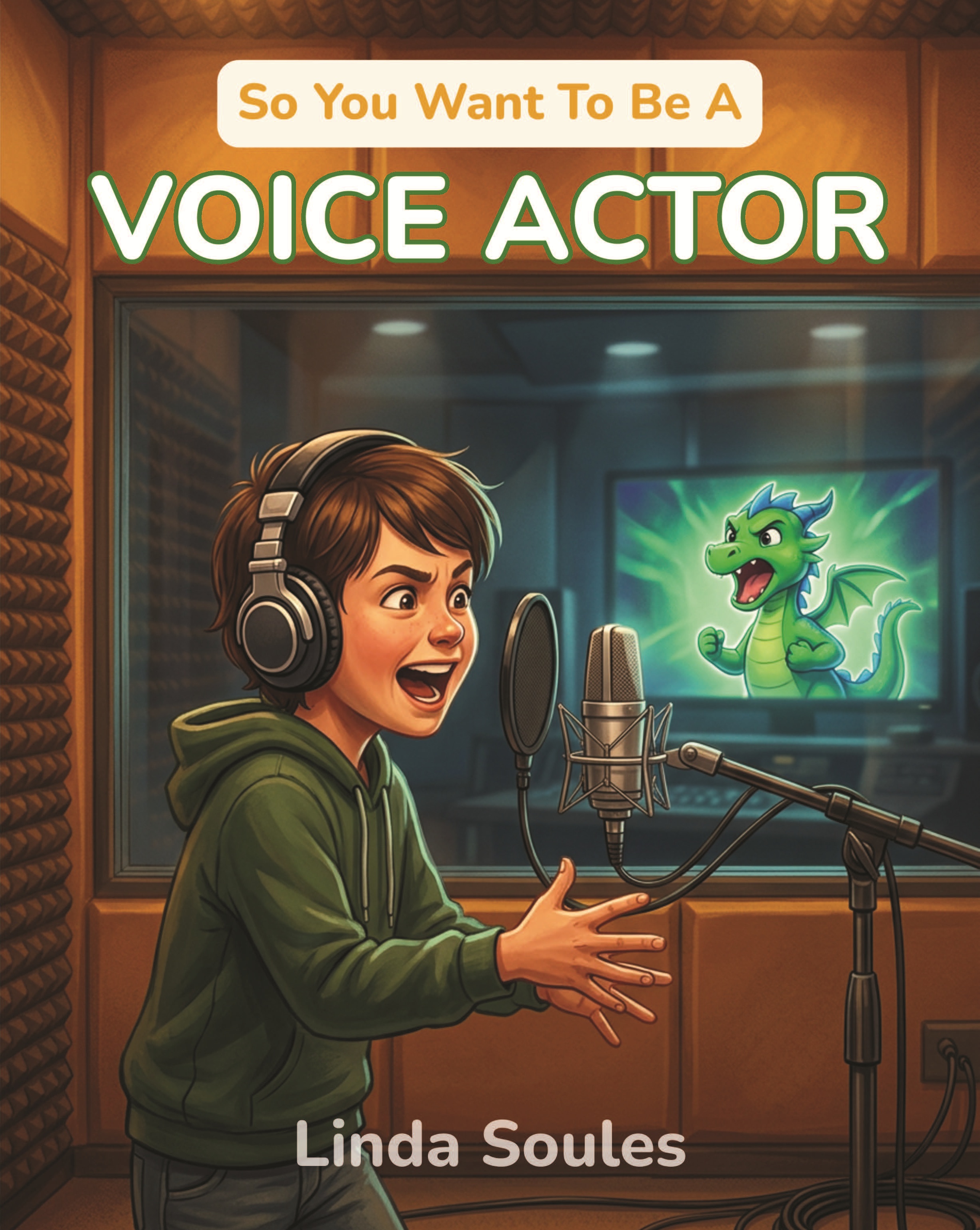
That instrument is powered by the whole body. Standing tall opens the chest and throat, helping produce a fuller, richer sound. Leaning forward can give a line urgency. Even smiling changes the shape of the mouth and lifts the cheeks, making the voice sound brighter and warmer, although the audience cannot see the smile. Actors gesture, point, wave, clench their fists, crouch, grimace, or rise onto their toes. A physical movement travels through the body and affects the sound at the microphone. The performance may be heard as a cartoon character’s voice, but behind it is a performer moving with complete commitment.
The recording booth is usually a small, soundproof space with room for the actor, a microphone, a music stand, and perhaps a stool. The director communicates through the glass, giving notes between takes. The actor may step out to hear the direction, then return to the microphone and try again. Some performers work from home in purpose-built booths or carefully treated closets. When those spaces are built well, they can produce recording quality as good as a professional studio, without the commute.
The microphone is more than a device to speak into. Different microphones capture different qualities, and professional actors learn exactly how their own microphone responds: how close to stand, what angle sounds best, and how to adjust their position for different characters. A pop filter helps prevent breath sounds from striking the recording as thumps. The script stand keeps pages at eye level, so the actor does not have to shift their head away from the microphone while reading. Headphones let the performer hear dialogue recorded earlier, along with music and sound effects, so the new performance can match the tone and energy of what will surround it.
The actor’s imagination is another essential tool, though it has no physical shape. To give a voice life, the performer must picture the world from inside the character: what the character sees, what frightens them, what makes them laugh. That imagined reality flows into the voice. Without it, the recording is only a sound; with it, listeners hear a person. The body helps the voice work, but imagination gives it somewhere to come from.
A typical workday begins well before the microphone is switched on. At nine in the morning, the actor prepares the script, reading aloud and exploring the character’s breath patterns and the points where the emotion changes. The goal is to know the character almost as well as a close friend. At eleven, the actor warms up the lips, tongue, and jaw, the muscles that shape sound. Lip trills, tongue twisters, and vocal scales help prepare the voice for animation’s wide emotional range and exaggerated articulation. A single line may need to be delivered in many different ways.
By noon, the actor is recording. Animation may appear on a screen, with mouth movements timed but not yet final; the performance being recorded will help give the animation its sound. The director may ask for more emphasis on a particular word, greater confusion at the beginning of a line, or a larger, more expressive delivery. The actor tries the line again, and then again. One session can include dozens of takes, each slightly different, until the director has the version the scene needs.
At two-thirty, the performer might move to an ADR session, re-recording dialogue that was unclear in an earlier recording. Here, the actor must match the existing character and fit the new words to mouth movements already animated. Timing can matter down to the individual syllable. Later, at four-thirty, the actor may meet with writers to discuss where a character’s story will go next. A change in the character’s arc has to register in the voice: the actor and writers talk through what should shift and what should remain consistent.
The work therefore joins imaginative discovery with close attention to sound, movement, and timing. A character may seem to arrive in one inspired moment, but the finished performance is built through preparation, physical commitment, careful listening, and repeated attempts to make each line belong to the person speaking it.
The satisfaction comes when the work suddenly clicks: a vocal choice makes the character feel alive, and the actor no longer has to force the performance. A timid character’s small, tentative voice may reveal unexpected courage; a laugh may carry genuine joy. In one session, a performer might move among a tiny mouse, a confident hero, a bumbling wizard, and an ancient dragon, making each distinct. That variety keeps the job challenging, but its deeper reward is making an audience believe in people who began as drawings.
For a child watching a favorite cartoon, the dragon, mouse, and cat are not sounds made by an unseen performer. They are friends who live inside the screen. A voice gives a drawing personality and presence, turning colored lines into someone a child can know and love. That connection can last long after childhood: a voice remembered from one generation may be heard again when a grown-up shares the same cartoon with their own children.
The demands behind that pleasure are easy to miss. A voice is a physical instrument, and the vocal cords can be injured by overuse, dehydration, or poor technique. Performers drink water, warm up, and take care of their voices beyond the studio, saving strenuous effects such as screaming for moments when they can use proper technique and recover afterward. A sustained session may mean hours of repeating lines at a director’s request while keeping the character’s voice consistent. The throat can be exhausted when the work is done, and the actor may need time to recover before recording again.
Patience is another essential part of the job. A director might ask for many versions of a line, adjusting the emotion or emphasis each time, yet not know exactly what is wanted until it is heard. The actor keeps trying, following notes toward a result that may be close but not quite right. Remaining open and focused through those repetitions is a professional skill, even when the answer takes a long time to find.
One surprising reality is how often performers work alone. An animated series may have a full cast, but its actors are usually recorded separately, sometimes months apart. When one character reacts to another, the performer may never have heard the original line. The director describes how the unseen scene partner spoke, and the actor imagines the exchange. Later, editors join the recordings so the separate voices sound like people sharing a room. Making that invented conversation feel natural depends on attentive listening and trust in what cannot be seen.
This kind of performance belongs to a much older tradition than recording studios. Long before books, storytellers held audiences with their voices. Parents at bedtime have conjured whole casts in a quiet room, while West African griots preserve community history through spoken storytelling. Japan has its seiyuu tradition, and early twentieth-century radio dramatists built worlds for listeners without pictures. Across cultures and eras, people have used their voices to create characters, emotions, and places. A booth and microphone focus that ancient power; they do not create it.
Even after recording, an actor may not feel certain about the result. Some performers avoid watching their own productions. Hearing a voice recorded months earlier, placed in a scene they could not fully picture at the time, may cause them to second-guess choices that worked perfectly well. Instead of satisfaction, they can feel an urge to go back and record the lines again. The finished performance often sounds different from what they imagined while making it.
No single person creates the final character. A director offers creative guidance throughout recording, while the writer supplies the words. A sound engineer captures and edits the performance, and a casting director helped match the actor’s voice to the role. When another cast member records in the same session, that performer’s energy can shape the response. The work is collaborative even when the actor is alone in the booth.
Animators are among the collaborators who carry the performance into the finished character. They synchronize the animation to the actor’s recording, and the exactness of that performance can shape what appears on screen. They may watch the performer’s face and hands for clues: a raised eyebrow, a blink, or a held breath can suggest a visual choice. Actor and animator contribute different things, but together they create a character neither could have made alone. Editors, colorists, musicians, and translators later carry that character forward, including for children watching in other countries.
And the audience gives the work its meaning. Children may hear a favorite character before they can read, recognizing the warm, funny, or brave voice as a familiar presence. The performer helps create a relationship that becomes part of what it felt like to be small and absorbed in a story. Without a voice, animation is movement without the same sense of life. Every child already knows something about this imaginative work: making a dragon sound enormous, a princess determined, or a stuffed animal different from oneself is a beginning. The professional craft grows from that instinct, and the people who will hear the next character are already waiting.
The history of voice acting becomes especially vivid through the performers whose characters have become more famous than their faces. Mel Blanc, remembered as “The Man of a Thousand Voices,” voiced Bugs Bunny, Daffy Duck, Porky Pig, Tweety Bird, Sylvester, Yosemite Sam, and many others. The range was so deeply associated with him that when he fell into a coma after a car accident, doctors addressed him as Bugs Bunny—and Bugs answered. Even his gravestone carries the signature farewell of one of his best-known characters: “That’s All, Folks.” Blanc’s career makes the peculiar intimacy of the work plain: listeners may recognize dozens of characters, yet hear one remarkable performer behind them.
June Foray created another large company of distinctive characters, including Rocky the Flying Squirrel, Natasha Fatale, and Cindy Lou Who. Her contribution was not only the performances themselves. Foray spent decades fighting for voice acting to be recognized as a serious art form and helped found the Annie Awards. She continued performing into her nineties. Her story connects artistic skill with professional recognition: a character can be beloved by millions, while the person who gives that character a voice remains less visible than the drawing on the screen.
Phil LaMarr’s route into voice work began in sketch comedy and stage acting. His roles include Samurai Jack, Green Lantern John Stewart in Justice League, Hermes on Futurama, and numerous video game characters. He also teaches, and the advice he gives young performers is direct: learn to act first. The character is the point; the voice follows. That principle returns to the distinction between building a person and merely selecting a sound. A striking voice matters most when it expresses the character rather than drawing attention away from it.
Tara Strong demonstrates how many separate personalities one performer can carry. She has voiced more than five hundred characters, among them Bubbles in The Powerpuff Girls, Twilight Sparkle in My Little Pony, Timmy Turner in The Fairly OddParents, and Harley Quinn in the Batman: Arkham video games. She may record all four characters in a single afternoon, switching between them mid-session. The feat depends on more than vocal range: each role has to remain recognizable, with its own character and emotional life, even as the performer moves rapidly from one to another.
Some voice careers stretch across decades in ways that change how audiences experience a character. Nancy Cartwright has voiced Bart Simpson, the same ten-year-old boy, since 1987, through more than 750 episodes. Bart remains ten while many of the adults who watched him as children grow up. A performer may also keep a character’s voice for thirty or forty years. Children who loved a cartoon can later hear that same voice while sharing the show with their own children: one performer, one familiar character, and a connection passed between generations.
Other facts reveal just how far a voice can travel beyond the original recording. The “Wilhelm scream,” a brief shriek recorded by Sheb Wooley in 1951, has been reused in more than four hundred films, from Star Wars to Pixar movies. A performance lasting only six seconds became an inside joke among sound designers and, through repetition, a sound heard by nearly everyone on Earth. It shows that even a tiny vocal moment can acquire a life of its own when it is carried from one production to the next.
Voice acting can also free a character from the performer’s appearance. A tall man may voice a tiny mouse; a young woman may voice an elderly man. The audience receives the character through sound, not through a visual resemblance between actor and role. In video games, the scale of the work can be different again: performers may record thousands of lines for one character, including lines triggered only in rare game situations that most players never encounter. Some characters have more than ten thousand recorded lines. The performance must exist even for moments many players will never hear.
Frank Oz offers another example of a voice career extending across different kinds of creative work. He performed Miss Piggy, Fozzie Bear, Animal, and Sam the Eagle while also directing major films. His characters live in millions of childhoods, though many people would not recognize his face in a lineup. The contrast is striking: a performer can be intimately familiar to an audience through several characters and still remain personally unknown to that audience.
Together, these careers and facts show how varied the work can be. One actor may build a gallery of characters, another may sustain one beloved role over much of a lifetime, and a single recorded sound may be reused in films made decades later. Performers can move among cartoons, games, and other productions, while listeners carry particular voices into memories that last beyond any one episode or recording. The image on screen may be fictional, but the choices behind its voice belong to real people—and those choices can become part of popular culture in ways the performers could not fully predict.
The qualities that matter most are not merely unusual vocal sounds, but the ability to make a complete person present in a line of dialogue. With no costume, set, or visible face to help, the actor must imagine the character’s fears, joys, and secrets so fully that even a brief sentence carries the weight of someone real. Vocal versatility then lets one performer create characters of different ages, sizes, species, and emotional states, even though the same vocal anatomy is doing the work. Yet the performance must serve the story, not show off a voice: the actor listens for what the moment needs and gives the scene exactly that.
Consistency is another essential skill. A performer may need to reproduce the same character voice across months or years, keeping it available on demand. This depends on knowing the character so well that the voice can be returned to reliably. It also takes trust in what cannot be seen or heard: a scene partner may have recorded elsewhere, the line being answered may not be playing, and the scene itself may not yet exist in finished form. The actor has to commit to the imagined situation as if it were real; otherwise, the performance can sound like a guess.
The less obvious requirements include acting without a scene partner, close attention to real voices, and the courage to be silly in a serious room. A performer may laugh at a joke no one has told yet, or roar like a dragon while watched through studio glass. Complete commitment is what lets such choices feel alive rather than self-conscious. Years of listening to people help build a storehouse of authentic rhythms: the pace of excitement, the sound of someone trying not to cry, or the way tiredness changes a voice. Convincing characters grow from observations of real life, not just from imitating other cartoons.
The history of the profession shows how much personality one voice can hold. Mel Blanc, known as “The Man of a Thousand Voices,” played Bugs Bunny, Daffy Duck, Porky Pig, Tweety Bird, Sylvester, Yosemite Sam, and many more. After a car accident left him in a coma, doctors addressed him as Bugs Bunny, and Bugs answered. Blanc’s gravestone carries the familiar words, “That’s All, Folks.” June Foray voiced Rocky the Flying Squirrel, Natasha Fatale, Cindy Lou Who, and dozens of other characters. She spent decades advocating for voice acting as a serious art form, helped found the Annie Awards, and continued performing into her nineties.
Phil LaMarr moved from sketch comedy and stage acting into a career voicing characters such as Samurai Jack, Green Lantern John Stewart in Justice League, and Hermes on Futurama, as well as numerous video game characters. His advice to young performers is to learn acting first: the character is the point, and the voice follows. Tara Strong’s work demonstrates the range this can require. She has voiced more than 500 characters, including Bubbles in The Powerpuff Girls, Twilight Sparkle in My Little Pony, Timmy Turner in The Fairly OddParents, and Harley Quinn in the Batman: Arkham games. She may record four characters in one afternoon, switching between them mid-session.
Some performers sustain a character for extraordinary stretches of time. Nancy Cartwright has voiced Bart Simpson since 1987, across more than 750 episodes, even though Bart remains ten years old. A single performance can also travel far beyond its original use: the “Wilhelm scream,” recorded by actor Sheb Wooley in 1951, has appeared in more than 400 films, from Star Wars to Pixar movies. And a character voice can connect generations when adults who loved a cartoon as children hear the same performer still voicing it for their own kids. Voice acting is not limited by a performer’s appearance, either: a tall man can voice a tiny mouse, or a young woman an elderly man. Video game actors may record thousands of lines for a character, including lines triggered only in rare game situations; some characters have more than 10,000. Frank Oz has voiced Miss Piggy, Fozzie Bear, Animal, and Sam the Eagle while also directing major films, though many people would not recognize him by sight.
There are practical ways to begin developing the craft. Reading a favorite book aloud with a different voice for each character makes one person the whole cast. Changing pitch, pace, and emotion helps distinguish them. A useful exercise is to say “I found it” five ways—excited, scared, angry, sad, and suspicious—and notice how the same words change meaning as pitch, pace, and breath shift. Another is to invent a character from the inside out: decide what a shy dragon or a brave mouse wants and fears, then ask how that person would sound. Recording the result can reveal whether the voice seems to belong to a person or is only a vocal trick.
The body offers practical evidence of how performance travels through sound. Record a sentence once without smiling and again with a smile; the second version should sound warmer and brighter, though the listener cannot see the face. Preparing the instrument matters too. Lip trills, tongue twisters such as “red lorry, yellow lorry,” and humming from a low comfortable note to a high one and back can loosen the lips, tongue, jaw, and voice. Five minutes of warm-up is a small version of what professionals do before a session.
A performer also learns to ask useful questions: Who is this character at their core, and what qualities in my voice can bring that to life? What does a line mean beneath its words, and how can that meaning come through? How can an unseen character become believable to someone who can only hear them? These questions keep attention on the person and the story, rather than on vocal display alone.
For someone wondering whether this could be a job, the invitation is straightforward: love of characters, the ability to inhabit them, and the desire to make people laugh, cry, or feel a chill through sound are a promising beginning. The challenge is performing without a visible body to do the work. The studio can be any quiet room, the microphone a friend’s ear, and the audience anyone willing to listen. A beginner can practice by reading aloud, listening closely to how real people speak, and watching the credits to discover how one actor may voice several characters. A demo reel—a short recording that shows a performer’s range—is one of the tools actors use to seek their first jobs. But the first step is simpler: read a line again, and mean it more. The characters still waiting to be heard may begin with the voice already inside you.
Chapter Summaries
Building a Character Through the Voice
The book presents voice acting as the creation of a complete, believable person using sound alone. Performers shape a voice through four controls: pitch, pace, breath, and emotion. A higher pitch may suggest youth or smallness, a slower pace can convey wisdom or menace, and breath can reveal fear, confidence, or urgency. Emotion matters most because listeners can tell when a feeling is genuine rather than merely imitated. Professional character work begins by understanding the person behind the words. Actors ask who the character is, what they want, and what they fear; only then do they find the voice that fits. The body helps create that sound: standing tall can enrich the voice, leaning forward can add urgency, and smiling can make a delivery warmer. The book encourages aspiring actors to explore characters from the inside out rather than relying on vocal tricks.
The Booth, the Tools, and the Workday
Voice actors usually work in small soundproof booths, communicating with a director through glass and repeating lines until the performance meets the scene’s needs. Some record in carefully treated home spaces. Essential equipment includes a microphone, pop filter, script stand, and headphones; actors learn how to position themselves relative to the microphone and use headphones to match dialogue with music, sound effects, and other performances. The workday may include script preparation, vocal warm-ups, animation recording, and ADR—re-recording dialogue to improve clarity or match existing mouth movements. Directors may ask for several versions of a line, such as more energy, confusion, or emphasis, while writers and performers discuss a character’s future development. The routine shows that the job combines preparation and creative exploration with careful timing, technical awareness, and collaboration.
The Rewards and Demands of the Job
One of the most satisfying moments for a voice actor is finding the choice that makes a character feel real. A timid but secretly brave character might need a particular pitch; a joyful laugh may emerge when the performer genuinely understands the character’s happiness. Actors may shift among a mouse, a hero, a wizard, and a dragon in one session, making the work a continual exercise in invention. The profession is also physically demanding. Vocal cords can be strained by overuse, dehydration, or poor technique, so performers warm up, drink water, and allow time to recover. A long session may involve hours of repeated lines and adjustments. Direction can be challenging when a director knows a take is not quite right but cannot yet explain why. Patience, experimentation, and the ability to keep trying without losing focus are professional skills.
Working Alone, Telling Stories, and Finding the Voice
Despite the impression of a lively ensemble, animated casts are often recorded separately, sometimes months apart. An actor may respond to a line they have never heard, relying on a director’s description and their own imagination. Editors later combine the performances so they sound like a shared conversation. The book connects this modern studio practice to a much older tradition: storytellers across cultures have long used their voices to preserve history, entertain audiences, and bring imagined worlds to life. A sample day might move from studying a character’s emotional changes to warming up, recording animation, matching dialogue to existing mouth movements, and talking with writers about a new character arc. Performers may even avoid watching their finished work because hearing a recording later can make them second-guess choices made in the booth. The completed performance can sound different from what they imagined, underscoring how much of the work depends on trust in the process.
The People and the Audience Behind the Performance
A voice actor’s work is shaped by a network of collaborators. Directors guide the performance, writers create the character’s words, sound engineers record and edit, casting directors match performers to roles, and fellow actors can influence a scene’s energy when they record together. Animators also build on the actor’s performance, using vocal details and visible movement—such as a held breath or gesture—to shape the character on screen. The book emphasizes the audience, especially children, as a central reason the work matters. A character’s voice can become a child’s trusted companion and a lasting part of growing up. Voice acting gives animation its emotional presence: a drawing becomes someone a child can recognize, love, and remember. The book also reminds young readers that they already practice the art when they give different voices to toys, stuffed animals, or characters in a story.
The Qualities and Practice of a Voice Actor
Successful voice actors need more than a wide vocal range. They must imagine a character’s inner life, listen for what a scene requires, reproduce a voice consistently across sessions, and commit to an imagined situation even when partners or footage are absent. They also need close observation skills: studying the rhythms of real people—how excitement speeds speech or tiredness changes its cadence—provides a foundation for convincing characters. The book offers practical exercises for beginners. Readers can perform a story as an entire cast, say the same sentence with different emotions, invent a character’s personality before choosing its voice, and compare recordings made with and without a smile. It recommends simple warm-ups such as lip trills, tongue twisters, and range glides. These activities make voice acting accessible as a practice, while reinforcing that the body, emotion, listening, and imagination all contribute to the result.
A Career to Explore
Profiles of performers such as Mel Blanc, June Foray, Phil LaMarr, and Tara Strong show the range and staying power of voice acting. Their work spans iconic animated characters, games, and multiple roles within the same production. The book’s examples highlight different lessons: voice acting can be a serious art form, a career benefits from strong acting skills, and one performer may create many distinct characters over a lifetime. Fun facts about long-running roles and reused sound effects further illustrate how voices can reach enormous audiences. The closing material invites readers to explore the profession further through books, websites, audiobooks, theater groups, professional organizations, and simple activities such as watching credits or listening to a scene with the picture off. A glossary explains terms including booth, cold read, demo reel, direction, lip sync, and mic technique. The author’s note encourages readers to begin with practice, patience, and a willingness to be silly, presenting the career as a possibility to explore rather than a distant mystery.
Notable Quotes
The character is not a voice. The character is a person who has a voice.
The person comes first. The voice follows.
The microphone is the ultimate truth detector.
Without this, the voice is just a sound. With it, the voice is a person.
Voice acting is not sound effects. Voice acting is creation: building people, emotions, and whole worlds from nothing but vibrating air.
The booth is just a quieter room. The microphone is just a tool. The voice is the magic — and the voice is already there.
The character comes first: who they are, what they want, what they fear. The voice follows naturally from who the character is. Not invented — discovered.
