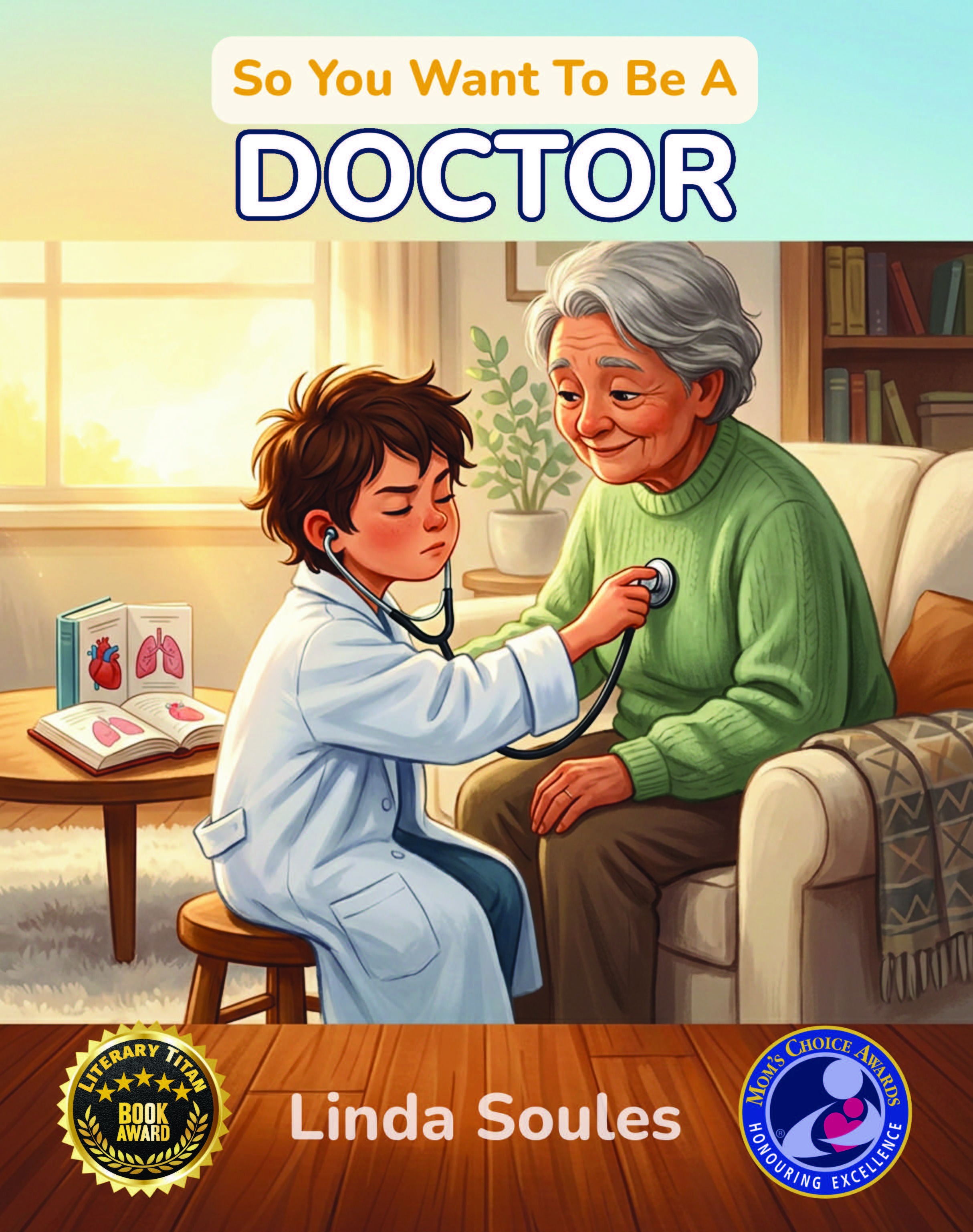
So You Want To Be A Doctor
by Linda Soules
Key Takeaways
Summary
A doctor’s work begins with a mystery: a person feels pain, notices a change, or simply knows that something is not right, but the body cannot explain the cause in words. The doctor has to gather clues and decide what they mean. That makes medicine a kind of detective work, grounded in knowledge of the human body but also in careful attention to the person describing what has changed.
The first clues come from questions. Where does it hurt? When did it start? What makes it better or worse? A patient’s answers help shape the possibilities, and small details can matter. Listening is not merely a polite beginning before the “real” medical work starts. The patient is telling the doctor about their experience, and the story may point toward the diagnosis. A doctor who listens closely can gather information that no instrument can provide.
Next comes the examination. The doctor may listen with a stethoscope, press gently on a particular area, or watch how the patient moves and responds. Each observation adds to the picture. Then the doctor has to think: combining the patient’s history with the examination and whatever tests are needed, and drawing on what they know about how the body works. The aim is to identify the most likely explanation, rather than simply to name the symptom.
That process requires science, but the best care also depends on seeing the whole person. A patient is more than the condition that brought them in. They have a life, a family, fears, and circumstances that may affect their health and their choices. Medical knowledge helps a doctor understand what may be happening; attentive, honest communication helps the patient understand it too. Listening carefully, explaining clearly, and making a patient feel heard are not extras added to treatment. They are part of helping someone make informed decisions about their care.
Doctors practice this work in very different places. A family doctor’s clinic is organized around appointments, each with its own question to investigate. An examination room has a table and an instrument tray, along with tools such as an ophthalmoscope for looking at the eyes and an otoscope for examining the ears. A clinic day follows the rhythm of one patient after another, with each encounter calling for its own questions, observations, and judgments.
A hospital brings together several demanding environments. In the emergency department, care is organized around speedy evaluation and assessment. In the intensive care unit, the atmosphere is quieter, but every breath and heartbeat is watched. The surgical suite is cold and precisely lit. Beyond hospitals, doctors may work in rural clinics, refugee camps, or disaster zones. Wherever they practice, they need to adapt their work to the needs of the setting and the people who have come for help.
Some of a doctor’s most useful instruments are simple. A stethoscope amplifies sounds inside the body, allowing an experienced doctor to hear a heartbeat, notice signs of abnormal valve function, or distinguish clear lungs from lungs containing fluid. It can reveal important information without a complicated machine. Other examination tools focus on particular clues: the otoscope looks into the ear, while the ophthalmoscope helps examine the eye. A reflex hammer taps the knee to test neurological function, producing a response from the nervous system faster than the brain can think. Blood pressure cuffs, pulse oximeters, and thermometers provide further measurements of how the body is working.
When questions remain after the physical examination, doctors can turn to tests and imaging. Blood panels can reveal what is happening at a molecular level. X-rays and scans show structures that cannot be seen from outside the body. A CT scan takes hundreds of X-rays from different angles and combines them into a three-dimensional map of the body’s interior. An MRI uses powerful magnets to produce detailed images of soft tissues, allowing doctors to see structures such as muscles and even the folds of the brain.
These tools do not all answer the same question. A doctor must decide which one is useful for the problem at hand, then interpret what it shows alongside the patient’s story and examination. A result is another clue, not a substitute for thought. Choosing carefully matters because the point is not to collect every possible test, but to find the information that helps explain what is happening.
The chain of reasoning can lead to a prescription. A prescription is an official order for medicine, specifying the drug, the amount, and how often it should be taken. It may be written on paper or sent electronically to a pharmacy, but either way it represents the path from symptoms, through a diagnosis, to a proposed treatment. Behind that instruction lies the doctor’s effort to understand which help is suited to this patient and this problem.
The rewards of medicine are often found in ordinary moments: a frightened patient leaves reassured, a test comes back normal, or a child whose parent feared the worst is well again a few days later. These recoveries matter because patients arrive trusting the doctor with their health and believing that help is possible. Honoring that trust, day after day, can make the work deeply fulfilling. Doctors also value the challenge of cases that do not reveal their answers quickly, when a patient’s history, examination, and test results have to be assembled into a sound explanation. It is a demanding puzzle, but its stakes are real: the person behind it needs the doctor to get things right. And when a doctor cares for someone over many years, sharing illnesses, recoveries, and other turning points, that lasting relationship becomes one of medicine’s most meaningful gifts.
The same responsibility that makes medicine rewarding can also make it hard. Decisions must be made about serious problems with incomplete information, often under time pressure, and no amount of experience removes their consequences. Doctors cannot fix everything. Sometimes an illness is too advanced, or a body cannot recover, despite everything the doctor knows and tries. When cure is no longer possible, the work changes but does not end: a doctor can ease discomfort, sit with a family, and speak honestly without losing gentleness. Caring for someone through suffering or loss can remain with a doctor for years. Yet sometimes only minutes after delivering devastating news, that doctor must enter another room and be fully present for someone else. Colleagues, nurses, loved ones at home, and other doctors help carry the burden, while the need to care for the caregivers is increasingly being taken seriously.
One less obvious difficulty is that experience and intelligence do not prevent every mistake in judgment. Doctors learn to recognize patterns, matching what they see with conditions they have encountered before. But a familiar diagnosis can spring to mind too quickly and crowd out a more likely explanation. Checklists and decision tools help slow that impulse and make sure important possibilities are not skipped; they can improve accuracy even for highly skilled doctors. Medicine demands not only knowledge, then, but also systems that help people use that knowledge carefully. The training itself is long: eleven to fifteen years after high school, including college, medical school, and three to seven years of residency in a hospital. Even after all that, doctors may feel they still have more to learn, because experience cannot be rushed.
The job has surprises both large and small. In 1816, a French doctor needed to listen to a young woman’s heart, but putting his ear directly against her chest was considered improper. He rolled a sheet of paper into a tube, placed one end on her chest and the other to his ear, and found he could hear her heart clearly. That simple workaround became the stethoscope, an instrument recognized around the world. It is a reminder that a practical problem, solved with whatever is at hand, can lead to something lasting.
A doctor’s day can move between different kinds of responsibility. At seven in the morning, hospital rounds begin: checking on patients admitted the day before, reviewing overnight lab results, changing medication when needed, and speaking with people in their rooms. One patient may be improving better than expected while another needs a new plan. By nine-thirty, clinic appointments are underway, often scheduled every twenty minutes—less time than a complex conversation may deserve. Some visits involve a chronic illness being managed well; others require a sensitive discussion about what must change. Lunch may turn into an unfinished meal and a conversation with a specialist about a shared patient. In the afternoon, a parent may raise concerns about a child’s development, a patient may need help with anxiety, or an older person may mention the concern they came in for only as they are leaving. Later come test results and phone calls, including conversations that take longer because they are difficult. Then there is charting: records must be accurate and complete, and the paperwork is part of the work, not an optional extra.
No doctor does that work alone. Nurses spend more time with patients than anyone else and may notice changes that are essential to the team’s decisions. Specialists offer detailed expertise when a problem needs closer attention. Pharmacists check that prescribed medicines will not cause unexpected problems when taken together. Radiologists interpret images, while laboratory technicians perform tests that help confirm what the doctor suspects. Social workers help with circumstances such as poverty, housing difficulties, and family struggles, which can affect health as powerfully as illness itself. Patients and their families are also central: they bring their experiences, fears, hopes, and knowledge of the person being treated. The doctor may lead the team, but cannot be the whole team. Medical students and residents learn alongside practicing doctors, and teaching them can make those doctors better too; learning and teaching continue through the profession.
A doctor’s influence can extend well beyond one appointment. Recognizing the same unusual illness in several patients may set off an investigation that protects a whole community. Speaking up when a patient is ignored or dismissed can make the work an act of justice as well as medical care. Teaching future doctors multiplies knowledge across generations. Some doctors bring their skills to places where care is especially difficult to find, including small rural towns, remote villages, and communities affected by war or disaster.
To meet these demands, doctors need more than the ability to recall medical facts. Clinical curiosity keeps them asking why, including what may lie beneath the first explanation. They must also be able to act without pretending to be certain: “I don’t know with certainty, and here is how we proceed” is an honest way to practice. Communication is part of treatment, because a diagnosis must be explained in a way the patient can understand and use to make an informed choice. Sustained compassion means being affected by suffering without being destroyed by taking on another person’s pain. Intellectual humility matters too: medical knowledge changes, and good doctors keep learning and follow new evidence even when it challenges what they were taught.
Some of the most important abilities are easy to overlook. The medical interview is where many diagnoses begin, so a doctor must put a nervous patient at ease and hear not only what is said, but what a person may be reluctant to say. Doctors also think in probabilities rather than certainties: perhaps there is a seventy-percent chance of one condition, a twenty-percent chance of another, and a ten-percent chance of something not yet considered. They must know when they might be wrong and have a plan for what to do next. And they need to understand how people think. A treatment a patient cannot or will not follow is not truly effective, so learning what someone fears and values can be as important as knowing which medicine suits the condition.
The history of medicine shows what it can mean to turn attention into action. Paul Farmer traveled to Haiti, where he saw suffering that medicine had largely abandoned, and co-founded Partners in Health to bring world-class care to some of the poorest communities on Earth. He believed that the place where someone was born should never determine the quality of medicine they received, and his work made that belief practical. Cicely Saunders noticed a different kind of neglect: dying patients were often treated as medical failures rather than as people still in need of care. After training as a nurse and social worker, she became a doctor and, in 1967, founded St. Christopher’s Hospice in London. Built around relieving suffering when cure was no longer possible, it helped create the modern field of palliative care. Elizabeth Blackwell confronted exclusion directly. Twenty-nine medical schools in America rejected her because she was a woman; the thirtieth accepted her, apparently as a joke by the students voting on her application. She graduated first in her class in 1849, becoming the first woman to earn a medical degree in the United States, then helped found a school to train other women. Each story makes visible a different way doctors can change care: by reaching people left out, staying with patients whom medicine cannot cure, or opening a path for those barred from entering the profession.
Medicine’s past also contains lessons in observation and skepticism. Handwashing before seeing patients was not standard until 1847, when a Hungarian physician noticed that wards attended by doctors arriving from autopsies had dramatically higher death rates. He was right, but people laughed at him for years before germ theory confirmed his insight. The episode is a reminder that evidence may first appear as an uncomfortable pattern someone must be willing to take seriously. Even the body’s ordinary workings invite investigation: it contains approximately 37 trillion cells, and each carries the complete genetic instructions for building a human being, though different instructions are switched on in different kinds of cells. Meanwhile, the placebo effect—improvement that can occur because a patient believes a treatment will help, even when it contains no active medicine—is sufficiently reliable and measurable to have its own scientific literature. The mind and body do not always fit into separate boxes.
Some details of medical practice sound almost unbelievable until their purpose becomes clear. In an MRI room, the machine’s magnet is powerful enough to pull a steel chair across the room, which is why metal objects, even a coin or a watch, must stay away. And care for caregivers matters too: some hospitals have therapy-dog programs for doctors and nurses. Studies show that healthcare workers who spend time with a therapy dog during high-stress shifts have measurably lower levels of cortisol, a stress hormone, for hours afterward. Even the oldest medical specialties reach far back. Physicians in ancient Egypt specialized in areas such as the eyes, teeth, and internal organs; the earliest physician known by name, Hesy-Ra, practiced around 2600 BC.
A future doctor can begin preparing without waiting for medical school. Learning basic first aid, then practicing until the steps become automatic, builds useful skills now: treating a cut, helping someone who is choking, or placing a person in the recovery position. A CPR course for young people, such as one offered by the Red Cross, can add to that foundation. Studying the body can start one system at a time—the circulatory, respiratory, digestive, or nervous system—and anatomy books with transparent overlay pages can make its layers easier to explore. Observation matters as much as reading. Take your own pulse and compare it with a family member’s; watch how a cut heals over several days; notice your eyes adjusting when you enter a dark room. Each small observation is practice in asking what the body is doing and why.
Curiosity can also be brought into an ordinary check-up. Ask your doctor what they are listening for with the stethoscope, or what made them choose this work. Doctors often welcome a child’s questions, and an answer may offer a memorable glimpse into the profession. Empathy, too, can be practiced deliberately: read literature, listen closely, and sit with someone who is frightened or in pain without rushing to fix the feeling. Volunteering at a food bank, nursing home, or community event offers another way to learn what people need and how their circumstances shape their lives. These experiences do not replace scientific study; they help develop the attention that makes knowledge useful to another person.
The questions behind medical work can be carried into these early experiences: What is actually causing a problem, rather than merely resembling it on the surface? What does this person need a doctor to understand about their life? How can the information be explained so the patient can make their own best decision? Medicine has words for some of the ideas that arise. A differential diagnosis is the list of possible conditions considered before one is selected, with explanations ruled out as evidence accumulates. A prognosis is an assessment of how a condition is likely to develop, and sharing it honestly and compassionately is a profound responsibility. Informed consent means explaining a treatment so the patient can make a free, informed choice; confidentiality protects what patients share and makes it possible for them to speak truthfully. Vital signs—temperature, pulse, breathing rate, and blood pressure—provide basic measurements of how the body is functioning. Learning the vocabulary is one way to begin seeing how many kinds of attention and responsibility are gathered into a doctor’s work.
Medicine has always depended on people willing to notice what others overlook and act on what they learn. Paul Farmer traveled to Haiti, saw communities suffering without adequate care, and co-founded Partners in Health to bring world-class medicine to some of the poorest places on Earth. He believed that a person’s birthplace should not determine the quality of care they receive. Cicely Saunders noticed that dying patients were too often treated as medical failures rather than people still needing help. After training as a nurse, a social worker, and a doctor, she founded St. Christopher’s Hospice in London in 1967. Its approach helped create modern palliative care: when medicine cannot cure, it can still relieve suffering and accompany people to the end. Elizabeth Blackwell faced rejection from twenty-nine American medical schools because she was a woman. The thirtieth accepted her, apparently as a joke among the students who voted on her application, but she graduated first in her class in 1849. She later helped establish a medical school to train women, opening a path for those who followed.
The history of medicine also holds reminders of how knowledge advances, sometimes despite resistance. Handwashing before patient visits was not standard until 1847, when Hungarian physician Ignaz Semmelweis observed that wards attended by doctors coming from autopsies had far higher death rates. He recognized the connection, but people laughed at him for years before germ theory confirmed his insight. And medicine’s past stretches far back: ancient Egyptian physicians already specialized in areas such as the eyes, teeth, and internal organs. The earliest physician known by name, Hesy-Ra, practiced around 2600 BC.
The body itself offers puzzles on a staggering scale. It contains approximately 37 trillion cells, each carrying the complete genetic instructions for building a human being, though different instructions are switched on in different kinds of cells. A patient can also improve through the placebo effect: the measurable response that occurs when someone believes they are receiving effective treatment, even if it contains no active medicine. Modern technology can be astonishing, too. An MRI’s magnet is strong enough to pull a steel chair across a room, which is why even a coin or watch must stay well away. And some hospitals offer therapy dogs to medical staff; time with a dog during a high-stress shift has been shown to lower healthcare workers’ stress hormones for hours.
For someone curious about medicine, preparation can begin long before medical school. Learning first aid is a practical start: practice treating a cut, helping someone who is choking, and placing someone in the recovery position. A CPR course for young people, such as one offered by the Red Cross, can turn knowledge into a skill that matters now. Learning about the body can happen system by system—circulatory, respiratory, digestive, and nervous—and observing your own body makes the lessons tangible. Take your pulse, watch a cut heal, or notice how your eyes adjust when you enter a dark room.
Questions can be part of that preparation, too. At a check-up, ask your doctor what they are listening for through the stethoscope or what led them to choose this work. Many doctors are glad to tell the story. Empathy also grows with practice: read literature, listen closely to someone who is frightened or hurting, and resist rushing to offer advice. Volunteering at a food bank, nursing home, or community event can help develop the compassion that caring for patients requires.
The questions doctors ask themselves reach beyond a symptom. What is actually causing the problem, rather than merely resembling it? What does this person need me to understand about their life before I can help? How can I give them the information they need to make their own best decision? A child who keeps asking why about the human body may already be thinking in a doctor’s way. So might someone who loves both science and people, listens carefully, wants to understand rather than simply collect facts, and feels moved when another person is in pain. Those qualities do not guarantee that medicine is the right career, but they are good reasons to explore it.
The decision also means facing the length and demands of the path. After high school, becoming a doctor takes eleven to fifteen years: four years of college, four years of medical school, and then three to seven years of residency, learning to care for real patients under experienced physicians. That training is long because there is so much to learn, and no doctor knows everything. Medicine calls for continuing study, honest decisions, and respect for the choices patients have a right to make. Informed consent means explaining a treatment fully so a patient can decide freely. Confidentiality protects what patients share, making it possible to speak truthfully about even frightening parts of their lives. The Hippocratic Oath, taken by doctors for more than 2,400 years, is a promise to practice ethically and put patients’ well-being first. Its best-known principle, “First, do no harm,” does not mean a doctor can prevent every harm or cure every illness. It means taking responsibility for the effects of one’s actions.
At the heart of the work is a promise more modest and more demanding than “I will save you,” “I will know everything,” or “I will fix it.” Doctors cannot honestly guarantee any of those things. The deeper promise is: I will not abandon you. It matters when a doctor can cure a disease, and it matters when cure is no longer possible—when the work becomes easing suffering, being truthful and gentle, and staying with a patient and family through a hard time. A person’s body entrusted to a doctor’s care, and a life that depends on the doctor’s honesty, are serious trusts. The disease may be the puzzle, but the person is the reason for solving it. For anyone drawn to this work, the road begins with curiosity, grows through study and listening, and is guided by the decision to keep showing up for people when they need help most.
Chapter Summaries
The Doctor as Detective
The book introduces medicine as both a scientific discipline and a relationship with people. A doctor tries to understand what is happening inside a patient’s body and help them move toward better health through diagnosis, treatment, prevention, and clear communication. The work spans many specialties, including family medicine, pediatrics, cardiology, neurology, oncology, and emergency medicine. Diagnosis is presented as a three-part investigation: ask about the patient’s symptoms and their timing, examine the body, and reason through the clues using medical knowledge. The patient’s own account is essential; a doctor who listens well may uncover information that tests alone cannot provide. The central lesson is that medicine works best when clinical expertise is joined with attention to the whole person—their fears, family, circumstances, and needs.
Where Doctors Work and What They Use
Doctors practice in settings with very different rhythms. A family clinic is organized around appointments and individual diagnostic encounters, while hospitals contain specialized spaces: emergency departments for rapid assessment, intensive care units where patients are closely monitored, and surgical suites designed for precise procedures. Medical care also reaches rural communities, refugee camps, and disaster zones where clinicians are needed. The chapter tours the tools doctors use and the questions those tools can answer. A stethoscope helps identify heart and lung sounds; an otoscope and ophthalmoscope examine ears and eyes; reflex hammers, blood-pressure cuffs, pulse oximeters, and thermometers add information to the physical exam. Blood panels and imaging reveal details that cannot be seen from outside the body: CT scans assemble many X-ray views into a map, while MRI uses powerful magnets to show soft tissues in detail. Prescriptions turn a diagnosis into a specific treatment plan, reflecting the reasoning that connects symptoms to care.
The Rewards, Difficulties, and Surprises of Medicine
The most satisfying moments can be concrete and ordinary: a frightened patient leaves reassured, a worrying test comes back normal, or a sick child recovers. Doctors may also value the intellectual challenge of assembling a patient’s history, examination, and test results into a sound diagnosis. Over time, many build relationships with patients and become trusted partners through illness, recovery, and major life events. The work also carries serious burdens. Doctors make consequential decisions with incomplete information and cannot cure every disease. When treatment cannot restore health, their role shifts toward comfort, honesty, and support; caring still matters even when curing is no longer possible. The book notes the emotional strength required to face a patient’s worst day and then be fully present for someone else. It also challenges the idea that a brilliant doctor should rely on instinct alone: checklists and decision tools can help prevent premature conclusions and make even experienced clinicians more accurate. Training is long—about eleven to fifteen years after high school—and the stethoscope’s origin illustrates how practical improvisation can lead to lasting innovation.
A Day in the Life, the Team, and the Wider Impact
A sample workday shows how varied and demanding a doctor’s schedule can be. The day may begin with hospital rounds, reviewing lab results and adjusting treatment, continue with tightly scheduled clinic appointments and sensitive conversations, and include specialist discussions during a rushed lunch. Later tasks involve reviewing results, calling patients, and completing accurate medical records after the appointments are over. Doctors do not work alone. Nurses observe patients closely, specialists bring deep expertise in particular areas, pharmacists check medication safety, radiologists interpret images, lab technicians run tests, and social workers help address life circumstances that affect health. Patients and families are central members of the care process, while medical students and residents learn through supervised practice. A doctor’s influence can extend beyond individual appointments: noticing a pattern may prompt a community investigation, advocating for a patient can challenge unfair treatment, and teaching can pass knowledge on to future clinicians. Some doctors bring their skills to places where care is scarce.
The Qualities and Less-Obvious Skills Doctors Need
The book identifies clinical curiosity as the engine of good medicine: doctors need to ask why a problem is happening and look beyond the first explanation. They must also tolerate uncertainty without becoming paralyzed, communicate diagnoses and choices in ways patients can understand, and sustain compassion without being overwhelmed by other people’s suffering. Intellectual humility matters because medical knowledge changes; clinicians must keep learning and follow evidence even when it contradicts what they were taught. Other essential abilities are less obvious than science knowledge. Expert interviewing helps doctors put anxious patients at ease and notice what is said, as well as what is left unsaid. Probabilistic thinking means weighing several possible explanations and having a plan for the chance of being wrong. Understanding how people think and what they value also shapes whether a patient can and will follow a treatment plan. Together, these skills make care more accurate, humane, and realistic.
Medical History, Facts, and Getting Started
Stories of Paul Farmer, Cicely Saunders, and Elizabeth Blackwell show different forms of service and persistence. Farmer worked to bring high-quality care to communities that had been neglected; Saunders helped establish modern palliative care, demonstrating that medicine can relieve suffering when it cannot cure; and Blackwell overcame repeated rejection to become the first woman to earn a medical degree in the United States, then helped train other women physicians. Their examples broaden the idea of what a doctor’s contribution can be. Fun facts connect medical practice to history and science: ancient Egyptian physicians had specialties, handwashing was resisted before later evidence supported it, and MRI magnets require strict safety precautions. For young readers considering medicine, the book recommends learning first aid and CPR, studying body systems, observing how the body works, asking doctors questions, reading and listening to build empathy, and volunteering. It closes this practical section with reflection questions about what is causing a problem, what a patient needs the doctor to understand, and how to help someone make an informed decision.
Is This Career for You? A Doctor’s Promise
The book invites readers to consider whether they are curious about how the body works, enjoy asking why, listen carefully, think before deciding, and care about both science and people. Its glossary explains key terms such as diagnosis, differential diagnosis, informed consent, patient confidentiality, prognosis, residency, and vital signs, giving readers a foundation for understanding medical language and professional responsibilities. In the author’s note, the deepest promise of medicine is described not as knowing everything or fixing every illness, but as refusing to abandon the patient. The disease may be a puzzle, but the person is the reason for solving it. The book’s recommended reading, websites, organizations, and activities extend that invitation: readers can investigate historical diseases, keep a symptom notebook, practice listening without interrupting, and explore reliable health resources. The overall message is that a medical career begins with curiosity and grows through learning, service, and care.
Notable Quotes
The science tells you what is wrong. The heart tells you how to help.
The technical knowledge is essential. But the human relationship is what makes it healing.
Sometimes the most important inventions in history begin as workarounds.
When they cannot cure someone, they can still care for them.
Being smart isn't always enough. Having a good system matters too.
The disease is the puzzle. The person is the reason.
The deepest part of the promise is simpler. It is: I will not abandon you.
