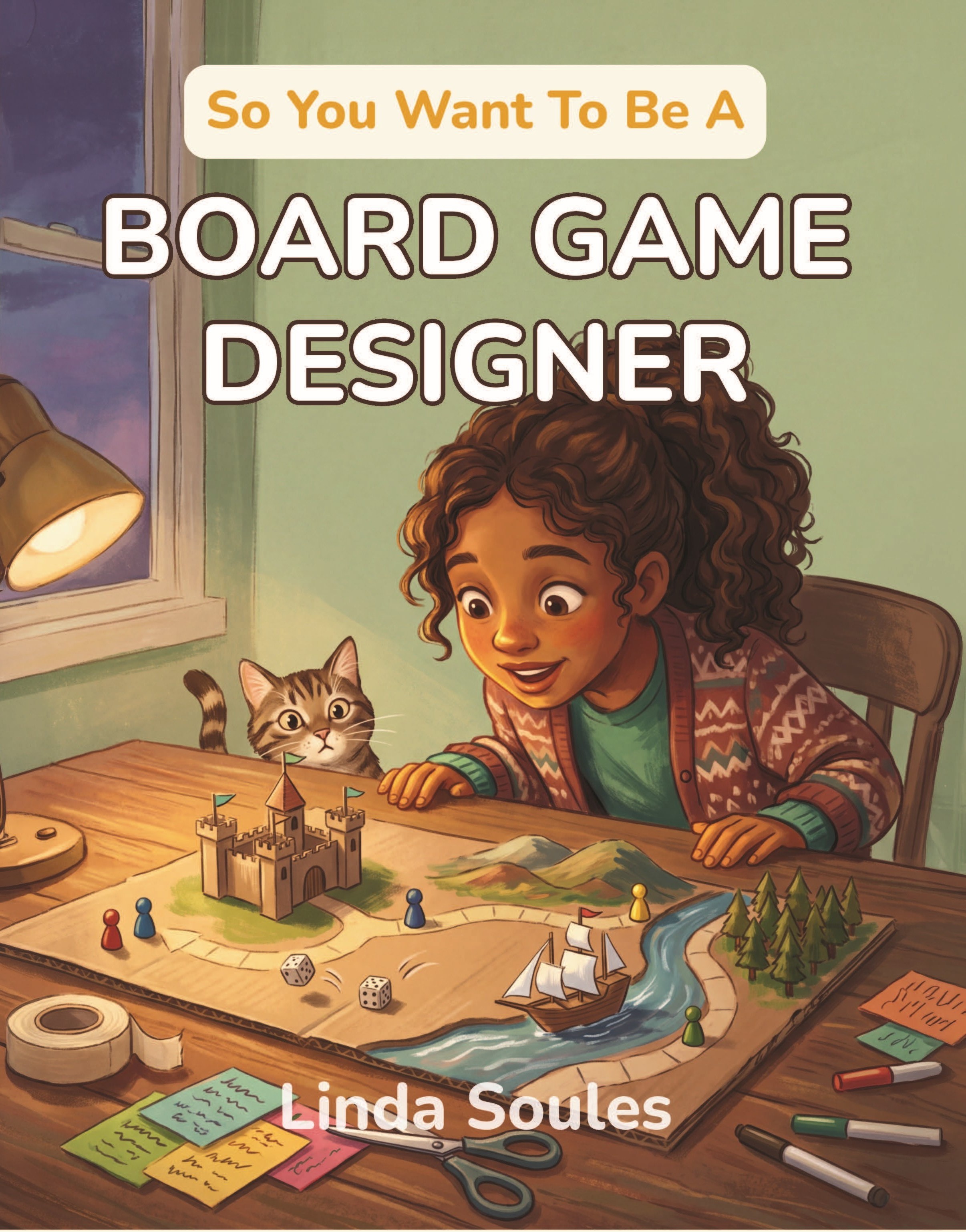
So You Want To Be A Board Game Designer
by Linda Soules
Key Takeaways
Summary
A board game designer shapes the rules, goals, and structure that make a tabletop game work. The mechanics are the actions players take and the systems behind them: rolling dice and moving, drafting cards from a shared pile, placing workers to collect resources, or building a deck that grows stronger. Designers combine familiar mechanics in new ways, then choose a theme—the world or story around those actions. In a game about running a bakery, the choices should feel connected to baking and selling; games have also brought players into worlds of sushi restaurants and cats sewing quilts.
The physical components matter just as much: boards, cards, dice, tokens, and wooden figures all affect how a game feels in players’ hands. They also affect its cost, since every extra piece must be manufactured. Designers look for the simplest set of components that still makes the game satisfying to play. They must also balance the experience. Each player should have a fair chance, smart choices should matter, and the ending should remain exciting. If one move or strategy reliably wins, players stop making interesting decisions and simply copy it. Testing and calculations help reveal where the rules need adjustment.
Once a game is working well, its designer has to find a publisher. Publishers pay for the art, printing, and sales, and designers usually pitch their prototypes to many companies before one agrees. A pitch should be brief, demonstrate how the game works, and make clear who might enjoy it. The worry that a publisher will steal an idea is common, but publishers rarely do; experienced designers share prototypes openly. If a game is accepted, the designer generally receives a royalty—a small share of the money from each copy sold. That might be five to eight percent of what stores pay the publisher. If a store pays $20 for a game, the designer might earn about $1. The publisher typically hires artists, graphic designers, and editors to turn the rough version into a finished product, so designers need not be skilled illustrators themselves. Self-publishing offers more control, but the designer then takes responsibility for the whole process, from factories to shipping.
Many designers work at home, fitting game design around another job, perhaps as a teacher, engineer, programmer, or office worker. Some are employed by publishers, developing games and helping other designers improve their rules. Others create games for classrooms, museums, escape rooms, or companies training their employees; some make puzzle books, restaurant card games, or games printed on cereal boxes.
Design work also happens in shared public spaces. Game cafés, libraries, and local stores welcome people willing to try unfinished games, and design groups meet in many cities to exchange advice and test one another’s ideas. Conventions provide another important meeting place, where games are played, demonstrated, and sold. Gen Con in Indianapolis draws about 70,000 fans each summer. SPIEL, in Essen, Germany, is the world’s largest game fair; in 2025 it drew a record crowd of about 220,000. At major fairs, eager players rush in to buy new releases, sometimes carrying carts or empty suitcases for their haul. Designers work around the world, too: successful recent games have come from Japan, the Czech Republic, Poland, France, Germany, and the United States.
The tools of the trade can be wonderfully improvised. A prototype kit might contain index cards, sleeves, scissors, glue, markers, dice, colored cubes, and meeples—small person-shaped pieces—along with bits salvaged from old games. A first version might be drawn inside a pizza box; later cards can be printed at home and placed in sleeves so they shuffle properly. Spreadsheets help designers track the power and cost of cards, the points different strategies earn, and the chances of particular outcomes. With two dice, for example, seven is six times as likely as two. That probability helps explain why the designer of Catan chose seven as the roll that sends out the robber. A spreadsheet can also expose an overpowered card before it becomes obvious at the table.
Clear writing is another essential tool. Players must be able to learn a game from its rulebook without the designer present. Designers write instructions with examples and pictures, then test whether newcomers can follow them alone in a blind playtest. Even a seemingly simple phrase such as “move forward three spaces” can prompt questions: does the space you start on count? Good rules answer such uncertainties before they cause arguments. Online tools expand testing, too. Virtual tabletops such as Tabletop Simulator and Tabletopia let players in different cities or countries move pieces and draw cards on a digital version. They make it possible to test with more people quickly, although many designers still value seeing players’ faces around a real table.
The most rewarding moment often comes when a game finally clicks. A prototype may feel clumsy for months, then one small change—a shorter turn or a new rule—brings it to life. Players stop asking questions and start teasing one another, and when the game ends, nobody gets up. They may even discover strategies the designer never anticipated. Beyond that moment is the pleasure of making something people share: a game that becomes part of a family’s holidays, starts a weekly gathering among friends, or gives grandparents and grandchildren something they both love. Designing itself can feel like play, whether the task is building a cardboard city, pretending to run a bakery, or deciding whether racing snails should get jetpacks. After years of handmade pieces and tape, holding the first finished copy—with its real art, cards, and custom components—can be thrilling. Seeing a stranger buy it in a store is a different kind of joy. A successful game might reach millions, become a family classic, or bring new players into schools, libraries, and game cafés; designers also find encouragement in a community that shares advice and celebrates one another’s work.
But the work brings frequent rejection. Publishers decline most games they see, sometimes with little more than a short email. A designer may spend two years on a game and hear no from ten companies in a row; some games never find a publisher. Scrabble was rejected by every large game company its inventor, Alfred Butts, approached in the 1930s, and remained unused for years before a fan helped it become a hit. Persistence means continuing to improve, while recognizing that a promising game can collapse in a playtest when someone finds a strategy that always wins. Repairs may take weeks, and one fix can create two new problems. Shelves of unfinished prototypes are common, though a failed game may still contribute an idea to a later one.
Criticism can sting, especially when a designer feels personally attached to a game. The useful response is to take notes and say “thank you,” not argue. Financially, most designers cannot rely on game royalties alone. If a game sells 3,000 copies and earns its designer about $1 per copy, that amounts to roughly $3,000, perhaps for two or more years of work. Most therefore keep other jobs; those who design full time often have many published games or one major hit. Manufacturing introduces more uncertainty: paper, wood, or shipping can become more expensive, and a shipment crossing an ocean may be delayed for weeks. Publishers may have to raise prices or postpone a release by months, a disruption that can hit small companies especially hard. Once a game is out, online reviews can be unkind, and themes drawn from real places or histories require careful research and respect.
At a small publishing company, a designer’s day might begin with a factory email: custom wooden submarine pieces for an underwater-city game cost too much, so the designer must decide whether cardboard tokens will work or another component should go. Later, four newcomers attempt a blind playtest, learning only from the rulebook while the designer stays quiet. They misunderstand one instruction and spend twenty minutes playing incorrectly. It is painful to watch, but the confusion shows exactly where the rules need another example.
Work shifts among different kinds of collaboration. At lunch, coworkers test a game about goats refusing to cross a bridge. In the afternoon, the designer studies a spreadsheet: the giant squid card wins too often, so its points go down and its cost goes up, while the numbers are checked to make sure the octopus does not become too powerful. A video call with the illustrator brings another kind of decision: the coral reef art looks wonderful, but two colors need to be easier to distinguish for color-blind players.
At a local game store that evening, a twelve-year-old discovers a winning strategy nobody else has noticed. He ignores the cities, collects every pearl, and wins in record time. Instead of explaining why the game is supposed to work differently, the designer thanks him and asks him to show exactly what he did. Back home, the designer sketches a change that will keep collecting pearls enjoyable without making it unbeatable. The next test is already being planned.
No one person makes a finished game alone. Developers at a publisher help polish the rules and balance; illustrators create the images, and graphic designers arrange icons and text so the game is easy to read. Editors check every word, because an unclear sentence can cause disputes at countless tables. When a game draws on a particular culture, publishers may bring in experts to check its accuracy and respectfulness. Producers work with factories, often overseas, while marketing teams make videos and show games at conventions. Distributors, shipping companies, and store owners help the finished boxes reach players. Designers also collaborate with one another: Pandemic Legacy, the game that changes each time it is played, was created by Matt Leacock and Rob Daviau.
Playtesters are among a designer’s most important partners. They can be friends, families, strangers at game cafés, children, grandparents, or experienced hobbyists. Designers need to observe what players do as well as listen to what they say. Someone checking a phone, sighing, or repeatedly asking whose turn it is may reveal boredom or a slow, confusing turn—even if that player cannot explain the reason. Children can be especially revealing testers; they often announce the moment they are bored with no attempt to soften the message.
A question like “Wait, whose turn is it?” may mean turns last too long or their ending is unclear. If someone takes eleven minutes to decide, the game may offer too many choices at once, a problem known as analysis paralysis. A player who can no longer win but can still determine who does is a kingmaker; the designer must decide whether that is an enjoyable part of the game or an unfair one. Complaints that one card or character is too strong point back toward balance. Even a five-year-old who declares victory despite losing may be inventing a house rule worth considering. The response designers hope for is simple: “Can we play again?”
Games matter because they bring people together face to face. They give families and friends a reason to talk, laugh, compete, and share a table. They can also help players practice reading, counting, planning, and teamwork. In cooperative games, everyone wins or loses together; Pandemic, for example, has players work as scientists trying to stop diseases from spreading around the world. Teachers use games in classrooms, and therapists use them to help patients practice skills. A game can also give someone who finds conversation difficult an easy way in: “Your turn” or “Nice move” may be the start of a friendship.
Good designers are curious about why one game holds attention while another drags. They notice which turn felt exciting and which seemed to last forever, then examine the rules as if taking apart a machine. They also love tinkering, accepting that a prototype may be crossed out, taped over, and rebuilt many times. Openness to feedback is crucial. When players frown or complain, the designer should ask why, take notes, and resist the urge to argue or explain. Their confusion is useful information, even when it stings.
Persistence helps designers continue through failed ideas and repeated revisions, but flexibility matters too: sometimes a game should be set aside, while its strongest idea can be saved for another project. Empathy means imagining the experience of different people at the table—the beginner, the expert, the child, the grandparent, and the person who is falling behind. A catch-up rule may keep the last-place player engaged, while larger pieces can suit small hands and larger lettering can help people read comfortably.
Design also draws on skills that might seem unexpected. Probability helps designers estimate card draws, dice rolls, and dwindling resources; adding just one extra powerful card can upset a game’s balance. Psychology matters because losing something already owned often feels worse than gaining something new feels good. Losing by a single point can make a player eager for another round, while different people may prefer risky moves or cautious plans. Business skills help designers pitch a game quickly, understand contracts and royalties, track costs, and explain an idea in a sentence or a short presentation. Art, writing, math, and collaboration all contribute to making a game playable and publishable.
The history of games stretches back thousands of years. Egyptians played senet by about 3000 BCE, and archaeologists found beautifully inlaid boards in the ancient city of Ur, in what is now Iraq. Games travelled along trade routes and changed as people carried them from place to place. Chess, backgammon, mancala, and snakes and ladders all acquired new pieces, boards, or rules along the way. Players still reshape games with house rules, and modern legacy games make change part of the design: players may add stickers, write on boards, or tear up cards, permanently altering the game as they go.
Designers’ histories can be just as surprising as the games they make. In 1904, Lizzie Magie, an actress, writer, and inventor, patented The Landlord’s Game to show how land ownership and rent could enrich a few while others struggled. It included one set of rules in which players tried to crush one another and another in which wealth was shared. Homemade versions spread and changed over time; decades later, a version called Monopoly became a worldwide hit. Magie received only $500 for her patent, and her part in the game’s history was nearly forgotten until a researcher uncovered it in the 1970s.
A good way to begin is to treat every game you play as a design puzzle. Try different kinds, from cooperative games to strategy games and party games, then ask yourself what made a turn exciting and what made the game drag. You can remix a familiar game by adding one rule—perhaps anyone who rolls doubles has to speak like a pirate—and see whether the change improves the fun or gets in the way. Keep an idea notebook for anything that sparks your imagination, even a single silly sentence. A lunchtime or after-school game club can provide both regular opponents and a steady supply of different perspectives.
Ideas can also come from playful constraints. One challenge is to invent a whole game that fits inside a mint tin, using only the pieces that fit. Another is to change tic-tac-toe by drawing a small board inside every square of a larger board. Each move sends the next player to the corresponding small board, and the winner is the first to claim three small boards in a row. A single extra rule transforms a simple game into a much more demanding puzzle.
For a quick burst of invention, roll a die three times to decide who is playing, what they want, and how they will play. You might end up with sloths trying to escape a haunted library by bluffing. How can a slow animal’s escape stay exciting? What does bluffing look like for a sloth? The questions are the point: each one gives the designer a problem to solve. Before long, a playful prompt becomes a reason to make a few cards, try a rule, or ask someone else to join in.
Preparation is less about collecting credentials than practicing useful habits. Play widely, test your own creations, and write the rules down so someone can learn without you explaining them. Roll two dice many times and chart the results to see how probability works. Notice how different people approach the same game, and listen when they tell you what confused or delighted them. The essential questions are practical: What choice will make players lean forward? Is there one strategy that always wins? Can a newcomer understand the rules? And if someone is losing, are they still having a good time?
The world of games reaches far beyond entertainment. A game gives people a reason to gather, talk, laugh, and pay attention to one another face to face. Grandparents and grandchildren can compete on equal terms, and a shy child who finds conversation difficult may still offer a “your turn” or a “nice move.” A small exchange like that can be the start of a friendship.
Games can teach, too. Players practice reading, counting, planning, and making choices. In cooperative games, everyone works toward the same outcome, learning to share information and solve problems as a team. Pandemic, for instance, asks players to work together as scientists trying to stop diseases from spreading around the world. Teachers use games in classrooms, and therapists use them to help patients practice skills. The table can become a place where people learn while they are absorbed in play.
Not every game aims for quiet concentration or serious strategy. Some invite players to be gloriously ridiculous. In Throw Throw Burrito, players match cards and then throw soft toy burritos at one another. Poetry for Neanderthals challenges players to describe a word using only one-syllable words, with an inflatable club as punishment for slipping up. Happy Salmon has players calling out and searching for a partner to match their card. In Rhino Hero, players build a precarious tower of cards while a wooden superhero rhino climbs it. Even Don’t Step in It!, with its blindfolded player crossing a mat of pretend poop, depends on carefully planned rules and playtesting. Comedy, too, is a design craft; someone has to decide exactly how squishy a burrito should be.
Could this work become your job? Loving games is a good start, but the deeper clue is wanting to know why they work. Perhaps you notice when a game slows down and begin imagining a fix. Perhaps you like building things, solving puzzles, working with numbers, or bringing people together. Designers also need to accept criticism and use it to make an idea stronger. If that combination sounds appealing, the work may suit you.
Design is only one path into the wider world of games. Video game designers create worlds explored on screens, while toy designers invent objects children can hold and play with. Puzzle makers and crossword constructors build challenges with carefully arranged answers. Graphic designers make cards, boards, and symbols clear and inviting, while chess masters devote themselves to studying strategy. These different careers share a fascination with how people play and what makes a challenge satisfying.
A board game is a curious invention: cardboard, wooden pieces, and rules that can make people shout, plot, and laugh together. A designer may be nowhere near the table, yet the players’ delight began with someone wondering what might happen if a rule changed. Each group makes the game its own, and every new play becomes a fresh story.
Games also create a small, shared world in which everyone agrees to follow the same rules for a while. Within that world, people can take a risk, lose, and laugh about it moments later. A game is especially kind when falling behind does not make a player feel excluded, and when there is always another turn to try again. That is one reason designers think about the experience of the person in last place, not only the thrill of winning.
The first games you invent may not work. That is no reason to wait. Take paper, make a rule, and invite someone to play. Pay attention to their faces, listen to their questions, and change what needs changing. A game that began as a scribble can travel to a table you will never see, where someone looks up at the end and asks, “Can we play again?”
Chapter Summaries
1. What a Board Game Designer Actually Does
A board game designer invents the goals, rules, and systems that shape how players act. Those systems, or mechanics, might involve rolling dice, drafting cards, placing workers to collect resources, or building a deck that improves over time. Designers also choose a theme and try to make its actions feel appropriate: a bakery game should make players feel as though they are baking and selling, not simply performing unrelated tasks. Boards, cards, dice, tokens, and figures matter as well, since every component affects both the play experience and manufacturing cost. Designers work to balance a game so that smart choices matter without one move or strategy always winning. They test and revise rules, sometimes using spreadsheets to check the numbers. To reach players, most designers pitch prototypes to publishers, which fund production, art, and sales. A designer commonly receives royalties—often around 5 to 8 percent of what stores pay the publisher—rather than a large payment upfront. Crowdfunding and self-publishing are other routes, but they require the designer to take responsibility for production, shipping, and other business tasks.
2. Where Designers Work and What They Use
Many designers work at home—in a spare room, basement, or kitchen—and create games alongside other jobs. Others work for publishers, develop educational games, or design for museums, escape rooms, and workplace training. Local game stores, libraries, cafés, and design groups provide places to test prototypes with people beyond a designer’s friends. Conventions offer chances to show games, meet publishers and players, and learn from the wider community; events such as Gen Con and SPIEL bring together large crowds and new releases from around the world. The tools are often simple at first: index cards, markers, scissors, dice, cubes, meeples, and salvaged pieces from older games. A prototype can be drawn on a pizza box, then printed and placed in card sleeves as it develops. Spreadsheets help track card strength, scoring, and probability—for example, two dice produce a seven more often than a two. Rulebooks need especially careful writing because players must learn without the designer present. Blind playtests reveal whether the written instructions work on their own, while virtual tabletop programs let people in different places test a game online.
3. The Rewards and Challenges of the Work
One of the most satisfying moments comes when a game finally clicks: a small change makes turns smoother, players stop asking questions, and the table fills with plans, laughter, and friendly competition. Designers also value seeing players discover strategies they never anticipated, or hearing that a game has become part of a family’s holidays or a group’s regular game night. The work itself can be playful and imaginative, and receiving the first finished copy—after months or years of cardboard and tape—makes the project feel real. Designers are also part of a community that shares advice and celebrates one another’s successes. The difficult side is equally real. Publishers reject many pitches, prototypes often fail, and a fix for one problem can create another. Designers must learn to hear criticism without becoming defensive. Income is uncertain: a game selling 3,000 copies at roughly a dollar in royalties per copy might bring in about $3,000 after years of work, which is why many designers have other jobs. Production expenses, shipping delays, online criticism, and the need to research themes responsibly add further challenges. Persistence means not only continuing, but also knowing when to revise, pause, or reuse a promising idea in a different game.
4. How a Game Gets Made: A Day and a Team
The imagined workday on an underwater-city game shows how design combines creative decisions with practical problem-solving. A factory’s quote for custom submarine pieces may force a switch to cheaper tokens; a blind test may reveal that players misunderstand a rule; spreadsheet checks may identify an overpowered giant-squid card. The designer consults an illustrator about artwork and accessibility, then watches a playtester uncover an unexpected winning strategy. The response is to thank the player, understand exactly how the strategy works, and test a revision the next day. A published game depends on a broad team. Developers polish rules and balance; illustrators and graphic designers create the visual presentation; editors make instructions clear; and cultural experts can help ensure a theme is accurate and respectful. Producers coordinate factories, while marketing, distribution, shipping, and retailers help the game reach players. Designers may also collaborate with other designers, as Matt Leacock and Rob Daviau did on Pandemic Legacy. Above all, playtesters are partners: their behavior—checking a phone, sighing, or repeatedly asking whose turn it is—can reveal more than a polite answer to “Did you like it?”
5. Playtesting, Players, and the Purpose of Games
The book treats playtesting as a conversation conducted through both comments and behavior. “Wait, whose turn is it?” may signal long or unclear turns; an extended hesitation can point to too many choices; a player who cannot win but can choose the winner may create a kingmaker problem; and repeated complaints that one card is too strong suggest a balance issue. Designers should also test with varied groups, including experienced gamers, children, grandparents, and strangers. A blind playtest is especially valuable because it checks whether the rulebook can teach the game without live help. Games do more than entertain. They give families and friends a reason to gather, talk, and look at one another, while also offering opportunities to practice math, reading, planning, and teamwork. Cooperative games such as Pandemic ask players to solve a problem together. Teachers and therapists use games to support learning and skill-building, and simple table interactions can help shy players begin communicating. The author’s closing reflection frames the game as a “magic circle”: a temporary world where people agree to follow rules, compete, take risks, and then return to ordinary life together. Designers should consider the experience of the player who is losing, because falling behind should not make the rest of the game feel pointless.
6. The Qualities and Skills Behind Good Design
Successful designers are curious about why some games hold attention while others drag. They mentally take games apart, notice which turns feel exciting, and look for ideas in everyday play. They also enjoy tinkering: making a rough version, testing it, changing it, and making another. Openness to feedback helps them learn from confused expressions, yawns, and complaints instead of explaining away every problem. Persistence matters because games may require dozens or hundreds of iterations, but flexibility matters too: sometimes the right choice is to set a project aside and rescue its best idea for something new. Empathy keeps the design focused on the people at the table, from first-time players to experts, young children, and grandparents. That can mean helping players who fall behind stay engaged, choosing pieces that fit small hands, or making text large and readable. Designers also need probability and basic math to understand dice, card distributions, and resource timing. Psychology helps them anticipate how people respond to losing something, narrowly missing a win, or taking a risky path. Finally, business skills help them explain a game in a short pitch, understand contracts and royalties, prepare materials for publishers, or manage the costs and responsibilities of crowdfunding.
7. Designers, Inventions, and Game History
Profiles of well-known designers show that there is no single route into the profession. Lizzie Magie patented The Landlord’s Game in 1904 to demonstrate how land ownership and rent could concentrate wealth; a later version became Monopoly, while Magie’s contribution was largely overlooked. Leslie Scott turned a family stacking game made with scraps of wood into Jenga. Klaus Teuber developed Catan in his basement while working in a dental lab, building a game around gathering and trading resources. Seiji Kanai demonstrated that a compelling game could use only 16 cards with Love Letter, while Elizabeth Hargrave drew on her interest in birds and extensive research to create Wingspan. Brothers Omari and Hamu Dennis built Rap Godz around hip-hop and pursued it through their own company and crowdfunding. The book places modern design in a long history of play. People played senet in ancient Egypt, and the Royal Game of Ur dates back roughly 4,500 years; an ancient tablet eventually helped scholars recover its rules. Games have traveled across cultures and changed as people adapted them, just as modern players make house rules or designers create legacy games that permanently change during play. Other stories reveal the many ways games emerge: Alfred Butts used newspaper letter counts to help set Scrabble tile quantities; UNO began after a family argument about card-game rules; and Candy Land was designed by Eleanor Abbott for children recovering from polio. These examples emphasize that observation, personal interests, and simple problems can all spark a lasting game.
8. Making Games: Exercises and Ways to Begin
The book turns its advice into practical challenges. Readers can remix a familiar game with one new rule, build a prototype from paper and coins, or try the “Tiny-Tin Challenge” of fitting a complete game into a small box. A three-roll idea generator combines a cast of characters, a goal, and a way to play—for example, sloths escaping a haunted library by bluffing—and encourages the designer to solve the creative problems that combination creates. Ultimate Tic-Tac-Toe shows how changing one rule can make a familiar activity much more strategic. The suggested preparation is deliberately accessible: play different types of games and ask what makes them work; keep an idea notebook; write rules clearly; invite people to play while you observe silently; and revise based on what confuses or engages them. Trying probability exercises, such as rolling two dice 100 times and recording the results, builds useful mathematical intuition. A school or library game club can provide regular playtesters. The core recommendation is to finish and test a small game rather than spend months imagining a huge one. The designer’s most useful questions include whether a single strategy always wins, whether someone can learn without help, and whether the player in last place is still having fun.
9. The Wider World of Games
The book expands the meaning of game design through examples of the people, products, and industries around it. Silly games such as Throw Throw Burrito, Poetry for Neanderthals, Happy Salmon, and Rhino Hero still depend on clear rules, balance, and careful testing; humor is a design craft, not a substitute for one. The book also introduces insider terms such as “analysis paralysis,” “point salad,” “take that,” and “shelf of shame,” showing how designers and players describe recurring experiences. Historical anecdotes underline how inventive and varied the field is: Monopoly sets were adapted to conceal escape tools for prisoners of war; a seven-year-old created Taco vs Burrito; a Roman dice tower included bells; and the “Free Parking” money pile in Monopoly is a house rule, not part of the official rules. The wider industry includes translators who adapt games for new languages and cultures, manufacturers, retailers, conventions, museums, and organizations that support young designers. The book points readers toward design events, competitions, books, and websites, presenting the hobby as a global community with many ways to participate.
10. Could This Be Your Job?
The final section asks readers to consider whether they enjoy both playing games and figuring out why they work. A future designer may notice when a game drags, enjoy making things by hand, like puzzles and numbers, accept criticism, and take pleasure in bringing people together. The job does not require a special degree or expensive equipment to begin. A child can start with paper, a pencil, coins, and willing players; older students may also find game-design courses or useful classes in math, art, writing, and psychology. The author’s note places design within a tradition of shared play and describes games as safe spaces to risk, fail, and try again. A designer is absent from most tables, yet their decisions shape the cheers, groans, and stories players carry away. The practical invitation is simple: invent a rule, ask someone to play, watch their reactions, listen, and improve the game. Many early designs will not work, but learning from that process is how designers begin—and a game may eventually reach people the designer will never meet.
Notable Quotes
“Most of all, designers build decisions.”
“The designer writes the rules, and the players write the stories.”
“A short game you finish is better than a giant one you never test.”
“A confused player is giving them free information.”
“The best designers think carefully about the player in last place, because a game is only as good as how it feels to lose it.”
“Most of your first games won't work, and that's how every designer starts.”
“Every great game started as a scribble and a question.”
