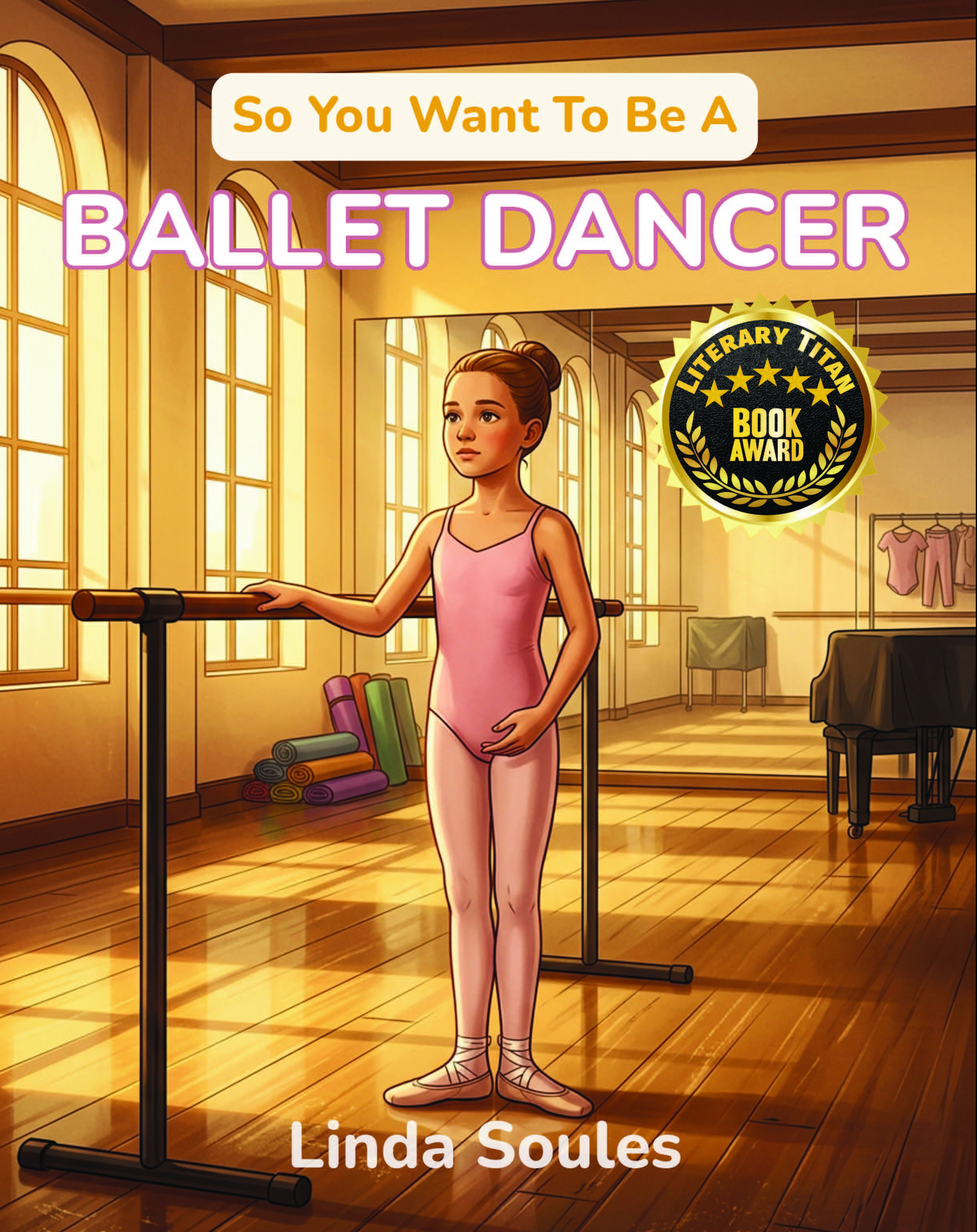
So You Want To Be A Ballet Dancer
by Linda Soules
Key Takeaways
Summary
Ballet can look like a person has escaped gravity: balancing on the tip of one toe, leaping high enough to seem suspended in air, telling a story through an arm’s angle or a turn of the head. But the audience sees the beauty, not the labor that makes it possible. Ballet is neither gentle nor easy. Professional dancers are elite athletes, combining the endurance of long-distance runners, the leg strength of sprinters, the flexibility of gymnasts, and the precise body control of martial artists. They may train six to eight hours a day, six days a week, for years. Their effort is meant to disappear into the performance. That apparent ease is part of the art.
Ballet dancers work with a shared vocabulary of movement. Its terms are French because ballet was formalized in France in the 1600s, at the court of King Louis XIV, who was himself a dancer. The language has traveled around the world: dancers in Tokyo, Lagos, and São Paulo use the same words for the same steps. A plié is a bend of the knees, a basic movement repeated countless times over a career. In a tendu, the foot slides along the floor and stretches to a point, training precision and connection to the ground. A relevé lifts the dancer onto the balls of the feet or onto pointe. An arabesque balances on one leg while the other reaches behind. A pirouette is a turn on one leg, while a grand jeté is a running leap with both legs split in the air. If a choreographer calls for a grand jeté into arabesque, trained dancers understand what to do.
Knowing the terms, however, is only a beginning. The dancer must make the movement precise, then repeat it until the body can perform it with artistry. A turn depends on the timing of the head as it snaps toward a fixed point; a landing depends on control as well as force. Rehearsal builds choreography into the body, attending to details such as the angle of a wrist and the quality of a jump. The aim is not simply to execute steps correctly, but to use technique to make a character and story feel alive.
One story captures why dancers return to those first movements. A retired ballerina whose career had ended early because of injury entered a studio to teach eight-year-olds. They had never done a plié. She showed them first position and watched a nervous child turn her feet out and bend her knees—imperfectly, but with wonder. In that moment, she remembered why she had danced: not only for performances or applause, but for movement itself, and for the discovery of what a human body can become.
The studio is where that discovery is practiced. Its sprung wooden floor gives under jumps and pointe work; a barre runs along the walls, and mirrors help dancers see and correct their form. Rosin adds to the particular smell of effort. A rehearsal studio is larger, with enough room for a company to run choreography together. Tape on the floor marks the dimensions of the stage, and a pianist may accompany the dancers from a corner, helping them connect their movements to music.
The stage has its own demands. On some older European stages, the floor slopes gently toward the audience, a feature called a rake. Touring dancers must adjust their balance to account for it. Just offstage, behind the curtains, the wings provide a place to wait for a cue. Stage lights bring heat as well as brightness, while beyond them the auditorium falls into darkness. The same room that holds ordinary work during rehearsal becomes something different in performance.
Among a dancer’s most distinctive tools are pointe shoes. En pointe, a dancer supports her entire body weight on the tip of one foot. The shoes are shaped for the individual dancer: each pair is bent, hammered, scored, and molded by hand. Yet the shoes are disposable; it is the dancer’s feet that must be treated with the greatest care. Pointe work does not begin immediately. Most dancers start around eleven or twelve, after years of training have built the strength needed to do it safely. Young feet are still growing, and beginning too soon can cause injury.
The barre and mirror remain companions throughout a dancer’s career. The barre offers support while the fundamentals are practiced, and the mirror provides constant visual feedback. A dancer’s bag carries smaller essentials: hair pins, resistance bands for strengthening, and needle and thread for sewing ribbons onto new pointe shoes. Rosin helps provide grip for turns and landings on the stage floor. Each item supports the daily preparation of the body.
Ultimately, the dancer’s primary instrument is the body itself. The calves, thighs, and glutes are trained to produce athletic force, while years of practice teach the body to control it. When a dancer lands from a jump, her legs absorb several times her body weight; in a hard landing, the force can reach ten times her weight. That impact is repeated through classes and performances. The same body must land, balance on the tips of the toes, and leap in ways that appear to defy physics. Every other tool serves this one.
For all the work hidden beneath ballet’s beauty, dancers describe rewards that are difficult to find elsewhere. After months of rehearsal, opening night changes everything: the music seems fuller, the movement more alive, and the audience becomes a presence the dancers can feel. A perfect jump has a tiny instant at its peak, when the body has stopped rising but has not yet begun to fall. Dancers cherish that sensation. They also find meaning in the transformation that lets them stop thinking about individual steps and inhabit a character. Technique remains underneath, but it becomes so secure that the audience sees something human and true rather than the labor that made it possible.
That labor has a cost. Pointe work can cause stress fractures and tendon damage, and soreness is an ordinary part of training and performance. Injury brings more than pain: a dancer may worry about losing a place in the company or shortening a career, and that fear can tempt them to return before they have healed. Yet coming back too soon can turn a small injury into a lasting one. The strongest dancers and companies understand that recovery is part of training, not a failure to train.
Because ballet is a visual art, dancers are judged by what their bodies can do—and, historically, sometimes by how their bodies look, according to standards that have not always been fair or healthy. Many schools and companies now welcome a wider range of body types and backgrounds, but the pressure remains part of the profession. The performing career is also short. Many dancers retire in their thirties; someone who joins a company at eighteen and leaves at thirty-two may have only fourteen years onstage, then face a new professional life while many peers are still establishing theirs. The discipline, focus, and artistry do not disappear with performance, however. Former dancers may become teachers, choreographers, company directors, physical therapists, or writers, shaping the art in different ways.
Some details of the profession surprise people. Pointe shoes, for instance, may last only twelve to twenty hours of dancing. A principal dancer can wear out more than a hundred pairs in a season, and sometimes nearly two hundred during a demanding run. The weightless appearance of classical ballet is built on shoes carefully fitted and prepared, then quickly worn through. Ballet’s history also holds surprises: men were its original performers, and women did not appear on ballet stages until 1681. Dancing on the tips of the toes developed in the early 1800s, making a technique now considered quintessentially classical only about two centuries old.
The athletic demands can be measured as well as admired. Scientists study dancers’ jumps, landing forces, oxygen capacity, and recovery in the same way they study those of sprinters and Olympic gymnasts. A fully extended grand jeté can carry a dancer as much as three feet off the ground; a dancer may turn three or four times from one push. The tutu that seems to float is another feat of construction: its layered netting gives it a stiff structure, and making one by hand can take a costume shop more than forty hours. Beads are secured against falling onto the stage, and hooks are reinforced to survive repeated lifts and turns. The costumes, like the dancing, must look effortless while enduring hard use.
A performance day is organized around preparing for those two hours onstage. At nine in the morning, a dancer may begin alone with stretching, foam-rolling, and a few minutes at the barre, warming the body before company class. At ten-thirty, the entire company takes ninety minutes of class: barre work followed by center combinations, including turns, adagio, and large jumps across the diagonal. Even professionals take class daily as students. Repetition is not pointless routine; it makes artistry possible.
At twelve-thirty, rehearsal might focus on Act II and a pas de deux, run several times while a partner and artistic director adjust a lift to fit the music. A timing problem may take four attempts to resolve. By three, rest is mandatory and protected, because rehearsal drains energy needed for the show. At five-thirty the dancer warms up again, this time alone, shifting from rest to readiness. The performance begins at seven-thirty and lasts two hours. At ten, the dancer returns home, puts ice on their feet, and knows the cycle will begin again the next day.
That routine depends on a close-knit company. The artistic director guides its vision and makes casting decisions; the ballet master leads class and rehearsals. Répétiteurs preserve ballets across generations, teaching choreography from memory, dancer to dancer, like songs passed along before sheet music. Fellow dancers are partners in the deepest sense: the corps de ballet must move as one body, while principal partners build an unusual physical and artistic trust. Much of their communication is silent—a glance, a small correction, a hand placed briefly on someone’s back. After hundreds of hours together, dancers learn to read one another like musicians in a quartet. Costume and lighting designers and physical therapists contribute to the same shared creation, while the audience gives the work its purpose.
The art form’s traditions are changing along with the people who make it. For a long time, ballet celebrated a narrow range of appearances and backgrounds. Dancers of color have spent decades fighting to be seen, valued, and cast in roles they deserve, changing what a new generation believes is possible. Adaptive dance programs have also shown that ballet’s discipline, expression, and pleasure in movement are not reserved for one kind of body. Boston Ballet’s Adaptive Dance Program, founded in 2002 with Boston Children’s Hospital, teaches students from age two through adulthood and has helped inspire programs around the world. A wheelchair user, a student who learns differently, or someone who needs a movement broken down and rebuilt can all belong in the studio. The joy of moving to music was never meant for only a few kinds of bodies.
Becoming a compelling dancer takes more than physical ability. Love of discipline helps a dancer find satisfaction in barre work, repetition, and gradual progress. Musicality means feeling phrasing and dynamics in the body, allowing the music to move through the dance rather than merely accompanying it. Spatial intelligence lets a dancer track their own position, a partner’s place, and the audience’s attention while performing demanding steps and expressing emotion. Physical courage makes trust possible in lifts and helps dancers face the difficult work required on performance night. And artistry reaches beyond technique: the strongest performers draw on what they read, see, hear, and experience, giving a role emotional truth that makes the audience forget the steps and simply feel.
A first way to test your interest is simply to begin, without needing special shoes or experience. If classes are available, take one: ballet builds on itself, and each week lays a foundation for the next. At home, learn the five basic foot positions, keeping turnout gentle rather than forcing it. First position brings the heels together; in second, the feet separate; in third, one heel meets the other foot’s arch; fourth places one foot in front with a step between them; and fifth lines one foot directly before the other, heel to toe. Even a simple plié, a slow bend of the knees, can be a beginning.
Preparation is about patience more than dramatic feats. Fifteen minutes of daily stretching can gradually develop flexibility in the legs, hips, back, and ankles, but a stretch should never be pushed into pain. Posture can be practiced anywhere: stand tall, align the head above the shoulders, shoulders above hips, and hips above feet, while keeping the stomach gently engaged and the shoulders relaxed. Listening to Tchaikovsky’s Swan Lake or The Nutcracker, or to music by Prokofiev and Stravinsky, helps the body become familiar with ballet’s musical world. Calf raises, planks, and single-leg relevés in socks offer simple strength work. Even balancing on one foot for a few seconds reveals the tiny corrections an ankle makes to keep the body upright.
Interest can also be explored through questions: How can a story live in the body so an audience feels it before it understands it? How can years of work look natural and free? What is the music asking, and is the dancer brave enough to answer with everything they have? A kitchen counter, chair back, or park railing can serve as a barre. Stand tall in first position and bend the knees slowly. That plié is where every grand jeté and pirouette begins. The test is not whether the first movement looks like a performance, but whether moving to music, learning gradually, and telling a story without words feel compelling.
The paths taken by famous dancers show how varied a life in ballet can be. Anna Pavlova was born poor in St. Petersburg in 1881 and saw her first ballet at eight. That night, she decided what she wanted her life to become. She went on to become the world’s most famous ballerina and carried ballet to India, Japan, Australia, and South America, places where it had never been performed. Pavlova believed the art belonged to everyone, and her touring life helped make that belief visible.
Misty Copeland’s beginning came much later than the usual start for a ballet prodigy. She took her first class at thirteen, in a free program at a Boys & Girls Club, on a basketball court. Her family had sometimes been without a home, and she was starting while many dancers her age had trained since six. Her teachers recognized her gifts within months, but she was also told her body was not right for ballet. She persisted, and in 2015 became the first Black woman promoted to principal dancer in American Ballet Theatre’s seventy-five-year history. After twenty-five years with the company, she retired in 2025. Her achievement changed who could imagine themselves in ballet and what the art’s leading dancers might look like.
Rudolf Nureyev’s story is marked by a different kind of courage. Raised in poverty in Russia, he became one of the great male dancers of his time. In 1961, at a Paris airport, he chose not to return to the Soviet Union. With Soviet agents nearby and orders to put him on a plane home, he stepped away and asked French police for protection. He chose freedom and art, then danced magnificently for the rest of his life. Maria Tallchief, born in 1925 on the Osage reservation in Oklahoma to an Osage father and a Scots-Irish mother, became America’s first major prima ballerina. Though critics expected her to use a more “European” name, she insisted on dancing as Tallchief. A muse to choreographer George Balanchine, she performed for presidents and kings while making room in classical ballet for her own identity.
For anyone wanting to explore further, books offer different windows into the art. In Firebird, Misty Copeland writes in verse to a young dancer who fears she will never be good enough; Life in Motion: An Unlikely Ballerina tells more of Copeland’s own journey. Maria Tallchief’s memoir for young readers, Tallchief: America’s Prima Ballerina, focuses on her childhood, her choice between piano and ballet, and her departure for New York at seventeen. Noel Streatfeild’s Ballet Shoes follows three unrelated sisters raised in a London boarding house, while James Howe’s Brontorina imagines a dinosaur who knows she belongs in ballet, even when she is too big for the studio. Together, these stories open different doors into persistence, belonging, and the discovery of a dancer’s own path.
Watching can be a form of learning, too. A live performance, a local company, a school recital, or a filmed Nutcracker can reveal how much story is carried by movement. Watch a dancer’s feet, then watch the face and hands; the story often becomes clearer above the waist. Sitting in on a class, when a studio allows visitors, shows the corrections and repetitions behind the finished performance. Another exercise is to tell a small story—losing something and finding it again, for instance—in thirty seconds and without words. Ballet’s vocabulary can be explored through American Ballet Theatre’s online dictionary, which offers definitions and pronunciations for 170 terms. New York City Ballet’s Anatomy of a Dance videos unpack what performers are thinking as they dance. The Royal Academy of Dance explains its graded examinations, from early levels through vocational training. American Ballet Theatre, Dance Theatre of Harlem, and Boston Ballet’s Adaptive Dance Program also offer ways to learn about training, company life, outreach, and dance for students of different abilities.
The larger invitation is not a demand that every curious child become a professional dancer. Linda Soules hopes instead that readers will recognize what can happen when someone devotes themselves to a disciplined, beautiful pursuit—and see that the same devotion is possible in any craft. Ballet asks much of the body and the mind, but a person can discover its value without committing to a career. The books and experiences that open a door may also lead to unexpected conversations between children, parents, and teachers. The important thing is to choose a fascination with open eyes, begin where you are, and be willing to begin again tomorrow.
Chapter Summaries
What Ballet Is—and What Dancers Actually Do
The book opens by challenging the idea that ballet is gentle or easy. Professional dancers are elite athletes who train for hours a day, building the stamina, strength, flexibility, and control needed to make demanding movement appear effortless. Yet technique is not the ultimate goal: dancers use it to tell stories and communicate emotion without words. The difference between executing steps and inhabiting a role is what makes a performance feel alive. Ballet also has a shared vocabulary, largely made up of French terms because the art form was formalized in France in the 1600s. A plié bends the knees, a tendu extends the foot along the floor, a relevé raises the dancer onto the balls of the feet or pointe, and a grand jeté is a large leap. Choreographers can combine these terms into precise instructions understood by trained dancers internationally. Rehearsal and repetition then turn this vocabulary into movement that feels musical and expressive. A story about a retired dancer watching children discover their first plié shows how the wonder of movement itself can remain at the heart of a dancer’s love for the art.
Studios, Stages, and the Dancer’s Tools
Dancers work in studios and theaters designed around the demands of movement. A studio typically has a sprung wooden floor that cushions jumps, a barre for practice, and mirrors for checking alignment. Rehearsal spaces allow the company to run full sections of a ballet, sometimes with a pianist. Onstage, dancers must adapt to features such as the rake—a floor that slopes toward the audience—as well as the wings, stage lighting, and the darkness beyond the footlights. The most recognizable equipment is the pointe shoe, which supports the dancer’s weight on the toe and is carefully shaped by hand to fit an individual foot. Dancers generally begin pointe work only after years of training and sufficient strength, often around age eleven or twelve. Other everyday tools include a barre, mirrors, rosin for grip, resistance bands, hairpins, and sewing supplies for attaching shoe ribbons. But the dancer’s body is the central instrument: jumps and landings demand tremendous force, and every piece of equipment ultimately serves the body’s ability to move with control and artistry.
The Rewards—and Costs—of a Dancing Life
One of the greatest rewards is the transformation from rehearsal to opening night. After months of practice, music, movement, and audience combine into a different kind of experience. Dancers describe the fleeting pause at the top of a jump as a feeling unlike anything else. They also value the chance to communicate a story through movement and the satisfaction of discovering what the body can become. Years of technique make it possible to stop concentrating on each step and let the audience see the character rather than the labor. The work has serious costs. Pointe work and repeated impact can lead to stress fractures, tendon damage, and other injuries. Dancers may feel pressure to return too soon because they fear losing their place in a company, but the book emphasizes that recovery is part of training, not a failure to train. Ballet’s visual nature has also subjected dancers to unhealthy or unfair expectations about appearance, although schools and companies are increasingly welcoming broader body types and backgrounds. Many performers retire in their thirties, so a dancer’s career may be shorter than those in many other fields. The skills they develop, however, can carry into teaching, choreography, directing, physical therapy, and other work.
Behind the Curtain: Surprises and a Typical Day
The book reveals how much practical labor supports ballet’s seemingly weightless appearance. Pointe shoes may last only twelve to twenty hours of dancing, and a principal dancer can use more than a hundred pairs in a season. Costumes are engineered too: a classical tutu can take a costume shop more than forty hours to make, with layers, beads, and fastenings built to withstand repeated performances. The history is surprising as well: ballet was first performed by men, women entered the stage later, and pointe technique developed in the early 1800s. Even celebrated feats such as Swan Lake’s fouetté turns depend on the trained technique of spotting. A professional performance day follows a demanding rhythm. A dancer warms up before company class, works through barre and center exercises, rehearses choreography, and then rests so the body can recover before the evening show. Another warm-up prepares the dancer for performance, which may last about two hours. Afterward come the practical routines of icing and caring for the feet before the cycle begins again the next day. This schedule makes clear that a performance is not an isolated event: it rests on daily conditioning, focused rehearsal, recovery, and preparation.
Company, Inclusion, and the Qualities of a Dancer
A ballet company depends on many kinds of collaboration. Artistic directors shape the company’s vision and casting; ballet masters lead class and rehearsal; and répétiteurs teach choreography passed down across generations. Dancers work in ensembles and build demanding partnerships with featured partners, while designers and physical therapists help bring a production to life. Much of the communication is nonverbal—a glance, a small adjustment, or a steadying hand—built through long hours of working together. The book argues that ballet belongs to more people than its history once suggested. Dancers of color have challenged exclusion, and adaptive programs have made ballet available to students with different abilities and ways of moving. Boston Ballet’s Adaptive Dance Program, founded in 2002 with Boston Children’s Hospital, is one example. To thrive in ballet, a dancer needs more than physical technique: love of practice, musicality, spatial awareness, courage, and artistry matter. Acting skills help convey emotion without dialogue, anatomy knowledge helps dancers understand and protect their bodies, and mental strength supports them through demanding training and evaluation. Reading, studying art, and listening widely can also deepen the emotional truth of a role.
Getting Started and Testing Your Interest
Readers who want to explore ballet are encouraged to begin with accessible, consistent practice rather than waiting to feel ready. Taking a class builds skills progressively; if classes are unavailable, the book introduces the five basic foot positions. It also suggests gentle daily stretching, attention to posture and alignment, listening to composers such as Tchaikovsky, Prokofiev, and Stravinsky, and building strength with simple exercises such as calf raises, planks, and balance practice. The guidance stresses patience and warns against pushing a stretch into pain. The book offers a simple way to experience the first movement: stand in first position and slowly bend the knees into a plié, using a counter or chair for support if needed. It then asks readers to consider whether they enjoy moving to music, mastering something gradually, and telling stories without words. Watching a performance, observing a class, and improvising a short silent story are practical ways to explore the art. These activities help young readers discover whether the process itself appeals to them, not just the spectacle of the stage.
Dancers’ Stories, Further Exploration, and the Book’s Message
Profiles of Anna Pavlova, Misty Copeland, Rudolf Nureyev, and Maria Tallchief show how dancers’ paths differ and how individual choices can widen the art form. Pavlova helped bring ballet to audiences around the world; Copeland overcame a late start and barriers around race and body image to become a principal dancer at American Ballet Theatre; Nureyev chose artistic freedom by defecting from the Soviet Union; and Tallchief insisted on being recognized by her own name and heritage. Their experiences illustrate perseverance, ambition, and the importance of expanding who gets to be seen onstage. The book closes with memorable facts, a glossary, suggested books and websites, organizations, and activities for further learning. It invites readers to explore ballet vocabulary, watch dancers explain choreography, attend or view a performance, and learn about companies and adaptive programs. The author’s note clarifies that the book is not a promise that every reader should become a professional dancer. Its broader message is to approach a meaningful pursuit with open eyes, commitment, and a willingness to begin again. The same kind of devotion dancers bring to ballet can be applied to any craft a young person chooses.
Notable Quotes
The work is invisible. The beauty is all you see.
The greatest dancers are not the most technically perfect; they are the ones who use technique to tell a story and convey emotion.
Ballet is a language spoken with the body.
Real healing is part of the training, not a break from it.
The career changes shape. The dancing never really stops.
The best dancers are the ones who never believe they've finished learning.
The joy of moving to music was never meant for only a few kinds of bodies.
Whatever you choose, choose it the way a dancer chooses ballet: with both eyes open, with both feet on the floor, and with the willingness to begin again tomorrow.
