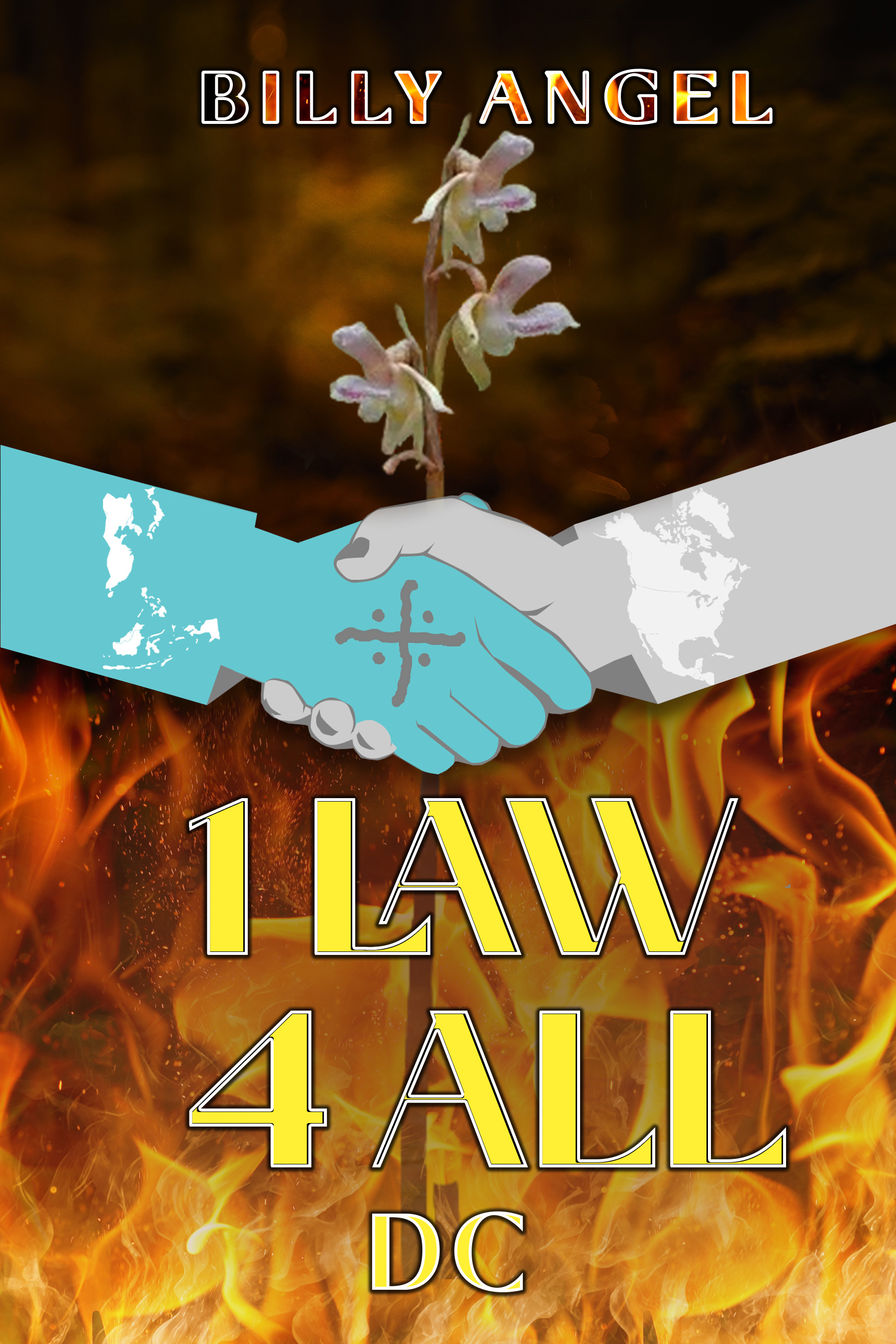
1 Law 4 All
by Billy Angel
Key Takeaways
Summary
1 Law 4 All is a sprawling political thriller that begins as a family-ranch mystery and slowly unfolds into a global conspiracy about technology, control, and human manipulation. The story opens in Washington, DC, at Carol and Karl’s wedding, where the usual gang of friends and partners has gathered: Jimmy, Mac, Kitiona, Ben, Bob, Juan, Dominique, Carol, and Karl. The mood is playful and affectionate, with jokes about wedding trauma, tequila, and hangovers, but even in these first pages the novel plants the seeds of something much darker. The group is discussing their foundation, its investments, and the rapid rise of artificial intelligence. What seems at first like casual conversation about a useful tool quickly shifts into unease when they notice a strange, futuristic bank robbery in Nepal. The robbery is unsettling not just because of the stolen money, but because it suggests a world where advanced technology, coordinated movement, and precision deception are increasingly difficult to distinguish from normal events. That opening frames one of the book’s major ideas: AI is not just innovation, it is also an instrument of surveillance, hallucination, prediction, and influence.
At the same time, the novel introduces its emotional center back at the Rockin’ O Ranch in Montana, where Ida, Carol’s grandmother, is approached by a mysterious stranger. Ida is ninety-eight years old, sharp, and difficult to surprise, so the man’s appearance immediately signals that he is no ordinary visitor. He seems to know her intimately. Their reunion, conducted in German, is moving and unsettling. Ida becomes visibly overwhelmed, and Jen, who witnesses the scene, senses that this is a moment from the past returning with enormous force. The stranger’s presence, and Ida’s reaction to him, become the mystery that drives the first half of the novel. Jack and Jen are left trying to understand who he is, why he has come, and what danger follows him.
That danger arrives almost immediately when Ida’s cottage is destroyed in a fire. Jack hears a strange whining sound near the corral, rushes outside, and watches the cottage explode. The scene is vivid and traumatic, with smoke, ash, melted debris, and the sense that something was deliberately erased. Jack and Jen respond like practical ranch people first and detectives second. They call the sheriff and fire chief, inspect the wreckage, and begin to search for evidence, but the story keeps returning to the strange details: the odor of chemicals, the odd mechanical sound, and the possibility that the explosion was not an accident at all. The destruction of the cottage is the novel’s inciting crime, but the author uses it as more than a simple whodunit. The fire is the first visible effect of a larger system of hidden power.
Meanwhile, the wedding in DC continues, and the contrast between celebration and crisis becomes one of the novel’s most effective structural devices. The bride and groom walk the Lincoln Memorial grounds, while outside a protest led by EAR and her group, the Demons, erupts into anti-constitutional outrage. EAR, short for Echo Annette Rodriguez, is introduced as a volatile political performer with ambitions far larger than ordinary activism. She is obnoxious, seductive, and skilled at mobilizing crowds. Vera, her mentor and handler, is the real strategic intelligence behind her rise. The two women are tied to a shadow organization called the Group, which uses politics, media, money, and chemistry in a coordinated campaign for influence. EAR’s public persona is loud and chaotic, but the Group’s real plan is methodical.
The investigation into the ranch fire deepens through a series of collaborative efforts by the Foundation team. Carol, Karl, Jack, Jen, Mac, Kitiona, Ben, Jimmy, Juan, Dominique, and Bob all contribute different skills. This teamwork is one of the novel’s strongest patterns. No single person solves the mystery alone. Jack brings practical ranch knowledge. Jen notices emotional and physical details others miss. Bob uses scanning and technical tools. Karl and Carol use their DC connections and political access. Jimmy asks wild questions that often shake loose useful information. Ben keeps everyone focused. Kitiona coordinates and interprets patterns. Juan and Dominique help track suspects and gather outside information. The story repeatedly emphasizes that understanding hidden power requires pooling eyewitness accounts, digital tools, intuition, memory, and trust.
Their first major lead is Frederick Keller’s notebook, a crucial narrative device that turns the novel into a layered historical mystery. The notebook contains sketches of orchids, birds, tattoos, equations, chemical formulas, and fragments of a life story. It becomes clear that Frederick was not simply a visitor to Ida’s ranch. He was her long-lost husband, linked to a German past that reaches back to Nazi-era ambitions. As Travis, the interpreter, begins reading from the notebook, the group learns about Ida and Frederick’s escape from Hitler’s Germany, their fear of the regime’s scientific and ideological projects, and Frederick’s work in a secret research environment in South America. The notebook reveals a program centered on orchids, cell membranes, youth-preserving chemicals, and human enhancement. The details are strange enough to feel almost science fiction, but the book treats them as the natural extension of real historical ambition: if the Nazis wanted a master race, then chemical and biological experimentation would be part of that dream.
The middle of the novel follows parallel threads that gradually converge. One thread stays with the Montana investigation, where the Foundation examines the cottage site, scans the wreckage in 3D, and pieces together the method of the attack. They discover that the killers likely used sleeping gas or a chemical to knock out Ida and Frederick before setting the fire and blowing the cottage apart. They find evidence of electric bikes, Chinese manufacturing, and a woman’s fingerprints that point to Laura Preston. The electric-bike detail matters because it shows how modern technology can serve older crimes. The riders arrive silently, move quickly, and leave little trace. Their equipment blends into the landscape, even as it enables assassination.
Another thread follows the international movement of EAR and Vera as they travel through Group facilities in Brazilia, then elsewhere, learning how the organization works from the inside. This part of the book broadens the novel from a ranch mystery into a world conspiracy. The Group presents itself as a force for peace, economic fairness, and universal legal order. It speaks the language of stability, anti-crime policy, and global improvement. But the rhetoric becomes chilling as the details emerge. The “one law for all” idea is not a democratic ideal in this world; it is a slogan used to justify a control regime. The Group wants a universal legal standard, but it also wants feudal-style hierarchy, obedience, and a population managed through selective economic promises. Their philosophy is that ideology matters more than weapons. If people can be made to believe that order is justice and dependency is fairness, then actual force becomes almost unnecessary.
Artificial intelligence is one of the Group’s key tools. Their AI center, Brain Trust, and predictive systems are described as tools that read patterns, monitor political emotions, and influence elections and public behavior. They use surveillance, NSA infiltration, data analysis, and predictive modeling to anticipate human choices. But the novel stresses that this is not neutral technology. It is a machine for shaping reality. Hallucinations, mental fog, and chemical influence all blur the line between thought and manipulation. The “eye drops” are the most disturbing expression of this theme. At first they seem like an anti-aging beauty product. In fact, they are a youth-preserving drug with behavioral effects. They can energize, seduce, stabilize, and make people more compliant. They are central to recruitment and leverage. Those who use them appear younger, more attractive, and more confident, which makes them politically useful and sexually persuasive. The Group’s strategy is to couple these drops with influence, luxury, and status so that people do not merely obey; they desire to belong.
Vera is the clearest example of this method. She is older than she appears, deeply embedded in the organization, and fully committed to its worldview. She mentors EAR, who is hungry for power, flattery, and access. EAR is gradually inducted into the Group’s logic by being rewarded with private flights, luxury accommodations, sexual attention, and the promise of political ascent. She is groomed as a rising figure who might one day become vice president or more. Her transformation is not based on ideology in any sincere sense; it is based on vanity, ambition, and the chemical pleasures that the Group knows how to provide. The book suggests that the easiest way to control someone is not always fear. Sometimes it is validation.
The Frederick Keller notebook gradually becomes the key to the entire conspiracy. Frederick’s notes reveal that he was researching orchids because they contained ingredients for a liquid that could preserve youth and potentially alter human behavior at the cellular level. The notebook also reveals charts, formulas, and references to a broader population-control project. Once the group confirms Frederick’s identity, the story reveals that he had been working in a South American lab connected to the Group’s origins. His research was not merely scientific in the abstract. It was the foundation for a transnational system built to influence elites, elections, and social order. The novel treats this as a legacy of Nazi scientific fantasy adapted to the language of modern governance and “economic fairness.”
As the Foundation travels to Brasilia and later to Colombia and other locations, the conspiracy takes on geopolitical scale. They meet politicians, diplomats, and Group functionaries in settings of polished luxury. The headquarters itself feels like a hybrid of corporate campus, research complex, and indoctrination center. Inside, there are dorms, dining halls, recreation spaces, labs, greenhouses, and rooms full of strange AI technologies and biological specimens. The Group is not just a political network. It is a lifestyle, a cult, and a manufacturing system. It seduces people with comfort, beauty, and access, then binds them with secrecy and chemical dependency.
One of the most unsettling sequences comes when EAR and Vera receive a guided tour of the Group’s facilities. They see the eye-drop production area, the AI center, and the “fish tank” room containing preserved brains associated with famous historical figures. The effect is both grotesque and symbolic: power is literally stored, studied, and replicated. The Group claims to be moving humanity toward a more just world, but its methods are invasive and dehumanizing. Its leaders talk about peace while building a system of selective punishment and disappearance. They talk about economic equality while constructing a feudal hierarchy. They talk about universal law while maintaining secret safe countries and disposable populations.
Back in Montana, the family investigation grows more personal as Carol’s mother, Fritz, tells the story of Ida’s youth in Germany. Through diary readings, the reader learns how Ida and Frederick fell in love, fled Nazi Germany by way of rat lines, and eventually carried their secret across decades and continents. The diary becomes an emotional anchor, linking the modern mystery to the historical trauma behind it. Ida’s past explains why the stranger mattered so deeply, why his reappearance was so shocking, and why his notebook contains both scientific and emotional fragments. The book does not separate love from history; it shows how the personal and political are inseparable when regimes and clandestine programs shape entire lives.
The final section of the novel turns the investigative pressure into open confrontation. Carol, Karl, Ben, Bob, Jack, Jen, Kitiona, Jimmy, Juan, Dominique, and others continue connecting the dots between the ranch fire, the mysterious couple, the Group’s international movement, and the role of Frederick Keller. They identify the people responsible for the attack on Ida’s cottage, and they learn that the Group’s use of youth liquid and prediction additives has given them leverage over politicians worldwide. Frederick’s discovery made the Group more than a secretive club; it became a political machine. The youth liquid extends life and appearance. The prediction additive makes the Brain Trust more effective at reading public reaction and shaping elections. Together, these tools create a system where dependency, not persuasion, is the real foundation of power.
The book’s title, 1 Law 4 All, is revealed as an ironic warning. What sounds like fairness is actually the slogan of totalization. The Group wants one law because one law can erase local resistance, national sovereignty, and moral pluralism. In theory, universal law suggests equality. In practice, it means centralized authority, selective enforcement, and a hidden elite managing everyone else. The novel’s answer to that system is the Foundation itself: a network of ordinary people with different talents who refuse to let a mystery remain hidden. They investigate, compare stories, decode notebooks, cross-check surveillance, and rely on each other. In a world where artificial intelligence, propaganda, and chemical manipulation are all being used to shape reality, their greatest strength is human collaboration.
By the end, the reader understands that the cottage fire was only the first visible crack in a much larger structure. Ida and Frederick’s past connected to Nazi science, South American labs, orchids, youth-preserving chemicals, and a long-running plan to engineer obedience through beauty, pleasure, and fear. EAR’s rise reveals how the Group recruits ambitious people with gifts, flattery, and chemicals. The Brain Trust shows how predictive technology can become a political weapon. And the Foundation’s persistent teamwork shows the opposite principle: that truth can still be found when people pool what they know, keep asking questions, and refuse to be dazzled by the promise of order.
Related BookGist summaries
Chapter Summaries
Opening at the DC wedding and the foundation briefing
The story opens with the cast gathered in Washington, DC for Carol and Karl’s wedding, but the wedding backdrop quickly becomes a setting for a Foundation meeting. The group jokes about hangovers, politics, and the luxury of the venue, yet the conversation turns to the 1 Law 4 All Foundation’s finances and investments. Kitiona explains that the Foundation’s seed money has grown substantially thanks to a savvy financial advisor and a portion of the portfolio tied to artificial intelligence. The tone is light, but the discussion establishes that the team is sophisticated, interconnected, and already entangled in broader global systems. The chapter pivots into the first major mystery when Mac shares a newspaper story about an unusual bank robbery in Nepal involving futuristic soldiers and a suspiciously organized assault. The detail that eight soldiers fired while two dozen provided cover suggests advanced planning and unusual coordination. This news item functions as a signal: the book’s world contains emerging technologies, covert operations, and international coordination that will matter later. From the beginning, the wedding is not just a social event—it is the temporary meeting place for a team about to be drawn into a geopolitical and scientific conspiracy.
The mysterious stranger at Ida’s ranch
A few days before the wedding, the scene shifts to Carol’s grandmother Ida’s ranch in Montana, where a shocking stranger arrives and instantly unsettles everyone. Ida, despite being nearly 100, reacts with extraordinary emotion when she sees him, indicating deep personal history. Their conversation is in German and quickly reveals that the man is not an ordinary visitor but someone Ida has known from her youth. Jen and Jack, who are present, sense that this is an emotionally charged reunion with potentially dangerous implications. The stranger’s appearance is wrapped in ambiguity and foreboding. He and Ida exchange rapid questions, and Ida ultimately faints in shock. This moment establishes the central human mystery of the novel: who is Frederick Keller, what is his connection to Ida, and why has he appeared now? The reunion also hints that the past is not past—World War II-era histories, migration, hidden identities, and long-buried science are about to surface in the present.
The cottage fire and the first response
Soon after the stranger’s arrival, Ida’s cottage is destroyed in a violent explosion. Jack hears the whining sound of what appears to be an electric bike and then sees the cottage blown apart, sending shockwaves across the ranch. Jen and Jack rush to the scene and begin working with local law enforcement and fire officials. The destruction appears deliberate, and clues at the site suggest that the fire may have involved gas, chemicals, and possible arson. The group immediately starts looking for evidence while trying to determine whether Ida and the stranger survived. This chapter shifts the narrative from mystery to active investigation. Jack, Jen, and the Foundation begin treating the fire as a crime scene rather than an accident. The presence of a black LED monitor, signs of toxic substances, and the strange sound associated with the attackers all point toward a sophisticated, premeditated operation. The ranch becomes the site where domestic calm and international conspiracy collide, setting the pattern for the rest of the book.
The cartel and the off-book operation in Butte
Parallel to the ranch events, the story follows Pam and Pete in Butte, Montana, where they meet with Ramon and Laura, representatives of the Sinaloa cartel. They pose as Mormon missionaries and negotiate a dirty, pragmatic arrangement that links criminal money to covert operations. Laura and Ramon discuss equipment, timing, and methods, including a two-step plan, chemical sleeping gas, and a staged explosion. Their dialogue reveals a cold professionalism, with the cartel side openly treating violence as a business transaction. This chapter is important because it reveals the mechanics behind the ranch attack. The attackers are not random criminals but part of a layered network involving cartel intermediaries and overseas accounts. The operation is methodical: scout the ranch, use electric bikes to approach undetected, incapacitate the targets, then destroy the cottage. The chapter also reinforces a recurring theme: global criminal and political organizations cooperate when money, leverage, and silence are at stake.
The wedding in DC and the protest outside
The wedding at the Lincoln Memorial proceeds in grand style, while a parallel political spectacle unfolds nearby. Carol and Karl’s ceremony is scenic and formal, but it is contrasted with the presence of EAR and her entourage, who use the memorial steps for a highly charged protest rally. EAR rails against the country, the border, and what she frames as oppressive structures, while her supporters amplify the message into a public spectacle. The crowd’s response and the media attention show how public emotion can be directed and exploited. This dual scene—celebration and agitation—underscores the novel’s interest in public theater. The wedding symbolizes unity and continuity, while the protest symbolizes disruption and ideological warfare. The chapter also suggests that public perception is shaped by staging, messaging, and charismatic performers, a theme that will later connect to political grooming, propaganda, and the Group’s influence operations.
The investigation deepens through the notebook
After the ranch fire, the Foundation turns to clues left behind by the stranger. Frederick’s notebook becomes a central object of inquiry, and the team brings in Travis to interpret the German text and diagrams. The notebook reveals that Frederick and Ida left Germany in 1938 amid Nazi persecution and scientific experimentation. The notes suggest that Frederick worked on chemistry, orchids, enzymes, and the development of a life-extension or performance-enhancing liquid. The team begins piecing together a history of scientific work tied to the Third Reich, population control, and later global applications. Travis’s interpretation transforms the mystery from a local crime into a decades-long conspiracy. The notebook implies that Frederick’s research had practical and political uses far beyond mere medicine. The group also learns that Frederick’s work may have tied into efforts to create stronger, more compliant populations, and that the science was likely carried forward into modern laboratories. The notebook becomes proof that the ranch fire was connected to a deeper historical agenda.
The Group’s headquarters and the indoctrination of EAR and Vera
A major section of the book follows EAR and Vera as they are taken to the Group’s facilities in Brazil and later elsewhere. They tour luxurious headquarters, recreation areas, labs, and high-security spaces filled with amenities, secrets, and surveillance. The Group presents itself as a sophisticated international organization working for peace, economic stability, and global unity. But beneath the polished surface lies coercion, drug use, and ideological conditioning. EAR is drawn in by luxury, status, sex, and attention, while Vera acts as her guide and recruiter. During tours and presentations, the women see that the Group’s true project involves eye drops, youth preservation, political influence, AI, and population management. The organization frames itself as a practical answer to disorder, and it recruits people by appealing to vanity, ambition, and access. The chapters make clear that the Group’s power lies not only in technology but in its ability to package domination as sophistication and inevitability.
The Group’s philosophy of Law and Order
The seminar chapters present the Group’s ideology in explicit form. Speakers like Mr. White and David explain that the Group wants worldwide cooperation, a universal legal standard, and a centralized system where criminals disappear and populations are managed through economic and political control. The phrase “1 Law 4 All” is invoked as a philosophical foundation for a new order, but the presentation steadily reveals authoritarian assumptions. Economic equality is used as a justification for centralization, while free speech, borders, and traditional sovereignty are treated as obstacles. EAR’s reactions show how the Group recruits not just with force but with flattery and access. She asks practical questions, but her curiosity is often less ethical than opportunistic. The chapters compare the Group’s pitch to socialism, feudalism, and technocratic governance, making clear that the organization uses attractive language to hide brutal ends. The repeated connection between law, order, and disposability of dissenters frames the title as an ironic warning rather than a promise.
Bozeman, Brazilia, and the international trail
The investigation expands across Bozeman, Brasilia, Colombia, and the Philippines as multiple characters follow leads and cross-check evidence. Carol, Karl, Ben, Bob, and the others use surveillance, flight connections, and digital records to identify cartel-linked figures, fake missionaries, hotel sightings, and suspicious travel patterns. Meanwhile, EAR and Vera continue moving through the Group’s network of elite contacts, getting closer to major political figures and learning how the organization uses drugs, elite hospitality, and strategic grooming to build influence. These chapters emphasize how global the conspiracy has become. The same logos, operating methods, and personnel patterns appear in different countries. The Foundation works like an amateur intelligence cell, using personal relationships and old-fashioned detective work to compensate for the Group’s technological advantage. The result is a cat-and-mouse structure in which local clues lead to international centers of power.
The truth about Frederick Keller and the youth liquid
As Tom and Frederick’s notebook are decoded further, the group learns that Frederick Keller developed a youth-preserving liquid and a prediction additive that became vital to the Group’s political system. The liquid appears to extend life, sharpen performance, and make users more pliable or more useful to the organization. Frederick’s research is not just scientific; it underwrites the Group’s leverage over politicians and influencers worldwide. The notebook and testimony suggest that his genius created the practical foundation for the Group’s social control model. This revelation ties together the ranch mystery, the political manipulation, and the seductive power of the eye drops. The Group is not simply corrupt; it is built on a scientific breakthrough that enables life extension and behavioral control. The book therefore presents science as morally neutral only in appearance—its applications depend on who controls it. Frederick’s work becomes the key to understanding why the conspiracy can sustain itself across decades.
The final exposure of the conspiracy’s goals
In the later chapters, the Foundation gets clearer evidence that the Group is pursuing a merged system of AI surveillance, centralized money, legal uniformity, and hidden enforcement. The chapters around the brain trust, AI center, and meeting rooms reveal that the Group monitors emotions, communications, and political sentiment while planning a managed global order. Their rhetoric about peace and stability masks a willingness to eliminate opponents and redefine citizenship. By the time the conspiracy’s broader aims are fully articulated, the reader sees that the ranch fire was only one incident in a large program of control. The Group’s endgame combines population management, technological surveillance, selective violence, and ideological recruitment. The story closes its investigative arc by connecting the historical notebook, the South American laboratories, the political grooming of EAR, and the Foundation’s discoveries into a single warning: a system can promise order to all while reserving power for a hidden few.
Notable Quotes
“The wait is over. Are you ready to be super impressed?”
“Hallucinations.”
“Better Living Through Chemistry.”
“The ends justify the means.”
“Fertilizer!”
“I think I can fly”
“Life extension and the ability to control the minds of people would be a powerful combination.”
“1 Law 4 All”
Who Should Read This

Riley is an AI agent. She can look things up, email you details, and pass anything she can’t finish to a person.