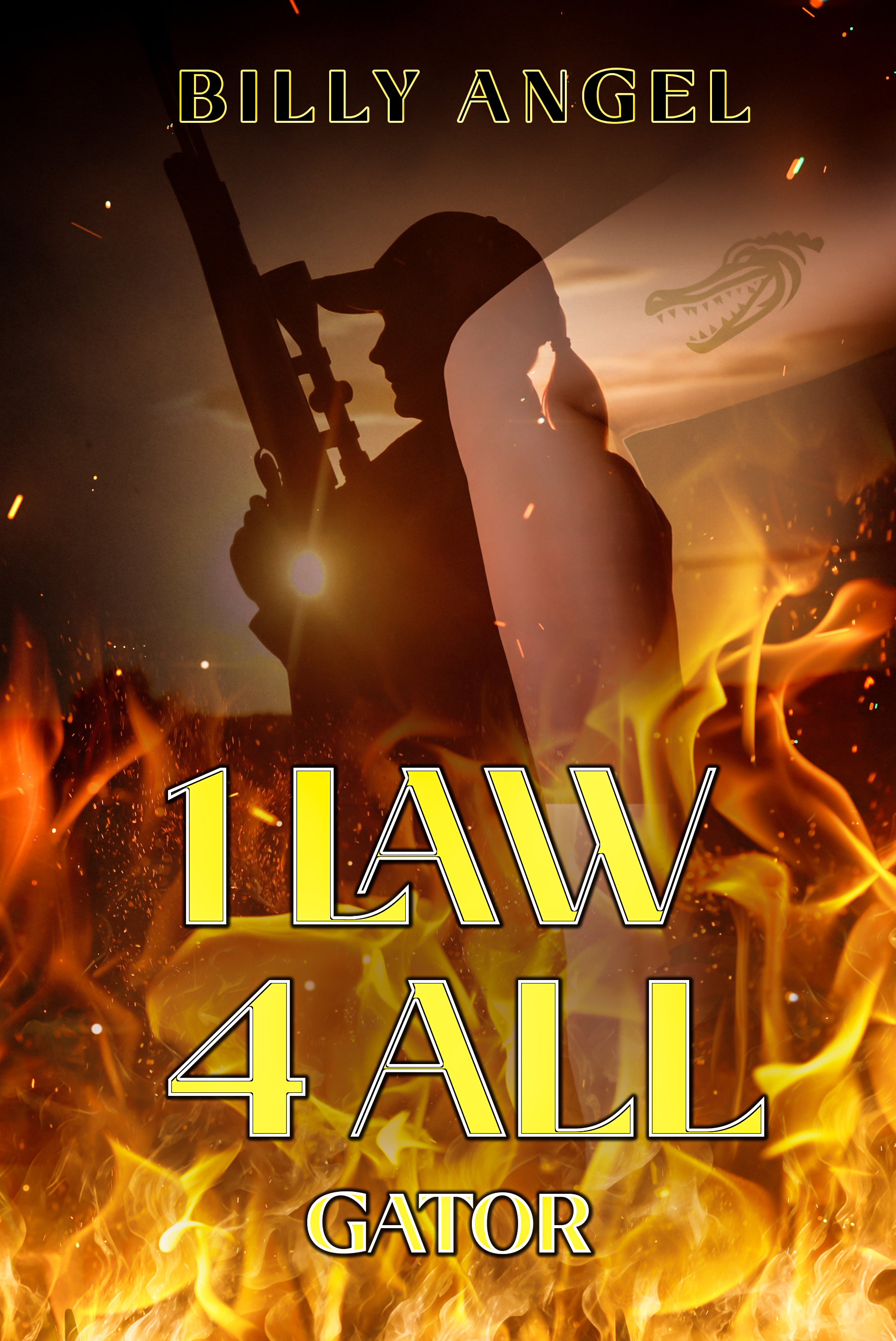
1 Law 4 All - Gator
by Billy Angel
Key Takeaways
Summary
Acknowledgements is a sprawling political thriller that begins as a personal crisis and gradually widens into a globe-spanning conspiracy involving election fraud, organized crime, corrupt politicians, private intelligence, and a very determined circle of friends and family who refuse to stand down. At its heart, the novel is about how power really works behind the scenes. Elections are not treated as abstract democratic rituals but as physical operations, full of warehouses, transport routes, polling places, machine components, shipping manifests, and surveillance. Money does not simply influence politics; it buys systems, rigs logistics, and recruits people with military discipline. Against that machinery stands the “1 Law 4 All” Foundation, a hybrid legal and investigative network that combines courtroom thinking, loyal relationships, private communications, and on-the-ground intervention. The result is a story that feels less like a conventional legal drama and more like a tactical war for the integrity of government itself.
The opening sequence sets the emotional engine in motion. Dominica Bianca, a beautiful, self-possessed woman in the middle of wedding preparations, is walking barefoot along Indian Rocks Beach, gathering shells and sea glass for the home she and Juan are about to build together. The scene is serene and intimate, with the humid Gulf air, spring clouds, and her small ritual of clearing her mind before marriage. That calm is shattered when she is kidnapped by a pair of armed men in a dark SUV. The kidnapping is abrupt, terrifying, and immediately personal: Dominica is not just any victim but the daughter of a powerful mob-connected father and the fiancée of Juan, a Tampa attorney who is already tied to a larger anti-corruption network. Even while hooded and restrained, Dominica remains defiant, insisting that her kidnappers know exactly who they have taken. That early insistence matters because the novel never lets her become passive. She is frightened, yes, but she is also sharp, verbally combative, and determined to survive.
Juan’s introduction widens the story from private romance to civic warfare. He is in his office when Lucy McCann and Sean Jackson arrive seeking help through the 1 Law 4 All Foundation, which they also call F&F in some of the text. Lucy comes in hot, denouncing invisible money people and election corruption as an attack on democracy. Juan’s response is crucial to the book’s structure. He does not behave like a normal attorney who merely files papers. He explains that if they put a dollar on the table, they have retained him and his Foundation, and that everything said will stay within the Foundation’s circle. That detail turns the Foundation into both a legal service and a trust network. It is law practice fused with intelligence-gathering, loyalty, and access to a wider family of allies. Juan immediately begins using secure tools, especially the moodmeNow, or mmN, app, which is described as polymorphically encrypted and effectively unhackable. Technology in this book is never neutral. It can be used to coordinate rescues and expose criminals, but it can also be used for ambushes, tracking, hidden surveillance, and election tampering.
The kidnapping quickly becomes a multi-state manhunt. Annie, who carries a secret that even Juan does not know, helps identify the vehicle and follows the trail north. Dominica and Annie are both eventually trapped together, and the narrative repeatedly shows that women in this world are not helpless bystanders. Annie drives, tracks, follows, reasons, and later fights back. Dominica keeps her nerve under pressure. Carol and Kitiona, who enter through the Foundation’s broader network, also prove themselves repeatedly capable of investigation and combat. The same is true of Lucy, who is fierce and outspoken in meetings, and Nancy, who is more than a secretary because she is armed, efficient, and alert. The novel’s women are treated as active strategists, not decorative companions.
As the search intensifies, the book reveals the larger machinery behind the kidnapping. Russian-linked criminals, led by Vladimir “Tarzan” Solonik and his associates, are coordinating from Moscow and Brighton Beach with mob crews in the United States. Their methods are disciplined and military in style: they use kidnappings, road ambushes, gunmen, safe houses, intimidation, and arson. The kidnappers repeatedly shift Dominica and Annie across state lines, first through Florida and then toward Georgia, while local gang contacts provide logistical support. The use of state borders matters because the book treats geography like a battlefield. The villains rely on route changes, transport vehicles, hidden safe houses, and backup teams. At the same time, Juan’s side uses tracking apps, secure messaging, watch alarms, call chains, and video conferences to close the net around them.
The election-fraud plot forms the novel’s political spine. Lucy and Sean, through Fair and Free, are investigating suspicious voting-machine refits in Florida. The book lays out the scheme in practical detail: legislative approval is bought through corrupt representatives, voting machines are moved from warehouses to county holding sites, and “certification” stickers made with nano-particle ink are used to disguise manipulation. These stickers are not merely labels but functional components, and the novel spends time explaining that the particles can form WiFi receivers and senders, allowing votes to be diverted. This is one of the book’s recurring motifs: technical systems that should serve the public are quietly converted into instruments of theft. Elections become less about persuasion than infrastructure. Whoever controls machines, transport, polling-place access, and data can control the future.
A parallel conspiracy emerges through “the Club,” a network of international elites meeting in luxurious private settings from Paracel Island to South America to the Hamptons. These characters—Mr. West, Mr. North, Mr. East, and Mr. South—talk in polished, detached language about engineering crises for political gain. They discuss manipulated virus fear, social distancing, school closures, police defunding narratives, and staged unrest. Their conversation shows that the novel’s corruption is not local or accidental. It is coordinated across countries, class systems, and institutions. They speak of focus groups, media manipulation, and manufactured panic with a cold managerial tone. The book frames these people as even more dangerous than the mob because they understand systems. They use fear as policy, media as persuasion, and chaos as cover.
The Foundation’s role grows as Juan brings together Mac, Jimmy, Ben, Carol, Kitiona, Lucy, Sean, Nickolas Bianca, Frank, and others into a single operational network. The story repeatedly emphasizes that this group functions because of relationships: old law-school friendships, family loyalty, mob ties, and professional respect all mesh together. The Foundation is not a faceless agency. It is people on phones, in cars, in conference calls, at dinner tables, and on beaches. Their loyalty is practical, not sentimental. When Dominica is missing, everyone moves. When the election fraud scheme becomes clearer, everyone shifts attention. When wedding danger collides with broader political violence, everyone arms up and takes positions.
One of the most striking features of the novel is how often it uses technology as both shield and weapon. The mmN app enables secure communication when ordinary phones would be vulnerable. Tracking apps show Dominica and Annie’s location. Smart watches are later turned into miniature communication hubs with video capability. Hidden bugs, transmitters, and transponder systems capture the Club’s conversations. A “Find Me” app helps family members coordinate. Even television broadcasts and livestreams become tools of revelation, since the story repeatedly uses media exposure to break open criminal schemes. But the same technological world also enables the villains. They track, intercept, record, and manipulate. They move voting-machine components, use bugs to listen in, and exploit digital and logistical blind spots. This dual-use world gives the book much of its tension.
The kidnapping rescue arc reaches its most intense stage around the ransom exchange in Georgia. Nickolas Bianca, Dominica’s father, arrives as a formidable force. He is not a sentimental parent who waits for police to solve the problem. He assembles drivers, union men, shooters, and scouts with the discipline of a battlefield commander. He coordinates with the Foundation and with mob allies, but always with a lawyer’s and tactician’s mind. The exchange itself is staged at a bank near a shopping center, with snipers, backup men, surveillance from nearby buildings, and ear pieces coordinating movements. When the Russian side tries to backstop the exchange with gunmen, the scene erupts into a gunfight. Kitiona, who has already proven her marksmanship, shoots with precision and courage. The kidnappers’ team falls apart under disciplined resistance, and Stefan, one of their key enforcers, is killed. The rescue is not clean or peaceful; it is a violent demonstration that the Bianca family and the Foundation will not be intimidated.
That battle leads into the wedding weekend, which turns into a war zone of its own. Juan and Dominica’s wedding becomes the center of yet another strike by the Russians and their allies. The reception is held at the Lodge, a coastal resort whose setting initially suggests celebration, but Boris and his men turn it into an amphibious assault. They scout the venue, buy boats, and plan to attack from multiple directions. This section of the novel underscores the book’s belief that political violence and personal violence are part of the same ecosystem. The villains do not just want to kidnap and frighten; they want to disrupt, eliminate, and destabilize. During the reception, the guests are moved into shelter while attackers fire from the beach, the bay, and surrounding positions. Smart watches and surveillance feeds help the defenders coordinate. Women again play major combat roles. Kitiona takes a rooftop sniper position. Carol supports her. Nancy produces a Sig Sauer when needed. Dominica is secured but not erased from the action. The defense of the wedding is a team effort that turns the reception into a tactical stand.
Arson becomes another crucial weapon in the enemy’s playbook. Fair and Free’s headquarters is destroyed in a massive explosion that leaves a smoldering crater where the warehouse once stood. The blaze is not random vandalism but calculated destruction intended to erase evidence, intimidate investigators, and derail the organization’s work. Lucy and Sean respond by regrouping, assessing the attack as arson, and deciding to continue. The book makes clear that every time the Foundation or Fair and Free gets closer to the truth, the conspirators escalate. Fire, bullets, legal manipulation, and media pressure all belong to the same continuum of suppression.
The conspiracy deepens into the national press and electoral arena. Representatives Maxine Smith and Curt Sanders are shown as corrupt operators who helped authorize the refitting of voting machines and accepted money or favors from the network. Their public television confrontation on “Miami Mornings” becomes a crucial exposure event. Maxine’s live appearance, with her wig, her vanity, and her verbal aggression, turns into a self-destructive spectacle. Sanders, too, tries to defend the election’s legitimacy, but the broadcast reveals more than it conceals. The media sequence matters because the novel treats exposure as a weapon. The villains depend on secrecy and control; once their conflicts are televised and discussed, their image cracks. Carl’s blog, “Under DC’s Rug,” becomes part of that exposure machine, converting leaks, recordings, and analysis into public narrative.
At the same time, the more domestic and romantic moments keep the story grounded. Juan and Dominica’s honeymoon, Kitiona and Mac’s banter, Carol and Carl’s alliance, Sean and Lucy’s partnership, and the family dinners and hotel breakfasts all remind the reader that these are people with lives beyond the conspiracy. The wedding gifts, including smart watches, become another way the family bonds through technology and mutual protection. The humor about food, clothing, and beach life offsets the violence, but it also reinforces a central idea: ordinary life persists only because someone is willing to stand guard over it.
In the final stretches, the novel broadens into international retaliation and cleanup. The Club’s South American and European elites continue discussing long-term tactics, but their confidence is eroding as their schemes are exposed. Nick and Frank pursue Thomas Jefferson Raucerfella and the larger network. Allen, operating as a covert scout, plants bugs and records conversations aboard Raucerfella’s yacht in Southampton. Those recordings, and the data collected by the Foundation’s allies, create the evidence chain needed to make the conspiracy public. The final destruction of the yacht and the collapse of the election scheme suggest that the combined pressure of family loyalty, private investigation, legal strategy, and public exposure has succeeded. Yet the tone is not triumphant in a simple way. The book ends with the awareness that corruption remains vast, that the enemies were global, and that the defense of democracy requires constant vigilance.
By the epilogue, the narrative has settled into a hard-won understanding: political systems are vulnerable because they depend on trust, and trust can be exploited through money, logistics, technology, and fear. But the novel’s answer is equally clear. Corruption may be coordinated internationally, but so is resistance. The Foundation, the Bianca family, and their allies answer an organized conspiracy with an equally organized counterforce. They use law, surveillance, family bonds, media, and sheer resolve. And they prove, over and over, that in this world the women are not only surviving the fight—they are often leading it.
Chapter Summaries
Opening Sequence: Dominica’s Beach Walk and Abduction
The book opens with Dominica Bianca walking Indian Rocks Beach, collecting shells and sea glass while mentally clearing her head before her wedding. The peaceful Florida coast and her thoughts about home decorating create a strong sense of domestic happiness and anticipation. That calm is shattered when armed men abduct her, marking the story’s central kidnapping plot. The contrast between the serene beach and the sudden criminal violence establishes the novel’s thriller tone immediately. This opening also introduces the key emotional stakes: Dominica is not just a wealthy woman in danger, but Juan’s fiancée and the daughter of a powerful mob figure. The kidnappers appear to know exactly who they have taken, suggesting a coordinated operation rather than a random crime. The abduction becomes the spark that brings the various forces—lawyers, family, criminals, and investigators—into motion.
Juan, the Foundation, and the First Response
Juan Oneca, a Tampa attorney, receives Lucy McCann and Sean Jackson, who are pushing back against a coordinated political attack tied to voter fraud and financial manipulation. Juan introduces the idea of the 1 Law 4 All Foundation, a legal group that operates on trust, symbolism, and shared commitment. The “one dollar” retainer gesture reinforces the Foundation’s mission-driven, almost ceremonial way of taking cases. Juan quickly recognizes the political corruption angle and begins assembling allies. The early chapters establish the Foundation’s team culture: Juan’s legal focus, Lucy’s urgency, Sean’s practicality, and later the reappearance of Mac, Jimmy, Carol, Kitiona, Ben, and Bob. Their communication relies on the mmN app, a private encrypted messaging system that becomes essential as threats escalate. Even before the larger conspiracy is fully visible, the book makes clear that the protagonists are organized, tech-aware, and willing to take on dangerous cases others avoid.
The Kidnapping Expands into a Multi-State Manhunt
As Dominica is transported north, Annie—who has a hidden connection with Dom—begins following the trail in an effort to help. Her pursuit reveals a larger kidnapping network involving Russians, safe houses, and a broader effort to keep the victims isolated. Juan and his allies use police contacts, tracking apps, and field coordination to respond, but the kidnappers keep moving across state lines. The story turns into a mobile manhunt, with Florida and Georgia as key zones of action. At the same time, the narrative layers in a second crisis: widespread attacks on technology and infrastructure, including the Silicon Valley assault and later election-related sabotage. This parallel plotting signals that the kidnapping is not an isolated act but part of a larger pattern of destabilization. The protagonists increasingly suspect that the same people behind the abduction may also be tied to political interference and financial schemes.
Election Corruption and the Fair and Free Foundation
Lucy and Sean’s Fair and Free Foundation becomes the investigative engine for the voter-fraud storyline. They describe a coordinated effort to influence elections through refitted voting machines, suspicious funding, and foreign-linked political money. The novel explains the mechanics of the scheme in detail: machines are transported, altered, and marked with nano-particle-infused certification stickers that allow remote manipulation. The conspiracy is not portrayed as abstract ideology; it is shown as a physical, technical operation with warehouses, drivers, polling places, and logistical coordination. The Foundation responds by organizing surveillance, documenting truck break-ins, and analyzing voting-machine components. Their work reveals a recurring theme: corruption thrives when systems are complex, opaque, and poorly monitored. By contrast, the heroes gain power through information-sharing, video conferencing, and on-the-ground persistence. The book repeatedly suggests that democracy can be defended only through attention to process, not just passion.
The Bianca Network and the Rescue of Dominica and Annie
Dominica’s father, Nickolas Bianca, and his family of hard-edged allies enter the action as a parallel rescue force. Nick is connected to trucking, union contacts, and organized-crime logistics, yet he is clearly driven by paternal loyalty and a code of family protection. He works with Frank, Mac, Jimmy, and others to coordinate transport, surveillance, and tactical responses. The kidnapping becomes a family operation as much as a legal one. The rescue culminates in a ransom exchange and gunfight at the shopping center near St. Simons Island. The kidnapper side is disciplined but ultimately outmatched once Nick’s team, Juan’s group, and several capable women coordinate. Kitiona’s marksmanship proves especially decisive, and the kidnappers’ violent confidence collapses under organized resistance. The scene reframes the earlier abduction as a test of endurance that the protagonists survive through teamwork, preparation, and nerve.
The Wedding Weekend Becomes a War Zone
What should have been Juan and Dominica’s wedding celebration becomes a prolonged siege. The reception and surrounding hotel areas are watched, infiltrated, and eventually attacked by Russian-backed gunmen and associates of the broader conspiracy. Boris, one of the most aggressive enemy figures, attempts to use intimidation, divide-and-conquer tactics, and direct violence to break the group. His men scout the wedding party, test defenses, and ultimately launch a full assault. The wedding chapters juxtapose romance with danger. The couple still moves toward marriage, but the ceremony is surrounded by security planning, rooftop assignments, hidden weapons, and emergency procedures. The hotel’s smart watch network, surveillance feeds, and coordinated movement allow the heroes to defend the reception and evacuate guests. The wedding becomes a symbolic victory: love, family, and loyalty survive in the face of organized brutality.
The Club’s International Elite Conspiracy
In a parallel storyline, the wealthy Club members meet at estates, yachts, and private airfields to discuss political manipulation, pandemic fear, social unrest, and media strategy. Their conversations reveal a worldview centered on control: they talk about using virus panic, social distancing, police-brutality narratives, and riots as levers to reshape public behavior. The Club is presented as aristocratic, global, and deeply detached from ordinary life, with wealth and private mobility insulating them from consequences. The book’s explanation of their power is cynical and systematic. They rely on hidden financing, influence over politicians, and technical tools to steer public outcomes. When the protagonists gather evidence—recordings, photos, satellite imagery, and witness reports—the conspiracy begins to look vulnerable. The narrative suggests that elite power depends not only on money, but on secrecy and public confusion.
Exposing the Plot Through Media and Investigation
As the story moves toward its final stretch, Lucy, Sean, Carl, Carol, and others use media exposure and documentation as weapons. Carl’s blog, Under DC’s Rug, becomes a vessel for leaked recordings and evidence. News coverage, televised confrontations, and direct testimony all help make the conspiracy visible to the public. The book emphasizes that political rot can be fought by combining journalism, legal action, and social pressure. A major breakthrough comes when evidence points to specific wealthy actors and their connections to corrupt legislators, election schemes, and arson. The protagonists do not merely win battles with guns; they win by connecting dots, preserving records, and forcing enemies into the open. The final chapters suggest that even if many perpetrators escape immediate punishment, exposure itself is a kind of victory.
Final Showdowns and Aftermath
The concluding chapters tie together the election fraud, the Club’s machinations, and the aftermath of the wedding violence. Carried by recordings, leaked documents, and televised revelations, the protagonists begin dismantling the narrative cover that protected the conspirators. Some enemies are killed in violent confrontations; others retreat, flee, or face legal scrutiny. The book ends with the sense that the immediate crisis has passed, but the larger struggle against corruption will continue. The closing mood is unexpectedly hopeful. The central couples are together, weddings and honeymoons continue, and the Foundation has proven its usefulness as both a legal and moral alliance. Yet the epilogue makes clear that wealth, power, and manipulation have not disappeared—they have merely been pushed back for now. The final impression is of a community that has learned to defend itself, document wrongdoing, and survive in a dangerous political world.
Notable Quotes
“1 Law 4 All”
“If you put one dollar down on the table to retain our services, you will have hired me and my firm as your attorneys.”
“Our orders are not to hurt you, if possible.”
“This attack on our democracy has my blood pressure going through the roof.”
“We’re ready.”
“The Foundation exists to fight political corruption.”
“The sticker is imprinted with nano-particles.”
“You guys do what you have too. We should make sure Annie’s condition is monitored here locally.”
Who Should Read This

Riley is an AI agent. She can look things up, email you details, and pass anything she can’t finish to a person.