Why Good People Are Actually Dangerous: The Hidden Cost of Moral Certainty
by Prasanth Kumar Vinakota
Summary
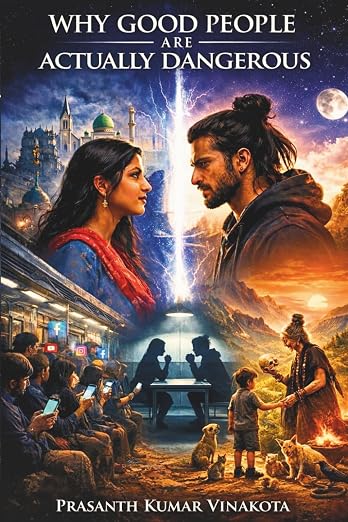
A necessary clarification opens the book with a warning that clarity, not comfort, is the point, and that the familiar sentence “I am a good person” is treated as one of the most dangerous beliefs humans carry because it so easily becomes a license for self-justification. Goodness, the author argues, is rarely a transparent quality; it is often a mask, a performance, a shield, and sometimes a weapon. The book frames “God” not as a person in the sky but as the universe, nature, existence, reality, the force that responds to what is actually operating rather than to what feels morally pleasing. It also insists that morality itself was manufactured by religion, family, society, culture, and governments as a way to produce obedient people, with religions especially training the binary formula that following makes you good and questioning makes you bad. That theme begins to sharpen in the metro incident involving Saira, whose life changes after a crowded 6:42 PM train ride when a man in a dark hoodie suddenly appears to snatch her handbag. She shouts “Stop him! Thief!” and the crowded compartment instantly turns into a moral spectacle: people grab him, strike him, and praise Saira for being brave and decisive. He gives his name as Pashi, stays unnervingly silent, and is dragged away after she files a complaint, while the crowd congratulates her for doing the right thing. The next day the incident turns into a public story of courage, then into a hero narrative, as messages, coworkers, relatives, and social media all reward her with admiration. She becomes “metro girl,” “brave,” “assertive,” and “strong,” and she begins to inhabit that identity with real pleasure, even as small distortions enter the story, first through repetition and then through the way people exaggerate what happened. The book uses that process to show how good people are made socially, with Saira becoming more distant, more self-conscious, and more invested in the heroic role as the praise hardens around her.
That hero story is then widened into a study of the many faces of “good people.” The text asks the reader to imagine that Pashi might not actually be a thief and that the entire metro scene may look different from another angle, then breaks down the crowd into moral types: the moral judge who wants a villain, the fake sympathiser, the hero performer, the spiritual pretender, the hyper-good person, the blamer, the social media saint, the fearful selfish one, the silent observer, the people pleaser, the victim good person, the overly nice manipulator, the crowd moralist, the “helpful” harmer, the secretively happy voyeur, the over-thinker, the helpless observer, the drama seeker, the old school moralist, the naive person who has seen too little, the social conditioning robot, the empath who misuses empathy, the authority worshipper, the apathetic passenger, the one who needs a villain, the over-supporter, the story builder, and the rare “relevant” person who does not know the truth but senses something is off and acts without superiority. The point is that everyone believes they are right, everyone thinks they are protecting someone, and almost nobody is actually using truth; they are using fear, ego, performance, conditioning, and the need to look moral. From there the book broadens into the claim that morality is ever-changing. Time changes it, place changes it, circumstances change it, and the story told around an event changes it too. It points to child marriage, women’s voting, inter-caste marriage, slavery, kings with many partners, punishments, and mental illness understood as possession to show that what one era condemns another once accepted. It also gives examples like surgery versus murder, soldier versus citizen, starving thief versus political leader, to show that the same act can move into a different moral category depending on context, intention, and who is involved. That sets up the chapter on how wisdom gets twisted, where Krishna’s detachment becomes escapism, Jesus’s “the kingdom of God is within you” becomes afterlife marketing, Buddha’s understanding becomes emotional withdrawal, and Prophet Muhammad’s discipline is turned into control. Across all of these, the pattern is the same: rulers, priests, governments, and modern simplifiers reshape deep teachings into tools for obedience, control, or convenience, and half-knowledge spreads faster than truth.
The first crack appears when Saira is invited to speak about women’s courage and begins feeling uneasy when a student asks whether the thief might not have been dangerous after all. Her confidence holds publicly, but privately the question lingers, along with the distant feel of colleagues becoming careful around her and the growing social distance that comes with being seen as “the brave one.” Then a police inspector calls about “unclear” CCTV footage, anonymous messages begin to suggest that the real story is hidden, and a local news item says police are looking for a male witness. The old certainty starts to wobble, and when she finally dreams of the metro thief as a faceless blur trying to speak, the book makes the internal shift visible: she is no longer certain she knows what happened. That is where the commander’s test enters, turning the issue toward a larger spiritual frame. A commander in a warzone must choose among wounded soldiers: one crying, one helping others despite pain, one blaming the commander, one making demands, and one saying he is with the commander no matter what. The lesson is that the only soldier worthy of the highest mission is not the strongest, but the one who trusts, learns, grows, stays involved, and does not run from pain. Then the book flips the analogy and says the commander is God, the soldiers are human beings, and the one who most resembles the chosen soldier is the one who says, in effect, “I am with you no matter what.” This is used to argue that life selects based on readiness, courage, understanding, and trust, not on self-image or moral claims. From there comes the sharpest challenge so far: the danger of “I am a good person.” The universe, it says, is not a moral police. It does not reward goodness and punish badness on demand. Nature responds to cause and effect, effort and output, commitment and consistency. Osama bin Laden and Hitler are given as brutal examples of people who produced results through discipline, focus, planning, and relentless work, even though their intentions and actions were monstrous. The point is not praise but warning: morality is not the same as outcome, and “goodness” can become entitlement when people believe life owes them a reward for being nice. The chapter ends with the stark idea that without people there is no good or bad at all, only comparison, labels, and human-made categories, and that much of what people call goodness is really a story about not being like the worst human beings they can find.
When Saira finally left the police station, the case was withdrawn, but nothing in her had returned to its previous shape. The walk home felt strange and weighty, and even the ordinary details around her seemed to have lost their old certainty. She had just seen Pashi alive, calm, and unbroken by the label that had been placed on him, and his simple answer to her question — that he had not stolen the bag, and that she had never asked — exposed how much of the entire story had been built on assumption. Back in her room, she could no longer hold the old narrative in place. The questions that had been sleeping at the edge of her mind became unavoidable: what exactly had he meant when he said to act before it was too late, and what was he refusing to take this time? Her imagination kept circling the same points, and with each pass the heroic certainty she had once lived inside gave way to something more painful but more honest. The first major shift was not relief, but the recognition that she had been wrong, and that the part of her identity built on being the brave, morally correct one had to crack open before anything else could be seen clearly.
That collapse led into the book’s deeper argument that intention sits underneath everything humans do, but that people almost never look at it directly. Saira’s own story becomes the example: she had not shouted because she was noble in some abstract sense; she had shouted because fear, control, and the need not to appear weak were already operating in her. Yet once the crowd praised her, those motives were immediately dressed up as courage, righteousness, and justice. The book spells out this process as the reverse order of justification. Human beings do not begin with morality and then act; they feel an impulse, choose a direction, notice the consequences only selectively, and then build morality, ethics, and law around the act to defend the self-image that has already formed. What was most unsettling was how naturally this happened. Saira did it, the crowd did it, and everyone around the metro did it too. The moral story came after the fact, not before it. That is why blame survives even when clarity begins to appear, because people defend not just actions but the identities those actions support.
From there the book turns to the distinction between action and intention, and why ordinary judgment nearly always mistakes one for the other. The action is visible, but the intention is hidden, so the mind automatically fills the gap. This is what the book calls the blind spot of intention confusion: people see what happened, apply a moral label, and then invent a motive that fits. The same mechanism operates inward and outward. When people judge others, they assume intention from the outside. When they judge themselves, they do the opposite, claiming the best possible intention to preserve their self-image. The book insists that this is not a rare moral failure but the common structure of human judgment. It introduces MIST, a map of how action, moral evaluation, assumed intention, and self-justification move together. In one state, an action looks morally aligned and intention is assumed good. In another, the same kind of action is defended while suspicion around intention grows. In another, a morally wrong-looking act may still leave people unsure, unable to settle on the expected condemnation. And in the final state, judgment simply gives up and disengages. MIST slows judgment, but it cannot reveal truth; it only shows how people place themselves and others when they are reasoning from morality instead of seeing clearly.
That limitation opens into the next and larger frame: perception and reality. Perception is not raw seeing but the mind’s filter, the layer that organizes sensory data into a version of the world that feels obvious and true. The book stresses that perception is built from memory, fear, habit, culture, and learned patterns, and that what a person perceives is not necessarily what exists. This matters because every moral and intentional judgment rests on perception first. Once that is admitted, the book moves to reality as the only stable reference point left. Reality is not a moral police force. It does not reward the good or punish the bad. It responds to what is actually operating, to habits, patterns, consequences, and repetition. It is not cruel or kind; it is reliable. That is why an action’s visible morality does not protect anyone from structural consequences. A donation done for validation may still be generosity, but reality will also respond to the practice of seeking attention, and over time the giver can become dependent on praise, shifting from helping to performing. Reality does not care about the story people tell about their motives. It responds to the structure underneath them.
That same principle is then extended into the book’s religious frame. Existence is presented as the only interface through which any experience of God can occur. Every claim made about God—being omnipresent, seeing everything, being one, creating and destroying, being unbiased, having no fixed form—already appears in existence itself. If someone believes in God, the book argues, the lived interaction with God still happens through reality, through breath, food, gravity, consequence, aging, healing, and decay. There is no separate channel outside existence. This does not erase faith; it grounds it. The point is that if intention is to align with anything real, it cannot be aligned with abstract morality or shifting ethics. It has to align with reality, because reality is what answers, what resists, what reveals. The chapter’s language is blunt: reality does not negotiate, but it does expose distortion over time. That is the only way hidden intention eventually becomes visible.
All of this prepares the ground for the final movement in this stretch: the recognition that blame itself is born in the gap between desire, intention, and consequence. The book shows how a person may feel a pull toward attention, affection, or validation, then quietly reframe that desire into something respectable, and then blame others when reality no longer matches the expectation that formed. That structure mirrors the larger human habit already seen in the metro, where people first acted and then justified. Saira’s old certainty finally breaks because she realizes that the one sentence that mattered most was the one she had never been able to say honestly: I don’t know. That admission is not a weakness here but the first place where real seeing can begin.
Pashi’s silence finally gives way to a revelation that turns the whole case inside out. In the station, when Saira returns and demands the truth, he answers plainly that he did not steal her bag. The apology she never heard, the denial he never gave, all the assumptions that had hardened around him begin to crack at once. Outside the station, as she is still trying to process what she has done, he points not to his own hardship but to the temple and the church across the road and asks why she keeps measuring life through visible success, as if goodness and worth were the same thing. The question lands because it exposes the deeper issue the book has been circling: people treat labels, outcomes, and moral appearances as if they were reality itself, when all along they are only stories pasted on top of intention and circumstance.
Her shock deepens into a kind of withdrawal. At home she cannot sleep, cannot settle, cannot return to the old certainty that made everything simple. The praise she once enjoyed now feels heavy, and she becomes afraid of the possibility that she has grown attached not to a criminal story but to the man she helped imprison. That fear is the beginning of a larger correction. The book shifts away from social approval and into its critique of “success” itself, arguing that society has trained people to equate visible achievement with rightness, and failure with shame. Rama and Jesus are held up as the clearest counterexamples: neither lived lives of worldly success, yet neither broke under suffering. Rama loses kingdom, home, wife, and family and still remains in alignment with duty; Jesus is born poor, betrayed, humiliated, and executed, yet never corrupts his intention. Their lives are used to show that reality does not reward image or status, only inward coherence under pressure. Pashi is placed in the same lineage of misunderstood figures, not because he is divine, but because the world can mistake a life of sacrifice and pain for defeat when it is really endurance.
From there the book reframes freedom itself. What most people call freedom, it argues, is really the narrow comfort of believing they are responsible only for themselves. That attitude makes everything outside the self feel like interference, which leaves a person easily disturbed by traffic, delays, other people’s mistakes, even an ant on the path. Real freedom begins when a person takes the opposite inward stance: that they are responsible for everything that happens in the world, not in a legal sense, but as an existential orientation. This does not mean fixing everyone or controlling events; it means owning experience so completely that blame loses its place. When there is no one left to blame, the world stops having power to disturb the inner state. That, the book says, is the freedom people never understood.
The final stretch brings the truth back to the metro with devastating clarity. Pashi is moving through the station when a symbol appears to him, tied to the tantric woman’s old promise that whenever he saw it, she would be with him. In the metro, he sees the danger before it fully unfolds. He reaches the thief first, retrieves Saira’s bag, and in the same motion slips his own phone and wallet into the thief’s hand so that the thief can escape. He is about to explain, but Saira’s cry of “Thief!” triggers the crowd, and everything collapses into the false story the earlier chapters had explored. The story then cuts to the present, where Saira receives a photo from the constable and sees another woman who looks like her. That image unlocks the final missing piece: the girl whose complaint years ago destroyed Pashi’s life, the girl connected to the old employment records, the one whose face he saw in Saira.
The closing reveal lands with terrible precision. Pashi had once saved that earlier girl from a blackmailer who threatened her into silence, and in doing so he became entangled in a false complaint that ruined his name. The metro was not his first encounter with Saira but a second crossing of paths shaped by unfinished truth. His silence was never guilt; it was survival, protection, and a refusal to speak until the right person arrived. What looked like a theft was actually an act of care, what looked like criminality was a warrior’s desperate attempt to protect someone else, and what looked like success in Saira’s life was a moral performance built on half-seen facts. The story ends with the full meaning of his words now visible: intention, not image, has been the real force all along.
Want the Full Experience?
This summary includes Key Takeaways, Chapter Summaries, Notable Quotes, Who Should Read This, and a professional AI-narrated audio version — available with a paid listing.
The author can upgrade this listing to unlock all sections.
