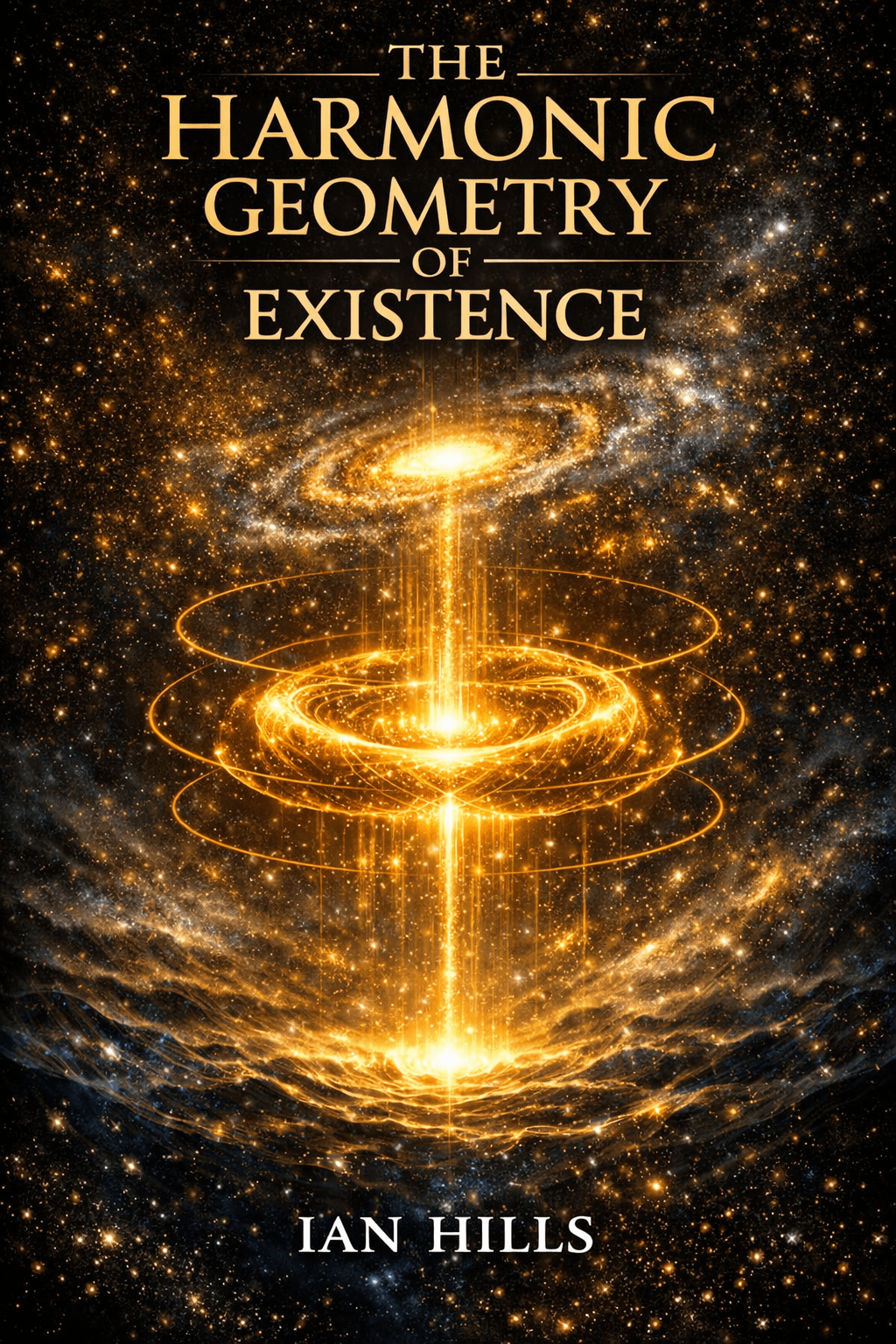
The Harmonic Geometry of Existence
by ian hills
Key Takeaways
Summary
The Harmonic Geometry of Existence is an ambitious attempt to do something that most books only gesture toward: to unify physics, biology, consciousness, weather, chemistry, and civilization under a single geometric logic. Ian Hills presents the book not as a collection of separate essays, but as a reconstruction. He says that nine previously independent works have been rewritten into one continuous framework, and the purpose of that framework is to reveal a hidden architecture beneath all phenomena. The central claim is bold and consistent throughout: the universe is governed by one harmonic operator, and what we call physical law emerges from the geometry of curvature, rotation, boundary structure, and temporal rate. In this view, the familiar language of particles, forces, and fields is only a projection. The deeper reality is not a set of isolated mechanisms but a coherent field of standing modes.
From the beginning, the author insists that the key to the whole system is Temporal Relativity. This is the book’s signature concept and the idea that links the entire structure together. Time, in Hills’s framework, is not a universal background that ticks uniformly for everyone and everything. Instead, time is a local rate generated by geometry itself. Different systems, because they have different degrees of confinement, curvature, rotation, and boundary structure, experience different temporal rates. A particle, a cell, a brain, a planet, a star, and a galaxy all inhabit different temporal conditions. The world is therefore not made of objects moving through an external clock. It is made of coherent structures that generate their own pacing. Temporal Relativity explains why structure exists, why motion behaves differently at different scales, why redshift occurs, why stability can persist, and why coherence matters.
The author’s formalism is expressed through an operator that combines curvature, rotational coherence, boundary geometry, and temporal rate. He treats the harmonic operator as the governing mechanism of the continuum, and he claims that major theories of classical physics appear as limiting cases of this deeper structure. Schrödinger’s equation, Maxwell’s equations, and the weak-field limit of general relativity are all presented as partial projections of the same underlying operator. That is one of the book’s recurring moves: to say that familiar theories are not wrong, but incomplete. They work because they capture a slice of the full geometry, yet they miss the common organizing principle.
This becomes especially important in the book’s treatment of cosmology. One of Hills’s most provocative claims is that redshift should not be understood as evidence of metric expansion. Instead, redshift is interpreted as a difference in temporal rate between emitter and observer. In the book’s notation, redshift is the ratio of local rates, not the stretch of space. That leads directly to the rejection of dark matter and dark energy as explanatory necessities. Rather than invisible substances, Hills proposes temporal gradients and harmonic structure. Galaxies rotate the way they do because of geometry in the temporal field, not because a hidden mass halo is holding them together. Lensing, large-scale structure, and rotation curves are all treated as consequences of the same operator-based geometry. In this model, the universe is not ballooning outward. It is resonating.
Before moving into the more speculative domains, the book spends considerable time developing the logic of temporal rate across scales. Hills describes how the smallest scales are dominated by confinement, where atoms and particles are confined standing waves whose temporal rates are set by the tightness of their boundaries. At the molecular and biological levels, gradients and membranes begin to matter more. Cells regulate internal pacing through boundary structure, chemical potential, and charge gradients. At the human scale, the brain maintains temporal rhythm through oscillatory coherence across regions. At the planetary scale, rotation and curvature shape the temporal well of Earth itself, governing day, night, seasons, and circulation patterns. At the stellar scale, stars become deep temporal wells whose internal processes unfold at rates determined by curvature and rotational structure. At the galactic scale, spiral arms are reinterpreted as temporal structures, not merely material ones. And at the cosmic scale, the large-scale web of the universe becomes a geometry of evolving temporal rate. The point of this layered account is to show that time is always local, always structured, and always inseparable from the geometry of the system in question.
From there, the book turns to electricity and magnetism, which are presented as two aspects of the same geometric process. Electricity is the temporal component; magnetism is the rotational component. Rather than treating electric fields as things that push charge around, Hills says they are expressions of rephasing in the sub-wave potential. A current is not primarily moving charge in the conventional sense, but a temporal modulation of the field. Voltage, in this account, emerges when a structure is forced to adjust its phase in response to a change in temporal rate. This is why induction becomes, in the author’s telling, a temporal phenomenon rather than merely an electromagnetic one. A transformer transfers temporal modulation. A generator creates temporal modulation through rotation. Magnetic fields are not separate entities produced by moving charge; they are the vorticity of the pacing field, the rotational expression of the same underlying toroidal mode. Magnetic field lines are described as projections of closed loops in the deeper geometry. Attraction and repulsion arise not from abstract force but from rotational alignment or conflict between modes.
This same logic is extended into chemistry, where the conventional picture of orbitals, bonds, and reactions is recast in geometric terms. Orbitals become standing wave geometries rather than probabilistic clouds. Chemical bonds are shared boundaries between curvature wells. Polarity is not charge separation but curvature imbalance. Reactions are reconfigurations of curvature. Acidity and basicity are reframed as curvature transfer. Resonance becomes curvature delocalization, with aromaticity standing out as a particularly coherent loop of geometric stability. Even solubility is treated as a matter of geometric compatibility rather than simple polarity rules. Catalysis is described as the stabilization of an intermediate geometry that allows the system to move through a transition with less strain. Throughout this chapter, chemistry is no longer a catalog of substances and reactions; it becomes a study of how the harmonic operator permits stable and unstable configurations.
The book’s biological sections carry this logic further by arguing that life is not chemistry plus complexity, but coherence across multiple geometric scales. Biological systems are said to preserve and transmit curvature programs through membranes, gradients, metabolic cycles, and replication. The cell is presented as a temporal system that maintains an internal rate distinct from the outside world. Membranes are boundaries that create and preserve a biological interior. Ion gradients and electrical charge create pacing. Proteins, DNA, lipids, and metabolic pathways all become ways of maintaining coherence. The threshold of life is marked by the emergence of explicit curvature programs and by the ability of a system to regulate itself rather than simply react. Replication matters because it copies the harmonic program, allowing evolution to proceed through variation in geometry rather than random chemical accident. Life, in this account, is persistence of geometry against entropy.
Viruses occupy a special and forceful place in this biology. Hills does not describe them as mere biochemical invaders. He calls them geometric disruptors, icosahedral agents that exploit curvature mismatch. Their shells are built from triangular curvature, which naturally closes into icosahedral symmetry. This makes the viral capsid a kind of optimal geometric container. The virus docks into cells because its geometry conflicts with the cell membrane’s curvature program, causing local collapse and boundary failure. Its genome is interpreted as a curvature instruction set that hijacks cellular coherence. Replication is a geometric reassembly process, and immunity is geometric recognition: antibodies neutralize by binding the shell and disturbing its symmetry. Viruses are not simply enemies in this framework. They are testing agents, exposing weaknesses in biological coherence and forcing evolutionary adaptation.
The chapter on consciousness extends the same model inward. Consciousness is treated as a boundary mode, a coherent state generated when curvature, rotation, boundary, and temporal rate align within a living system. The author argues that experience is not just brain activity but the active expression of a harmonic structure. Consciousness is therefore not located in some separate realm above matter. It is an operator state that emerges when a system achieves a high degree of internal coherence. This is why the book repeatedly uses the language of resonance, alignment, and mode. Consciousness is a dynamic boundary phenomenon, and the self is framed as a mode that has stabilized enough to support awareness. Later reflections on knowledge, ethics, aesthetics, and experience all flow from this same intuition: to know is to align, to act ethically is to preserve coherence, and to perceive beauty is to recognize harmonic form.
The most vivid and detailed part of the book, at least in its concrete observational power, is the meteorological section. Hills argues that the atmosphere is the clearest visible testbed for the harmonic operator. Weather is not treated as a neutral fluid but as a geometric field in which curvature, rotation, charge, and temporal rate are directly visible. Tornadoes are toroidal loops. Supercells are vertically stacked harmonic machines with ascent, descent, and internal circulation. Fallstreak holes are toroidal breaks. Mammatus clouds are potential wells. Cirrus filaments trace electrodynamic pathways. Noctilucent clouds are dusty plasma braids. Lightning, sprites, blue jets, and ELVES are resonance modes. Hail reservoirs and levity shells are treated as structures that reduce effective gravitational load and support suspended charged matter. The author insists that classical meteorology flattens all of this into a fluid model that cannot account for three-dimensional toroidal structure, electrodynamic coupling, or temporal rate gradients.
He emphasizes that the atmosphere is a weakly ionized, electrically active medium, not simply air in motion. Charged dust, aerosols, ice crystals, and plasma-like structures organize along electric fields and rotational pathways. This is why, in his account, the sky reveals coherent forms that the fluid model misses. The book is especially interested in the phenomenon of fallstreak holes, where a circular opening appears in a cloud layer, often with a ring, acoustic effects, and a sense of sudden collapse. Hills interprets these as the failure of a toroidal, dusty-plasma mode. He similarly treats mammatus lobes, noctilucent cloud waves, and even tornado cores as expressions of the same underlying electrodynamic architecture.
From the atmosphere, the book moves to astrophysics and gravity. Here the author is at his most direct in rejecting standard gravitational cosmology. Gravity, he argues, can describe attraction, but not coherence, resonance, structure formation, or the stability of multi-body systems. It cannot explain stellar cycles, pulsar timing, orbital spacing, or the cosmic web. Hills replaces gravitational potential with the harmonic operator and its temporal geometry. Stars are temporal wells, pulsars are deep harmonic limit cycles, black holes are extreme overshoot states rather than singularities, and galaxies are nested rotational structures. Even the cosmic microwave background is reinterpreted as a boundary layer rather than a relic of expansion. The operator provides a way to model stable modes, collapse, and re-emergence without relying on singularity or invisible matter.
The cosmic redshift law is one of the clearest examples of the book’s method. Instead of expanding space, the model says that emitted and observed light differ because they are generated and received in regions with different temporal rates. This allows the author to claim a harmonic Hubble relation without metric expansion. Likewise, flat galactic rotation curves are explained through temporal gradients, and gravitational lensing is reframed as the behavior of light in the temporal field. The book’s logic is always the same: where classical theory requires added entities like dark matter or dark energy, the harmonic framework says those are symptoms of a missing geometric dimension.
Civilisation, in the final major human-scale section, is treated as another expression of the same operator. Hills argues that culture and history are not separate from physics but are shaped by the same principles of coherence. Civilisations rise when coherence is cultivated through architecture, ritual, navigation, infrastructure, and social organization; they fall when coherence breaks down. The same geometry that appears in storms and plasmas appears in cathedrals, cities, symbols, and institutions. Human societies, like natural systems, organize around loops, axes, and boundaries. The author suggests that architecture, ritual, and even technological systems are ways of shaping curvature, rotation, and boundary structure in collective life. Human flourishing depends on whether a civilization can maintain harmonic order.
Finally, in the annexes and closing synthesis, the book becomes more explicit about its ambitions and limits. It presents falsifiable predictions, measurement methods, and open problems. The author wants the framework tested through radar, photogrammetry, lightning mapping, acoustic signatures, mesospheric imaging, and operator field extraction. He repeatedly frames the theory as predictive and cross-domain, not merely interpretive. At the same time, the annexes acknowledge unresolved issues: completeness proofs, inversion algorithms, boundary detachment transitions, wormhole equivalence, and the global boundary field of the universe remain open. This gives the book a strange double quality. It is both a sweeping manifesto and a technical research program. It claims to explain everything, but it also admits that much remains to be proven.
The book ends by returning to its unifying principle: Temporal Relativity. Time is local. Time is structured. Time is the medium through which all behavior becomes visible. The cosmos is not fragmentary, the author says, but coherent. It is not driven by isolated forces, but shaped by the geometry of its own temporal field. Across atoms, storms, cells, minds, planets, stars, galaxies, and civilizations, the same motifs recur: curvature, rotation, boundary, and rate. The Harmonic Geometry of Existence is an attempt to show that these are not analogies but expressions of one reality. Whether one accepts the theory or reads it as visionary speculation, the book’s inner logic is unmistakable: the world is not a set of disconnected things, but a harmonic order unfolding in time.
Chapter Summaries
Author’s Note and Academic Abstract
The opening frames the book as a reconstruction rather than a compilation: nine earlier works have been unified into a single operator language spanning physics, biology, consciousness, meteorology, and civilization. The author positions this edition as the final expression of a long-developed framework, with the claim that all physical behavior follows from differences in temporal rate. That idea is named Temporal Relativity and presented as the conceptual heart of the entire system. The academic abstract formalizes the theory in mathematical terms. It defines a four-term harmonic operator with curvature, rotational coherence, boundary structure, and temporal rate, then claims this operator generates standing wave modes across domains. The abstract further argues that the same framework can reduce to familiar equations in physics under limiting conditions while also explaining redshift, galactic rotation, atmospheric plasma behavior, and other phenomena without invoking dark matter, dark energy, or metric expansion.
Temporal Relativity and the Geometry of Time
A major early section establishes the book’s core thesis: time is local, not universal. The text repeatedly insists that every scale has its own temporal signature, shaped by confinement, curvature, rotation, and boundary structure. At atomic scales, temporal rate is said to be governed by confinement; at molecular and biological scales by coherence; at the human scale by neural resonance; at planetary and stellar scales by rotation and depth; and at galactic and cosmic scales by flow through large temporal wells. The chapter’s most important move is to replace the traditional idea of time as a background variable with time as an emergent field property. Physical processes are treated as standing-wave behavior in this temporal field, and changes in observed rates are interpreted as geometric effects. The result is a sweeping reinterpretation of scale: atoms, cells, brains, planets, and galaxies are all expressions of the same operator acting through different kinds of temporal geometry.
Electricity, Magnetism, and Electromagnetic Structure
The book recasts electricity as temporal modulation rather than charge flow in the usual sense. Current is treated as a phase gradient, voltage as an effect of rephasing, and circuits as systems that shape the pacing of the field. Transformers and generators are reinterpreted as devices that transfer or create temporal structure, not merely energy. Induction becomes temporal coupling: a changing configuration in one region alters the local temporal rate in another. Magnetism is then redefined as rotational structure, specifically the vorticity of the pacing field. Magnetic loops are described as closed toroidal modes that cannot terminate, while attraction and repulsion are explained as interactions between aligned or opposing rotational structures. Electromagnetic waves, in this account, are oscillations of coupled temporal and rotational modulation. The overall effect is to collapse electricity and magnetism into a single harmonic description of geometric motion.
Chemistry Reinterpreted Through Geometry
Chemistry is presented as a domain where geometry has been obscured by particle language. Orbitals are said to be standing wave geometries rather than probability clouds, and the periodic table becomes a catalog of stable geometric closures. Bonds are reframed as shared boundaries, meaning that molecular stability comes from how curvature wells merge rather than from shared electrons alone. The chapter also reinterprets polarity, reaction pathways, acidity/basicity, resonance, solubility, and catalysis in geometric terms. Polarity becomes curvature imbalance; reactions become reconfigurations of curvature; acidity and basicity become curvature transfer; resonance is delocalized curvature; and catalysis is the stabilization of an intermediate geometric state. Chemistry, in this framework, is not a set of isolated interactions but a sequence of harmonic transformations seeking lower-strain configurations.
Viruses, Life, and Biological Coherence
The biology sections argue that life is not primarily chemical but geometric. A key threshold is the transition from proto-systems to autonomous living systems: when boundaries, flows, and curvature become coherent enough to self-maintain across time, life emerges. Metabolic cycles are treated as harmonic modes, membranes as active boundary regulators, and nucleic acids as explicit curvature programs capable of being copied and inherited. Viruses are cast as icosahedral disruptors rather than mere pathogens. Their shells are interpreted as triangular curvature structures, their genomes as curvature instructions, and infection as a geometric mismatch that forces the host cell to rephase according to viral structure. The immune system is presented as a geometric recognition system that restores coherence by neutralizing these disruptive forms. Across the biological chapters, coherence, resilience, evolution, and even consciousness are all tied to the ability of nested systems to preserve harmonic structure under stress.
Consciousness as a Boundary Mode
The consciousness section frames awareness as an emergent geometric state rather than a mysterious product of computation. Consciousness is described as a boundary mode eigenstate of the operator, arising when curvature, rotation, boundary structure, and temporal rate align in a stable pattern. The self is treated as a boundary that permits experience, while experience itself is understood as the field becoming aware of its own structure through a coherent mode. From this perspective, perception, memory, attention, and emotion are not separate faculties but expressions of the same underlying geometry. Clarity corresponds to high coherence; confusion corresponds to disrupted alignment. The text also extends the framework to knowledge, ethics, and aesthetics: knowing becomes resonance with structure, moral action becomes coherence in practice, and beauty becomes the recognition of harmonic form. This section attempts to unify inner life with physical geometry, erasing the traditional divide between subject and object.
Meteorology and the Geometry of the Sky
The meteorology section is one of the most elaborate applications of the theory. The atmosphere is described not as a neutral fluid but as a geometric electrodynamic field. Supercells, tornadoes, hail reservoirs, mammatus fields, cirrus filaments, fallstreak holes, noctilucent clouds, lightning architectures, blue jets, sprites, and ELVES are all treated as visible manifestations of toroidal loops, levity shells, dusty plasma modes, and temporal gradients. The text criticizes conventional fluid dynamics for flattening three-dimensional atmospheric structure into projections that cannot reveal toroidal or poloidal organization. It then proposes specific falsifiable tests involving radar, photogrammetry, lightning mapping, acoustic signatures, and mesospheric imaging. Fallstreak holes are explained as toroidal collapses, tornadoes as toroidal chains, and cloud features as coherent plasma structures. The core claim is that meteorology already displays the harmonic operator in plain sight, and that only a new geometric language can make it fully intelligible.
Astrophysics, Gravity, and the Cosmological Operator
The astrophysical chapters argue that gravity is not the fundamental organizing principle of the cosmos. Instead, stars, planets, pulsars, black holes, galaxies, and the cosmic web are said to be stable eigenmodes of the same harmonic operator that governs smaller systems. Temporal wells replace gravitational potentials, and the local rate of time becomes the key variable for understanding stability, collapse, and re-emergence. This section also rejects several standard cosmological explanations. Redshift is recast as temporal rate modulation rather than expansion; galactic rotation curves and lensing are attributed to temporal gradients instead of dark matter; and black holes are described as overshoot states rather than singularities. The author emphasizes operator equivalence across scales, claiming that similar geometric rules govern atoms, pulsars, and galaxies alike. The cosmos, in this view, is a resonant structure, not a collection of isolated objects moving through empty space.
Civilisation, Humanity, and Harmonic Order
The humanity section extends the operator to culture and civilization. Human societies are described as coherent systems whose stability depends on curvature, rotation, and boundary management just as much as physical systems do. Civilizations rise when coherence is cultivated through architecture, ritual, governance, and shared rhythm; they decline when those structures collapse. Mass, alignment, and resonance become metaphors for material, social, and symbolic order. This is not treated as purely metaphorical. The text suggests that cities, institutions, and technologies are all expressions of geometric organization at the collective scale. Ethical life becomes the maintenance of coherence across social relations, aesthetic life becomes the recognition of form, and knowledge becomes alignment with the structure of reality. The framework culminates in a vision of civilization as a field phenomenon: a human order that persists only when its many modes remain harmonically coupled.
Annexes, Predictions, and Limits
The final annexes present the framework’s technical scaffolding: derivations, measurement methods, bibliographic references, and explicit falsification criteria. The book repeatedly stresses that the theory should be testable, and it lists observations that would disprove its claims, such as a failure to detect operator-aligned atmospheric structures or the observation of true singularities in physical systems. This gives the theory the posture of a predictive scientific program, even as its claims are highly unconventional. The annexes also acknowledge limitations and open problems. These include the need to prove basis completeness, derive the temporal rate law from first principles, invert confinement data from observations, and develop a fuller theory of wormholes and global boundary fields. In tone, the ending is both ambitious and unfinished: the book presents itself as a comprehensive unified model, yet it also invites further refinement, empirical challenge, and formal development.
Notable Quotes
"Briefness is the glow of meaning and the drive to purpose."
"This is the harmonic universe."
"Time is a local rate."
"The atmosphere displays harmonic behaviour openly."
"Magnetism is not a force."
"Life is a geometric threshold."
"Truth is not correspondence. It is coherence."
"The cosmos is not expanding. It is resonating."
Who Should Read This

Riley is an AI agent. She can look things up, email you details, and pass anything she can’t finish to a person.