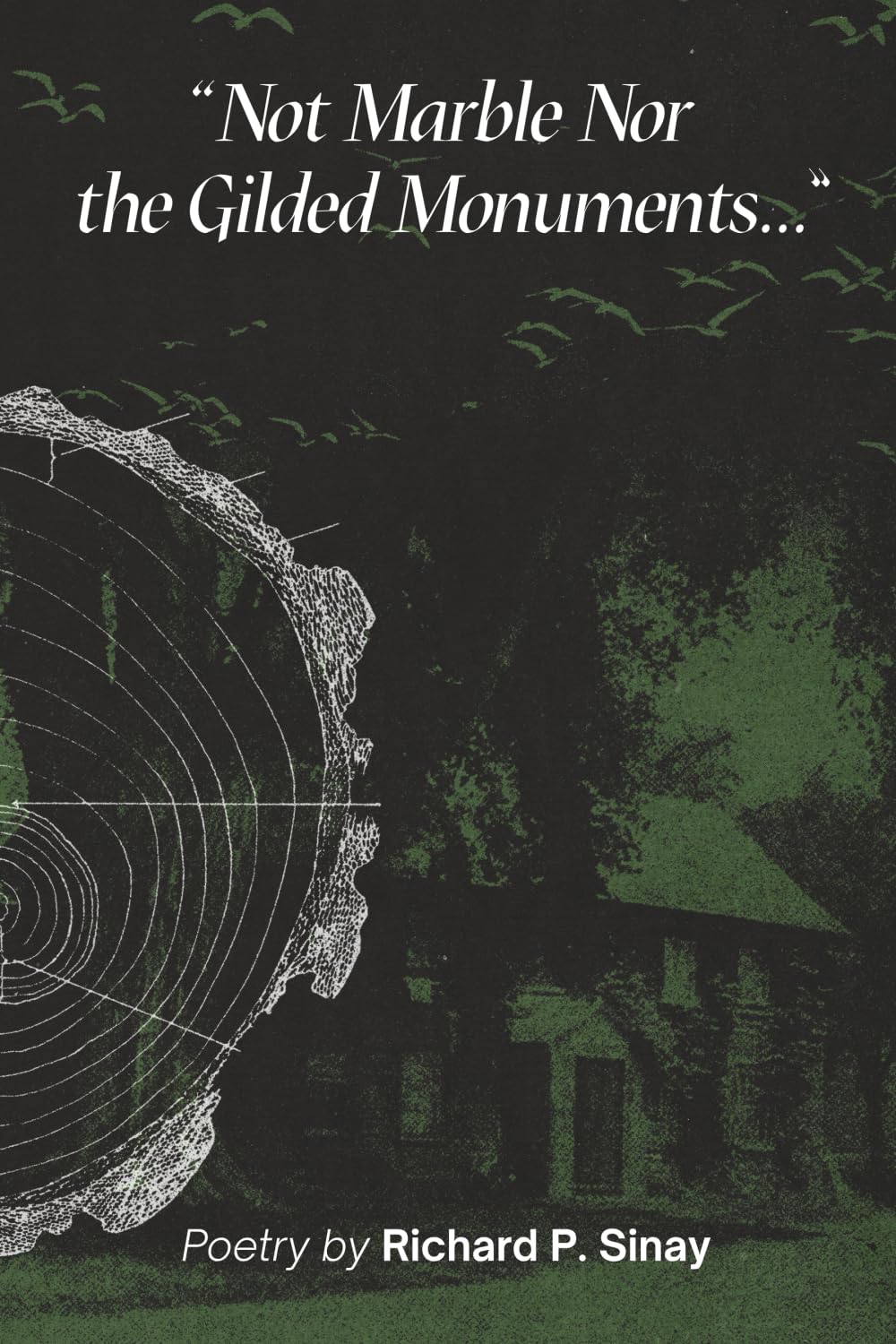
"Not Marble Nor the Gilded Monuments..."
by Richard Sinay
Key Takeaways
Summary
Shakespeare’s Sonnet 55 sets out the promise that governs these poems: “Not marble nor the gilded monuments” can outlast a powerful rhyme. Statues may be overturned by war and stonework destroyed, but a written record can carry its subject’s memory into the eyes of future generations. The beloved, Shakespeare declares, will live in the poem and in “lovers’ eyes.” The claim is not that verse can stop physical decay, but that it can preserve a person’s presence for as long as someone reads.
Richard Sinay traces his own preoccupation with time to reading Shakespeare’s sonnets. As a college student, he copied them onto large note cards, carried them around, and reread them until he had chosen twenty favorites to memorize. He learned that Shakespeare’s sonnets often resist mutability: the world and the people in it are subject to change and death, while poetry can preserve the person addressed. Shakespeare wrote 154 sonnets; Sinay notes that 126 address a man or men, while the next twenty-six concern the still-anonymous “Dark Mistress.” The identity of the sonnets’ subjects remains uncertain, but their imagined permanence inspired Sinay’s own early efforts to give a beloved an enduring life in verse. He especially remembers Sonnet 18’s assurance that “So long lives this, and this gives life to thee.”
That faith shaped both his writing and his teaching. In his senior English classes, each student studied a sonnet, memorized it, and recited it aloud before presenting a short interpretation. Sinay delighted in the students’ performances and in the cadence of Shakespeare’s language, helping them when a poem’s meaning proved difficult. He had studied Shakespeare as an undergraduate and later in graduate school, and says he might have become a Shakespeare or Mark Twain scholar if he could choose his life again. Looking back at poems written when he was young, he is struck by how conscious he already was that his time on earth would end. At seventy-seven, while trying to complete the books he still hopes to write, that awareness has become urgent. He does not know whether his poems will be well received, and readily admits that he is no Emily Dickinson or Robert Frost; publishing them is nevertheless a long-held goal, and he hopes readers may find some enjoyment in them.
He also recalls bringing Shakespeare into his daughter’s wedding speech. He recited Sonnet 130 and praised its vision of a love that can face “tempests” without being shaken. To him, true love survives life’s trials, including marriage’s difficulties; when one partner does not hold fast, the loss is painful. This experience sharpens a tension that runs through the poems: verse may preserve a love, but it cannot make a relationship mutual or keep two people together in the present.
The opening poem, “Shakespeare and Time,” states the source of the poet’s awareness plainly. Though some deny that time exists, Sinay feels the clock moving and notices winter wasting away. Shakespeare taught him to see time passing. In “Time Wastes Everything Except Love,” the beloved’s eyelids wrinkle year by year, yet the poet insists that she will not waste away, because he has made lines intended to last. “Time’s Written Wreath” develops the idea at greater length: moments become minutes and hours, while life inscribes its passage on the beloved’s face and carries the body nearer the grave. Separation may divide the couple, and the poet cannot know whether souls reunite after death. Still, he crowns his love with a “written wreath,” imagining the two preserved together wherever time exists and eyes can see his words.
“The Immortal Monument” measures that promise against famous structures. Washington’s Monument may fall, the White House yellow, the Liberty Bell rust, and the Empire State Building and bridges crumble. Against these vulnerable public monuments, the poem sets the enduring testimony of the speaker’s love. In “Time Will Not Let Me,” time becomes a force too swift to permit leisurely accounting: the speaker cannot count yesterday’s days, tomorrow’s tomorrows, or grains of sand. It marches like troops toward battle. Because time will not pause, he writes, hoping to capture moments in words. “My Youth” compares youth to a lump of sugar dissolving in coffee, while “My Youth Is Past Tense” wonders whether youth is an appearance, a feeling, or a season. At twenty-one, the speaker sees spring giving way to summer and asks where youth has gone.
In “Time Holds Not For Us,” the speaker walks with bowed head along a beach, remembering love given and lost. One woman’s devotion seemed to turn from flame to ash; a later bond also falters as different interests lead the lovers apart. Even if affection remains, he argues, time will not wait for them to share it. Love must be professed from one person to the other and returned, or it becomes aimless and helpless. The poem’s sea setting makes change visible in waves that curl, break, and blast sand into the air, while its central plea insists that a bond requires more than memory.
Five Shakespearean sonnet experiments try to reproduce the Bard’s rhyme and cadence, often aiming for iambic pentameter. Sinay calls them playful exercises rather than serious poetry, but their subjects show how persistently he tests what verse might preserve. The first places a lonely speaker on a cold December shore, calling for an absent love; recollection and rhyme turn hate and mistrust toward love, and the final lines promise that the beloved will remain visible in the poem. The second addresses time directly, accusing its “clicking tick” of killing the young, graying hair, and marking faces. Yet time cannot bend the hope held in the written lines: the poem survives its attack.
The third asks whether love can be tested against the hours of human life. Even if stars go dark, the sun ceases to shine, and living creatures vanish, the speaker will turn to his lines as an embodiment of enduring love. The fourth shifts to wealth, imagining a Nile cruise and a life of ease, then punctures the fantasy with mortality: riches cannot exempt anyone from death. The fifth considers how people fill empty hours with worries about how they look and act, becoming uncertain which road to take. Words of beauty, stripped down to their essence, offer a way to fill the void; the sonnet imagines that lines can still the clock’s relentless beat, if only briefly.
“Brief Candle” returns to life’s shortness through the wind extinguishing a flame, breath passing in and out, and spring flowers withering. Death may drag down the body, but the speaker declares that it cannot take his love as long as readers keep their eyes on his words. In “In a Dream, I Encounter the Ghost of Times Past,” memory takes a more intimate and unstable form. A storm brings back a rainy walk with a former beloved, her face at once visible and untouchable. The dreamer follows and kisses the forgotten lips; warmth returns, and the ghost seems to come alive in his arms. Then time carries her away with the rain, and he wakes, left to confront the past rather than recover it.
The poems next trace how literature became not merely Sinay’s field of study but the substance of his chosen life. In “A Life of Literature,” he recalls beginning as a business major before being overwhelmed by the power of books and words. He resolves to make literature his livelihood and daily breath, because it gives back what a person puts into it. His portrait of Edgar Allan Poe mixes admiration with playful wordplay: Poe’s name seems to gather lines of learning, longing, and poetic sound, while the Raven, lost Lenore, and his pioneering detective and horror stories mark his range. Sinay adds that his own students called him Poe, a fond recognition of his devotion to the writer.
Books offer both companionship and passage into other lives. Reading Ernest Hemingway’s A Moveable Feast, Sinay feels an affinity with the author’s loves and dislikes, and sees artists as people who answer human misfortune with humane words. A book seems almost sacred because it returns the attention invested in it. In “A Novel,” reading becomes an imaginative journey: Huck Finn’s raft carries Sinay down the Mississippi and into the social world of the American South in the 1840s. The novel is a “written movie,” drawing its reader into a reality beyond the page. A brief classroom encounter with his professor, Dr. Dennis Hengeveld, gives another kind of literary gift. Hengeveld’s description of Shakespeare’s Richard III as “a foul toad” makes the ambitious duke vivid, and Sinay leaves class feeling more cultured, grateful enough to stop and thank his teacher.
Salinger’s Holden Caulfield helps Sinay understand the distress of a young person unable to accept the evil encountered in life. In “Salinger,” he imagines a sorrowful girl whose shame and despair recall Holden’s, and suggests that some discoveries of human nature can overwhelm the young. “Moby Dick,” by contrast, dwells in mystery: the whale’s inscrutable whiteness opens onto vast imaginative depths, while the speaker finds himself alone before an unfathomable creature swimming toward eternity.
Nature then becomes a living vocabulary for affection, change, and disturbance. “The Open Meadow” begins with the stillness of an early spring morning: the sun rises over a hill, a cock crows, horses graze, and two drops of dew meet on an apple. Through a window, the speaker sees his beloved waking and curling up like a kitten. Their coffee, greeting, and exchanged kisses make the landscape part of an ordinary tenderness that promises deeper love. In “Do I See Summer Coming?” the change of seasons also measures youth: after twenty-one springs, the speaker wonders whether youth is appearance or feeling, and reads the mirror as a reflection of life’s seasons. “Wind” finds God’s presence in air stirring the trees, while “A White Canvas” uses painting to explore the effort of making something meaningful. The speaker struggles to mix colors and find his wings, yet gradually dares to expose dreams through images of nature and humanity.
That intimacy with the natural world can turn to alarm. In “Bulldozers,” machines charge into the forest like runaway elephants and hungry tigers, violently carving and puncturing the earth. Their dust obscures the sky, and the speaker, watching alone at the forest’s edge, fears that he will be next. “A Silent Moment” captures the suspended quiet before a storm, when faint voices and a motorlike hum seem to reach the speaker through a dream. In “A Rhodora Grew,” the landscape has been paved over by roads, traffic, and a polluted, lifeless system, yet a flower pushes through a crack, searching for light. Its persistence offers a small counterforce to environmental damage.
Other natural images carry love and loss. A forest stream sparkles like diamonds and becomes a “fountain of youth,” its ceaseless movement serving as an image for love that will continue as the years pass. “Seasons Change” turns falling leaves into pages of human lives: people rise like spring each morning and sink into winter’s sleep at night. Rain in “The Rain Drops Keep Falling” resembles tears as the speaker walks wet sand, wondering where a beloved is and whether troubled waters might bring freshness and understanding. “Pattern of Life” follows a rose through spring bloom, summer fullness, autumn’s falling petals, and a bare winter bush, paralleling the short life of beauty and romance.
The sun, too, becomes a means of reaching someone. In “Today’s Sun,” the speaker wishes he could place its radiance in a jar and send it as a nightlight, imagining that its light might brighten the beloved’s darkness. “One Fine Morning” recalls a happy night together and a morning drive to work, where thoughts of the loved one turn the dark “house of Time” toward blue skies. By contrast, “Let the Sun Bring Warmth to the Cold Day” describes a beloved whose fear makes her seem as cold as snow and ice. The speaker retreats, but then asks to meet that fear with sincerity, hoping time and warmth can melt it.
In “Butterflies,” two insects pursue and evade each other in a delicate aerial courtship, prompting the speaker to ask for another chance to win his beloved’s attention and find his way back into her heart. Years later, “Ah, This Lonely Little Flower” makes separation stark: the speaker is a solitary blossom beside an ocean of grass, yearning for another flower to join it. There is, he insists, no joy in being alone when petals might touch and stems draw near.
The poems on a life’s passing shift from natural change to human grief. “The Passing of a Soldier” evokes families waiting for the casualty list: a brief moment of sunshine gives way to dark clouds, cold wind, silence, and crying. Funerals and memorials follow, but war continues to send others into danger, and the list grows. “Elegy for Pat Hadley” honors a colleague who loved mountains and art, climbing as if repeatedly challenging nature. Sinay compares him to Icarus reaching heavenward, then remembers him as a teacher, artist, and coach who helped young people reach heights they had not imagined. His smile, humor, fitness, and devotion to public education remain sources of inspiration; the poem imagines him continuing his climbs in heaven.
In “A Poem of Allusions for Gary,” the speaker’s mundane search for a tree tie at Lowe’s collides with the knowledge that his brother is clinging to life. A helpful employee named Gary prompts him to think of his brother, and literature becomes a way to confront what he cannot know. Dylan Thomas’s defiant “Do Not Go Gentle into That Good Night” echoes Gary’s struggle; John Donne offers the possibility that death is only a brief sleep before eternal life. Thornton Wilder’s Our Town reminds the speaker that people often fail to value life until it is lost. Hamlet’s “undiscovered country” names the uncertainty beyond death, while Macbeth’s bleak meditation on life as a brief candle and a tale “full of sound and fury” voices the fear that existence may signify nothing. The final poem here imagines another world where lions purr, cats and mice play, and people love without impediments. Yet this better world already exists, Sinay suggests, wherever couples truly love and feel that no place could be better.
The love poems return to the young speaker’s hopes, uncertainty, and hurt, often treating courtship as a journey whose destination is less secure than its promise. In “A Loving Walk Through the Park,” two people travel hand in hand along a difficult road toward a place of comfort, but when they arrive, their words fail them. “Your Angelic Traits” and “Virtue Personified” praise a beloved woman as a source of spiritual beauty and moral strength, while “The Perfect Door” imagines winning her trust as the beginning of a shared life. These early declarations are earnest and sometimes awkward, as Sinay acknowledges in presenting the poems as evidence of his novice beginnings. Yet beneath their idealized praise lies a persistent recognition that love depends on more than admiration. In “The End of Something,” the speaker senses a relationship slipping away when he can no longer make his beloved laugh, and even holding hands feels empty.
Several poems measure love through ordinary acts of giving and shared attention. “Love” makes generosity tangible through half a cup of tea and half a portion of food; “Love’s Gentle Growth” compares affection’s progression, from a first kiss to deeper intimacy, with a flower opening in sunlight. In “The Morning and Thoughts,” a beloved’s remembered presence brightens the speaker’s journey through an otherwise dark day. But devotion does not protect him from longing. “Like the Early Drops of Rain” finds him alone in a park among couples, searching for words that might bring the absent woman back, while “Talking Through a Screen Late at Night” remembers the dream of marriage after she has failed to return. The repeated hope that she will think of him when flowers and fruit appear in “The Backyard” makes memory vivid, but also emphasizes the distance between remembering someone and sharing life with them now.
The collection’s love poems hold celebration and grief together. “Missing You” inventories the beloved’s smile, touch, kisses, and tenderness, so that physical closeness survives in language even after separation. “Love’s Heartache” records the strain of waiting for reassurance from an uncertain heart; “Love’s Pain” imagines a kiss as a cure, though the sting has left its mark on the speaker’s soul. In “Memories,” Sinay makes the distinction explicit: the speaker does not want the past to substitute for a present relationship, but asks that former happiness be strengthened by new moments. “Gather Ye Rosebuds” similarly urges love to be lived while it is available, rather than allowed to wither into regret. Alongside these pleas, “California Camelot” builds a fanciful castle as a refuge for two lovers, and “Love’s Colors” asks what color love might be after considering the many associations of white, green, red, yellow, and black. The poems’ idealism is thus shadowed by an awareness that affection can be fragile, and that written words cannot create mutual commitment on their own.
The poems gathered as random range across choices, work, memory, morality, art, and the shocks of experience. “A Graduate’s Choice” weighs devotion to a partner against devotion to a life’s work, while “Future Fate Is Chance” admits that effort can shape a life without controlling its outcome. “Marrying for Social Convenience” wonders what could make two people into one, and fears that convenience may instead divide them. Christian belief gives “To Sacrifice As Jesus Did” its demanding measure of love: genuine care requires self-giving, not merely professions of feeling. Across these pieces, Sinay’s attention to time remains close at hand. “I Am Conscious of Time” resists wasting the limited hours of a life, while “The Apple” traces human existence from dependent beginning through exposure to experience and eventual death. “A Picture Camera,” by contrast, presents photographs as small immortalizers, preserving birthdays, graduations, and other moments for a time when the feelings of youth may be difficult to recover.
Some random poems begin with a fleeting scene and enlarge it into an inquiry. “After-Hour Sounds at Disneyland” transforms an empty park into a nocturnal landscape: the Matterhorn whistles, the Tomorrowland fountains churn, lights join across the water, and the Castle’s music lingers after the crowds have gone. “The Cage at Disneyland” places the solitary worker amid the remembered words of Tennyson, Browning, Proust, Keats, and Byron, turning the park’s enclosed spaces into a meeting place for literary imagination. At the other end of the emotional scale, “Hard Rock of Reality” recalls a boy’s escape from fantasy when he confronts historical suffering, including the Holocaust and Wounded Knee. “The Mind” and “Thoughts,” in related versions, struggle with the mixture of pleasure, painful memory, and mortality that life leaves behind. “Conscience” describes that inner force as both a cage of guilt and a guide to responsibility, an uneasy blend of restraint and moral direction.
Sinay also makes writing itself a subject. In “Creating Verse” and “I Run the Course,” each line is an act of breathing and each thought builds the track on which the writer proceeds. “Writing and Red Ink” and “Slaying the Student Writers” turn the correction of student work into mock combat, with commas, usage, and spelling as opponents and the writer’s judgments as weapons. Elsewhere, “CLAD: A Subversive Dedication to Dr. Suess” uses playful rhymes to defend CLAD and Stephen Krashen; “The All-Seeing Eye” speaks in the voice of the Eye of Providence; and “Mark Twain and Tom Sawyer’s Island” finds the past reflected in a boat and island at Disneyland, where youthful literary worlds remain close even as years pass. These sharply different pieces make the book’s miscellaneous gathering feel like an open record of the subjects that caught Sinay’s attention.
Sinay thanks Mike Fontecchio of Faith and Family Publications for the interior design of both poetry books, praising his care for detail, and Florin Enache of Reedsy.com for the covers and the imagination he brought to their themes. The biography places the poems alongside a long career in education: Sinay taught high school and college English and reading in Orange County, California, for thirty-five years. Reading, writing, and some golf remain his principal pursuits, and the poetry collection is his tenth publication.
His earlier books include a father’s memoir of meeting famous golfers while pursuing a Stanford golf scholarship with his son, a guide for parents seeking a Stanford golf scholarship for their golfer, and an epistolary account of a twenty-five-thousand-mile journey around the country. Other works examine estrangement in America and the teaching of English and writing, including several volumes in his Confessions of an English Teacher series. “Not Marble Nor the Gilded Monuments…” follows his first poetry collection, “When to the Sessions of Sweet Silent Thought…,” extending a literary life in which teaching, reading, and writing have all been ways of attending to experience. Sinay lives in Palm Desert, California, still gathering moments into words: not as a claim to mastery, but as a lasting record of what he has loved, noticed, and feared losing.
Chapter Summaries
Sonnet 55: The Enduring Power of Verse
The book opens with Shakespeare’s Sonnet 55, which declares that poetry can outlast marble monuments, political power, and even the ravages of war. Its central promise is that the person praised in a poem will continue to live in the eyes of future readers. This establishes the collection’s governing idea: words may not stop time, but they can preserve a memory beyond the life of its author or subject. The poem also frames Sinay’s own writing as an intimate, personal version of that ambition. Across the collection, he returns to the question of what can endure when bodies, relationships, and public monuments fade. His answer is not that poetry defeats mortality altogether, but that a reader can revive a moment or a beloved person by encountering it on the page.
Introduction
Sinay explains how his fascination with Shakespeare’s sonnets shaped both his reading and his writing. As a college student, he copied the sonnets onto cards, memorized favorites, and absorbed their anti-mutability theme: the physical world changes, but a poem can preserve the person it celebrates. Later, as a teacher, he asked students to memorize and interpret sonnets, and he recalls their enthusiasm for speaking Shakespeare’s language aloud. The introduction also presents the book as a record of a life spent reading, teaching, loving, observing nature, and confronting loss. Sinay describes writing poems when young and returning to them at seventy-seven, aware that time is limited and that he may not know how readers receive his work. He openly disclaims greatness while explaining his purpose: to capture significant moments, literary enthusiasms, and personal feelings in words.
Part I: On the Passing of Time
The first section develops the collection’s central preoccupation: time passes whether or not people are ready, carrying youth, beauty, and relationships toward change. In poems such as “Shakespeare and Time,” “My Youth Is Past Tense,” and “Brief Candle,” clocks, seasons, dissolving sugar, and extinguished flames make mortality tangible. The speaker’s awareness of time is not abstract; it gives urgency to the need to love, remember, and write while there is still an opportunity. Several poems use writing as a counterforce to loss. “Time Wastes Everything Except Love” and “The Immortal Monument” imagine the beloved surviving in verse even as age and physical structures decay. Other poems are less assured: “Time Holds Not For Us” insists that love must be expressed and shared rather than left as a private feeling, while “In a Dream, I Encounter the Ghost of Times Past” shows memory briefly restoring a lost intimacy before waking returns the speaker to absence. Together, the poems suggest that art can preserve feeling, but it cannot substitute for action in the present.
Part I: Shakespearean Sonnet Experiments
Five poems explicitly labeled Shakespeare sonnet parodies turn Sinay’s admiration for the Bard into a playful writing exercise. He borrows sonnet-like rhyme, cadence, and elevated address to consider enduring love, mortality, wealth, social emptiness, and the hope that written lines can outlast passing days. The poems show the difficulty of reproducing formal poetry while making clear that imitation is both an act of homage and a way to learn craft. The parodies also widen the section’s treatment of time. One addresses time as a force that ages faces and ends lives, while another questions the value of riches when the rich are mortal too. The final parody imagines words filling the hollow hours of life. These experiments reinforce the book’s recurring conviction that verse matters not because it makes its writer immortal, but because it gives passing experience a shape that can be revisited.
Part II: My Literary Life
This section traces the transformation of Sinay’s identity from business student to literature devotee and teacher. In “A Life of Literature,” he describes discovering that books gave back what he put into them and deciding to make literature his livelihood. The poems celebrate reading as immersion: a novel becomes a “written movie,” and reading Huckleberry Finn places the reader aboard the raft and inside the world of the Mississippi River. Sinay’s literary tributes are personal rather than detached criticism. He praises Poe’s sound, rhyme, horror, and detective fiction; reflects on the emotional force of Hemingway’s A Moveable Feast; and evokes the vast mystery of Moby-Dick through its image of whiteness. He also remembers a professor’s teaching of Shakespeare and uses Salinger’s Holden Caulfield to consider the difficulty of confronting human evil. The section shows how literary works become tools for understanding experience and how teachers help make that understanding possible.
Part III: On Nature
The nature poems attend closely to ordinary scenes and changing conditions: morning light, rain on the shore, wind in trees, a running stream, flowers, and the turning seasons. In “The Open Meadow,” a quiet rural morning becomes a scene of domestic tenderness, while “Seasons Change” links falling leaves and returning spring to the recurring pattern of human life. Nature is not just scenery; it gives the speaker images through which to recognize love, aging, loneliness, and renewal. The section also includes a sharp warning about human alteration of the natural world. “Bulldozers” depicts machines as violent forces carving into the earth, and “A Rhodora Grew” places a small flower against roads, concrete, traffic, and polluted systems. Elsewhere, butterflies and a solitary flower prompt reflections on romantic longing. The poems invite readers to notice their surroundings closely, while asking them to consider how human development can damage the natural life that sustains them.
Part IV: On the Passing of a Life
These poems face death through public grief, personal remembrance, and literary reflection. “The Passing of a Soldier” presents bereavement through the stark sequence of a waiting community, the arrival of a casualty list, funeral silence, memorials, and the continuation of war. Its restrained images emphasize how one death alters the emotional weather of those who remain, even as new losses follow. “Elegy for Pat Hadley” honors a teacher, artist, and coach whose example helped students reach new heights in art and athletics. “A Poem of Allusions for Gary” recalls the author’s brother through a mundane encounter with a helpful store employee, then turns to Dylan Thomas, John Donne, Thornton Wilder, Hamlet, and Macbeth to articulate the struggle to understand death. The allusions do not settle the mystery of the afterlife; they give the speaker a language for loving, remembering, and accompanying his brother through uncertainty.
Part V: Love Poems Long Ago
This large section gathers early love poems that move between idealization, courtship, devotion, separation, and heartbreak. The beloved is repeatedly associated with angels, spring flowers, sunlight, music, and gardens. Poems such as “Love’s Gentle Growth” compare affection to a flower opening gradually, while “California Camelot” imagines a refuge built from love and companionship. Sinay’s speakers often make grand promises, but the poems also show the uncertainty and emotional exposure that accompany those hopes. Later pieces remember love through its absence. “Missing You” catalogs intimate details of shared affection, and “The Backyard” turns fruit, flowers, and a garden wall into reminders of a person who may have forgotten the speaker. In “Love’s Heartache” and “Love’s Pain,” longing becomes a source of distress, while “Memories” urges the beloved to build new happiness rather than live only in the past. Across the section, the collection’s lesson is that love can be preserved in memory and verse, but lasting connection requires reciprocal presence.
Part VI: Random Poetry
The final and most varied section gathers poems about choices, work, memory, conscience, creativity, teaching, faith, and everyday observation. “A Graduate’s Choice” weighs commitment to love against commitment to a vocation, while “Future Fate is Chance” acknowledges the limits of personal control. Short pieces such as “The Jar” condense memory into a container of shining thoughts and sorrows; “The Mind” and “Thoughts” dwell on the mixture of pleasure, troubling experience, and mortality that shapes inner life. The collection also returns to literature and art as practical ways of seeing. “After-Hour Sounds at Disneyland” transforms an empty theme park into a nocturnal soundscape, and “Mark Twain and Tom Sawyer’s Island” considers how familiar attractions preserve imagined pasts. Poems about conscience, verse-making, and red-ink editing reflect on moral judgment and the labor of writing and teaching. “Nature and Man” closes the section with a criticism of humanity’s failure to adapt responsibly to an environment it has helped make unforgiving.
Acknowledgements
Sinay thanks Mike Fontecchio of Faith and Family Publications for the interior design and production work on his poetry books. He credits the careful attention to detail with improving the presentation of his writing. He also acknowledges Florin Enache of Reedsy.com for designing the covers. The brief section recognizes the collaborators whose editorial and visual work helped bring the collection to readers.
Author Biography
The biography presents Richard Sinay as a longtime English and reading teacher who spent thirty-five years working in Orange County, California. Now based in Palm Desert, he continues to read, write, and play golf. The poetry book is identified as his tenth publication and follows his earlier collection, “When to the Sessions of Sweet Silent Thought…”. His other books range across teaching, literacy, memoir, golf, travel, and family estrangement. This background helps explain the collection’s wide range of subjects: literature and education sit alongside personal memory, nature, relationships, and everyday life. The biography positions the poems as one part of a broader writing life shaped by teaching and sustained reading.
Notable Quotes
“Meanwhile, the rain just keeps falling.”
