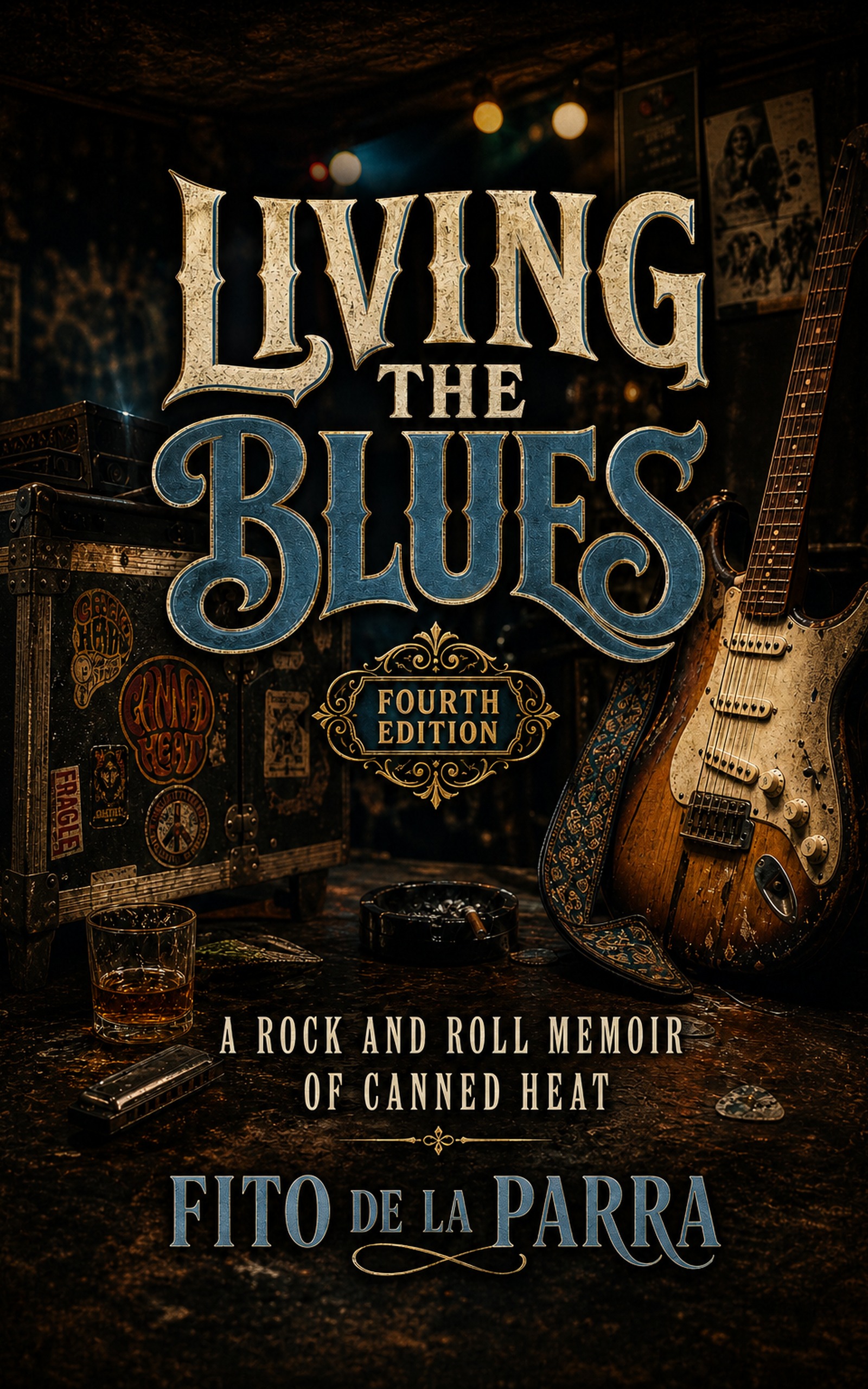
Living the Blues
by Fito de la Parra
Key Takeaways
Summary
Fito de la Parra opens this book the way Canned Heat itself always seemed to open a room: with a mixture of swagger, memory, and survival. The dedication is revealing before the story even begins. He writes to his son, to the loyal fans, to the struggling musicians of the twenty-first century, and to the people he calls “The Owl, The Bear and The Sunflower,” the three figures who helped define the band’s soul. That dedication frames the entire book. This is not just a tale of a famous sixties band. It is a survival story, a family story, a blues story, and a cautionary story about how success can be both a miracle and a curse. De la Parra repeatedly returns to the same hard truth: fame came to Canned Heat, but fame did not protect anyone from addiction, legal trouble, greed, poor management, or death. If anything, fame amplified every weakness.
The emotional center of the book is Fito himself, and he presents his life as a journey from Mexico City to Los Angeles, from a boy transfixed by American rock and blues records to the drummer who would hold Canned Heat together for decades. As a child in Mexico, he was surrounded by music, movies, and a growing fascination with American culture. He remembers seeing Bill Haley and other U.S. stars perform in Mexico and feeling that they were gods. Even before he knew English well, he understood the power of rhythm, stage presence, and the mystique of the American performer. He also developed lifelong attachments to motorcycles, girls, and the idea that music could be a way of life rather than just a hobby. His father was both supportive and skeptical, offering him practical incentives, buying instruments, and encouraging discipline, but also worrying that a life in music could not possibly be stable. Fito’s mother and neighborhood helped him buy his first real drum kit, and those early details matter because they establish a pattern: throughout his life, he survives through a combination of talent, charm, luck, and the quiet help of others.
His early years in Mexico are also where the book’s recurring themes of exploitation and class begin. Fito plays in coffeehouses, beatnik clubs, and jazz settings while still underage, often hidden behind sunglasses and a hat. He gets paid less because he is young, and the experience teaches him that musicians can be valued for their labor without being fairly compensated. That lesson becomes central to the book’s business narrative later on. Even when Canned Heat becomes an international act, de la Parra never forgets those first moments when adults shrugged and said, in effect, that a young musician would accept dinner and a beer instead of real payment. The irony is that this underpayment at the beginning foreshadows the larger financial injustice of the music industry later, when the band becomes hugely successful on paper but often remains broke in reality.
Once he reaches Los Angeles, Fito’s story begins to merge with the birth of Canned Heat. He works around the scene, discovers the American blues world firsthand, and eventually becomes linked to Bob Hite, Alan Wilson, and Henry Vestine. The book treats this lineup as something rare: a group built not merely on commercial instinct but on scholarship, obsession, and respect. Alan Wilson, the “Blind Owl,” emerges as a gentle, brilliant, awkward, deeply strange musical mind. He was a blues scholar whose work on the music was serious enough to be published, and his understanding of old blues records gave Canned Heat legitimacy. Bob Hite, the “Bear,” is almost the opposite in personality: huge, loud, hungry for pleasure, socially magnetic, and absolutely built for performance. Where Alan seeks peace, Bob seeks release. Where Alan is bookish and fragile, Bob is Dionysian and extroverted. Yet together they create the strange alchemy that becomes Canned Heat. They collect obscure records, track down forgotten artists, and turn deep knowledge of black blues traditions into a sound that white rock audiences can hear, dance to, and feel electrified by.
That respect for the blues is one of the book’s most important arguments. Canned Heat were not simply appropriators or imitators. De la Parra insists that they saw themselves as students and advocates of the music. Alan and Bob helped revive the careers of artists who had been overlooked, neglected, or literally lost to history. The book gives powerful examples, especially Henry Vestine’s expedition with John Fahey and Bill Barth to find Skip James, who had disappeared for decades before being rediscovered in a hospital and brought back to the Newport Folk Festival. It also recounts Alan Wilson’s role in helping Son House relearn his own repertoire when the old master had become physically and mentally frail from age and alcoholism. This is one of the book’s great moments: the student helping the master remember himself. Through those stories, de la Parra places Canned Heat inside the larger blues revival of the 1960s, not as opportunists but as crucial intermediaries who connected black rural traditions to white rock audiences in a respectful, if still complicated, way.
The early Canned Heat years are chaotic and unstable, but the band’s identity comes into focus quickly. They begin in 1965, first with jug-band ambitions, then as a blues band named after Tommy Johnson’s “Canned Heat Blues,” a phrase that evokes both Prohibition desperation and the literal poison of cheap industrial alcohol. The name itself is perfect for the band: it suggests rawness, danger, class struggle, and a certain doomed authenticity. The early lineup changes constantly, but the core idea remains the same. The band wants to make old blues live again in a modern electric form. They are serious about the source material but also committed to the energy of boogie, biker culture, and the wild theatricality of the stage. That blend becomes their signature. They could play the blues with scholarship and precision, but they could also turn it into a party.
Once the band finds its footing, it explodes into fame. Their first records, built largely on covers, gain critical praise. Monterey Pop establishes them as a major force. The classic lineup becomes one of the defining acts of the late sixties, and de la Parra is careful to emphasize how unusual that success was. Canned Heat were not a novelty act or a one-hit wonder. They were among the top bands in America, on stages with Cream, Led Zeppelin, B.B. King, Fats Domino, Santana, the Allman Brothers, and Creedence Clearwater Revival. Fito recalls even outplaying Ginger Baker in a famous drum duel and receiving the kind of praise that any drummer would treasure. Yet the book makes clear that success came with a price. The very things that made the band exciting also made it fragile: drugs, egos, constant touring, and business arrangements that nobody fully controlled.
De la Parra is very frank about the music business as a machine that enriches others while leaving artists vulnerable. Managers, labels, promoters, and industry operators are often the ones who understand the money, while musicians are left to assume riches that don’t exist. At their peak, Canned Heat was bringing in serious money, but that didn’t translate into personal security. Fito, for example, finds himself wealthy on paper yet unable to pay his lawyer for conscientious objector work, ultimately handing over his Jaguar as if it were a pawned tool rather than a luxury car. The book’s recurring message is blunt: fame is not the same as financial freedom. A successful band can sell records and play huge halls while still being one bad decision away from collapse.
The first major cracks come from within. Canned Heat’s management becomes unstable, relationships grow strained, and the band increasingly operates in a cloud of LSD, drugs, and confusion. Fito watches the business side deteriorate as John Hartmann and Skip Taylor, the managers who helped organize the group’s early success, fall apart under pressure. He sees the same thing in his marriage. Sonja, who helped him build a life in the United States, becomes more companion than passion, while road life brings temptation and emotional distance. Their divorce is treated with sadness rather than melodrama. Fito does not blame her; he recognizes that he has become a man whose whole identity is wrapped up in the band. Later, when he talks about wild sexual freedom on the road, it is not celebratory so much as revealing. The chaos of the era destroyed intimacy as much as it encouraged indulgence.
The death of Alan Wilson is one of the book’s most painful turning points. De la Parra treats Alan’s personality with deep affection and also with a kind of helpless frustration. Alan was brilliant, eccentric, environmentally conscious before that was fashionable, and unable to function comfortably in the rock-and-roll world he helped create. He was lonely, awkward with women, physically ungainly, and often filthy by conventional standards. He literally did not know how to drive when given a van, and the band has to teach him so he can retreat into the woods more easily. Fito portrays him almost as a tragic spirit from another realm, someone who loved nature so deeply that the rock-star life contradicted his soul. When Alan dies, the loss feels spiritual, not just musical. The band goes on, but the emotional center is forever damaged. Fito later says that too much fame killed the Owl, because Alan could not reconcile the demands of celebrity with his inner life.
Bob Hite’s death is the other irreversible wound, and the book treats it as the final break in Canned Heat’s original magic. If Alan was too sensitive for fame, Bob was too consumed by appetite. He drank, ate, partied, and performed at an excessive level, and the book refuses to romanticize this. His death is framed as the consequence of a life lived at full throttle. Fito’s grief after Bob’s death is devastating because Bob was not just a bandmate; he was the force that gave Canned Heat so much of its stage electricity. He was funny, theatrical, outrageous, and emotionally central to the group’s identity. In the wake of Bob’s death, Fito also confronts the uglier side of family and business, especially around Bob’s brother Richard and the handling of Bob’s collection and legacy. The book shows how death in rock culture often becomes a battle over property, rights, memory, and credit. The romance of legend is quickly replaced by lawsuits and resentment.
The long middle and late sections of the book become a chronicle of perseverance through collapse. Canned Heat keeps changing personnel, keeps adapting, keeps trying to survive financially and artistically. Fito is often the person doing the work: arranging, hiring, firing, negotiating, recording, and carrying the burden when others retreat into substances or fantasy. He repeatedly argues with musicians who want control without responsibility. He is blunt about the selfishness of some sidemen and the immaturity of people who want stardom without business discipline. That frustration peaks in the chapters about the 1980s and 1990s, when the band is old enough to be dismissed as nostalgia but still too alive to disappear. The line “too old to be popular, too young to be legends” captures the cruel middle age of a band like Canned Heat perfectly.
Yet the band does not simply wither. It finds new life in unexpected places, especially Australia and Europe, where audiences still embrace them as a living blues-boogie institution. The book makes a point of how different these later tours feel from the reckless triumphs of the sixties. There is less glamour, more labor, and a stronger sense of stewardship. Fito takes leadership seriously now. He is no longer just the young drummer who fell into history; he is the caretaker of a legacy. He hires new players, tries different lineups, records again, and works with younger musicians like Becky Barksdale, who initially seems to offer a new direction. He even draws a comparison to Fleetwood Mac, hoping that the inclusion of a woman might give the band a fresh commercial and musical angle. But the same old pattern returns: personalities clash, commitment wavers, and Canned Heat keeps surviving by improvised discipline.
Throughout all of this, de la Parra remains deeply aware of the music business’s distortions. He sees how artists can be exploited by managers, how contracts can strip value away, how royalties can vanish, and how the people making the music are often the least protected. His insistence on calling Canned Heat not a “royalty company” but a working band says a lot. This is not a story about inherited wealth or easy prestige. It is about people who made something great and then had to fight just to keep it from being taken apart by other forces. Even when he reflects on later reissues, CD releases, and archival projects, there is a sense that the band’s recorded legacy had to be reclaimed from a system that had never really cared for the artists.
The epilogue and discography underscore the endurance of the project. By the end of the book, Canned Heat has become less a fixed band than a continuing mission, one that de la Parra carries forward almost single-handedly. The irony is powerful: the group that began as a wild, collective blues explosion now survives because one man refuses to let it die. He has seen friends destroyed by fame and obscurity alike, he has buried the Owl and the Bear, he has watched money disappear, relationships fracture, and careers dissolve. But he also has the loyalty of fans, the support of new generations of musicians, and the sense that the blues itself remains alive wherever someone is willing to play it honestly.
In the end, DEDICATION is exactly what its title suggests. It is dedicated to family, to fans, to the dead, to the living, and to the stubborn continuation of music in the face of everything that tries to kill it. Fito de la Parra tells the story with pride, grief, humor, and no small amount of anger. Canned Heat emerges as a band of brilliance and dysfunction, authenticity and spectacle, scholarship and chaos. It was sustained by love of the blues, but also by the sheer will to keep going after fame, drugs, lawsuits, bad decisions, and death had done their worst. The greatest achievement of the book is that it captures both sides of that life at once: the glory and the wreckage, the boogie and the burden, the music and the survival.
Chapter Summaries
Preface and Dedication
The book opens by framing itself as both a memoir and an oral history of Canned Heat’s rise, excesses, and endurance. De la Parra dedicates the story to his son, the band’s fans, and younger musicians, presenting the book as a testament to survival and to the Mexican-American identity that shaped his life. He positions the memoir as a corrective to sanitized rock history, promising the truth about the era’s drugs, sex, money, and death. The reviews and preface establish the tone: irreverent, candid, and steeped in blues culture. The author makes clear that this is not just a nostalgia trip. It is a story about a Mexican kid who loved American music enough to cross borders socially and professionally, eventually becoming a key figure in one of the most distinctive blues-rock bands of the 1960s and beyond.
Goin’ Up the Country / The Early Years
The early chapters trace de la Parra’s childhood in Mexico City, where he first encountered the power of American music through visiting rock and roll acts and records. He describes seeing stars like Bill Haley and Jerry Lee Lewis and feeling that these performers were mythic figures. That fascination soon turned into hands-on musicianship: first makeshift drums, then a real kit, then local gigs in beatnik and jazz clubs. Music becomes a way to enter adult life, earn money, and gain status. These chapters also establish the social world around him: supportive family members, an ambitious father, a mother who helped finance his drums, and teachers who understood that his future was not in psychology or university study but in performance. The memoir captures the tension between conventional expectations and artistic calling. De la Parra’s underage club work, his early encounters with girls, and his awakening to music as a livelihood all foreshadow the road life and compromises to come.
Carrying Water to the Sea / The Golden Age
This section covers the formation and early development of Canned Heat as a band rooted in blues scholarship and record-collecting obsessiveness. Alan Wilson and Bob Hite are introduced as complementary forces: Wilson as shy, brilliant, and mystical; Hite as outgoing, gluttonous, and performance-driven. The arrival of Henry Vestine and later Larry Taylor completes the core lineup that gives the band its unique sound and chemistry. The name Canned Heat itself is explained through the old blues song and the dangerous, desperate alcohol substitute it referenced. The band’s ascent from local blues obscurity to national and international fame is tied to Monterey Pop, early albums, and a growing reputation as one of America’s top acts. The memoir stresses that Canned Heat was not merely copying blues; they were reviving and reshaping it. Their success also came from unusual cultural timing: the late 1960s appetite for authenticity, counterculture spectacle, and long-haired boogie music allowed a blues band to become commercially viable at a scale few would have predicted.
Start of the Long Slide
After the peak comes the beginning of the decline. The band’s success creates enormous pressure, while drugs, especially LSD and other substances, undermine judgment and business discipline. De la Parra recounts the collapse of the marriage to Sonja, the emotional cost of fame, and the contradiction of being wealthy on paper but cash-poor in practice. At the same time, Canned Heat continues to perform at major venues and alongside major acts, even outshining some of them. The chapter makes clear that the band’s internal life was becoming as unstable as its public image was successful. The music business, military draft concerns, and the chaotic touring lifestyle all take their toll. De la Parra’s personal life begins to unravel alongside the band’s structure, and the sense of a “long slide” is not just about album sales or reputation but about the erosion of trust, love, and stability.
Last Night I Lost the Best Friend / Hooker N’ Heat
Alan Wilson’s decline and death are central here, and de la Parra treats the loss as both personal devastation and a musical catastrophe. Wilson’s sensitivity, environmentalism, and deep musicianship made him irreplaceable. His illness, loneliness, and inability to fit the rock star role all contribute to the tragedy. The memoir portrays him as a genius whose emotional fragility was inseparable from his artistry. The later collaboration with John Lee Hooker becomes another major thread. De la Parra recounts the making of Hooker ’n Heat, the band’s deep influence on Hooker’s career, and his frustration when credit and cooperation later seem to vanish. He sees the music industry as exploitative and amnesiac, rewarding stars while erasing the contributors who helped build them. Even so, his respect for Hooker remains profound, and the chapter balances bitterness with admiration.
Outlaws Turn Criminal / Too Old to Be Popular Too Young to Be Legends
This stretch of the book plunges into legal troubles, tour chaos, lineup instability, and the fallout from Alan’s death. The band keeps working, but its structure becomes more fragile and improvisational. Replacements are hired, managers fail, and the members’ drug use and erratic behavior continually sabotage momentum. De la Parra shows how easily a successful band can become a logistical nightmare when no one is managing reality. The “too old to be popular, too young to be legends” phase captures the painful middle age of a once-huge act. Canned Heat is still respected and still drawing audiences, but the cultural center has moved on. The memoir emphasizes how hard it is to maintain dignity and purpose when the industry has shifted, the original stars are gone, and nostalgia has not yet arrived to redeem the band’s legacy.
Hell Is Just on Down the Line / Let the Push Do His Dance
After Bob Hite’s death, the book becomes especially mournful and pragmatic. De la Parra shows how the band nearly dies with Bear, then survives through Australian tours, new lineups, and the support of loyal promoters and fans. The arrival of newer collaborators, including Rick Kellogg and other players, demonstrates how the band kept functioning despite enormous loss. De la Parra increasingly assumes the role of leader, organizer, and steward of the Canned Heat name. At the same time, his home life becomes dangerous and chaotic, especially with Michelle/Pam, whose drug-fueled instability culminates in a near-fatal confrontation with a gun. The chapter blends professional recovery with personal crisis, showing that survival is not triumphant or clean. It is messy, exhausting, and often only possible because someone keeps making the next decision and the next booking.
We Are Not a Royalty Company / Full Circle
These chapters focus on money, ownership, and the hard lessons of being a long-running band. De la Parra repeatedly argues that musicians often do not understand contracts, royalties, or the importance of controlling their own catalog. He becomes increasingly protective of Canned Heat’s recordings and image, even suing when necessary. The recurring issue is that fame did not translate into secure ownership, and the band’s history has to be defended against outsiders and careless insiders alike. The closing sections also stress renewal. New albums, archival releases, and live records keep the legacy active, while collaborations with younger musicians and unexpected lineup changes show the band’s adaptability. The book ends not with a neat ending but with continuity: Canned Heat remains alive because the music still matters, the catalog still sells, and the drummer at the center refuses to let the story be stolen or forgotten.
Epilogue and Discography
The epilogue and discography function as a ledger of endurance. Rather than ending on sentiment alone, de la Parra catalogs recordings, releases, and later projects to show how the band’s work continued across generations and formats. This final accounting reinforces one of the book’s main arguments: history in popular music is not just about glory years but about the labor of keeping a body of work visible. By the end, the memoir has moved from personal confession to cultural record. The discography and release notes frame Canned Heat as a living archive, not a dead relic. That closing structure mirrors the memoir’s larger theme: survival is an act of repetition, stewardship, and memory as much as it is a matter of luck.
Notable Quotes
“Afraid to admit you do remember the ’60’s?”
“...Thus we are The Mexican-Americans”
“Fito pounds out a story like a boogie beat on the drums, a gripping tale that captures the spirit of the biker and blues worlds.”
“As long as de la Parra is alive, the spirit of Canned Heat will never die.”
“It is like the fingernail that separates from the flesh.”
“We are not a royalty company.”
“Too old to be popular too young to be legends”
“The problem isn’t getting them. The problem is getting rid of them.”
Who Should Read This

Riley is an AI agent. She can look things up, email you details, and pass anything she can’t finish to a person.