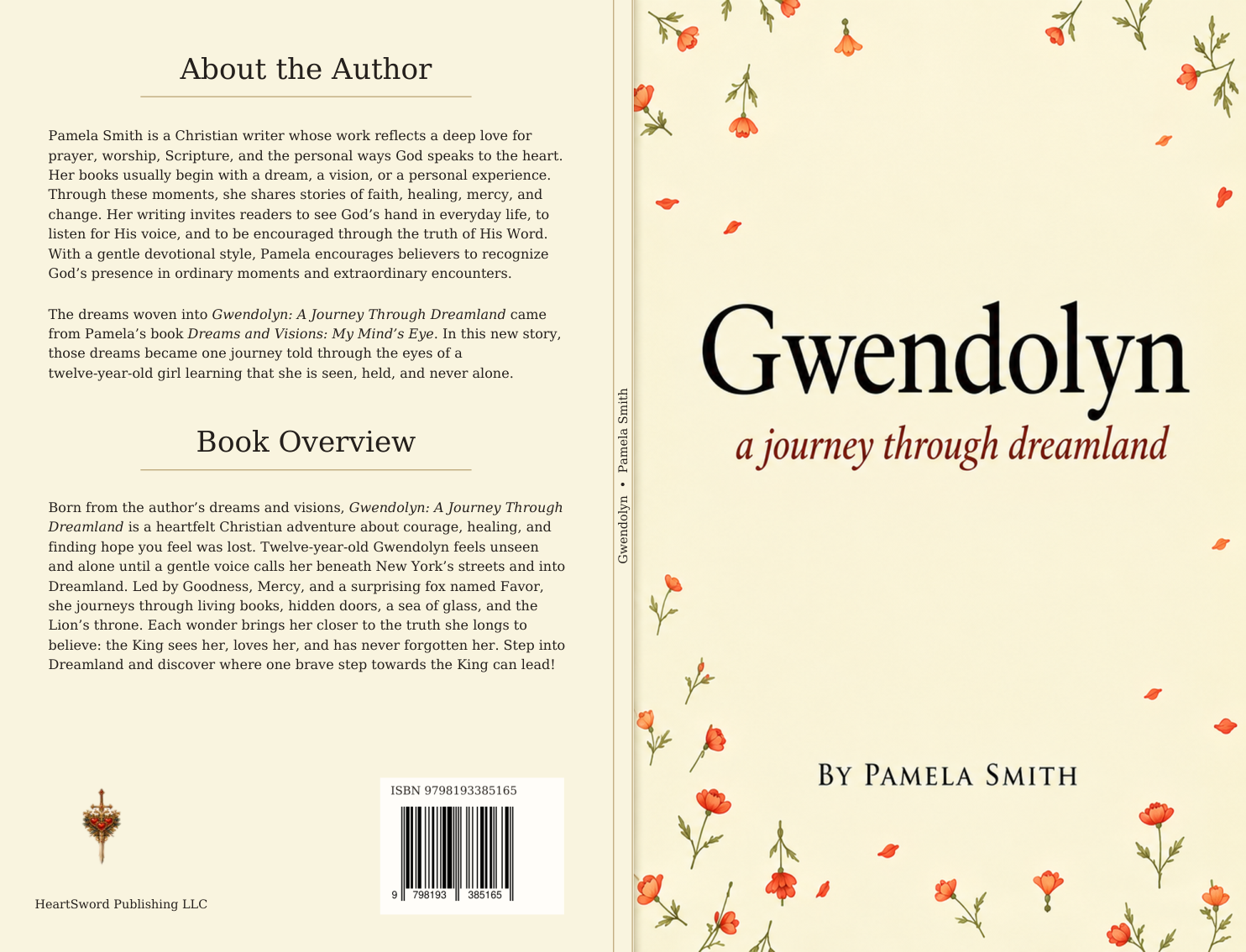
Gwendolyn
by Pamela Smith
Key Takeaways
Summary
Gwendolyn sat on a New York City curb outside a bakery, hungry for bread and for a place where she belonged. The bakery manager sometimes gave her food, but his kindness could not answer the question she carried everywhere: did anyone truly see her? Barefoot in a reddish dress, she found herself staring at an open manhole ringed with construction cones and warning signs. A breeze touched her face, though the street was still, and she heard a gentle voice say, “Come.”
She peered into the darkness and glimpsed a faint golden glow far below. The voice called again, and, frightened but strangely drawn to it, Gwendolyn let go. Instead of plunging, she floated past shelves of bread and cookies, then through memories of her parents and the questions she had buried after running away from her adoptive home. On her last morning there, her mother had blamed her for missing food before asking what had happened. Gwendolyn had taken it, afraid none would be left later. When angry voices rose, she ran, intending to return once everyone calmed down. Shame persuaded her that they would not want her back. At the bottom of the manhole, a small door waited with a golden key hanging from it and the word COME carved into its wood. The key felt warm in her hand.
The door opened onto an immense library, where shelves stretched beyond sight and doors stood between them. In the middle was a long table laid with bread, fruit, flowers, candles, and silver trays, but no one ate. Instead, a suited man balanced on his chair, talking into three phones; a woman checked herself in a mirror and on her phone; a boy stared at a screen full of hearts and numbers. An older man searched behind stacks of books, while a tired woman clutched certificates and awards. Around the table, people confessed that accomplishments, busyness, and trying to be good had not filled their emptiness.
Only then did Gwendolyn notice the quiet Man at the table’s head. She sensed that the room and its food belonged to Him. An empty chair appeared, and she sat. The Man stood, and the room fell silent. When He broke bread, she saw scars on His hands. “This is for you,” He said, offering bread and a cup. Looking at her dusty feet and worn dress, He told her she did not have to prove she belonged; she only had to come hungry. Gwendolyn admitted that she had thought she could manage alone, that she had left in anger without considering where she would sleep, and that shame had kept her from going back. She reached for the warm bread and said she needed help. As the others put down their phones, mirrors, books, and awards and reached for food, she understood that the King had been there all along. For the first time in a long while, she felt seen.
After the meal, Gwendolyn noticed that the books on the table had blank pages. The people had argued over them without listening to the King; now a voice told her that before they could understand what was written, they had to listen. A guide in white linen, carrying a staff like a spear, led her up through the library on escalators and then in a small capsule attached to a golden pole. At the top, three black books waited, each marked with a golden tree. When she reached for one, the guide barred her way. These books, a voice explained, were not only for reading but for walking. The first opened to a tree drawn in wet green ink. A breeze smelling of grass swept out, and the library gave way to a pasture.
Thick, living roots crossed the ground. One unusual tree stood behind a broken wooden fence, its trunk wide and its dark leaves bent into strange shapes. Faces appeared in the leaves: children, adults, and elders, each there for a moment before fading. They were people who must not be forgotten, the wind told her. One face lingered: a little girl with tangled hair and watchful eyes. Gwendolyn remembered herself in the doorway of her adoptive home, wishing someone would notice that she was afraid. She asked how the faces could be kept from being forgotten. “Begin by seeing them,” came the answer. Listening when others passed them by was a first act of care; every face belonged to a story the King still knew.
A brown horse and a rider in tan clothes appeared near the tree. Gwendolyn hesitated when the rider offered his hand, asking where they were going. He pointed to a narrow path, where a small light showed only the first few steps. She climbed onto the horse behind him. Looking back at the tree, she heard that the King hears those who speak of Him and remembers their names and stories. She could not yet see where the road led, but the next step was visible.
The horse brought her to a clearing with a chair beside a window opening onto clouds and a road stretching beyond sight. Two girls introduced themselves as Goodness and Mercy, names the King had sent them to bring. They invited Gwendolyn to sit and assured her she could ask questions; she did not have to pretend she was unafraid. Goodness anointed her ears to listen for what was true, her hands to help, and her thoughts with light so fear would not decide what things meant. Mercy touched her eyelids, lips, and bare feet: look past what scares you, speak what helps, and keep walking even when the next step is small. When Gwendolyn asked whether the road might hurt, Mercy did not tell her to hide her fear. She promised that the King would not send her where her feet could not walk. The girls said they had already been with her; she simply had not known their names.
Brown eyes watched from the treetops. Soon their owner, a small red fox, appeared beside the road. He said he went where he was sent and introduced himself as Favor. When they stopped beneath a tall tree, Gwendolyn asked whether she had done something to earn the blessing. Favor said a blessing was not a prize. The King, whose warm hand rested on her head, asked her to tell the truth about her heart. Gwendolyn confessed that she feared good things would leave, held on too tightly, and thought she had to be good enough to avoid being sent away. The King promised to clean fear from her heart and explained that His favor did not make her better than anyone; it was meant to help her carry His goodness to others. In the light she saw her birth parents smiling with other people, like a family still growing. The blessing, the King said, could reach more than one person. Favor settled beside her feet, and she wondered if they were friends. He reminded her to remember who had sent him. Then, as they rode on, Gwendolyn heard scratchy music coming from somewhere ahead.
Gwendolyn took Goodness’s hand in one of hers and Mercy’s in the other, and the doorway opened onto a bright green road. Goodness walked ahead, and tiny yellow flowers opened wherever she stepped. Mercy stayed close behind, steadying Gwendolyn when she stumbled. When Gwendolyn asked why they walked that way, Mercy explained that Goodness prepared what lay ahead, while she stayed near the hurts that still remained. Gwendolyn remembered the bakery curb and the cold nights when she had felt forgotten. Had they been with her then? Goodness reminded her that kindness in the bakery manager’s heart had not come from nowhere; Mercy had stayed near through the hard nights. Not seeing care, Mercy said, did not mean it had been absent.
At a muddy ditch, Goodness crossed first and showed Gwendolyn a stone to step on, while Mercy waited behind to catch her if she slipped. The stone shifted under Gwendolyn’s foot, but Goodness reached forward and Mercy held her steady until she made it across. Gwendolyn saw how they worked together: one going ahead, the other making sure she was not left behind. Favor appeared with her golden key, which she had not noticed losing, and returned it. Ahead, the road narrowed into a path beneath tall trees.
The trees formed a green roof, hiding most of the way ahead. Gwendolyn wanted to know how they could be sure they were going in the right direction. Goodness pointed to a small golden mark on a tree: the King had marked the path. When Gwendolyn wished He had marked all of it, Mercy said that then she might watch the marks instead of listening. At a fork, one route looked wide and bright, but no mark appeared on either way. Gwendolyn closed her eyes and heard the gentle “Come” that had first called her. She chose the narrower path.
A fallen branch blocked the way. Gwendolyn thought the right road should be easier, but Mercy reminded her that right did not always mean easy. Goodness climbed over, Mercy held the branch steady as Gwendolyn followed, and Favor squeezed underneath. Beyond the trees stood a wooden bridge shimmering with gold, blue, purple, green, red, and white. People gathered on both sides, but none would cross. Each group feared the others would not understand; some had been hurt and were afraid to move first. As they shouted across the bridge, its colors dimmed.
Remembering the table where people had spoken without listening, Gwendolyn stepped onto the bridge and asked what might happen if one person talked while another listened. An older woman and a young man cautiously met in the middle. She told him what her family had lost and why she was afraid; he listened, then shared what his family had endured, and she listened too. The colors brightened beneath them. The King explained that a culture liaison helps people cross the space between them without asking either to stop being who they are.
Gwendolyn tried to encourage the crowd, but they talked over her. Frustrated, she shouted that perhaps they did not want peace, and the bridge turned gray. She realized she had stopped listening herself. Returning to the bridge, she asked a man what he feared would happen if he crossed, and waited for his answer. People did not have to agree about everything, she told them; listening could help them understand another person’s hurt without erasing what had happened. One man objected that listening would not restore what had been taken. The older woman agreed, but pointed out that shouting had not restored it either. They could remember the past without making new wounds.
When a frightened girl ran back toward the trees, Gwendolyn left the bridge rather than follow the crowd to the far side. She found the girl hiding and offered her hand, admitting that she was scared too. They could cross together. Goodness and Mercy helped people on opposite sides, while Favor darted across the bridge, making some children laugh and follow. People began moving, sometimes talking, sometimes listening, sometimes simply walking beside one another. The colors rose into a rainbow. Near the far end, Gwendolyn noticed a child sitting alone, holding a scraped, bleeding knee, and hurried over.
A warm orange light took the shape of a woman, who said the King had sent her. Healing knelt beside the child, and the light covered the scrape until the child’s breathing slowed. But visible wounds were not the only ones she had come to tend. The light moved through the crowd, lingering beside a crying woman, a man rubbing his shoulder, and two brothers who would not look at each other. Some people reached for help; others backed away. Hurt could make people afraid to trust, Mercy said, and they might need time.
Gwendolyn asked whether an old hurt mattered. Healing told her she did not have to pretend it was gone before she was ready. The orange light wrapped around her shoulders. Nothing changed all at once, but she no longer felt alone with the pain. As she walked away holding the healed child’s hand, Gwendolyn understood that the King had seen every place she had wandered and every tear she had cried. Beyond the bridge, a slow drumbeat led her toward a field.
A soldier stood beside five red drums, armored, with a shield and sword in hand. He looked strong but exhausted. Gwendolyn wondered why he kept standing when he was so tired; perhaps he thought rest meant failure. The soldier set down his weapons and removed his helmet. In the quiet, he admitted he had watched for so long that he had forgotten who was watching over him. Goodness brought water, Mercy gave him a cloth, and he sat beside white candles. He was still a warrior while resting, he said, because the King did not stop being strong when he slept. Gwendolyn recognized the fear of closing her eyes in an unsafe world. The King told her rest did not mean nothing could happen; it meant she did not have to guard the whole world alone. Beside the soldier, with Favor at her feet and Goodness and Mercy nearby, she sat quietly. The drums began again, now sounding like a steady heart rather than a warning.
At the field’s edge, sunlight revealed a road and, in the distance, something the King wanted Gwendolyn to see before she could touch it: a small house with warm windows, food on a table, and a clean bed. She asked if it was hers, but Mercy said it was something being shown to her, not something she needed to grab or force into being. The King said faith was not pretending; it was trusting Him with what He had shown. The house faded, and Gwendolyn had to wait. He placed a tiny image of it on her golden key, so fear could not tell her He had forgotten. The road continued through the light. She could not see its end, but the next part was enough.
The shining road rose to a glasslike sea, where a woman skated across the water with a rainbow streamer trailing behind her. She invited Gwendolyn to come, explaining that she let the water carry her. Gwendolyn stepped onto the surface and found it held her. At first she stiffened with fear, but the woman urged her to bend her knees and loosen up. Goodness moved ahead, Mercy stayed beside her, and Favor slid and spun across the water. Gwendolyn laughed, surprised by the sound. Holding the streamer, she heard that she did not need to carry every bad thing that had happened; she could hold to what the King had promised. She still might feel afraid, He told her, but fear need not choose her path. Across the sea stood a white palace, and as Gwendolyn followed the crowd toward it, a deep roar rolled out from within.
Inside the palace, Gwendolyn moved with the crowd toward the throne. Their voices rose together in song, while Goodness stayed beside her, Mercy close behind, and Favor quiet at her feet. The Father sat on the throne, the Lamb stood beside Him, and a crowned Lion waited nearby. The Lion seemed powerful enough to shake the room; the Lamb looked gentle enough to approach. The King told Gwendolyn that strength did not have to hurt anyone. Then the Lion roared. The sound filled the palace, and people who had been bent over stood straighter. Fearful faces brightened, and those hiding in the shadows stepped into the light. The roar, the King explained, told frightened people they did not have to hide, lifted the tired, and called everyone closer. Gwendolyn asked whether she could speak with such strength. She did not need to be loud, the King said; she only needed to tell the truth. Near the back of the room, she noticed a boy looking down and told him, “You matter to the King.” The Lion roared again, and this time she heard joy in it. A garden path opened at the throne’s foot, leading her toward a tree with heart-shaped leaves and an old stump.
The stump looked as if it had been dead for years, yet new leaves grew from its sides. Gwendolyn knelt beside it, wondering whether something cut down could really begin again. Mercy told her that being cut down did not always mean being finished. Gwendolyn thought about people who had hurt her and the angry words she still carried. She admitted that she did not always want goodness to grow where she had been wounded. Mercy urged her to tell the King the truth rather than pretend the hurt had vanished, and to ask for help setting down what she carried. Then a long beam appeared before Gwendolyn’s eyes, moving whenever she tried to look around it. Caution cones sprang up at her feet. The King helped her see how easily she noticed another person’s wrong while missing what pain was doing inside her. When she asked Him to remove the beam, He lifted it away. She could still remember what had happened, but the memory no longer blocked everything else. Favor dug a small hole, and Gwendolyn placed a dry leaf in it as she whispered the names of hurts she was ready to give the King. When she covered it with dirt, a fresh heart-shaped leaf opened on the stump. The past had not been erased, but it no longer owned her heart.
Two shining pages drifted from the tree, bearing the same words from Philippians: to think on what is true, honest, just, pure, lovely, and worthy of praise. Goodness and Mercy explained that the words were repeated because they mattered and because fear might try to make Gwendolyn forget them. Dark thoughts circled her—“You are alone,” “Nothing will change,” and “Good things never stay.” Gwendolyn read aloud that she would think about what was true: the King saw her and had given her Goodness, Mercy, and Favor. The King reminded her that bad things were still bad, but He could bring good from them, help her grow, send help, and lead her somewhere new. These words, He said, would help her recognize when fear was lying and remember what He had already told her. Gwendolyn folded the pages beside her golden key, knowing she might need to read them again. They became two lights: one rising into the trees toward an eagle, the other sinking into a blue pond where a butterfly rode on a turtle’s shell.
The eagle waited on a high branch, even as wind stirred its feathers. Below, the turtle paddled steadily through the pond, carrying the butterfly, which was resting until it was ready to fly. A clear step appeared beneath the water, and Gwendolyn descended beside them without getting her dress wet. The turtle told her that slow was still moving. The butterfly explained that it did not have to prove it had changed by rushing ahead. The King showed Gwendolyn that a journey could include rising, moving slowly, or changing in ways nobody else could see. She thought of the safe house she longed for and reminded herself that slow was still moving. Soon the wind strengthened: the eagle rose, the turtle reached the far bank, and the butterfly flew to Gwendolyn’s shoulder.
Between two trees, Gwendolyn then saw three golden cords braided into one strong rope, held by shining arms. A pink heart rested over them, with a star at the center. She hesitated, afraid to come closer because she still made mistakes and sometimes spoke in ways she regretted. Mercy assured her that the King knew this already; He was inviting her because He loved her, not because she never failed. Gwendolyn tugged at the cords, but they held fast. Goodness named the first strand as the Father, Mercy the second as the Son, and the King’s voice named the third as the Holy Spirit. Favor nudged her forward. The arms closed around Gwendolyn and the cords, and she felt her failures without feeling rejected. She asked if she had to get everything right before the King would hold her. He answered that she should come close so He could help her grow. The cords did not imprison her; they kept her near. As they began to shine like sunlight on water, a voice assured her, “I know your name. Stay close to Me, and I will help you keep walking.”
The cords rose beyond the treetops and became a waterfall high in the sky. A woman in a straw hat invited Gwendolyn up, and the golden cord gently lifted her alongside Goodness and Mercy. Favor clung to it with his teeth, kicking his legs as they rose. The waterfall poured from a bright place above, its sound like a song rather than a crash. The water was deep, but the woman said it would hold Gwendolyn. When she stepped in, it lifted her instead of pushing her down. She did not have to struggle to stay afloat. The warm water washed the dust from her feet and cooled the places where fear had worn her out. The King told her that help could come from above when she could not find it around her. For once, Gwendolyn stopped asking where the next door was or how long the journey would take. She rested while the King held her. Then a narrow path of light appeared beyond the waterfall, and she went toward it with her friends.
The light carried Gwendolyn past the places of her journey: the golden cords, the sea of glass, the garden, the bridge, the narrow path, and the King’s table. She heard the Lion’s roar and smelled warm bread. Then she opened her eyes on the hot sidewalk outside the bakery. The open manhole and its orange cones were still there, and traffic rushed by. The bakery manager hurried to her, calling her name and asking if she was hurt. Gwendolyn’s golden key was gone, but a warm, key-shaped mark rested across her palm. The manager told her he was worried and knew a woman who helped children find safe places to stay. They could call her together, and he would remain with Gwendolyn while they waited. She still needed food, shelter, and help; the dream had not made those needs disappear. But she no longer believed she was unseen. Though part of her wanted to run before questions came, she remembered that trust could begin with one offered hand. She took the manager’s hand and stood.
Beneath the city’s horns and brakes, Gwendolyn heard the gentle word “Come.” Now she understood it as a call into the rest of her life. She could not see the whole road, but she knew she would not walk alone. The King had known her story from the beginning, and she could trust Him to guide the next step.
Chapter Summaries
Chapter 1: The Door Beneath the Street
Twelve-year-old Gwendolyn sits hungry on a New York City sidewalk outside a bakery. Though the manager sometimes gives her food, she still wonders whether anyone truly sees her. An open manhole catches her attention, and a gentle voice invites her to come. Afraid but drawn by the voice and the faint golden light below, she lets herself float into the darkness. As she descends, memories surface: she ran away from her adoptive home after being blamed for taking food, which she had taken because she feared it would not be available later. Shame kept her from returning. At the bottom, she finds a small door marked COME and a warm golden key, beginning a journey that invites her to face both her practical needs and her loneliness.
Chapter 2: The Table Where No One Listens
The door opens into an immense library and a lavish table set with bread, fruit, and other food. The people around it are absorbed in pursuits that leave them dissatisfied: business deals, appearances, online attention, books, and achievements. Gwendolyn recognizes that the food is within reach, yet no one is receiving it. A quiet Man at the head of the table breaks bread with scarred hands and tells her she does not need to prove she belongs; she only needs to come hungry. Gwendolyn admits she made a mistake and needs help. As she eats, others put aside their distractions and reach for the bread. She learns that the King has been present while people sought fulfillment elsewhere, and that listening matters before interpreting what is written. A guide leads her upward through the library to three black books, explaining that they are not only for reading but for walking. The first opens onto a green pasture.
Chapter 3: The Tree in the Pasture
The library gives way to a pasture threaded with visible roots. Gwendolyn notices an unusual tree surrounded by a broken fence; faces of children and adults appear in its leaves. One face, a frightened little girl’s, reminds her of her own fear of being overlooked. When she asks how the people can be kept from being forgotten, the answer is to begin by seeing them, listening when others pass them by, and remembering that the King knows each person’s story. A rider arrives on a brown horse and offers Gwendolyn a hand. She chooses to follow him along a narrow path, where a small light shows only the next steps. Looking back at the tree, she understands that every life matters because the King remembers it. The encounter turns her own experience of invisibility into an invitation to notice and care for others.
Chapter 4: Ready for the Journey
The rider takes Gwendolyn to a clearing where she meets Goodness and Mercy. They explain that they are what the King has sent to bring, then invite her to sit before beginning the next part of the journey. Gwendolyn is wary of being told what to do, but Mercy assures her that she may ask questions and need not pretend she is unafraid. Goodness and Mercy anoint Gwendolyn’s ears, eyes, lips, hands, and feet, giving each a purpose: listen for truth, look beyond fear, speak helpfully, use her hands to help, and keep walking one step at a time. Light surrounds her head as a reminder not to let fear decide what confusing events mean. She rides onward with her new companions, reassured that they were near even before she knew their names.
Chapter 5: The Blessing of Favor
A red fox appears in the trees and introduces himself as Favor. He leads Gwendolyn and the others to a quiet place beneath a tree, where she asks whether she did anything to earn the blessing. Favor tells her that a blessing is not a prize, and invites her to speak honestly about what is in her heart. Gwendolyn confesses that she fears good things will disappear and feels pressure to be good enough to keep people from sending her away. The King comforts her and explains that His favor is not a mark of superiority; it helps her carry goodness to others. Gwendolyn briefly sees her birth parents and a wider, growing family, suggesting that the blessing can reach beyond her. Favor joins the journey, and music leads them onward.
Chapter 6: The Record Player
The music comes from a little house where two children sit on a seesaw that turns in a circle. The room becomes a giant record player, and a dripping faucet keeps time with the song. The King invites Gwendolyn to dance with Him. She does not know how, so He teaches her to follow His lead, slowing her when she moves too quickly and waiting when she stops. Gwendolyn compares the seesaw’s movement to a life that goes up, down, and around familiar struggles. The King assures her she is not going around alone, and explains that small, gradual help can fill an empty place: His presence is not absent simply because it comes one drop at a time. When the music ends, a blue dress and silver tiara appear near a new doorway.
Chapter 7: The Blue Dress and the Heavenly Yes
In a white room, a woman shows Gwendolyn a blue dress with her name sewn inside and a silver tiara. Gwendolyn questions whether she deserves them, but the woman explains that she wears them because the King says she belongs to Him, not because she earned them. The clothing is a tangible sign of welcome and identity rather than a prize for perfect behavior. The next room resembles an office, with sections labeled REQUEST REVIEW and BALANCES SETTLED. Gwendolyn learns that the scene is meant to show that the King does not forget prayers, though an answer should not be rushed and a person may need to be prepared to carry it. She tells the King what she wants most and sees the word HEARD on a paper. Her request has been heard, even though the story does not promise that every answer arrives immediately.
Chapter 8: Goodness, Mercy, and Me
Goodness leads along a grassy road, where yellow flowers open under her steps, while Mercy stays close behind Gwendolyn and steadies her when she stumbles. They explain their different roles: goodness helps prepare what lies ahead, while mercy attends to what still hurts behind. Gwendolyn wonders whether they were present during her homeless nights, and they point to the bakery manager’s kindness and the care that accompanied her even when she could not recognize it. At a muddy ditch, the two help Gwendolyn cross together: Goodness reaches forward while Mercy prevents her from slipping backward. The image makes their companionship practical and memorable. Favor returns Gwendolyn’s missing golden key, and she continues along a narrowing path with Goodness ahead, Mercy behind, and Favor beside her.
Chapter 9: The Path Through the Trees
The group enters a narrow, winding path beneath a roof of branches. Small golden marks show that the King has prepared the route, but the travelers are not given a complete map. When the path divides, Gwendolyn cannot find a mark; she closes her eyes and recognizes the gentle invitation she heard at the beginning. She chooses the narrow route, learning to listen rather than demand that every answer be visible in advance. A fallen branch blocks the way, and Mercy reminds her that the right path is not necessarily easy. The group works together to get past it. The trees open onto a colorful wooden bridge, where people stand divided on opposite sides. Gwendolyn sees that the journey’s next challenge will involve more than her own fears.
Chapter 10: The Culture Liaison
The bridge is alive with shifting colors, but people from different backgrounds refuse to cross because they fear the other side will not understand them. Their shouting makes the colors dull. Gwendolyn remembers the table where people talked without listening and suggests that one person speak while another listens. Two people begin sharing the losses and fears their families carry, and the bridge brightens as they hear one another. Gwendolyn initially loses patience and raises her voice, making the colors fade again. She recognizes that she has stopped listening too, so she steps away, returns, and asks what people fear rather than starting with another speech. She learns that a culture liaison helps people cross the space between them without requiring anyone to stop being who they are. When a frightened girl runs away, Gwendolyn leaves the crowd to accompany her, saying they can cross together. The bridge becomes a place for listening and shared movement, not a demand to erase past harm or agree on everything.
Chapter 11: The Angel of Healing
At the far end of the bridge, Gwendolyn finds a child with a bleeding knee. A warm orange light takes the form of a woman who identifies herself as Healing, sent by the King. Healing tends to the scrape, but she also moves through the crowd, approaching people with grief, physical pain, and unresolved conflict. Some accept the light while others shy away, and Mercy explains that hurt can make trust difficult and that people may need time. Gwendolyn asks about pain from long ago. Healing tells her that old hurts still matter and that she need not pretend they are gone before she is ready. The light surrounds Gwendolyn too; her pain does not vanish instantly, but she feels less alone with it. A remembered promise that every tear is seen prepares her for the next encounter: a fully armored soldier whose strength is visibly strained by exhaustion.
Chapter 12: The Warrior Who Learned to Rest
In a field marked by five red drums and white candles, Gwendolyn notices a soldier in armor who looks exhausted. He sets down his sword and shield, removes his helmet, and sits near the candles. He admits that he has been watching for so long that he forgot who was watching over him. Goodness brings him water and Mercy offers him a cloth, modeling care in ordinary, practical forms. Gwendolyn asks whether he is still a warrior when sitting down. He says that he remains one even while resting, because the King’s strength does not stop when he sleeps. The King explains that rest is not a claim that nothing bad can happen; it is trusting that one person does not have to guard the whole world. The drums resume with the sound of a steady heart rather than a warning, and a road appears in the sunlight.
Chapter 13: Trusting What the King Shows
On the road of light, Gwendolyn sees a small house with warm windows, food on a table, and a clean bed. She hopes it is hers, but Mercy clarifies that it is something being shown to her, not something she must seize or make happen. The King distinguishes faith from pretending: trusting what He has shown can include waiting for it to arrive. The house fades, but a small image of it remains on Gwendolyn’s golden key as a reminder not to let fear say she has been forgotten. She learns that some hopes may be carried in the heart before they are placed in someone’s hands. The road continues toward a shining sea, where a woman glides across the surface with a rainbow streamer.
Chapter 14: A Freedom Ride on the Sea of Glass
The woman invites Gwendolyn onto the glasslike sea, where the water holds her without skates. At first Gwendolyn stiffens and fears falling; the woman advises her to bend her knees and loosen up. With Goodness, Mercy, and Favor nearby, she learns to let the water carry her and is surprised to laugh freely, without watching over her shoulder. The woman gives her the rainbow streamer and encourages her to hold on to what the King has promised rather than carry every bad thing that happened. Gwendolyn moves with increasing confidence, though the story acknowledges that fear may still arise. Across the sea stands a white palace; when a roar sounds from it, Gwendolyn does not flee but follows the light toward the throne.
Chapter 15: A Roar from the Throne
Gwendolyn enters a bright palace filled with people singing together. The Father sits on the throne, the Lamb stands beside Him, and a crowned Lion is nearby. The King explains that strength need not hurt anyone. When the Lion roars, people who are bent stand straighter, frightened faces brighten, and those hiding step into the light. The roar calls people closer rather than driving them away. Gwendolyn asks whether she could speak with similar strength. The King tells her she need not be loud; she needs to say what is true. She tells a boy that he matters to the King, and the Lion’s next roar sounds joyful. A garden path opens by the throne, leading to a living tree and a stump sprouting new leaves. The scene presents the King’s authority as both powerful and just.
Chapter 16: Where Mercy Still Grows
In the garden, Gwendolyn finds a healthy tree beside a cut-down stump that is growing heart-shaped leaves. Mercy explains that being cut down does not always mean being finished. Gwendolyn thinks about people who have hurt her and admits that she is not sure she wants anything good to grow from the pain. Mercy encourages her to tell the truth rather than pretend the hurt has disappeared. A beam appears in Gwendolyn’s view, followed by caution cones; it moves when she tries to dodge it. The King explains that another person’s wrongdoing can be easier to see than the effect of hurt inside oneself. Gwendolyn asks Him to help her see rightly, and the beam is lifted: she remembers the past, but it no longer blocks everything else. She names hurts she is ready to release, buries a dry leaf beside the stump, and sees a new leaf open. The scene portrays healing as change in how pain is carried, not erasure of what happened.
Chapter 17: When the Father Gives a Word
Two shining pages carry the same words from Philippians 4:8, urging attention to what is true, honest, just, pure, lovely, and worthy of praise. Goodness and Mercy explain that the repetition helps Gwendolyn remember important words when fear tries to make her forget. Dark thoughts circle her—such as “You are alone” and “Good things never stay”—but she answers them by recalling that the King sees her and has given her companions. The King does not deny that bad things are bad. He explains that He can bring good from them through growth, help, or a new direction. The pages teach Gwendolyn a practical way to notice fear’s claims and respond with what she knows to be true. They transform into two lights: one rises toward an eagle, the other descends into a pond where a turtle carries a butterfly, setting up the next lesson about different kinds of change.
Chapter 18: Wings, Water, and Hidden Change
Gwendolyn sees an eagle that does not fly, a turtle moving slowly through a pond, and a butterfly riding on its shell. She learns that the eagle may be waiting for the wind, the turtle’s slow movement still counts as progress, and the butterfly can be changing while being carried. A clear step appears beneath the pond’s surface, allowing Gwendolyn to approach the turtle without getting wet. The King explains that not every part of a journey looks alike: sometimes a person rises, sometimes moves slowly, and sometimes change happens where nobody else can see it. Gwendolyn applies the lesson to her hope for a safe house, acknowledging that she still wants it but can wait without concluding that nothing is happening. The wind lifts the eagle, the turtle reaches the far bank, and the butterfly flies to Gwendolyn’s shoulder.
Chapter 19: Held by the Threefold Cords
Between two trees, Gwendolyn finds three golden cords braided together and held by bright arms, with a heart and star above them. She hesitates because she still makes mistakes and gets scared. Mercy reassures her that the King is inviting her close because He loves her, not because she has never failed. Gwendolyn pulls at the cords but cannot separate them. Goodness, Mercy, and the King identify the three strands as the Father, the Son, and the Holy Spirit. The arms welcome Gwendolyn, and she asks whether she must get everything right before being held. The King says she should come close so He can help her grow. The cords represent connection rather than confinement, and their promise that she is known and will not be forgotten becomes a waterfall high in the sky.
Chapter 20: The Waterfall in the Sky
A woman in a straw hat invites Gwendolyn to the waterfall, and the golden cord lifts her and her companions above the treetops. The water pours from a bright place in the sky like a many-voiced song. Gwendolyn worries that it may be too deep, but the woman assures her that it will hold. Rather than having to fight to stay afloat, Gwendolyn lets the water carry her. The water washes dust from her feet and soothes the places where fear has worn her out. The King explains that the waterfall will remind her that help can come from above when she cannot find it around her. For once, Gwendolyn stops asking what comes next and rests. When a path of light appears beyond the waterfall, she takes Goodness’s hand, joins hands with Mercy, and continues with Favor toward the final part of the journey.
Chapter 21: Back Where the Dream Began
Gwendolyn travels back past images of the places she has visited: the golden cords, sea of glass, garden, bridge, narrow path, King’s table, and Lion. She wakes on the sidewalk beside the bakery, with the open manhole and construction cones still present. The golden key is gone, but a warm key-shaped mark remains on her palm, and the lessons of the journey stay with her. The bakery manager checks whether she is hurt and offers to call a woman who helps children find safe places to stay, promising to remain with Gwendolyn while they wait. Her needs have not magically disappeared: she still needs food, safety, and assistance. But she no longer believes she is unseen, and she accepts his offered hand. The story closes with Gwendolyn ready to take the next step, trusting that she will not have to walk alone.
Notable Quotes
“You do not have to prove that you belong here,” He said. “You only have to come hungry.”
“A blessing is not a prize.”
“Right does not always mean easy,” Mercy said.
“Rest is not saying that nothing can happen. It is trusting that you do not have to guard the whole world by yourself.”
“Slow is still moving.”
“Not every place makes you fight to stay up.”
