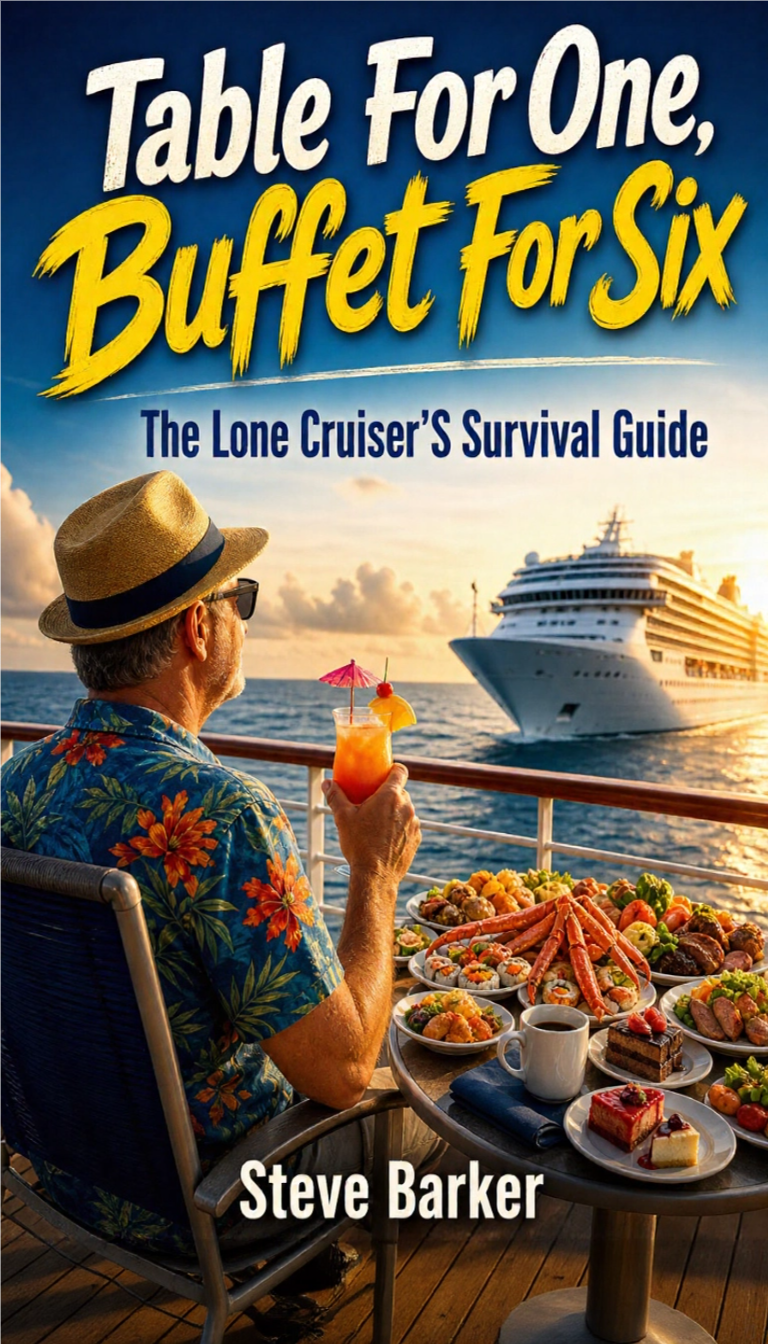
First Class Fool: Table For One, Buffet For Six
by Steve Barker
Summary
Cruising can look, before the first booking, like a holiday designed for pairs, but solo travel at sea is really about choosing the atmosphere, pace, and level of anonymity that suits you. The opening concern is emotional rather than social: the awkwardness most first-time solo cruisers feel is usually internal, because the ship is not broadcasting their status and the other passengers are too absorbed in their own luggage, dining plans, and miniature holiday dramas to stare. Once aboard, the initial self-consciousness gives way to the more ordinary reality that people are preoccupied with finding cabins, coffee, and the right lift. That shift becomes part of the appeal, because a cruise creates a temporary society where you can be as social or as private as you want, and where the routines soon start to feel reassuring rather than strange.
That rhythm looks very different depending on whether you choose an ocean cruise or a river cruise. Ocean ships are sprawling floating resorts with theatres, bars, decks, pools, shops, and enough public spaces to disappear into. River boats are smaller, calmer, and more intimate, with less room to hide but also less need to master a maze. Ocean cruising tends to offer anonymity, variety, and the ability to drift in and out of company; river cruising tends to offer familiarity, gentler pacing, and a social atmosphere that becomes recognisable very quickly. The choice is really about whether you want bustle or quiet, scale or simplicity, and how much structured sociability feels comfortable. Ocean ships can feel like lively seaside villages at sea, while river boats behave more like compact travelling hotels that happen to move through the scenery. Sea days on an ocean ship create pauses where the ship itself becomes the destination, while river days are tied more closely to the passing landscape and the scheduled excursions. For shy travellers, river cruising often feels humane and manageable; for sociable travellers, a big ship offers more options without demanding commitment. For anyone who simply wants a nap with scenery, both can work, but the river makes the scenery do more of the work.
Money is where the cruise dream gets complicated. The single supplement is one of the industry’s biggest traps for solo travellers, because the price you first see is often based on two people sharing a cabin. The supplement is the extra charge that appears when one person occupies the space the cruise line had assumed would house two paying passengers. That makes the headline fare almost useless until you know the final total, because taxes, port charges, gratuities, Wi-Fi, drinks, specialty dining, and excursions can all join the bill later. Ocean cruises often look cheaper up front and then accumulate costs gradually, while river cruises usually appear expensive immediately but bundle in more of the things people actually use. The book’s advice is to compare the final price, not the decorative one, and to treat “special offers” and “from” prices with skepticism. The real bargain is not the lowest headline figure but the sailing whose total cost matches the holiday you actually want, without making the trip feel like a financial obstacle course.
A solo cruiser can save a lot by booking carefully. Shoulder seasons, less obvious itineraries, midweek departures, and repositioning sailings often offer better value because they avoid peak demand. The cheapest cruise is not always the best value if it turns into a trip where every extra costs more than you expected or the cabin location is dreadful. That is why the small print matters. Deposits, cancellation rules, amendment fees, and what counts as refundable or non-refundable all need to be checked before money changes hands. A specialist cruise agent can be worthwhile because they know the jargon, understand cabin categories and supplements, and can spot the pricing traps that make a deal look better than it really is. The booking process should be handled with calm suspicion rather than excitement alone, because once the deposit is down and the rules are set, changing your mind can become expensive.
Cabin choice is another place where value matters more than glamour. Proper solo cabins are ideal when they are genuinely designed and priced for one person, because they avoid the absurdity of paying for a second occupant who isn’t there. But a solo cabin still needs the right location, daylight, and noise level to be worth it. An inside cabin can be excellent value if you mostly sleep there and don’t mind living without a window; an outside cabin gives daylight and a sense of orientation; a balcony can be wonderful on the right route, but may become an expensive wind tunnel in the wrong weather; and a suite buys space, comfort, and privacy if the budget allows. The crucial thing is to read the deck plan like a suspicious detective. Look at what is above, below, and beside the cabin, because proximity to a theater, bar, pool deck, crew corridor, or lift shaft can mean noise, vibration, or late-night foot traffic. The same caution applies to river boats, where smaller scale reduces some problems but does not eliminate them.
The book keeps returning to the idea that a cruise cabin should feel like a refuge, not a punishment. Noise and motion are what separate a restful cruise from a sleepless one. Midship cabins on lower or middle decks are usually the safest choice for anyone sensitive to movement, while cabins near elevators, service doors, pools, or entertainment venues can be deceptively convenient and deeply annoying. Balconies need particular honesty: they can be luxurious on scenic routes and calm weather, but if you won’t actually sit out there, the extra cost may not be worth it. The best cabin, in the end, is the one that supports how you actually travel, not the version of yourself the brochure imagines.
Packing for a cruise has a strange effect on otherwise rational adults. A person who can run a household, hold down a job, and remember the council tax suddenly begins preparing as though they are leaving civilisation forever and may need to rebuild society from a medium suitcase.
The problem is that you are not packing for the cruise you booked. You are packing for every imaginary version of yourself who might appear on board. There is Elegant Dinner You, who apparently requires shoes with opinions. There is Brisk Morning Walk You, who owns fitness clothing in theory. There is Sudden Adventure You, who may inexplicably take up paddleboarding despite having shown no previous interest in balance, water, or public embarrassment.
Then there is Weather-Anxious You, the most dangerous of the lot. This version insists on extra jumpers, a waterproof jacket, a scarf “just in case,” and enough layers to survive both a mild breeze and the collapse of central heating across Europe. Left unchecked, Weather-Anxious You will pack like a Victorian explorer with access to online shopping.
Resist the urge. A cruise does reward sensible preparation, but it has very little patience for luggage drama. Cabins may be cleverly designed, but they are not magic wardrobes leading to Narnia. At some point, your suitcase, your shoes, your formal clothes, and your secret snack supply must all coexist in a space that already contains furniture with territorial ambitions.
The real skill is not packing for every possible event. It is packing for the holiday you are actually likely to have. You need clothes you will wear, shoes that will not betray you, something smart enough for dinner, something comfortable enough for wandering, and enough practicality to avoid becoming the person who buys an emergency sweatshirt in port with the name of the destination printed across it in desperate lettering.
Overpacking feels reassuring at home because everything still fits somewhere. On board, it becomes a domestic scandal. The suitcase refuses to close properly, the wardrobe gives up early, and one chair becomes a refugee camp for garments you packed in a moment of optimism. By day two, you are not dressing from a selection of outfits; you are excavating fabric like an archaeologist with dinner reservations.
So pack with restraint, not panic. The ship is not sailing into a lawless void where socks are currency, and cardigans decide social rank. You are going on holiday, not establishing a colony. Take what you need, leave behind the fantasy personalities, and remember that the most useful thing you can bring is not a fourth pair of shoes, but the ability to shut your suitcase without needing to sit on it and negotiate.
The first rule of cruise packing is that the ship will not reward your breezy confidence. You may stride into the terminal looking like a person who has mastered travel, only to realise the one thing that matters is still at home, sitting beside the kettle with the quiet dignity of evidence. Cruises may involve sunsets, linen napkins, and people saying “sail-away” as though it were a personality trait, but they are not forgiving places for the phrase, “I’m sure it’ll be fine.”
Before you even look at shoes, shirts, or the emergency cardigan you claim is “just sensible,” gather the dull essentials and put them somewhere reachable. Not buried beneath swimwear. Not in a suitcase already surrendered to the mysterious luggage gods. Not in “a safe place,” which is the phrase humans use five minutes before patting every pocket with the expression of a burglar fleeing his own house.
Your passport sits at the top of this paperwork monarchy, wearing a crown and judging your life choices. Check the expiry date early, because some destinations insist it remains valid for months after your return, as if your passport needs a retirement plan. Also check visas, entry forms, blank-page requirements, and whether the name on your booking matches the passport exactly, including the middle name you usually treat as a rumour invented by your parents.
Travel admin is not improved by spontaneity. It does not respond well to charm, optimism, or the phrase “surely they’ll understand.” Discovering a passport problem the week before sailing is not a thrilling plot twist; it is a bureaucratic cold shower involving urgent appointments, unflattering photo booths, and a level of self-loathing normally reserved for assembling tax records in April.
Alongside the passport, keep your cruise confirmation, boarding pass, luggage labels, insurance details, hotel bookings, transfer information, and flight documents together. Save digital copies, but do not trust one phone, one app, one battery, and one patch of terminal Wi-Fi to behave like a competent support team. Technology is marvellous until it decides to update itself at the precise moment a check-in agent asks for proof you exist.
Paper copies may feel old-fashioned, but so do umbrellas until it rains. A printed confirmation is not glamorous, but it does not need charging, does not forget its password, and never announces that it has failed to sync because “connection is unstable.” For solo travellers, this matters even more, because there is no travelling companion standing beside you saying, “I thought you had it,” which is marriage in six words.
Medication and health documents deserve their own little kingdom. If you take regular prescriptions, keep them in your hand luggage, preferably in original packaging, with enough for the trip and a sensible surplus for delays. Do not pack them in the suitcase that may decide to explore the terminal independently. Luggage has ambitions. Sometimes it leaves you standing on board with fresh clothes elsewhere and only the outfit you travelled in for moral support.
Bring any doctor’s letter or prescription note you may need for medication, injections, medical devices, mobility equipment, or anything security might look at as though you are personally testing their training manual. This is not overthinking. It is the difference between a smooth embarkation and explaining your inhaler, tablets, or mysterious medical gadget to someone wearing gloves and the expression of a disappointed science teacher.
Money needs discipline too, because travel turns pockets into black holes. Bring the card you intend to use on board, plus a backup if possible, and tell your bank where you are going before it gallantly blocks your spending in the name of fraud prevention. Nothing says “relaxing holiday” like standing in a port café while your bank protects you from the reckless purchase of a sandwich.
Carry a little local currency if your itinerary calls for it, especially for taxis, small tips, market stalls, toilets, or the sudden irresistible need to buy something carved, painted, woven, or shaped like the town you are visiting. A slim wallet or document pouch is often better than distributing your identity across pockets, bags, and jacket compartments like clues in a low-budget detective drama.
There are also small items that seem boring until their absence becomes operatic. Pack a pen, because forms appear when pens vanish. A small notebook can be useful for excursion times, cabin numbers, passwords, table arrangements, and the name of the person you met at lunch who is now “Margaret? Possibly Maureen? Excellent scarf.” Memory is confident until pudding arrives.
Your charging cable, plug adapter, and portable battery should be treated as essential travel equipment, not afterthoughts tossed into a side pocket during a last-minute panic. A dead phone is not a phone; it is a shiny rectangle of accusation. It contains your tickets, maps, messages, bookings, photos, emergency contacts, and, most importantly, the ability to look calm while secretly searching “which deck is the dining room on?”
The final trick is access. Owning the document is not enough if retrieving it requires emptying your bag across a terminal floor like a street magician with worsening blood pressure. Keep the items needed for embarkation in hand luggage, easy to reach, and grouped together. The goal is not to impress anyone with your administrative brilliance; it is to avoid performing a one-person rummage ballet while the queue behind you begins to develop opinions.
Make copies of key documents and store them separately. Keep secure digital versions as backup. Photograph the passport information page, save important confirmations, and make sure you can reach them without needing the exact Wi-Fi signal apparently available only beside a vending machine facing north. This is not paranoia. It is simply refusing to let one missing email turn your holiday into a hostage negotiation.
Cruising should begin with a boarding card, a cabin key, and the pleasant sense that someone else is now responsible for meals. It should not begin with you sweating gently over an open suitcase while a polite official waits for your entire identity to reassemble itself.
Pack the documents first, organise the essentials, and only then worry about whether one more jumper is prudence or a cry for help.
Packing for a cruise is not one packing job. It is three separate packing jobs wearing the same suitcase and arguing in the hallway. You are packing for lazy ship days, active shore days, and evenings when the cruise line gently suggests you stop dressing like someone who has just survived a garden centre.
Sea days require clothes for comfort, drifting, sitting, wandering, and occasionally making a bold expedition from one lounge to another in search of cake. This is not the moment for complicated outfits that need instructions, assistance, or emotional commitment. You want layers, soft fabrics, and shoes that can survive a surprising amount of indoor walking, because ships are very good at making “just going for a coffee” feel like crossing a regional airport.
The ship itself will have several climates, none of which appear to have spoken to each other. One lounge may be air-conditioned like a supermarket cheese aisle, while a deck outside is warm enough to make your sunglasses feel underqualified. A light jumper, cardigan, wrap, or casual jacket is not overpacking; it is climate diplomacy. You are not dressing for the weather. You are dressing for a vessel with mood swings.
Sea days also tempt people into sporting delusion. You see the running track, the gym, the pool, and the spa, and suddenly imagine yourself becoming a sleeker, healthier version of yourself by Wednesday. Pack the kit if you genuinely use it at home. Otherwise, be honest. Many passengers board with trainers and noble intentions, then discover their true athletic gift is carrying pudding across a moving deck without spilling it.
A few ship-day essentials earn their place quickly. A reusable water bottle stops you from becoming mysteriously tired and then blaming the sea. Sunglasses, sunscreen, and a hat matter because sunlight bouncing off water has the subtlety of an interrogation lamp. A small tote or day bag is useful for carrying a book, phone, cardigan, glasses, and whatever item you suddenly need ten minutes after leaving the cabin.
Shore days are a different species entirely. They do not care about your elegant shipboard comfort. They care about pavements, steps, heat, rain, queues, and streets apparently paved by people who disliked ankles. Comfortable walking shoes are not optional unless your excursion plan involves being carried between attractions by sympathetic strangers, which is rarely included in the fare.
The best shore outfit is practical without looking as though you have come to catalogue moss. You need clothing that suits the weather, respects local customs where necessary, and allows you to move without making small noises of regret. Cities, churches, temples, museums, and old towns may all have different expectations, but most agree on one thing: nobody wants to watch a tourist discover too late that their outfit was designed for a pool bar, not a cathedral.
A shore bag should close properly, because open bags are just public invitations to gravity, weather, and mischief. Carry water, a compact rain layer or umbrella, a phone charger, any tickets, your ship card, and enough local currency for small purchases, tips, toilets, or the sudden need to buy a wooden object that seemed charming at the time and inexplicable later.
Port days also require emotional restraint. You do not need to pack for a jungle expedition if you are visiting a town square, a café, and a museum gift shop. Equally, do not wander ashore with nothing but a phone and optimism. The sensible middle ground is to carry enough to rescue the day, but not so much that you resemble a mobile lost-property office by lunchtime.
Formal evenings are where packing becomes theatre with luggage. The phrase “formal night” can make beginners panic and imagine ball gowns, tuxedos, and a string quartet judging the socks. In reality, most ships want you to look as though you made an effort, not as though you are attending a state banquet after inheriting a title.
Choose smart clothes you can actually enjoy wearing. A stylish outfit that lets you breathe, sit, eat, and walk normally will always beat a dramatic one that requires bravery, pins, and a private recovery period. For solo travellers, comfort matters even more because there is nobody nearby whose job is to whisper, “Your collar’s wrong,” or rescue you from shoes with a vendetta.
Mix-and-match pieces are your friends. A jacket, smart trousers, a dress, a decent shirt, a polished top, or a versatile skirt can do more work than a suitcase full of one-night wonders. Accessories can change the mood without occupying half the cabin. A scarf, tie, necklace, belt, or pair of smarter shoes can make an outfit look deliberate rather than merely clean.
Shoes deserve serious thought, because they are the part of packing most likely to stage a rebellion. One reliable walking pair, one smarter pair, and perhaps sandals or trainers depending on the itinerary will usually outperform six pairs chosen during a burst of pre-holiday fantasy. Your feet will not thank you for artistic ambition if they spend the week feeling like they have filed a complaint.
Pack for the cabin as well as the destinations. Cruise storage can be clever, but it is not a cathedral of spare space. Every item you bring must live somewhere, and that somewhere may already be occupied by your suitcase, your coat, your shoes, and the strange number of charging cables modern life requires. Clothes that can be worn more than once, dry quickly, and resist creasing are worth far more than dramatic items that sulk after one outing.
A small laundry bag, travel-sized toiletries, basic stain remover, and a few practical extras can make cabin life much calmer. You are not trying to become a minimalist monk with a passport, but you are trying to avoid turning your room into a textile landslide. The aim is to open your suitcase and feel prepared, not personally accused by every garment you packed in a panic.
The secret is to pack for your real cruise, not the imaginary cruise starring a more organised, athletic, glamorous version of you. Bring clothes for comfort, movement, weather, and the occasional smart evening. Leave space for souvenirs, laundry, and common sense. Your suitcase should support the holiday, not arrive on board like a second passenger with demands.
Packing for a cruise begins as a calm domestic activity and, within minutes, becomes a private inquiry into your character. You start by laying out sensible clothes and end by wondering whether you need a backup outfit for a lifestyle you do not currently lead, have never led, and are unlikely to begin between Southampton and Lisbon.
The danger is that a cruise feels varied enough to justify almost anything. You tell yourself you need options for dinner, walking, rain, sunshine, sudden elegance, mild exercise, unexpected glamour, and the unlikely but apparently important possibility of becoming “the sort of person who wears white linen confidently.” This is how a suitcase becomes less like luggage and more like a portable midlife crisis with wheels.
The aim is not to pack for every mood your future self might develop after two desserts and a sea breeze. The aim is to pack so your cabin does not look, by the second evening, as though a charity shop has exploded during a weather warning. Cruise cabins are clever, but they are not TARDISes with towel animals. Storage exists, yes, but it has limits, dignity, and a quiet dislike of unnecessary shoes.
Packing cubes are useful because they impose order on the madness before the madness gets ideas. Instead of one great fabric swamp, you get compartments: daywear, evening wear, underwear, swimwear, and the mysterious section labelled “essentials,” which somehow contains plasters, sunglasses, chargers, painkillers, a corkscrew you probably cannot use, and three objects you do not remember packing but are afraid to remove.
There is also a smug emotional benefit to packing cubes, which should not be underestimated. Opening a suitcase full of neat little blocks makes you feel like a competent adult with a system, rather than someone who threw clothes at a bag and hoped gravity would provide structure. This illusion may not survive the week, but on embarkation day it is worth a great deal.
Zip pouches are excellent for smaller items, especially the things that enjoy disappearing at the exact moment they become necessary. Chargers, adapters, earbuds, medication, reading glasses, spare cards, lip balm, and that one cable nobody can identify but everyone is afraid to leave behind should not be left loose in the suitcase. Loose items become feral. By day three, they are living behind the socks and refusing all contact.
Toiletries deserve containment because bottles are not to be trusted. They sit quietly at home, innocent and upright, then board a ship and decide to express themselves inside your wash bag. A separate waterproof pouch is not fussiness; it is border control. Nobody wants to discover that their shampoo has staged a coup against the toothbrush, moisturiser, and emergency plasters.
Once on board, unpack early if you can. This is not because you are trying to win a housekeeping award, but because a half-open suitcase on a cruise cabin floor has the power to lower morale by several degrees. Hang what needs hanging, drawer what needs drawing, and give shoes a specific home before they begin colonising the walkway like badly behaved pets.
Laundry is where optimism meets biology. At home, you may imagine yourself rewearing outfits with relaxed continental sophistication. On board, you may discover that heat, excursions, dining rooms, and mysterious cabin warmth have turned “wear again” into a scientific question. Pack clothes that can survive multiple appearances, but do not assume every garment will remain fresh simply because you looked at it encouragingly.
For a short cruise, a small wash kit can be enough: travel detergent, a few pegs or clips, and realistic expectations. Sink-washing light items is perfectly respectable, provided you understand that cabin drying is an art, not a guarantee. Some fabrics dry overnight. Others remain faintly damp for so long they begin to feel like dependants.
For longer cruises, ship laundry can be a sensible luxury rather than a moral failure. There comes a point when paying someone else to return your clothes clean is not extravagance; it is civilisation defending itself. Self-service laundries, where available, are also useful, though they can develop the atmosphere of a frontier town if too many passengers discover them at once.
Space-saving works best when it is dull. Choose clothes that mix easily, colours that do not require a personal stylist, and shoes that earn their passage. One reliable walking pair, one smarter pair, and perhaps one casual extra will usually do more good than a whole footwear delegation arriving with conflicting agendas and no clear purpose.
Beware the phrase “just in case.” It is responsible for half the luggage problems in modern travel. “Just in case” will pack a third jacket, a formal outfit for an event that does not exist, a heavy book you will not open, and a spare bag large enough to suggest smuggling furniture. “Just in case” is not prudence. It is anxiety wearing a luggage tag.
The moment you step aboard a large ocean ship, you realise you have not joined a boat so much as a small floating municipality with carpets. There are districts, landmarks, traffic patterns, restaurants, theatres, shops, lounges, pools, staircases, lifts, and enough corridors to make you suspect the architect was paid by the yard.
The scale is thrilling, but it can also make a first-time solo traveller feel as though they have accidentally checked into an airport that serves breakfast. Everything is vast, polished, signposted, and still somehow capable of leading you somewhere you did not intend to be. You set off for the dining room and emerge beside a jewellery shop, walking with the brisk confidence of someone who has absolutely no idea what is happening.
Big ships are built on abundance. More decks, more bars, more places to eat, more shows, more activities, more quiet corners, more noisy corners, and more opportunities to say, “I’m sure it’s this way,” just before discovering it very much is not. This is part of the fun, provided you treat wandering as exploration rather than evidence of personal failure.
For the solo traveller, the key is not to be intimidated into standing still. A large ship rewards curiosity. Take a slow lap. Learn one route at a time. Find your cabin, then the nearest lift, then the place where coffee lives. Do not attempt to master the whole vessel in an afternoon unless you enjoy feeling like a mouse in a hotel brochure.
The ship is not trying to defeat you. It is simply offering more than any reasonable human could consume in one voyage. You do not need to visit every venue, understand every deck, sample every restaurant, or attend every event with the grim determination of someone auditing leisure. Some places can remain a mystery. This is not ignorance. It is portion control.
There is also freedom in the scale. On a large ocean ship, you can be sociable when you want company and beautifully anonymous when you do not. You can join a quiz, disappear into a theatre audience, sit in a café with a book, or find a deck chair far enough from organised fun to restore your faith in silence. The ship gives you options, and the solo traveller’s great advantage is not having to negotiate any of them with a committee.
The trick is to let the big ship become familiar in pieces. By day two, you will know which lift is least annoying. By day three, you will have a favourite route, a preferred coffee spot, and at least one corridor you distrust on principle. By day four, you may even walk the wrong way with such authority that other passengers briefly consider following you.
That is when the size stops feeling like a threat and starts feeling like a gift. A big ocean ship is not asking you to conquer it. It is inviting you to find your own version of it: the lively bit, the quiet bit, the food bit, the theatre bit, the deck with the good view, and the chair that feels, after two successful visits, legally yours.
The first thing to accept about a large ship is that understanding it all at once is not a realistic goal. It is not a cottage. It is not even a hotel. It is a floating district council with upholstery, and if you try to master it on embarkation day, your brain will quietly hand in its notice somewhere between the atrium and the gelato counter.
Stand in the middle of the ship too early, and you will see lifts, staircases, shops, signs, glass, carpets, music, passengers walking with alarming purpose, and at least one person who appears to know exactly where the good coffee is. Do not be fooled. That person was probably lost yesterday and has simply converted trauma into confidence.
The sensible approach is not conquest, but survival by landmarks. Learn where your cabin is, which lift bank gets you nearest to it, where breakfast happens, where dinner happens, and where you can sit with a drink while looking as though you have chosen stillness rather than been defeated by architecture. That is plenty for day one. Nobody is awarding medals for memorising the emergency route to the spa.
Large ships are divided into areas, although the cruise line will give them names that sound like destinations in a lifestyle advert. “The Grand Promenade” may mean shops, music, and people drifting about with cocktails. “The Central Atrium” may mean the loud, shiny middle bit where everyone meets, mishears announcements, and looks briefly upward as if expecting revelation. Translate the romance into practical geography.
Think of the deck plan as a suspicious treasure map. It contains useful information, but it also contains optimism. Find the buffet, the theatre, the main dining room, the café, and the route back to your cabin that does not require you to pass through three retail opportunities and a man trying to sell watches. Once you know those routes, the ship shrinks to a manageable size.
Do not assume decks connect in the way a fair-minded person would design them. Ships enjoy little jokes. A corridor may stop without warning. A staircase may lead to a place you did not ask for. A route that looks simple on the map may, in practice, involve walking through a casino, a photo gallery, and an area where people are being encouraged to buy jewellery while slightly sunburnt.
When lost, go vertical first. Find stairs or lifts, change deck, and begin again with dignity. Wandering horizontally for too long can make you feel as though the ship is moving through time as well as water. The lifts may be slow, crowded, or full of people dressed for dinner while you are carrying a pool towel, but they remain useful allies in the war against corridor despair.
Not every public space is meant to be used in the same way. Some areas are thoroughfares, some are nests, and some are stages where passengers gather to be seen holding drinks under flattering lighting. The atrium is often useful as a landmark, but not always as a refuge. It is the ship’s town square, and town squares are rarely where a person goes to recover from other people.
Promenade decks and walking routes are excellent for orientation because they let you move without committing to a destination. This is very comforting for a solo traveller. A loop allows you to walk with purpose while making no decisions at all, which is one of the great underrated pleasures of cruising. Eventually, the ship begins to arrange itself in your head, usually around food, seating, and exits.
Pay attention to patterns rather than details. Breakfast crowds appear at predictable times. The pool deck has noisy hours and quieter windows. The theatre queue forms before the show with the solemnity of a national ceremony. Certain lounges look busy but are only temporarily occupied by people waiting for something else. These patterns matter more than knowing the name of every bar.
If you are prone to disorientation, become productively nosy. Notice artwork, carpet colours, stairwell décor, venue names, and any distinctive object large enough to be remembered after a glass of wine. Big ships often use design like breadcrumbs, though the breadcrumbs may be shaped like sculptures, mirrors, or murals that appear to have been commissioned during a very confident meeting.
The best way to make a large ship feel smaller is to organise it by need. Where do you go for coffee? Where do you go for quiet? Where do you go when you are hungry, cold, restless, sociable, or in urgent need of a chair that does not wobble? Once you know your personal map, the official map becomes less important.
And when you do end up somewhere completely wrong, which you will, do not treat it as failure. Everyone gets lost on a big ship. Some people simply disguise it by walking faster and looking annoyed at the signage. If you arrive at the wrong lounge, wrong deck, or wrong end of the vessel, call it exploration. On a cruise, confidence is often just confusion wearing better shoes.
Sea days are the point at which an ocean cruise stops being transport and starts behaving like a resort that has cut its ties with land and developed opinions about your timetable. There is no port to rush towards, no guide holding a sign, no coach waiting with the patience of a disappointed teacher. There is just the ship, the horizon, and the alarming possibility that nobody is going to tell you what to do unless you let them.
This can be glorious for the solo traveller, because a sea day is the closest many adults get to being unsupervised in comfort. You may wake when you like, eat when you like, move when you like, and achieve absolutely nothing with a level of cushioning usually reserved for expensive sofas. The only real danger is that the ship will keep presenting options until your peaceful day starts to look like an audition for organised leisure.
The daily programme on a sea day can resemble a town newspaper produced by people who fear silence. There will be talks, tastings, quizzes, demonstrations, fitness sessions, spa tasters, craft activities, shopping events, films, music, games, and something involving art that may or may not be an auction. The ship is not forcing you to attend any of this. It is merely placing it before you with the bright-eyed confidence of a host who has made far too much trifle.
Your first duty is to remember that the schedule is not a command structure. You are not in uniform. You do not have to report to the lounge at 10.15 for “Fun Facts of the Mediterranean” unless you genuinely wish to receive them. A sea day is not improved by frantic obedience. It is improved by choosing one or two things that appeal, then letting the rest continue bravely without your presence.
Large ships layer entertainment like a cake assembled by an excitable committee. There are big shows for those who enjoy lights, costumes, and applause; quiet lounges for those who prefer music with their dignity intact; daytime games for passengers who believe strangers are simply teammates they have not yet defeated; and late-night venues where confidence increases in direct proportion to cocktail umbrellas. You may visit any of them. You do not need to become a resident.
The clever solo traveller learns their own sea-day weather. Some people wake sociable, polished, and ready to join a quiz before their second cup of coffee, which is impressive and possibly a medical category. Others require a slow breakfast, a quiet chair, and at least forty minutes of staring at water before they can tolerate another human voice. Neither type is superior. One simply has a louder morning setting.
If you are feeling sociable, sea days are useful because nobody has gone ashore and scattered. People linger. Faces reappear. Conversations begin near coffee machines, deck rails, puzzle tables, and bars where the day has just become relaxed enough for opinions. You can join a class, sit near a group, ask a harmless question, or let the ship provide the social excuse. Nobody has to know you planned it with the stealth of a diplomatic mission.
If you are feeling quiet, the sea day is equally generous. A large ship usually contains enough corners to hide a small republic. There will be a lounge nobody has discovered yet, a deck space away from the pool politics, a window seat with excellent light, or a library corner where conversation would feel like vandalism. Being alone there does not look tragic. It looks like competence with a view.
The trap is believing that a blank day must be filled to prove you are making the most of the cruise. This is land-based nonsense wearing deck shoes. At sea, doing little can be the luxury you paid for. Reading half a chapter, eating lunch slowly, taking a nap, walking one peaceful circuit of the deck, and then sitting down again with the seriousness of a person conducting research into chairs is a perfectly valid itinerary.
Variety helps, but only in sensible doses. A good sea day might involve coffee in one place, a wander somewhere else, one talk or show if it appeals, lunch without urgency, a quiet hour, and an evening that does not require a rescue team. You are not trying to extract value from every square inch of the vessel. You are learning which parts of the ship suit the person you actually are when nobody else has a vote.
One of the pleasures of a big ocean ship is that it allows you to change mood without explanation. You can be chatty at breakfast, invisible by noon, curious after lunch, glamorous for dinner, and back in your cabin by ten with a biscuit and no regrets. On land, this might look inconsistent. At sea, it is simply good navigation.
So let the ship offer its shows, talks, games, music, lectures, and mysterious events involving folded towels. Dip in when curiosity calls. Drift away when your patience begins packing. The best sea days are not the busiest ones; they are the ones where you move through the ship at your own speed, enjoying the rare and civilised pleasure of having nowhere urgent to be while several thousand tonnes of holiday quietly does the travelling for you.
The trick to finding peace on a cruise is to stop looking for one official sanctuary, as if the ship has helpfully labelled a room “Silence, Biscuits, and Emotional Repair.” It usually has not. A large ocean ship is not a monastery with stabilisers. It is a bustling leisure town where several thousand people have all decided that relaxation involves talking near glass.
Quiet on a ship is not a fixed location. It is a moving target, like the good table at breakfast or the one lift that does not appear to be touring the vessel for its own amusement. Peace appears in gaps: the lounge before the quiz, the deck before the sunbed colonists arrive, the café after the morning rush, the corridor nobody loves because it leads nowhere glamorous.
The solo traveller who learns these little pockets is not being antisocial. They are being sensible. There is only so much organised cheer a person can absorb before the soul starts looking for a cupboard to sit in. A quiet corner is not a retreat from the holiday. It is where the holiday becomes possible again after the atrium pianist has finished giving your nervous system a brisk polishing.
Libraries, where they still exist, are the aristocrats of cruise calm. Some are proper rooms with chairs, views, and actual books. Others are a shelf beside a plant and a brave little sign asking passengers to whisper. Either way, the intention is noble. A ship library says, “Please lower your voice and remember that civilisation did not end when the buffet opened.”
Observation lounges are another gift, especially if you enjoy scenery without the full outdoor experience of wind attempting to remove your face. They offer large windows, comfortable chairs, and the pleasing illusion that staring into the distance is an activity. Take a book, notebook, or cup of tea, and you instantly look thoughtful rather than merely unwilling to attend salsa.
Outdoor quiet requires more strategy, because decks attract human territory disputes. The pool area may look serene in the brochure, but in reality it can become a towel-based feudal system by mid-morning. Search the edges instead: a side deck, a shaded bench, a forgotten stretch near the walking route, or the kind of spot people ignore because it requires one extra staircase and a basic commitment to peace.
Inconvenience is often the toll road to tranquillity. If a place is slightly awkward to reach, too far from the bar, not immediately obvious from the lift, or lacking the seductive glow of the main deck, it may be perfect. Many passengers will not walk an extra forty yards for silence. This is excellent news. Their laziness is your spa treatment.
Timing matters as much as geography. The same lounge can be heavenly at 9.20 and unbearable by 11.05, once a craft session has released glue, opinions, and competitive ribbon use into the atmosphere. Early mornings are often best, when the ship has not yet fully wound itself up. Late afternoons can also be good, when half the passengers are changing for dinner, and the other half are reconsidering their shoe choices.
Port days are a quiet-seeker’s secret weapon. When the majority go ashore in search of churches, coaches, and fridge magnets, the ship suddenly becomes civilised in a way that feels almost illicit. Corridors empty. Chairs become available. Staff smile with less battlefield tension. You can sit with coffee and enjoy the rare sensation that a giant vessel has been provided largely for your personal recovery.
Noise is not always volume. Sometimes it is the pressure of possibility: the sense that something is happening somewhere and you are failing to be there in the correct shoes. Quiet spaces protect you from that. They remind you that “making the most of the cruise” does not mean allowing the daily programme to chase you round the ship with a clipboard.
River boats handle calm differently. They are smaller, so there are fewer hiding places, but also fewer reasons to hide. The whole atmosphere tends to run at a lower emotional speed. A window seat, a quiet patch of deck, or a corner of the lounge during scenic sailing can feel private enough, especially if the river is providing castles, trees, and villages like a well-behaved visual aid.
There is, however, etiquette to quiet, and it should be observed with the seriousness normally reserved for lifeboats. Do not discover a peaceful corner and then summon six people to discuss excursions at full volume. Do not conduct speakerphone calls in a library. Do not turn a window seat into headquarters for a family briefing. Quiet spaces are delicate habitats. They cannot survive too many people explaining their plans for tomorrow.
Claiming a quiet place does not require apology. Sit down as though you belong there, because you do. Open a book, look at the water, sip your tea, or do absolutely nothing with the serenity of someone who has finally understood maritime leisure. You are not hiding from the ship. You are using it intelligently, like a person who knows that even pleasure needs a little ventilation.
The beauty of cruising alone is that you can move between noise and calm without negotiation. You may join the bustle for lunch, vanish to a quiet deck afterwards, reappear for music, then disappear again before anyone suggests “one more drink.” This is not inconsistency. It is elegant self-preservation. The ship offers the crowd. The wise solo traveller also finds the silence.
A large ocean ship can make a solo traveller feel deliciously insignificant, which is not an insult but a spa treatment for anyone tired of being useful. You step aboard and realise, with deep relief, that nobody is waiting for your opinion on anything. The ship has several thousand other people to feed, steer, entertain, hydrate, photograph, and gently misdirect towards the jewellery sale. Your personal existence is not a crisis. It is just another cabin number with shoes.
There is comfort in that scale. On a smaller holiday, being alone can feel visible, as if every empty chair is giving evidence. On a big ship, solitude is absorbed into the general traffic. You are not “the solo passenger.” You are simply one more person moving through a vast, carpeted ecosystem in search of coffee, shade, dinner, or the lift that appears to have entered negotiations with another deck.
For private travellers, this anonymity is golden. You can read in a corner for two hours without anyone forming a rescue party. You can eat when you like, leave when you like, and return to the buffet with the grave expression of someone conducting research rather than someone who has just remembered the bread pudding. No one is compiling a report. Unless you are wearing sequins at breakfast and carrying a parrot, the crowd will probably
Want the Full Experience?
This summary includes Key Takeaways, Chapter Summaries, Notable Quotes, Who Should Read This, and a professional AI-narrated audio version — available with a paid listing.
The author can upgrade this listing to unlock all sections.
