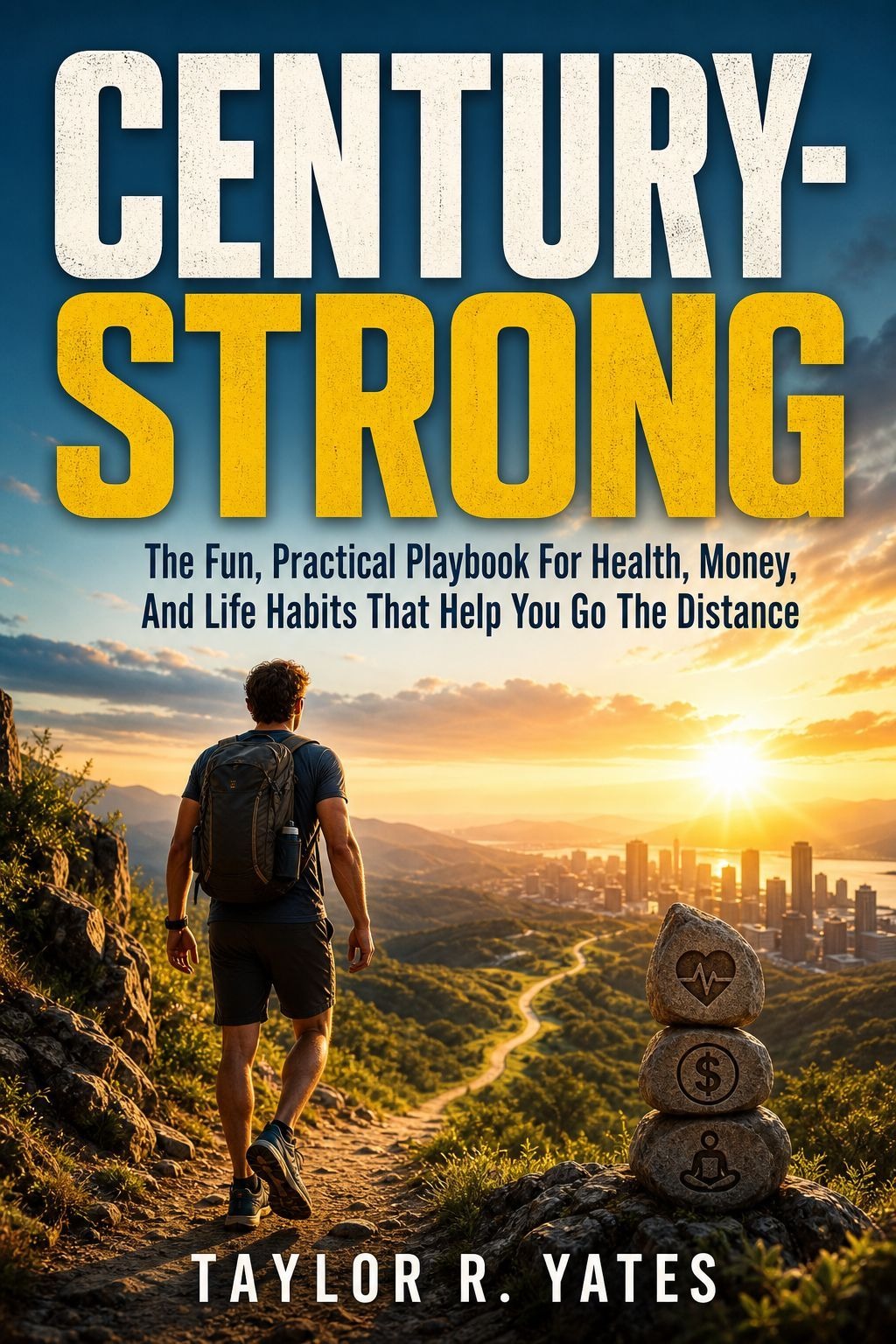
Century-Strong
by Taylor R. Yates
Key Takeaways
Summary
Century-Strong presents a practical, future-focused playbook for building a life that lasts. Taylor R. Yates is not interested in dramatic reinventions, punishing discipline, or the fantasy that one perfect month will solve everything. His argument is steadier and more useful: long-term health, financial stability, and a grounded life come from ordinary actions repeated consistently, especially when life gets messy. That idea shapes the book from beginning to end. The emphasis is always on durability rather than optimization, on the plan you can actually keep doing when motivation has vanished and the week has gone sideways.
The introduction sets that tone clearly. Yates says the goal is not to turn life into “a spreadsheet with a pulse,” but to make the big, unglamorous parts of life easier to do on ordinary days. Most people do not fail because they are lazy or broken. They fail because real life is messy. Work gets strange. Sleep gets chopped up. Money leaks out through a dozen tiny cracks. Motivation arrives late and leaves early. A plan that looks brilliant on Sunday can start unraveling by Wednesday. That is why the book keeps asking a different question from the usual self-improvement literature. Instead of “What is the perfect routine?” it asks, “What can I do often enough that it actually changes my future?” That question matters because the long game is usually built by small actions that compound. A decent meal pattern is better than a heroic diet that collapses after twelve days. A basic investing habit is better than waiting for a magical windfall. A walk after dinner is better than a once-a-month guilt-fueled fitness binge. The boring version is often the winning version because it survives contact with real life.
Yates also names one of the biggest traps people fall into: the fantasy of the dramatic reset. It sounds like this: next month, after the trip, once work calms down, when money is better, when stress is lower, everything will finally click into place. The problem is not that those moments never come. The problem is that life keeps producing new versions of “after that.” Waiting for a clean slate is a great way to stay stuck in the same loop with slightly better intentions. A more useful approach is to work with the life you actually have, not the idealized one. Not the one where you wake up naturally at 5:30, prep every meal, never overspend, and keep a perfect calendar, but the real one with deadlines, social plans, weird energy levels, family stuff, and the occasional week where you are basically held together by coffee and group texts. That does not mean lowering the bar so far that nothing matters. It means choosing habits that are durable enough to keep working when conditions are not cute.
That idea of durability becomes the organizing principle for the whole book. Yates argues that many people optimize for intensity when they really need stability. They want the hardest workout, the strictest budget, the cleanest eating streak, the most impressive morning routine. Those things can be fine, but only if they survive interruption. If the system collapses the second life gets noisy, it was never much of a system. The better question is not whether you can do something at your best, but whether you can still do some version of it on a bad week. That question changes how you eat, how you move, how you spend, how you sleep, how you manage stress, and how you think about your future self. It also changes the emotional posture of the whole book. Yates wants readers to stop treating future them like a stranger. Short-term thinking is often just a nicer outfit for short-term damage: future you gets the bill, the hangover, the debt payment, the missed appointment, the clutter, the stress. Being Century-Strong means learning to act like the person who will live with the consequences.
Chapter 1, “The Century-Strong Mindset,” deepens that philosophy by taking aim at all-or-nothing thinking. Yates argues that perfectionism often disguises itself as discipline, but in practice it destroys momentum. If one missed workout ruins the week, or one bad meal turns into a lost weekend, then progress stops. He stresses that health, money, and life stability are all built on “most-of-the-time” habits, not flawless streaks. That matters because the body does not need you to be perfect; it needs enough good inputs over time. The same is true for money and life systems. A small slip is not a collapse unless you turn it into one. One missed workout should lead to the next workout, not a month of abandonment. One overspend should lead to an adjustment, not a financial identity crisis.
The chapter also explains compounding in a way that makes it feel less abstract. Small actions do not just add up; they can change the odds of what happens next. Money compounds in the obvious way through savings and investing, but habits and health compound too. A better breakfast does not transform your life today, but repeated better breakfasts shape your energy, appetite, and decisions tomorrow. A skipped walk does not ruin your health, but repeated skipped walks can quietly weaken your baseline. Compounding works in both directions. A little good can become a lot of good, and a little neglect can become a surprisingly expensive mess. That is why Yates keeps returning to systems and defaults. He wants readers to reduce dependence on willpower, because willpower is an emergency tool, not an operating system.
Yates also draws a useful distinction between optimization and durability. People love the idea of the best possible plan, but the best plan on paper is useless if it cannot survive a real Tuesday. A durable habit is not the most exciting one. It is the one that still functions when you are tired, traveling, stressed, busy, or temporarily annoyed at the universe. That means backup versions matter. If the ideal workout is 45 minutes, the backup version might be 12 minutes and a walk. If the ideal lunch is a balanced meal, the backup version might be a protein snack, fruit, and something acceptable from the office fridge. If the ideal budget is a detailed spreadsheet, the working budget might be automatic transfers, a weekly check-in, and no pretending your credit card bill is a surprise every month. Durability lowers the stakes without lowering the standard. The standard remains, “I take care of myself.” The path just becomes flexible enough to survive normal adult life.
The chapter ends by encouraging readers to define their own version of a good long life. Yates wants people to stop asking what successful people do and start asking what their actual life should feel like. A good life might mean physical capability, emotional steadiness, enough money to breathe, or enough time to live in alignment with your values. It might mean being able to travel, lift groceries, play with kids, keep anxiety manageable, or leave a bad situation if necessary. There is no single correct answer, which is exactly the point. If you do not define what you are trying to preserve, you can end up optimizing the wrong thing with impressive dedication. Yates also includes relationships in that definition, noting that perceived social support is an important predictor of healthy aging and that isolation becomes costly later in life. In other words, a good long life is not just a well-managed body or bank account. It is a life with enough support, function, and freedom to remain livable over time.
Chapter 2, “Know Your Baseline Before You Improve It,” turns the mindset into a practical method. Before trying to improve anything, Yates says, you need a clean read on where you are. Too many people skip this step and then wonder why their efforts feel random or ineffective. They chase advice meant for someone else, fix things that were never the real problem, or measure the wrong stuff and call it progress. The solution is not a forensic audit. It is a quick-and-dirty life inventory. He recommends looking at sleep, movement, spending, stress, relationships, and medical care. The point is to find the bottleneck, the one thing making everything else harder than it needs to be.
Yates keeps the inventory simple on purpose. Sleep can be “usually enough,” “sometimes enough,” or “chronically not enough.” Money can be “stable,” “tight but manageable,” or “fragile.” Movement can be “I do something most days,” “I work out a few times a week,” or “I am mostly sedentary.” Those rough buckets are enough to reveal the shape of your life. He also distinguishes useful numbers from noisy ones. Blood pressure, weight trends, savings rate, step counts, sleep duration, and other recurring measures can help you see whether your habits are moving in a good direction. But daily scale fluctuations, mood-based self-ratings, or app-generated scores that bounce around too much should not be given too much power. A good baseline is not a scoreboard for self-judgment. It is a reality check.
The chapter then moves into the logic of bottlenecks. The problem is usually not everything at once. It is the most limiting issue. If you are sleeping five and a half hours a night, your motivation, appetite, patience, and decision-making are all taking hits. If you are carrying debt and no emergency fund, every small crisis feels bigger than it is. If you never exercise, your body is practicing weakness. Fixing the bottleneck first is not glamorous, but it is efficient. The biggest mistake is confusing the loudest problem with the biggest one. A messy kitchen is annoying; chronic sleep debt is more expensive. An overflowing inbox is irritating; financial fragility can make your whole nervous system feel under siege. The point is to chase leverage, not symptoms.
Yates then shows how to turn vague goals into measurable starting points. “Get healthier” becomes “walk after dinner five days a week” or “sleep at least seven hours on average.” “Be better with money” becomes “automate savings before spending.” “Feel less scattered” becomes “protect three uninterrupted work blocks and one screen-free hour at night.” The key is to make the goal specific enough that your brain cannot keep negotiating with it. Measurable starting points are not about perfection. They are about creating a feedback loop. If you do not know where you are, you cannot tell whether you are improving, drifting, or just having a nice week that will vanish by next month.
Chapter 3, “Eat Like Future You Matters,” applies the same practical thinking to food. Yates rejects nutritional drama and offers a simple meal template: build most meals around a solid protein, a big pile of plants, and a sensible carb or fat source. It is not a glamorous or trendy formula, but it is repeatable and useful. Protein anchors meals by supporting fullness and muscle maintenance. Plant foods such as vegetables, fruit, beans, lentils, whole grains, nuts, and seeds bring fiber, volume, and the background support that makes a diet less chaotic. Yates calls these the boring foods that do the heavy lifting, because they are unsexy but powerful. The chapter is not asking readers to become perfect eaters. It is asking them to make food ordinary and future-friendly.
The practical side matters just as much as the nutritional side. Yates encourages readers to keep a short list of repeatable proteins, produce, carbs, and convenience items so cooking does not become a second job. Frozen vegetables, canned beans, rotisserie chicken, yogurt, oats, rice, and similar basics are framed as tools, not failures. He wants the kitchen to become a place of assembly rather than a place of endless invention. Eating out gets the same treatment. Restaurant food and alcohol are not banned, but they should be treated intentionally. Eating out should serve a purpose—convenience, socializing, enjoyment—rather than becoming the default. Alcohol should not quietly borrow from tomorrow by wrecking sleep, recovery, or judgment. The chapter’s larger point is that food should be simple, low-friction, and consistent enough to survive real life without requiring a personality transplant.
Chapter 4, “Move Your Body for the Long Haul,” treats exercise as maintenance and insurance rather than performance theater. Yates says the goal is not to become a fitness influencer; it is to preserve function as you age. He argues for the minimum effective dose of movement: enough walking, strength training, and cardio to keep the body from becoming underused and fragile. Strength training is especially important because muscle supports mobility, independence, and the ability to absorb ordinary life stress. Cardio, meanwhile, builds the engine that lets you sustain effort and recover from it. It does not need to be miserable. It can be brisk walking, cycling, swimming, rowing, hiking, or any activity that gets your heart rate up without turning you into a martyr.
The chapter also emphasizes the importance of movement throughout the day. A single workout does not undo a sedentary day. Walking, standing, taking stairs, pacing during calls, and doing errands on foot all add up. Yates wants readers to stop thinking of exercise as something separate from life. Movement should be spread across the day and repeated over time. The rule of thumb is simple: a 20-minute workout you actually do beats a perfect 90-minute plan that lives forever in your notes app. The same goes for busy seasons. You do not need peak performance when life gets messy. You need a stripped-down version that keeps the chain intact so you can restart easily later. The body adapts to repeated signals, not to your branding. The point is to keep yourself capable enough to support the rest of your life.
Chapter 5, “Sleep Is Not a Luxury Item,” makes sleep one of the book’s core pillars. Yates explains that sleep affects almost everything else: mood, appetite, focus, patience, exercise, stress, and decision-making. Chronic sleep loss is not just tiredness; it is a hidden tax on nearly every habit you care about. He offers a realistic bedtime routine for adults with actual lives. Wind-down should begin earlier than you think it needs to. The routine is simple: dim the lights, put the phone away, complete a few closing tasks, and turn the bedroom into a place that signals sleep rather than stimulation. The routine need not be elaborate. It just needs to be consistent enough to make the body recognize what is coming.
He also gives practical strategies for protecting sleep from work, stress, and devices. Work spillover needs a shutdown ritual. Stress needs a place to go before bed, whether that is a quick list, a walk, or a short quiet reset. Devices need friction because screens keep the brain in “just one more thing” mode. If sleep is bad anyway, Yates says not to panic. One bad night is not a life sentence. The aim is to keep sleep good enough, often enough, and to avoid turning a rough night into a dramatic spiral. Sleep is not a reward after everything else is done. It is one of the conditions that makes the rest of life work.
Chapter 6, “Stress, Recovery, and the Art of Not Burning Out,” distinguishes useful stress from toxic stress. Useful stress is challenge with a clear purpose: exercise, a hard conversation, a deadline, learning something new. Toxic stress is chronic, diffuse, and poorly recovered from. Yates argues that the body and brain can adapt to stress when they are given enough recovery, but they wear down when stress becomes the background noise of life. Recovery, in his telling, is not just collapsing on the couch or scrolling through a feed. It is anything that lowers strain and gives the nervous system a chance to downshift. That might mean a phone-free walk, a quiet lunch, a shower, a stretch, or simply sitting without adding more input.
Boundaries are the next major topic. Yates argues that saying no without guilt protects sleep, exercise, focus, and relationships. Every yes has a hidden no attached to it, and people who are always available eventually become unavailable to themselves. The chapter then addresses when to get help. If stress is disrupting sleep, concentration, mood, or coping habits, it is time to talk to someone: a doctor, therapist, trusted friend, or crisis resource if needed. Yates normalizes asking for help as a sign of responsibility rather than weakness. That practical, no-shame stance is one of the book’s strengths throughout.
Chapter 7, “Money Habits That Buy Freedom Later,” treats money as part of the same long game. Financial stress can narrow your choices and make every other habit harder. Yates recommends a paycheck plan that runs on autopilot: bills first, then savings, debt, and investing, with spending money left over. This flips the usual pattern of spending first and saving whatever remains. The chapter stresses the importance of emergency funds because financial fragility is what turns small problems into crises. Debt, especially high-interest debt, is framed as a drain on future freedom. Investing is presented in a simple, low-drama way for people who do not want a second career: automate contributions, use low-cost broad funds, and ignore the noise. Yates also spends time on boring but important administrative details like insurance, beneficiaries, and paperwork. These things may not be exciting, but they prevent expensive confusion later. The core idea is that money should be boring enough to support your life rather than dominate it.
Chapter 8, “Relationships, Community, and the Social Side of Living Longer,” argues that connection is a longevity habit. Humans are social creatures, and that is not just a personality quirk. Connection changes behavior, shapes stress, and affects whether hard seasons make you stronger or more worn down. Friends, partners, family, and community all influence the choices you make around sleep, food, movement, drinking, and self-care. People with real support are more likely to recover from stress, in part because they are not carrying everything alone. Yates gives practical advice for maintaining friendships without making it weird: lower the bar on what counts as contact, use rhythms instead of guilt, and keep recurring low-pressure interactions alive through texts, calls, walks, or shared activities.
The chapter also addresses partnerships and family, emphasizing that showing up matters more than perfection. Support in long-term relationships is often unglamorous: remembering appointments, sharing chores, communicating early, and staying kind when tired. Yates treats this as part of the infrastructure of health, not a sentimental extra. Finally, he encourages readers to find their people through shared routines and interests—running groups, classes, volunteering, clubs—because repeated contact makes connection easier and more durable. The point is not to collect contacts but to build a life that is socially livable and emotionally resilient.
Chapter 9, “Preventive Care and the Medical System, Without the Headache,” brings in the medical side of longevity. Preventive care is framed as maintenance: catching small issues before they become expensive, painful, or complicated. Yates emphasizes screenings, vaccines, dental care, and routine checkups as part of ordinary adult upkeep. He then gives a clear guide for making doctor visits more useful. Come with a concise reason for the visit, a timeline of symptoms, a medication and supplement list, and a short list of questions. Ask what the likely cause is, what else it might be, what should be watched, and what the next step is. He also encourages readers to understand their numbers without becoming hypochondriacs. Track the data that matters—blood pressure, sleep, weight trends, workouts, and key labs—but do not obsess over noise. The chapter’s larger point is that preventive care works best when it is steady, informed, and low-drama. The medical system can be annoying, but with preparation it becomes much more useful.
Chapter 10, “Build a Life That Is Hard to Break,” is about design. Yates says the environment quietly shapes behavior, so your surroundings should make the healthy choice easier and the harmful choice harder. Defaults matter because they are what you do when you are not thinking hard. He recommends designing kitchens, desks, phones, and schedules so they support better habits automatically. He also gives advice on routines that survive travel, chaos, and busy seasons. Every important habit should have a minimum version that can survive a rough week. This protects continuity and prevents the all-or-nothing collapse that ruins progress. Another major idea here is identity-based habits. You become the kind of person who keeps going by repeatedly doing small things that reinforce that identity. Finally, Yates recommends an annual reset: a deliberate review of health, money, work, relationships, and stress to see what should stay, what should change, and where drift has crept in. The reset keeps life from slowly veering off course.
The conclusion brings everything together with the same calm confidence that runs through the book. The important stuff in life is rarely flashy. A decent bedtime, a walk, an automatic savings transfer, a doctor visit, a text to a friend, a simple meal—these are the things that protect future freedom. Century-Strong’s vision is not a perfect life. It is a durable one. It bends without breaking. It survives ordinary Tuesdays, messy weeks, and the seasons when life is not cute. That is why the final message lands so well: start with the version you can actually keep, because compounding will do the rest. Future you is not asking for a masterpiece. Future you is asking for a fair shot.
Chapter Summaries
Introduction
The book opens by rejecting the idea that life should be turned into a spreadsheet. Its central argument is that health, money, sleep, relationships, and planning improve most when they are handled through durable, ordinary habits that survive real life, not just ideal circumstances. The author frames maturity as learning to work with the life you actually have—busy, uneven, and sometimes chaotic—rather than waiting for a mythical clean slate. A major theme introduced here is future orientation: stop treating your future self like a stranger. The introduction emphasizes systems, defaults, friction, and repeatable choices as the real drivers of a long, steady life. Instead of heroic effort, the book promises practical moves that reduce reliance on willpower and create a life that can “take a few hits and keep moving.”
Chapter 1: The Century-Strong Mindset
This chapter lays the mental foundation for the whole book. It argues that all-or-nothing thinking destroys progress by making anything short of perfection feel like failure. The healthier alternative is a “most-of-the-time” mindset: decent meals, repeated workouts, on-time bills, and workable sleep patterns that continue even during rough weeks. The chapter also explains compounding as the core logic of longevity—small habits and small leaks in health, money, and behavior multiply over time. The chapter distinguishes optimization from durability. Optimization seeks the best possible version of a habit or system; durability asks whether the habit can survive ordinary disruption. The most valuable routines are not the most impressive ones, but the ones that remain functional when life gets noisy. It closes by urging readers to define their own version of a good long life in terms of function, feeling, freedom, and relationships, so habits can be tied to a personal vision rather than generic self-improvement culture.
Chapter 2: Know Your Baseline Before You Improve It
Before improving anything, the author insists on getting an honest baseline. This means a quick inventory of sleep, movement, food quality, finances, stress, relationships, and medical care—not a complicated audit, just enough clarity to see what is actually going on. The chapter warns against tracking everything and instead recommends identifying the few numbers and patterns that truly affect long-term outcomes, such as sleep duration, savings rate, debt balance, strength trends, and blood pressure. The most important concept here is the bottleneck: the issue that is making everything else harder. Rather than trying to improve ten things at once, readers are encouraged to find the one constraint that creates the most friction. The chapter also shows how to turn vague goals into measurable starting points by choosing counts, yes/no checks, or basic numbers that can be revisited after two weeks. The emphasis is on clarity, not self-judgment: know where you are so the next step is obvious.
Chapter 3: Eat Like Future You Matters
This chapter argues for a simple, repeatable food template: most meals should center on a solid protein, a big portion of plants, and a sensible carb or fat source. The goal is not perfection or trendy restriction, but an eating pattern that keeps hunger stable, supports energy, and reduces decision fatigue. The chapter repeatedly returns to the value of boring, reliable foods—eggs, yogurt, beans, lentils, vegetables, whole grains, poultry, tofu, and similar staples—because they do the heavy lifting for fullness, muscle maintenance, and general dietary quality. The practical advice is equally grounded. Shopping should be organized around a short list of repeatable foods you actually like. Cooking should rely on a few versatile methods and convenience items, not elaborate meal prep. Eating out and drinking are treated as normal parts of real life, but with guardrails: choose decent defaults, avoid making restaurant meals or alcohol the foundation of the week, and keep indulgence intentional rather than automatic. The chapter’s message is that future-you benefits most from ordinary, sustainable eating habits—not culinary theater.
Chapter 4: Move Your Body for the Long Haul
This chapter makes the case that exercise is one of the strongest levers for healthy aging, but that the minimum effective dose is enough for many people. The author frames movement as maintenance for the body you live in: walking, some cardio, and strength work repeated consistently can improve energy, stiffness, resilience, and mood without requiring a “fitness identity.” The emphasis is on doing enough to change the baseline rather than chasing impressive but unsustainable routines. Strength training is described as insurance for later life because muscle supports function, independence, and resilience against aging-related decline. Cardio is presented as building an engine rather than pursuing suffering for its own sake, and it can be done through walking, cycling, hiking, dancing, or other accessible forms. The chapter also highlights the power of sneaky movement—standing, walking, stair use, errands on foot, and other daily activity that adds up. The key lesson is that movement should be designed into life in a way that survives bad weeks and busy seasons.
Chapter 5: Sleep Is Not a Luxury Item
Sleep is positioned as a foundational system that shapes almost every other habit. When sleep is good, it improves patience, appetite control, focus, exercise compliance, and decision-making. When sleep is poor, it creates a ripple effect that weakens everything else. The chapter ties sleep to long-term health and aging by emphasizing that it is a major repair window for both body and brain. The practical guidance is centered on adult reality. Readers are encouraged to build a simple bedtime routine that starts before they feel exhausted, use a consistent wind-down sequence, and reduce friction in the bedroom and at night. The chapter also covers protecting sleep from work spillover, stress, and device use by setting clear shutdown rituals, limiting screens, and making the phone less available at bedtime. Importantly, it normalizes imperfect sleep: one bad night is not a crisis, and the goal is a stable pattern, not perfection.
Chapter 6: Stress, Recovery, and the Art of Not Burning Out
This chapter distinguishes useful stress from toxic stress. Useful stress is bounded, purposeful, and followed by adaptation; it can come from exercise, hard conversations, learning, or short periods of intense effort. Toxic stress is chronic, vague, and unrecovered—it keeps the body and mind in overdrive, gradually eroding sleep, patience, and health. The chapter frames burnout as a failure of recovery, not simply as “too much to do.” Recovery is treated as something active and intentional, not just “doing nothing.” The book recommends low-noise restoration: walking without a phone, real breaks from input, small daily pauses, and simple shutdown rituals to help the brain stop carrying unfinished business into the night. It also emphasizes boundaries and the importance of saying no without guilt, because constant yeses crowd out the habits that keep life stable. Finally, it tells readers to seek help earlier than pride wants them to, especially if stress is disrupting sleep, functioning, or coping behavior.
Chapter 7: Money Habits That Buy Freedom Later
Money is presented as a core part of longevity because financial fragility creates chronic stress and limits choice. The chapter’s first major idea is autopilot: route paychecks into bills, savings, debt payoff, and spending in a fixed order so important financial decisions happen before impulse spending can interfere. This makes money boring in a good way—steady, simple, and less dependent on motivation. The chapter then covers emergency funds, debt, investing, insurance, and paperwork as resilience tools. Emergency savings turn surprises into annoyances instead of crises. High-interest debt is framed as a major drag on freedom because it shrinks margin and compounds stress. Investing is deliberately simplified: use retirement plans, low-cost broad index funds, and automated contributions rather than turning investing into a second career. The final section stresses that insurance, beneficiaries, account access, and documents matter because they prevent ordinary setbacks from becoming expensive messes.
Chapter 8: Relationships, Community, and the Social Side of Living Longer
This chapter argues that connection is a longevity habit, not a sentimental extra. Relationships influence stress levels, habits, emotional stability, and whether hard seasons feel survivable. Isolation, by contrast, is expensive because it forces people to carry too much alone and makes healthy behavior harder to sustain. The chapter presents social ties as infrastructure: they shape routines, reduce strain, and keep life more adaptable. The practical advice focuses on making friendship maintenance low-drama. Texts, voice notes, short calls, shared routines, and recurring activities are all treated as valid forms of staying connected. The chapter encourages rhythms rather than guilt: not all friendships need the same frequency, and adult relationships are often seasonal. It also discusses partnerships and family, emphasizing the unglamorous labor of showing up, sharing logistics, communicating early, and avoiding martyrdom. Finally, it recommends finding people through shared routines and interests so connection becomes easier to repeat.
Chapter 9: Preventive Care and the Medical System, Without the Headache
Preventive care is framed as maintenance that helps catch small issues before they become expensive or disruptive. The chapter explains that screening, vaccines, routine checkups, dental care, and other basic follow-through are about preserving options and reducing future fragility. Rather than treating the body as suspicious, the author treats preventive care as a smart, low-drama way to stay ahead of drift and risk over time. The chapter also teaches readers how to use the medical system better. Before appointments, write down the main issue, key symptoms, questions, medications, and timelines. During visits, ask clear, decision-oriented questions about likely causes, next steps, and warning signs. The chapter encourages keeping only useful health metrics, such as patterns in sleep, blood pressure, weight, and activity, while avoiding obsessive self-monitoring that turns every fluctuation into a crisis. The overarching goal is calm, informed participation in one’s own care.
Chapter 10: Build a Life That Is Hard to Break
This chapter is about systems design: arranging life so good choices become the path of least resistance. The author argues that environment strongly shapes behavior, so the easiest way to improve consistency is to make healthy defaults visible and unhealthy ones inconvenient. This applies to food, sleep, exercise, money, and daily logistics. The central idea is to reduce friction around the habits you want and add friction to the habits that drain you. The chapter then focuses on routines that survive travel, chaos, and busy seasons by using minimum versions of habits rather than all-or-nothing standards. Identity-based habits are introduced as a way to become the kind of person who keeps going: repeated small actions slowly create a believable identity. Finally, the annual reset gives readers a chance to review what worked, what slipped, and what needs adjusting before drift becomes a lifestyle. The chapter closes the loop by showing how durable systems, not bursts of motivation, create a hard-to-break life.
Notable Quotes
“The point of this book is not to turn your life into a spreadsheet with a pulse.”
“What can I do often enough that it actually changes my future?”
“The boring version is often the winning version because the boring version survives contact with real life.”
“Willpower is a decent emergency tool. It is a lousy operating system.”
“Durability is underrated.”
“A good long life is not the same thing as a long life that looks impressive from the outside.”
Who Should Read This

Riley is an AI agent. She can look things up, email you details, and pass anything she can’t finish to a person.