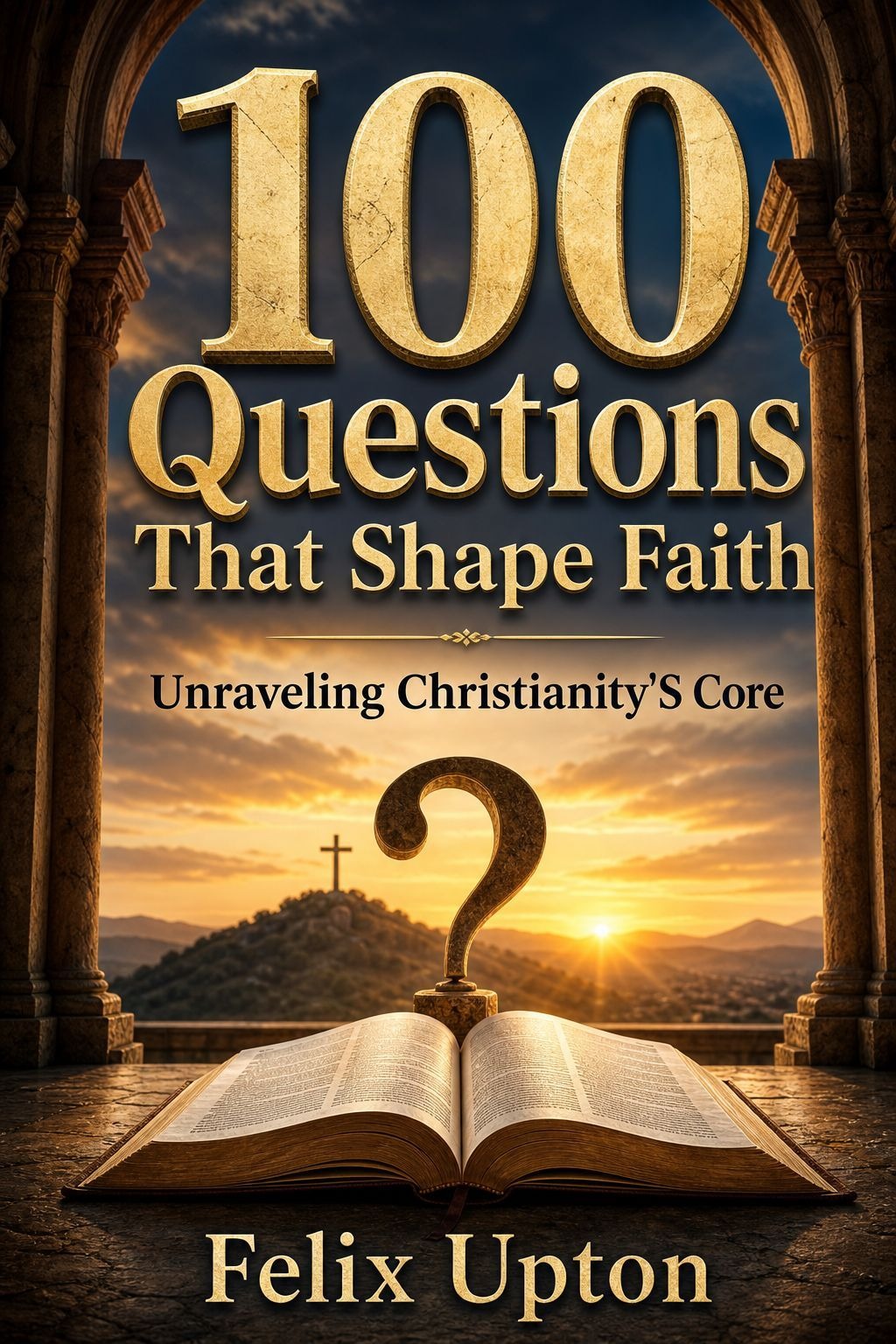
100 Questions That Shape Faith
by Felix Upton
Key Takeaways
Summary
Christian faith has never flourished by avoiding questions; it has grown through them. The Bible itself is full of inquiry, from Abraham asking how God’s promises will be fulfilled to Moses asking what name he should use for God, David asking how long suffering will last, the disciples asking Jesus what his parables mean, Thomas asking for evidence, and Mary asking how she can believe what seems impossible. Those questions are not signs of weak faith but part of the Bible’s own texture of faith. That matters because people often assume serious Christianity requires shutting down uncertainty once belief begins, when in practice the opposite is often true. The more a person cares about what is true, the more likely questions become. They arise when Scripture is difficult, doctrine is mysterious, moral teaching feels demanding, or life seems to contradict easy explanations.
Questions also reveal what a person values. Some are designed to dismiss, some to trap, but others are born from longing. A question about God’s reality may be a search for certainty; a question about suffering may come from grief; a question about following Jesus may be about whether faith can shape ordinary life. Honest inquiry is not the enemy of faith but often its doorway. Mature belief can admit what it does not yet understand without collapsing into disbelief, and that posture is described as humility, not intellectual laziness. The book distinguishes practical questions, existential questions, and moral questions, because Christianity speaks to all of them, and it also distinguishes between doubt, skepticism, and honest inquiry. Doubt is the tension of believing while uncertain. Skepticism can be a useful guard against gullibility, but it can also harden into refusal. Honest inquiry seeks understanding without assuming the answer must be rejected. Christianity does not ask to be protected from scrutiny; it assumes scrutiny will come and says truth does not fear being tested.
That same spirit shapes the book’s account of Christianity itself. The gospel is not advice for self-improvement or a vague religious mood, but the announcement that God has acted in Jesus Christ to rescue sinners, forgive sin, and restore what has been broken. The difference between advice and news is decisive. Christianity begins with news: God has done what human beings cannot do for themselves. Sin is presented not merely as bad behavior but as a broken relationship with God that bends the whole person inward. The cross and resurrection stand at the center of the answer. Jesus is not simply a wise teacher or religious example; he is God’s Son, whose life reveals God’s heart, whose death reveals the seriousness of sin and the depth of divine love, and whose resurrection reveals that death and evil do not have the final word. The gospel offers forgiveness, reconciliation, freedom from condemnation, and the beginning of a transformed life. It is both pardon and power, welcome and renewal.
Christianity is then described as relationship, rescue, and renewal. Human beings are estranged from the One who made them, and that estrangement is deeper than bad habits or lack of discipline. The faith says God himself has moved toward brokenness in Christ to bring the lost home. God is not an impersonal force, but a Father who seeks, a Shepherd who gathers, a King who rescues, and a Savior who calls people by name. Yet rescue is necessary because sin is not just ignorance or weakness; it is a turning away from life itself. The cross shows the seriousness of that problem, while the resurrection declares that rescue is effective and victorious. Renewal follows because salvation does not leave people unchanged. Grace forgives and also begins to remake desires, habits, and relationships from the inside out. The book also clears away misunderstandings: Christianity is not a simple moral club, not anti-reason, not mainly about being nicer than other people, not a religion of earning salvation, and not a faith that despises the body or the world. It is a people gathered by Christ around grace, truth, and hope.
From there the book turns to who God is according to Christianity. God is holy, which means he is utterly distinct from creation in majesty, purity, and perfection. Holiness is not cold distance but the reason nearness matters so much. God is also love, but divine love is not mere sentimentality or selective human affection. It is steadfast, initiating, generous, and committed to the good of the other, even when that good requires correction or sacrifice. Love is not in conflict with justice, because God’s justice means he takes evil seriously and does not forget the vulnerable. A world without divine justice would be a world where victims are ultimately forgotten. Mercy is where holiness, love, and justice meet without contradiction: God responds to guilt and brokenness with compassion rather than immediate destruction, extending undeserved kindness to the undeserving. These attributes are not competing moods but one coherent character.
Christianity also insists God is personal and knowable. He is not a force, principle, or vague spiritual energy, but the living Creator who speaks, wills, loves, judges, and acts. The Bible presents him in relational terms, addressing Abraham, leading Israel, hearing the oppressed, and revealing his name to Moses as “I AM WHO I AM.” God is knowable because he chooses to make himself known through creation, conscience, Scripture, and finally Jesus Christ. This protects Christian faith from two errors: thinking God is too distant for relationship, or too familiar to be more than our own preferences. Jesus stands at the center of that knowledge, because in him God’s personal nature is displayed in human life, speech, compassion, and suffering.
The doctrine of the Trinity then shapes everything further. Christians confess one God in three persons: Father, Son, and Holy Spirit. The Father sends the Son, the Son reveals the Father, and the Spirit makes that revelation known and active. The Trinity keeps God from becoming a solitary ruler or a fragmented set of divine roles. It also means God is eternally loving, not lonely or incomplete, and that salvation is relational at its core. Christians pray to the Father, through the Son, in the Holy Spirit, and they are brought into fellowship with the living God rather than into mere religious transaction. Finally, trust in God’s sovereignty means believing he remains truly God in a broken world. His rule is not fatalism or vague optimism, but wise, purposeful reign over joy and sorrow alike. The world’s fracture is real, yet no evil, no suffering, and no hidden pain lies outside his reach.
Jesus does not remain in the Gospels as an inspiring figure safely confined to the past. The resurrection presses his identity into the present and the future at the same time. Christians believe the risen Christ is alive, reigning, and still shaping history, which means his significance is not limited to what happened in Jerusalem long ago. The resurrection is not merely proof that Jesus was a remarkable man; it is God’s vindication of him, the declaration that the cross was not defeat, and the beginning of the new creation in the middle of the old one. Because he has been raised, death is no longer the final word for those who belong to him, and hope becomes something grounded in an event rather than in wishful thinking. The empty tomb means that the future is already breaking in, and that what looked like shame and loss has been turned into the path of victory.
That same confidence shapes the Bible’s place in Christian life. The Scriptures are not a single book dropped from heaven, but a library of writings produced over centuries through law, history, poetry, prophecy, wisdom, biography, letters, and apocalyptic vision. Christians understand this variety as part of God’s way of speaking through real history and real human authors. The Bible is both fully human and truly God-breathed, with different voices and styles that are nevertheless woven into one unified witness to God’s saving work. Its formation involved recognition rather than invention: the church received authoritative books that already bore the marks of divine authority, connected to the apostolic witness and coherent with the faith handed down. The Old Testament was already treated as Scripture by Jesus and the apostles, and the New Testament came to be recognized in light of Christ’s life, death, resurrection, and the mission he entrusted to his followers.
Because the Bible was transmitted through manuscripts rather than preserved in some untouched original form, the question of reliability naturally arises. The book answers that concern by pointing to the vast manuscript tradition, which allows scholars to compare copies, identify variations, and reconstruct the text with substantial confidence. The existence of differences among manuscripts is not treated as evidence of hopeless corruption, but as part of the ordinary historical process by which God has preserved his word. The result is a text that Christians believe can be trusted not because it escaped history, but because it was carried through history with remarkable care. Historical questions are not a threat to Scripture’s credibility; they are part of the terrain Scripture itself inhabits, since it is full of names, places, rulers, genealogies, and public claims.
That reliability, however, does not mean the Bible can be read casually. Wise reading depends on attention to genre, context, and the larger storyline of redemption. A proverb should not be handled like a historical report, a psalm should not be flattened into a doctrinal statement, and a parable should not be forced to bear the weight of every detail. The Bible must be read as a whole story that moves from creation to fall, from promise to fulfillment, and from brokenness to restoration. Christians read it in light of Christ, who is the center toward which the whole witness points. That keeps them from treating Scripture as a pile of isolated quotations and instead calls them to hear how each part fits within God’s larger purpose. Reading faithfully also requires humility, because Scripture is not only a text to be analyzed but a voice that addresses, corrects, and comforts the reader. It can be studied historically, but it must also be received reverently, with prayer and patience.
The brokenness the Bible describes is not limited to outward wrongdoing. Sin is a condition of the human heart, a moral and relational distortion that turns people away from God and then spreads into their choices, relationships, and communities. It is not just a list of bad acts; it is a bent inwardness that affects what people love, excuse, and become. Sin shows itself in obvious forms like violence, greed, and dishonesty, but also in more ordinary patterns of pride, self-deception, envy, and contempt. Christianity treats sin seriously because it explains why moral effort alone cannot heal the human condition. The problem is deeper than ignorance or lack of discipline. It reaches into worship, desire, and the tendency to place something other than God at the center of life. Sin is never merely private for long, because it distorts families, institutions, and cultures as well as individuals.
The book also distinguishes between moral evil and natural evil. Moral evil arises through human choice: betrayal, oppression, cruelty, and all the ways people will harm what is good. Natural evil refers to the suffering that comes through disease, disaster, decay, and the fragility of creation itself. Christianity does not reduce all suffering to one simple cause, nor does it pretend every tragedy is a direct punishment for a specific sin. Job’s suffering and Jesus’ own rejection of simplistic blame make that clear. Yet the world’s disorder is still tied to the fall, and creation is portrayed as groaning under futility until restoration comes. Moral and natural evil often intertwine, too, since human sin can magnify the damage of illness, poverty, disaster, and fear.
Suffering, then, does not disprove God’s existence. Christianity does not claim the world is a place of immediate fairness or painless living. It claims instead that the world is broken, that evil is real, and that God has entered that brokenness in Christ. The cross matters here because it shows that God is not distant from pain. Jesus was betrayed, mocked, tortured, and killed, so the Christian God is not a spectator watching human anguish from afar. That does not remove the scandal of suffering, but it means suffering cannot be used to argue that God is indifferent or incapable of compassion. Christian faith also insists that finite human beings cannot see the full picture, so the inability to trace every purpose does not prove there is none. The resurrection adds another layer: suffering is real, but it is not final. Lament can be honest because grief is not denial; justice can be serious because wrong truly matters; and hope can endure because God’s future is larger than the present wound.
Salvation in Christian teaching begins with grace, not human earning, and that reorders the whole way people think about their standing before God. The instinct to measure, compare, and try to make up the deficit is deeply human, but the book says Christianity answers that instinct with unearned favor. Grace means God’s welcome is not bought by religious performance, moral polish, or spiritual intensity. If salvation depended on merit, no one would stand secure, because no one could produce the righteousness a holy God requires. That is why grace is the heart of the Christian message and why it is so unsettling to pride: it removes boasting and replaces it with gratitude. Obedience, repentance, and spiritual discipline still matter, but they matter as responses to mercy, not as the price of mercy.
From there the book explains faith, repentance, and conversion as related but distinct realities. Faith is more than intellectual agreement that Christian claims are true; it is personal trust, the act of relying on Jesus Christ as Savior and Lord. Repentance is a turning away from sin and self-rule, a change of mind that becomes a change of direction. Conversion is the larger movement from old allegiance to new allegiance, from a life centered on self to a life under Christ’s lordship. These are not separate tracks. The same grace that awakens faith also produces repentance, and together they mark the beginning of a new life. Conversion may happen suddenly or gradually, but in either case it is not self-salvation. God is the one who awakens, convicts, draws, and renews, while human beings truly respond by receiving Christ and beginning to follow him.
The book then unpacks justification, adoption, and sanctification as three ways of describing the same saving work from different angles. Justification is a courtroom word: God declares sinners right with him, not because they have become morally flawless, but because Christ has provided the righteous standing they could not achieve. Adoption is family language: the justified person is not merely pardoned but welcomed into God’s household as a son or daughter, given belonging, inheritance, and the intimacy of prayerful relationship. Sanctification is the ongoing work of being made holy, the slow but real transformation of desires, habits, and character by God’s Spirit. These terms keep the gospel from collapsing into a single narrow idea. Salvation is not only about being forgiven; it is about being brought home and being remade.
Assurance of salvation is treated with similar care. Christians can know they belong to Christ, but assurance does not rest on moral perfection or on a flawless inner feeling. It rests first on God’s promise in Christ and on what Christ has already done. Human performance is too unstable a foundation for confidence, because even genuine believers remain aware of weakness and inconsistency. Still, the book says assurance is not merely a private hunch. The New Testament connects confidence with visible signs of grace such as trust in Christ, repentance from sin, love for God’s people, and a growing desire to obey. Obedience is not the means of earning salvation, but it is evidence of a living faith. A settled pattern of rebellion without repentance should unsettle false assurance, while weak faith can still be real faith if it continues to look to Christ. The ordinary means through which believers are strengthened are Scripture, prayer, worship, confession, fellowship, and, in their tradition, the sacraments or ordinances.
What it means to live as a Christian is then described as a whole way of life shaped by grace rather than an occasional religious feeling. Prayer is presented as communication with a God who hears, knows, and acts, and its biblical forms range from praise and confession to lament and thanksgiving. Worship is the fitting response to God’s worth, not because God needs affirmation but because he deserves it. Worship reorders attention and pulls the heart away from self-absorption toward God’s centrality. Spiritual formation is the slow shaping of the believer into the likeness of Christ through repeated practices like prayer, Scripture, worship, confession, service, repentance, and obedience. The point is not self-improvement in religious language, but grace working over time to reshape habits, desires, and perception. The book emphasizes that people are always being formed by something, so Christian discipleship asks what is shaping the soul beneath conscious belief.
The church and Christian community are presented as essential rather than optional. The faith is not meant to be lived in isolation, because the New Testament imagines believers as members of one body joined to Christ and to one another. The church is the community created by grace, not by natural similarity or social compatibility. It gives believers language for worship, context for perseverance, and a setting where truth and love can meet in ordinary life. The book also notes that churches can fail badly through pride, control, tribalism, or abuse, but those failures do not erase the need for the church; they show why the church must always be measured by Christ rather than its own image. Christian community becomes one of the places where the gospel is visible in patience, forgiveness, burden-bearing, and shared obedience.
Christian ethics and vocation are then grounded in the conviction that ordinary life belongs to God. Ethics is not just about avoiding scandal; it is about becoming the kind of person whose character reflects God’s holiness and mercy. The everyday shape of discipleship includes integrity in speech, stewardship of money and possessions, responsible use of power, and faithfulness in work, whether visible or hidden. Vocation is more than a career or a means of self-expression; it is a calling to serve, cultivate, and care for what God has made. A parent, teacher, nurse, mechanic, student, retiree, or volunteer can all live faithfully in ordinary tasks. Christian growth often comes through suffering and discipline as well, because pain exposes illusions and forces deeper dependence on God. Discipline is described as the corrective love of a Father who does not leave his children unchanged. Grace keeps suffering from becoming despair and discipline from becoming condemnation, because both are understood within God’s loving work of formation.
When the book turns to moral and social issues, it begins with the image of God. Every person bears God’s image, which means human dignity is received, not invented, and does not depend on usefulness, status, ability, or achievement. This gives moral weight to the unborn, the elderly, the disabled, the refugee, the prisoner, the poor, the stranger, and even the enemy. The image is marred by sin but not erased, so Christians affirm both the dignity and the fallenness of humanity. Questions of sex, marriage, family, and identity are therefore not merely private matters; they concern what kind of creatures human beings are. Sex is treated as morally weighty and bound up with covenant, and marriage as a public, faithful, lifelong union. Family is a place of nurture and formation, while the church also becomes a kind of family for those whose natural families are broken or absent. Identity, the book says, is received before it is expressed, and desire is real but not ultimate.
Justice, mercy, poverty, and public responsibility follow from that same vision. Justice is the commitment that what is right should be upheld, what is wrong named, and what has been damaged set toward repair. Mercy is generous movement toward the vulnerable, guilty, or wounded. The book insists these are not enemies; the cross holds them together. Christian concern for poverty is likewise rooted in the fact that the poor are neighbors made in God’s image, not abstract problems. Christians are called to care about public life because faith is not only private devotion; it has implications for law, economics, education, and the common good. Technology and culture require faithful discernment because tools and social patterns shape habits, attention, and desires. What Christians repeatedly handle begins to handle them, so the question is whether a given technology or cultural pattern helps love of God and neighbor or competes with it.
In the final movement, the book addresses other religions, science, and the future. Other religions are treated with respect and seriousness, because truth, conscience, beauty, and longing are not confined to the church, yet Christianity still claims that God has revealed himself decisively in Jesus Christ. Christians should listen carefully to Judaism, Islam, Hinduism, Buddhism, and others, recognizing genuine insight and moral seriousness, while also witnessing that the fullness of grace and truth is found in Christ alone. Science is described as a valid and honorable way of studying the natural world, but one that cannot answer every question of meaning, purpose, personhood, or hope. Christianity and science need not be enemies because they ask different kinds of questions. Science can explain mechanisms; it cannot decide whether the universe is a gift or whether human life has sacred worth.
Death, judgment, heaven, and hell are then framed with equal realism and hope. Death is an enemy and a rupture, but not the final word. Judgment means human beings are answerable to God, whose justice is never arbitrary and whose mercy is real. Heaven is communion with God, not vague disembodied drift, and the final Christian hope is not escape from creation but its renewal. Hell is described as the tragic reality of final separation from God, the dreadful consequence of persistent refusal of grace. The last word, though, belongs to resurrection and new creation. Jesus’ resurrection is the beginning of the world’s renewal and the pledge that death will be undone. Christian hope is not optimism about progress; it is trust that God will complete what he has begun, raise the dead, and make all things new.
Chapter Summaries
Introduction
The introduction argues that questions are not enemies of Christian faith but part of its natural terrain. The Bible itself is full of questions asked in longing, confusion, trust, and lament, and the book frames inquiry as a path toward deeper faith rather than a threat to it. It distinguishes sincere questions from postures of dismissal, showing that the same question can arise from doubt, pain, curiosity, or resistance. This matters because Christianity is not presented as a system that requires intellectual silence, but as a truth-claim sturdy enough to withstand examination. The introduction also sets the tone for the whole book: questions can expose assumptions, clarify doctrine, and uncover the difference between inherited language and living belief. The author emphasizes that faith is not certainty without complexity, but trust that can admit mystery, ask hard questions, and still remain open to God. In that sense, the book is designed not to produce argument for argument’s sake, but to move readers toward clearer knowledge of God, Christ, and the Christian life.
Chapter 1: Why Questions Matter in the Life of Faith
This chapter develops the idea that sincere questions are essential to spiritual growth because they interrupt shallow familiarity and force a person to confront what they actually believe. Questions are shown to move someone from passive reception to active engagement, helping faith become thoughtful rather than merely inherited. The chapter also warns against confusing confidence with depth, arguing that mature faith can tolerate tension without collapsing into unbelief. A major theme is the difference between doubt, skepticism, and honest inquiry. Doubt is presented as the struggle of trust under pressure, skepticism as a guarded posture that may resist truth, and honest inquiry as the willingness to follow evidence and listen carefully. Christianity, the chapter argues, does not fear scrutiny because truth is not weakened by examination. Questions become spiritually important when they move beyond curiosity and begin to press into issues of trust, obedience, worship, and identity.
Chapter 2: What Is Christianity, Really?
This chapter defines Christianity in its most basic terms: not self-help, not vague spirituality, and not a moral club, but the good news that God has acted in Jesus Christ to rescue sinners and restore what sin has broken. The gospel is described as news rather than advice, with sin understood as a broken relationship with God that affects the whole person. The chapter stresses that the cross and resurrection are central, because they reveal both the seriousness of sin and the depth of divine love. Jesus is placed at the center as the one whose person and work make Christianity what it is. He is not merely a teacher or example, but the one through whom God reveals himself and saves. The chapter also presents Christianity as relationship, rescue, and renewal: people are estranged from God, need deliverance, and are remade by grace. It closes by correcting common misunderstandings, such as the idea that Christians reject reason, believe in salvation by goodness, or are mainly defined by culture rather than Christ.
Chapter 3: Who Is God According to Christianity?
This chapter presents God as holy, loving, just, merciful, personal, and knowable. Holiness is foundational: God is utterly distinct from creation and morally perfect, which gives weight to both his justice and his mercy. The chapter explains that divine love is not sentimental indulgence but steadfast commitment to human good, while justice means evil matters and cannot be ignored. Mercy then appears as God’s compassionate response to sinners without denying holiness. The chapter also explains why Christians believe God is personal: he speaks, acts, calls, and reveals himself. The Trinity is introduced as the church’s way of naming the biblical reality that God is one in essence and three in persons—Father, Son, and Holy Spirit. Finally, God’s sovereignty is framed as trust-worthy rule in a broken world: not fatalism, but confidence that no suffering or evil is outside God’s ultimate purposes. The chapter holds together transcendence and nearness, mystery and knowability.
Chapter 4: Who Is Jesus, and Why Does He Matter?
This chapter argues that Jesus cannot be reduced to a moral teacher. He is presented as teacher, miracle worker, and Messiah, with each role reinforcing the others. His teaching carries authority because he speaks not just about God but from a unique relationship with the Father. His miracles are signs that the kingdom of God has arrived, revealing God’s power over sickness, evil, chaos, and death. The chapter then focuses on Jesus’ own claims about himself: his authority to interpret the law, forgive sins, reveal the Father, and define access to God. It presents the cross as the center of his mission, not a tragic interruption, because there sin is dealt with and reconciliation is accomplished. The resurrection completes the picture by vindicating Jesus, confirming the meaning of the cross, and grounding Christian hope in a historical act of God that changes the future of the world.
Chapter 5: How Can We Trust the Bible?
This chapter describes the Bible as a library of writings rather than a single modern-style book, composed across centuries in different genres and historical settings. The Bible is both human and divine: written by real authors with distinct voices, yet understood by Christians as God-breathed. Its formation is explained as a process of recognition rather than invention, where the church received authoritative writings that already bore the marks of apostolic witness and divine coherence. The chapter also addresses inspiration and authority. Inspiration is not dictation but divine superintendence through human authors; authority means the Bible stands over the church as God’s word written. Historical reliability is defended through the manuscript tradition, early origins, and the Bible’s rootedness in real places and events. Finally, the chapter gives practical guidance on reading Scripture wisely: attend to genre, context, the whole story of redemption, and the centrality of Christ, rather than using isolated verses as slogans.
Chapter 6: Why Is the World So Broken?
This chapter explains brokenness through the Christian doctrine of sin. Sin is not only bad behavior; it is a condition of the human heart, a rupture in relationship with God that distorts desire, judgment, and community. The chapter emphasizes that sin is both personal and social: it appears in obvious wrongdoing, but also in pride, self-deception, injustice, and systems that normalize harm. Christians name sin honestly so that grace and rescue can be understood as necessary rather than optional. The chapter then distinguishes moral evil from natural evil. Moral evil arises from human choices; natural evil includes disease, disaster, and suffering bound up with a disordered creation. Suffering does not disprove God’s existence because the Christian story already expects a world marked by rebellion and fracture, and because God’s presence in suffering is revealed most clearly at the cross. The chapter brings lament, justice, and hope together: lament tells the truth about pain, justice insists evil matters, and hope refuses to let brokenness have the last word.
Chapter 7: How Does Salvation Work?
This chapter centers on grace versus earning. Salvation is presented as a gift, not a wage, because human beings cannot work themselves into right standing with a holy God. Grace is unearned favor, and it overturns both anxiety and pride by making Christ—not personal performance—the basis of acceptance. Obedience matters, but as a response to mercy rather than the price of it. The chapter clarifies faith, repentance, and conversion as related but distinct realities: faith trusts Christ, repentance turns away from sin, and conversion marks the shift in allegiance and direction. It then explains justification, adoption, and sanctification in accessible language: justification is being declared right with God, adoption is being welcomed into God’s family, and sanctification is the ongoing transformation into Christlikeness. The chapter closes with assurance: believers can know they belong to God not because they are perfect, but because God keeps his promises and produces fruit in their lives.
Chapter 8: What Does It Mean to Live as a Christian?
This chapter shows that Christianity is meant to be lived, not just believed. Prayer is described as real communication with a God who hears; worship is the re-centering of life on God’s worth; spiritual formation is the slow shaping of the person through repeated practices like Scripture, prayer, confession, and service. The chapter emphasizes that Christian growth is usually gradual and ordinary rather than dramatic. The church is presented as essential, not optional, because believers are called into a shared body rather than private spirituality. Community provides correction, encouragement, and embodied care, and it is one of the primary places where the gospel becomes visible. The chapter then broadens into ethics, vocation, and everyday discipleship, arguing that work, speech, money, rest, and relationships all belong to God. Finally, it explains how suffering and discipline can deepen dependence on grace and form believers into truer, more resilient people.
Chapter 9: How Should Christians Think About Moral and Social Issues?
This chapter begins with human dignity: every person bears the image of God, which grounds worth that does not depend on ability, productivity, or social approval. That doctrine shapes Christian thinking about justice, the unborn, the elderly, the disabled, the poor, and the enemy. Because the image of God remains even after sin has distorted it, Christians are called to defend dignity while refusing to romanticize human nature. The chapter then addresses sex, marriage, family, identity, justice, poverty, and public responsibility. Sex is treated as morally weighty and covenantal, marriage as a faithful public union, and family as a primary place of formation and belonging. On social questions, the chapter argues that justice and mercy belong together, poverty demands practical and moral attention, and Christians must think publicly rather than privatizing faith. It closes with discernment about technology and culture, warning that tools and social narratives shape attention, desire, and allegiance in ways that require wisdom.
Chapter 10: What About Other Religions, Science, and the Future?
This chapter first addresses other religions by combining respect with conviction. Christians should listen carefully to other traditions and recognize truth, beauty, and moral seriousness in them, but they also believe God has revealed himself decisively in Jesus Christ. That means other religions may contain partial insights, but they do not replace the uniqueness of the gospel. The right posture is humble witness, not hostility or relativism. The chapter then explores faith and science, arguing that the two address different kinds of questions. Science examines how the natural world works; Christianity asks who made it, why it exists, and what it means. Conflict usually arises when one field is made to answer the other’s questions or when scientism claims more than science can prove. The chapter closes with death, judgment, heaven, hell, resurrection, and new creation. Christian hope is not escape from the world but the renewal of embodied life and the restoration of creation under God’s reign.
Notable Quotes
Christian faith has never flourished by avoiding questions. It has grown through them.
Honest inquiry is not the enemy of faith; it is often the doorway into a more mature faith.
The gospel is the announcement that God has acted in Jesus Christ to rescue sinners, forgive sin, and restore what has been broken.
Christianity is not finally centered on an idea, a moral code, or even a spiritual experience, but on a person.
The cross is not an unfortunate interruption to an otherwise successful ministry. It is the place where Jesus fulfills his mission.
Grace means unearned favor.
Every person bears the image of God.
The resurrection is the hinge on which the Christian account of history turns.
The Bible is not finally a book about moral self-improvement, though it certainly instructs moral life.
Who Should Read This

Riley is an AI agent. She can look things up, email you details, and pass anything she can’t finish to a person.