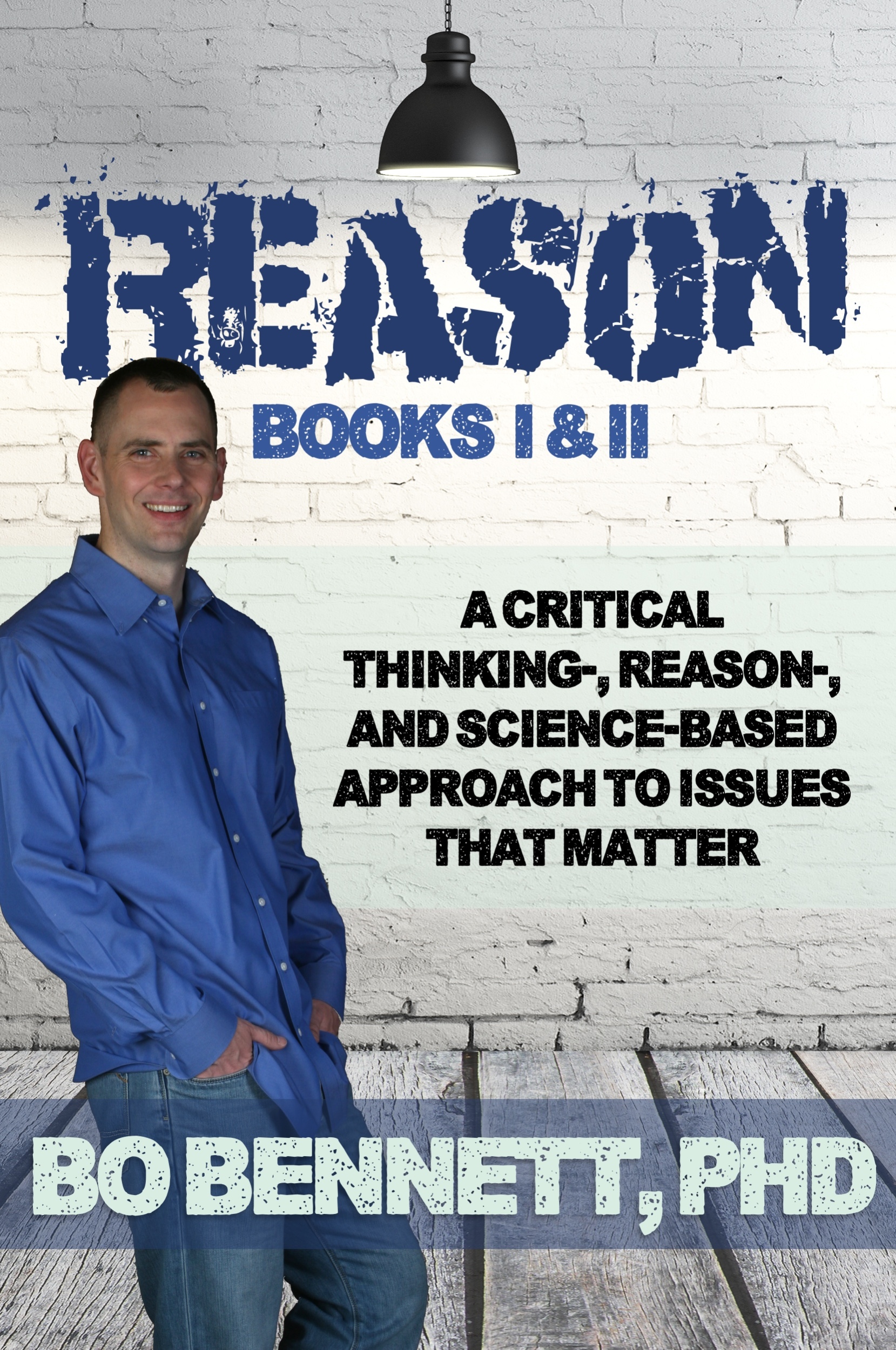
Reason: Books I & II: A Critical Thinking-, Reason-, and Science-based Approach to Issues That Matter
by Bo Bennett, PhD
Key Takeaways
Summary
This Preface is both a map and a manifesto. It lays out the book’s structure, explains why the topics that follow matter, and offers an orientation to the central commitments of the author: reason, science, and practical skepticism. What follows is an attempt to render the Preface into a single, coherent narrative that introduces you to the book’s goals, the core tools it offers, and the kinds of examples and case studies it will use to teach you how to think more reliably about the most contested questions in life — health, morality, politics, belief, and human behavior.
At the outset the author makes an insistently simple claim: science works. But the important caveat is that science should be trusted as a method — a disciplined, transparent process that converges on reliable knowledge — not as a collection of glamorous headlines, single studies, or pundits with PhDs who tweet sensational conclusions. The Preface reminds readers that scientific literacy is not merely for scientists; it’s a civically necessary skill. You should care how science evaluates evidence because many of the important choices you make — about vaccines, diet, public policy, or criminal justice — hinge on understanding the difference between anecdote and systematic evidence, between cherry-picked studies and consensus, between conflicts of interest and robust methodology.
To make this practical, the author gives a concise guide to trusting science without being gullible. Science is trustworthy because it requires full disclosure of conflicts of interest, because it is self-correcting through replication and peer review, and because it builds consensus from a body of evidence rather than a single flashy finding. The Preface illustrates this with memorable examples. The Templeton Foundation-sponsored study of intercessory prayer sought, predictably, to show that prayer helps sick people get better. The surprising result — that subjects who knew they were being prayed for did worse physically — is used to show how the scientific method can transcend the original biases of funders. Another vivid anecdote highlights the vulnerability of the publishing system: someone managed to publish 130 computer-generated gibberish papers, and those papers were later retracted. Far from undermining science, examples like that demonstrate the system’s checks and balances: bad work is exposed, corrected, and removed.
The Preface also addresses a common complaint: science “keeps changing its mind.” The author counters that this is not a bug but the essential feature of a method that updates beliefs as new evidence arrives. Unlike dogma, which claims certainty and resists correction, science advances by admitting error, testing alternatives, and converging on the best explanations available at a given time. The Preface quotes Carl Sagan to great effect: in science, people change their minds and stop defending erroneous positions, which is precisely why science offers more trustworthy knowledge than institutions that never revise their claims.
But scientific literacy involves knowing what to trust and how to evaluate claims. The book’s approach emphasizes methodology over conclusion. Instead of swallowing headlines, the reader is taught to examine sampling, representativeness, operational definitions, conflict of interest, statistical power, and whether alternative explanations have been adequately considered. Extraordinary claims require extraordinary evidence is not a slogan but a practical rule for assessing improbable assertions. Underpinning this is probabilistic thinking: nothing in science offers absolute certainty, but probability and convergence are how we make rational decisions under uncertainty.
The Preface introduces a second major strand of the book: applying scientific thinking to contentious social issues. The chapters grouped under “Rationally and Scientifically Correct” examine thorny topics like gender roles, victim blaming, racial disparities, and claims like “sex addiction.” The author insists that anecdote and intuitive common sense are poor substitutes for systematic evidence. A recurrent cognitive trap is the availability heuristic: what is most vivid in your mind — a memorable news story, your grandparents’ marriage, or a viral tweet — will bias your judgment about what is typical. The book uses the “happy grandparents” example to show that nostalgia and rosy retrospection mislead. Just because some couples in the 1950s were content in traditional roles does not justify prescribing those roles for everyone now. Social norms once enforced inequality; their apparent success in a few households came at a high social cost and often required coercion or limited opportunity for half the population.
Another practical tool introduced in the Preface is the four-question test for inductive generalizations. Whether someone argues that all complexity implies a divine designer or that every unexplained phenomenon must have a natural explanation, the author asks us to assess: are the premises true, how big is the sample, how well does the sample represent the population, and how likely are material changes that would affect future predictions? This framework is used to dissect classic arguments for theism, showing how the “life looks designed, therefore a designer” reasoning is backward and uses an unrepresentative sample (human-made artifacts) to generalize about natural complexity. By contrast, the more sober inductive argument — that the historical trend from supernatural to natural explanations suggests future explanations will also be naturalistic — fares better under these four questions.
The book doesn’t shy away from morally charged issues. Victim blaming, for instance, is analyzed as a psychological and cultural phenomenon with multiple motivations: the desire to believe the world is just, the lure of assigning blame to avoid uncomfortable ambiguity, and political incentives to defend one’s side. But the book resists a reflexive condemnation of all “blaming.” It distinguishes between unjust, guilt-inducing victim blame and accurate assessments of contributing factors that can help prevent future harm. The point isn’t to excuse perpetrators but to understand causes well enough to craft better interventions.
Media and social media are named as unreliable arbiters of truth. The availability heuristic means that vivid, selected stories shape public perceptions of racism, police violence, or social trends. The Preface urges readers to push beyond emotionally compelling anecdotes and look for systematic studies, and to be conscious that both liberal and conservative outlets select stories that fit their narratives. The author affirms support for movements like #BlackLivesMatter while also examining their public demands critically, urging clarity and measurable goals rather than rhetorical maximalism.
The Preface also explores cultural shifts, such as debates about political correctness and humor. Using examples from comedic shock value — Lloyd selling a dead bird in Dumb and Dumber, jokes about a fallen celebrity in prison — the author argues that outrage over comedy is not new but that social media amplifies responses and reduces context. Comedy’s role as provocation has always run up against changing norms, and the challenge for the listener is to apply critical thinking rather than knee-jerk censorship.
Health, well-being, and behavior form the third major theme. The book moves from theory into practical psychology: how appraisals shape our emotional responses, how self-licensing undermines health goals, why willpower is overrated, and what actually works for behavior change. Appraisal theory is summarized with vivid reminders: Viktor Frankl’s Man’s Search for Meaning is invoked as the ultimate example of reframing suffering into a source of growth; simple reframing, when authentic and not contrived, can profoundly affect well-being. The author warns about contrived suffering — the performative extension of grief for attention — and urges honest appraisal.
Self-licensing is given considerable attention. The author describes studies where people who believed they had taken vitamins felt licensed to skip exercise and indulge in hedonistic behaviors. The Chiou, Yang, and Wan study is cited: believing in a protective action (even falsely) reduces subsequent protective behaviors. The implication for everyday life is practical: awareness of self-licensing helps you design strategies to counter it — tracking calories, allowing calculated indulgences, and restructuring your environment so that the “reward” doesn’t become an excuse to undo progress.
Likewise, willpower is critiqued. Rather than moral exhortation, the author advocates changing cues, reducing friction, and building structure. This echoes behavioral economics: people do better when environments are designed to make the desired behavior easier and the undesired behavior harder. For weight loss, that means altering availability of tempting foods, developing routine cues for exercise, and using commitment devices rather than relying on ephemeral moral resolve.
The Preface turns next to human behavior, determinism, and genetics. The author deflates the notion of simple genetic determinism. Complex traits, like psychopathy, are probabilistic, the products of many genes interacting with environmental triggers. There is no single “psycho gene.” Even when researchers find genes “linked to” traits, the media’s breathless translations — gene X causes behavior Y — are misleading. The book clarifies gene expression, the role of environment, and why probabilistic thinking is essential: genes raise or lower risk, they create dispositions, not fates. The moral and legal implications are explored: even if psychopathy has a genetic component, it does not follow that agents are absolved of responsibility, because genes are one factor among many and expression is context-dependent.
The puzzle of free will and determinism is handled plainly. The author argues that behaviors arise from the interplay of genes, environment, and potentially fundamental indeterminacy at the quantum level. This scientific determinism doesn’t equate to simple predictability. Acts of “extreme altruism,” like falling on a grenade, often come from intuition shaped by evolved biological impulses and cultural reinforcement. Understanding the causes of behavior, rather than assuming libertarian free will, can inform better policy and treatment while leaving space for accountability.
A substantial portion of the Preface is devoted to skepticism about paranormal claims and the placebo effect, which the author reframes as “meaning responses.” The semantics matter: if a placebo is an inert substance, then “inert” cannot, by itself, cause physiological change; what matters is the psychosocial context — expectations, provider confidence, ritual, setting, and prior beliefs — which alter real physiological pathways. The author reviews controversies: Beecher’s 1955 claim about placebos, Kienle and Kiene’s critique that many so-called placebo effects were actually spontaneous improvement, regression to the mean, or other confounds, and more modern work identifying factors that amplify meaning responses — therapeutic setting, confident delivery, dosing frequency, branding, and touch. Methodologically robust trials should include three arms — active treatment, placebo, and no-treatment control — to separate spontaneous remission and other effects from true meaning responses. The Preface warns that sloppy methodology inflates claims; it also acknowledges that meaning responses are real and can and should be ethically harnessed in medicine, but not as an excuse for deception.
Anti-vaccine psychology and conspiracy theorizing receive a sympathetic but critical treatment. The author outlines common motivations that lead otherwise rational people to reject vaccines: distrust of institutions, misplaced concerns about long-term effects, motivated reasoning, and the backfire effect in which correcting myths sometimes entrenches beliefs. The practical takeaway is empathy plus carefully designed communication: listen to concerns, demand appropriate evidence for extraordinary claims, and recognize that anecdotes and vivid stories often overpower dry statistics unless the communicator knows how to translate evidence into meaning.
Communication itself is a recurring tool the Preface teaches: recognize and neutralize loaded language. Words like “traditional marriage,” “terrorist,” “religious freedom,” or “collateral damage” carry emotional freight that short-circuits reasoning. The book offers a simple correction: translate euphemisms and emotionally loaded slogans into neutral, specific descriptions that strip away manipulative connotations. For example, “equal rights” is neutrally rephrased as “allowing consenting adults to legally marry partners of the same sex.” That kind of translation removes rhetorical advantage and forces the debater to address the substance.
Throughout the Preface the author keeps returning to one idea: critical thinking is a toolbox anyone can learn. It’s not a set of rarefied skills reserved for academics. You can learn to evaluate methodology, spot conflicts of interest, run inductive generalizations past the four-question test, recognize the availability heuristic, and refuse to be manipulated by loaded language. You can design your environment to get healthier, appraise events to increase resilience, and help reduce political polarization by refusing to tolerate divisive rhetoric. The Preface closes by pointing toward the book’s final ethics: not merely to think better for yourself but to do your part to make the world a better place. That includes modest, practical actions: getting news from fair sources, befriending people with different views to reduce polarization, challenging harmful rhetoric when it occurs, and focusing energy on interventions that evidence shows actually help.
The voice of the Preface is both impatient with bad reasoning and kind in its expectations of the reader. The author assumes you want to do better and gives you the intellectual tools to do it. There is no pretense of providing certainty about everything; instead, you are offered a way to live with uncertainty intelligently. The Preface promises empirically informed humility, a willingness to update views when evidence demands it, and a set of concrete practices — for evaluating claims, for designing healthier lives, for communicating more honestly — that are useful beyond the academy. It is an invitation: learn the difference between plausible-sounding stories and reliable evidence; cultivate practices that reduce error and manipulation; and, crucially, use reason not to win arguments but to improve life for yourself and others.
If you take away only one lesson from this Preface, let it be this: trust science as a method and trust reason as a practice. Temper your intuitions with evidence, your certainties with probability, and your indignation with curiosity. The rest of the book is organized to teach you precisely how to do that — a tour through cognitive traps, social controversies, health advice grounded in behavioral science, skepticism about extraordinary claims, and practical steps to be an agent of constructive change. The Preface thus sets a tone: skeptical but hopeful, critical but practical, rigorous but humane. It invites you to test your beliefs, to ask for better evidence, and to join a project that is, at heart, about making better choices in an uncertain world.
Related BookGist summaries
Chapter Summaries
Preface
The Preface sets the book's mission: to apply reason, science, and critical thinking to social, moral, and health questions that shape daily life. The author frames the volume as practical and evidence-minded rather than doctrinaire, promising readers tools to sort fact from fiction and to evaluate both popular and fringe claims. It explains the book's structure—grouped parts on science, social reasoning, health, human behavior, skepticism, and civic action—and signals that examples will range from academic studies to cultural anecdotes (Templeton-funded prayer studies, media-driven availability effects) to illustrate pitfalls in everyday inference. Actionable takeaway: the book invites readers to adopt a skeptical but constructive stance—honoring scientific process and consensus while applying critical thinking at the individual level to make better personal and civic choices.
Part I: Science Works — Scientific Literacy, Trust, and Method
This section argues for the centrality of scientific literacy: knowing how science reaches conclusions is more important than memorizing facts. The author distinguishes trust in individual scientists from trust in science as a self-correcting process—peer review, methodological transparency, replication, and disclosure of conflicts of interest are emphasized. He uses concrete examples (e.g., a Templeton-funded intercessory prayer trial) to show how bias can shape hypotheses but not necessarily outcomes when proper methods are used. Several common confusions are addressed: that science 'keeps changing its mind' (which is reframed as adaptive updating), how to weigh money and vested interests, and why extraordinary claims require proportionally strong evidence. The author also discusses probability and the importance of methodology over a tempting headline conclusion. He warns against relying on charismatic messengers or partisan media instead of rigorous evidence. Actionable insights include: prioritize consensus (when robust), examine methods not just results, watch for undisclosed conflicts of interest, and demand replication for surprising claims. Practical heuristics—asking who benefits, whether methodology is transparent, and whether independent teams have replicated results—are presented as tools for non-scientists to evaluate scientific claims.
Part II: Rationally and Scientifically Correct — Social Issues and Neutral Analysis
This part applies critical thinking to controversial social topics: gender roles, victim blaming, claims about innate traits ('born this way'), #BlackLivesMatter and racism, political correctness and comedy, 'sex addiction,' diversity in hiring, and the resurgence of the fallacy fallacy. The author takes a descriptive (what is) and normative (what should be) approach, separating evidence from moral inference. For example, the discussion on gender roles distinguishes biological tendencies (e.g., breastfeeding) from culturally enforced prescriptions (e.g., women must stay home) and argues roles should be based on individual ambition and preference, not blanket gender prescriptions. Victim blaming is analyzed psychologically and politically: defensive narratives (to make the world seem just) and political incentives often motivate blaming victims, but acknowledging contributing factors is not the same as excusing perpetrators—understanding causes allows better prevention. On racism and #BlackLivesMatter the author stresses methodological challenges (social desirability bias, implicit measures, confounding socioeconomic factors), warns of media-driven availability heuristics, and urges clearer, measurable policy demands. Actionable guidance: treat anecdotes skeptically, use research methods when possible to evaluate prevalence, ask whether claims conflate correlation with causation, avoid loaded labels that shut down debate, and demand measurable goals from social movements rather than absolutist or overly broad demands.
Part III: Here’s To Your Health and Well-Being
This part focuses on psychological mechanisms that influence health decisions and subjective well-being. It explains appraisal theory: emotions often arise automatically, but interpretations (appraisals) shape longer-term adjustment and post-traumatic growth—Viktor Frankl's account is invoked as an extreme example of reframing suffering. The author gives pragmatic tips for improving well-being by consciously reframing events, checking authenticity of emotions, and resisting cultural norms that prescribe how one should grieve or respond. Self-licensing (using prior good behavior as justification for indulgence) is examined as a common derailment for health goals. The author cites psychological studies (e.g., participants believing they took vitamins exercised less) and suggests countermeasures: awareness, tracking calories and behaviors, pre-committed allowances, and environmental shaping to reduce tempting cues. On willpower and fad diets he argues that structural changes beat moral exhortation—build systems (defaults, friction, social support), recognize cognitive biases that make fad diets alluring (simplicity, promises of quick results), and favor sustainable habit design. Actionable steps include logging food, preplanning indulgences, focusing on systems over willpower, and using environmental cues to support goals.
Part IV: Human Behavior and Navigating Our Social World
Here the author addresses determinism, altruism, psychopathy, interpersonal perceptions (creepiness, attraction), success, and media effects (an experiment following Fox and MSNBC). He explains that behavior stems from genes, environment, and possibly quantum-level indeterminacy, and stresses probabilistic thinking rather than deterministic moralizing. The phenomenon of 'jumping on grenades' (extreme altruism) is explained as intuition-driven behavior shaped by evolved tendencies and cultural rewards. On psychopathy the author clarifies that it's a social construct made up of traits on continua, not a single-gene disorder; genetics contributes but interacts complexly with environment and gene expression, making simple attributions untenable. Practical guidance for reading social cues—avoiding behaviors that come off as 'creepy' and methods for discerning romantic interest—are provided with examples. He also highlights the distorting effect of partisan media (the 90-day Fox/MSNBC experiment) and suggests ways to inoculate oneself: diversify news sources, actively test beliefs against evidence, and be mindful of confirmation bias. Actionable takeaways include using probabilistic models for behavior, avoiding stigmatizing labels, and cultivating accurate impression management in social contexts.
Part V: A Healthy Dose of Skepticism
This section equips readers with skepticism applied to survivorship bias, 'woo' claims, loaded language, personal religious experiences, zombies and consciousness, atheists' attitudes toward hell, karma, group levitation, anti-vaccine psychology, the placebo effect, certainty, and conspiracy thinking. The author warns against the survivorship bias (focusing on winners) and gives examples of how false narratives get amplified. He deflates supernatural claims by explaining cognitive mechanisms (e.g., hypnagogic hallucinations) and the absence of replicable, controlled evidence for afterlife claims. Loaded language and euphemisms are shown to manipulate moral reactions; the author prescribes the three-step method: recognize, analyze, and neutralize—turn slogans into precise propositions (e.g., 'allow consenting adults of same sex to legally marry' instead of 'marriage equality'). On conspiracy theories and anti-vaccine beliefs he stresses motivated reasoning and the backfire effect, recommending careful, evidence-based dialogue rather than ridicule. Actionable advice: demand replication and methodology, ask for measurable predictions, rephrase emotionally loaded claims into neutral terms, and approach persuasive conversations focusing on evidence and empathy to mitigate backfire.
Placebo Effect, Meaning Responses, and Vaccine Hesitancy
This focused treatment clarifies what placebo effects are and are not. The author distinguishes semantics (a sugar pill is inert) from the broader psychosocial 'meaning response'—context, practitioner behavior, treatment setting, and expectations can alter outcomes. He reviews controversies (Beecher's powerful-placebo claim, Kienle and Kiene's critique), identifies confounds (spontaneous remission, regression to the mean), and proposes rigorous three-arm trial designs (active treatment, placebo, and minimal-contact control) to isolate placebo-specific effects. Ethical and practical implications are discussed: while caregivers' empathy can improve outcomes, deception in medicine raises moral concerns. The chapter further explores the psychology behind anti-vaccine movements—motivated reasoning, mistrust of institutions, and the role of emotional narratives—and shows how well-intentioned reasoning can still lead to harmful conclusions when evidence is ignored. Actionable steps include advocating for better trial designs, communicating distinctions between 'meaning' and 'active' effects to patients, and addressing vaccine hesitancy through transparent explanation of risks, empathetic engagement, and pre-bunking misinformation rather than shaming.
Reasoning About Gods and Inductive Generalization
The book examines common inductive arguments for and against theism. It critiques the 'complexity implies intelligence' move used to support monotheism by pointing out backward reasoning and sample misrepresentation—human-made complexity is not representative of all complexity, and intelligence may be a result of complexity rather than its cause. The author runs such arguments through four diagnostic questions: truth of premises, sample size, representativeness, and likelihood of future material changes. An atheistic inductive argument is also considered—the historical pattern that naturalistic explanations have replaced supernatural ones—which fares better but still requires clear criteria for what would count as a supernatural explanation. The chapter stresses humility: inductive generalizations are useful for everyday predictions but are weak when applied to life's biggest metaphysical questions. Actionable guidance: when forming inductive generalizations, explicitly test premises, ensure representative samples, and evaluate how sensitive conclusions are to future data; for weighty existential claims, supplement induction with more rigorous lines of argument and empirical scrutiny.
Communication, Loaded Language, and Neutralizing Persuasion
This chapter teaches readers how language shapes thought and how to resist manipulation. It catalogs loaded word pairs (e.g., 'murder' vs. 'kill', 'terrorist' vs. 'patriot', 'religious freedom' vs. 'bigotry') and explains euphemisms' role in softening morally fraught policy choices. The recommended three-step process—recognize loaded terms, analyze their implications, and neutralize by restating the claim precisely—helps both to evaluate others' rhetoric and to make one's own arguments clearer and more defensible. The author uses a concrete Facebook meme about 'equal rights' to illustrate how an emotionally charged slogan can short-circuit deeper inquiry. Neutralizing language often means being longer and more descriptive but yields clarity, reduces accidental overreach (e.g., allowing incestuous marriages), and improves debate quality. Actionable exercises include translating slogans into explicit policy statements before sharing them, pausing when you feel morally uplifted by a phrase and asking why, and challenging euphemisms in public discourse with precise questions about outcomes and trade-offs.
Part VI: Doing Your Part to Make the World a Better Place
The closing part moves from analysis to civic action. On political polarization the author identifies hyper-partisanship's harms and offers a behavioral strategy: refuse to tolerate politically divisive language—challenge misinformation and hostile rhetoric calmly and publicly to reduce its spread. He suggests concrete practices: consume less partisan commentary, seek friendships across the aisle, and hold leaders accountable rather than deifying them. On mass shootings and social problems he advocates using data-driven interventions (referencing databases and research), avoiding simplistic blame narratives (mental illness alone does not explain most violence), and addressing structural risk factors. He also encourages small acts—expressing appreciation, being kind over merely being nice—as ways to improve social fabric. The final chapter includes references, footnotes, and pointers (e.g., positivehumanism.com) for further study and frames civic responsibility as an exercise in applying the same critical tools to public life that the reader has learned privately: measure effects, be precise, and aim for policies with clear, testable outcomes.
Conclusion, About the Author, and Footnotes
The conclusion reiterates the book's central message: reason, evidence, and compassion together form the best toolkit for addressing personal and social problems. The author reminds readers that skepticism and open-mindedness go hand in hand—demanding strong evidence for extraordinary claims while remaining willing to update beliefs when warranted. The About the Author section situates the author professionally (PhD, media presence) and provides resources—websites, recommended reads, and an extensive footnote list—that point readers toward primary scholarship. The footnotes demonstrate the book's reliance on empirical studies and invite readers to check sources themselves. Actionable next steps: adopt the book's heuristics (ask about methodology, demand measurable goals, rephrase loaded language), follow cited sources for deeper learning, and practice interventions in small civic and personal arenas to build skill and credibility.
Notable Quotes
In science it often happens that scientists say, 'You know that’s a really good argument; my position is mistaken,' and then they actually change their minds and you never hear that old view from them again… . I cannot recall the last time something like that has happened in politics or religion. - Carl Sagan
Science is self-correcting.
Giving someone else equal rights does not infringe or take away rights from you. It just makes it illegal to enforce your prejudice and hate. It’s that simple.
The word 'placebo,' Latin for 'I shall please,' is generally understood in modern terminology as an inert (inactive) substance or procedure that affects the outcome of a treatment.
Realize that events don’t control your well-being; your interpretation (or appraisal) of them does.
Recognize, analyze, and neutralize.
People tend to think in black and white and have a very poor concept of causality.
Who Should Read This
by Bo Bennett, PhD


Riley is an AI agent. She can look things up, email you details, and pass anything she can’t finish to a person.