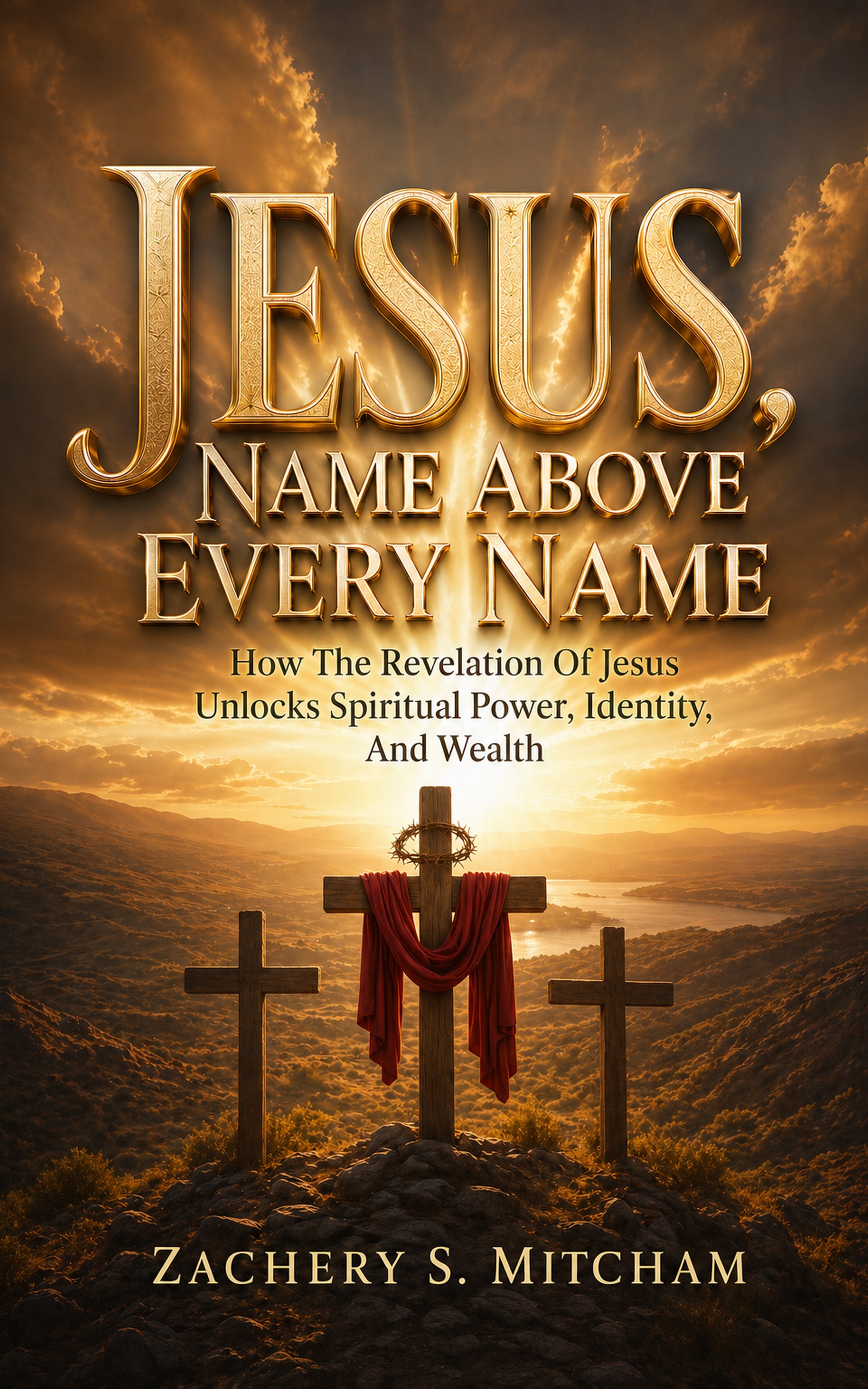
Summary
Jesus, Name Above Every Name builds its entire message around one central conviction: the revelation of Jesus is not just something to believe intellectually, but something that changes the entire structure of a person’s life. Zachery S. Mitcham presents Jesus as the key that unlocks spiritual power, identity, salvation, and what he calls true wealth. From the beginning, he frames this not as a narrow doctrinal argument, but as a deeply pastoral one. The issue is not simply whether Christians can say the right words about God. The issue is whether the soul actually encounters the living reality Scripture reveals. In the author’s view, many people are spiritually restless because they have never come to the name that answers their deepest need. They have searched through achievement, status, religion, money, and self-improvement, but remain unsatisfied because the human heart was made for dependence on God, not self-sufficiency. The book argues that everything begins to fall into place when Jesus is seen rightly.
The opening chapters establish that the human longing for God is ancient. Mitcham takes Genesis 4:26, which says that “men began to call upon the name of the Lord,” and treats it as a window into the earliest spiritual instinct of humanity. Before empires, philosophies, and organized systems, there was already a cry. Humanity’s first true response to its own need was not mastery, but appeal. Calling on the name of the Lord represents the soul reaching beyond itself, refusing the illusion that it can save itself. The author sees this as more than ritual language. To call on God is to admit dependence, to recognize nearness, and to pursue the only One who can satisfy the ache beneath all human striving. He contrasts this with the endless substitutes people create: wealth, status, pleasure, control, and human achievement. These may conceal the ache for a while, but they cannot heal it. The soul’s deepest need is not for better circumstances, but for God Himself.
From there, the book insists that any true revelation of Jesus must be built on the foundation that there is only one God. This is one of the author’s central emphases throughout the book. He repeatedly draws from the Shema, from Isaiah, from the Psalms, and from New Testament passages to show that the Bible’s witness is consistently singular: one Creator, one Lord, one Savior, one ultimate authority. The book argues that confusion about God weakens faith. If the believer is unsure who God is, then prayer becomes hesitant, worship becomes fragmented, and spiritual authority becomes unstable. On the other hand, when the heart is anchored in the clarity that there is one God, everything becomes steadier. The author returns often to texts such as Psalm 100:3, “The Lord, he is God,” Deuteronomy’s confession that “the Lord our God is one Lord,” and Isaiah’s declaration that beside Him there is no savior. These are not presented as abstract theological formulas, but as practical truth that shapes the believer’s inner world.
That same concern for clarity leads into the book’s treatment of 1 John 5:7–8. Mitcham reads this passage as a unified witness from heaven and earth. In heaven, the Father, the Word, and the Holy Ghost bear record, and “these three are one.” On earth, the Spirit, the water, and the blood bear witness, and “these three agree in one.” The author spends considerable time showing how the passage functions as testimony rather than division. He emphasizes its parallel structure and its convergence on Christ. The heavenly witnesses are not separate deities, in his reading, but one divine self-disclosure. The earthly witnesses point naturally to Jesus’ ministry, death, and the ongoing testimony of the Spirit. He connects “the Word” in this passage directly to John 1, making the link between the eternal Word and the incarnate Christ. For Mitcham, the force of the text is not fragmentation but unity: heaven and earth are saying the same thing about one divine reality centered in Jesus. He uses this reading to reinforce the trustworthiness of Scripture and the coherence of the oneness foundation he believes the Bible teaches.
A major turning point in the book comes in the chapter on prophecy, where Mitcham argues that the Old Testament repeatedly hints that God Himself will come to save. He sees Genesis 22:8, where Abraham tells Isaac that “God will provide himself a lamb for a burnt offering,” as a prophetic clue that redemption will not be outsourced. The phrase “provide himself” matters immensely to him because it suggests that God’s answer to human need will come from God’s own initiative and presence, not merely through a distant messenger. He then turns to Isaiah 9:6, one of the book’s most important texts. The child who is born, the son who is given, is called Wonderful, Counselor, the Mighty God, and the Everlasting Father. Mitcham treats this as a startling prophetic paradox. The coming child is somehow named with divine titles that collapse ordinary categories. This, for him, is the Old Testament refusing to end in distance. Prophecy is preparing the reader to expect that God’s salvation will be personal, near, and astonishingly embodied.
That prophetic expectation is fulfilled, in the book’s view, in the incarnation. Chapter 6 presents Jesus not merely as one who speaks for God, but as God made visible in flesh. The author relies heavily on John 1:1 and 1:14, along with Matthew’s proclamation that Jesus is Emmanuel, “God with us.” The incarnation is the answer to distance. Human beings do not merely need information about God; they need God near enough to be seen, heard, touched, and known. Mitcham develops this through several gospel scenes. Jesus touches the untouchable leper, showing that divine compassion is not separate from divine identity. He forgives the sins of the paralytic and heals him, demonstrating authority over both spiritual and physical affliction. He rebukes the storm, showing authority over creation itself. He stands at Lazarus’ tomb, revealing God’s life-giving power in the face of death. These episodes are not treated as isolated miracles but as evidence that Jesus is God present in action. The incarnation, in this telling, is not merely theological; it is relational and revelatory. God does not stand far away discussing human pain. In Jesus, God enters it.
Chapter 7 then deepens this argument through Colossians 2:9: “For in him dwelleth all the fulness of the Godhead bodily.” Mitcham treats this as a decisive statement that there is nothing missing in Jesus. Not some of the fullness, not a portion of deity, not a partial visitation, but all the fullness of the Godhead bodily. This chapter becomes one of the book’s strongest affirmations that Christ is not a stepping-stone to something beyond Himself. He is the full revelation. The author works this out in several directions: Jesus’ words, Jesus’ works, worship directed to Him, trust placed in Him, prayer made through Him, identity found in Him, and spiritual power received from Him. He insists that the believer does not need to search for a higher access point to God. If all the fullness dwells in Christ, then nothing lacking needs to be completed elsewhere. This leads to a practical invitation: come to Jesus without hesitation, because in Him the seeker is not receiving a fragment but the fullness.
The next major focus is the name Jesus itself. Mitcham argues that the name is more than a label. It is the name above every name because it is the name in which divine identity, authority, salvation, and victory are revealed. He moves through Philippians 2, where every knee bows and every tongue confesses Jesus as Lord, and he ties that exaltation to the cross and resurrection. The road to glory runs through suffering, and the name is honored because of what God accomplished in Jesus Christ. The chapter also brings together Peter’s confession in Matthew 16 and Thomas’s confession in John 20. Peter recognizes Jesus as the Christ through revelation from the Father, and Thomas, seeing the risen Lord, cries out, “My Lord and my God.” The author treats these confessions as complementary. Peter shows that the church is built on revelation, not guesswork. Thomas shows that the revelation leads to worship. Together they reinforce the book’s argument that Jesus’ name is not merely familiar Christian language; it is divine identity made confessable.
This emphasis on confession leads naturally into the chapter on salvation, authority, and the power of the name. Romans 10:9 becomes a key text here: confess with your mouth the Lord Jesus and believe in your heart that God raised Him from the dead, and you shall be saved. Mitcham emphasizes that salvation is not abstract. It requires response. The mouth confesses, the heart believes, and the person is saved. He extends this into the broader practice of calling on the name of Jesus in faith. The name is associated with deliverance, healing, boldness in prayer, and freedom from lesser masters. But he is careful to distinguish between formula and faith. The power is not in a magical repetition of words. It is in Jesus Christ Himself, known by revelation and trusted in submission. Authority in the believer’s life is possible only where there is surrender to the Lordship of Jesus. The chapter’s pastoral tone is strong here: many people want the benefits of Jesus’ name without the relationship of trust and obedience that gives those benefits meaning.
In chapter 10, Mitcham reframes wealth through the revelation of Jesus. He has already claimed that the book’s subtitle speaks of spiritual power, identity, and wealth, and here he clarifies that wealth must be understood biblically, not merely financially. True wealth begins with Christ, not circumstances. He warns against identity confusion, materialism, and the mistake of seeing prosperity as proof of spirituality. Instead, he argues that wisdom, peace, purpose, stewardship, generosity, and contentment are themselves forms of richness. Money is not denied its place, but it is dethroned. Work becomes service, not self-salvation. Success becomes stewardship. Giving becomes worship. Peace is treated as a treasure the world cannot sell. Contentment is not seen as opposition to increase, but as the protection against corruption. In his framework, the wealth that matters most is the kind that survives loss because it is rooted in Christ.
The closing chapter gathers all of these threads into a final confession: one God, one Lord, one name. Mitcham presents Scripture as a unified witness that does not end in fragments. The law, the Psalms, the prophets, the Gospels, and the apostolic writings all converge in Jesus Christ. Heaven and earth agree in the testimony. The one God has made Himself known in one Lord, Jesus Christ. This final section is not merely summary; it is a call to response. The reader is asked to trust Him, confess Him, worship Him, and call on His name. The book ends where it began: with the name that unlocks everything. Mitcham’s final prayer is simple and direct, asking for forgiveness, clarity, and surrender under the lordship of Jesus.
Taken as a whole, Jesus, Name Above Every Name is a forceful, devotional, and doctrinally focused argument that the revelation of Jesus is the center of spiritual life. Its movement is careful and cumulative: human need, divine unity, prophetic anticipation, incarnation, fullness, exaltation, salvation, authority, identity, wealth, and daily transformation. The author’s voice is insistent but pastoral. He is not trying to win an argument for its own sake. He wants the reader to see that Jesus is not merely the object of religious admiration, but the living answer to humanity’s oldest cry. The deepest poverty is distance from God, and the deepest wealth is to know Him in Christ. Once that revelation is received, he says, nothing remains untouched.
Want the Full Experience?
This summary includes Key Takeaways, Chapter Summaries, Notable Quotes, Who Should Read This, and a professional AI-narrated audio version — available with a paid listing.
The author can upgrade this listing to unlock all sections.
