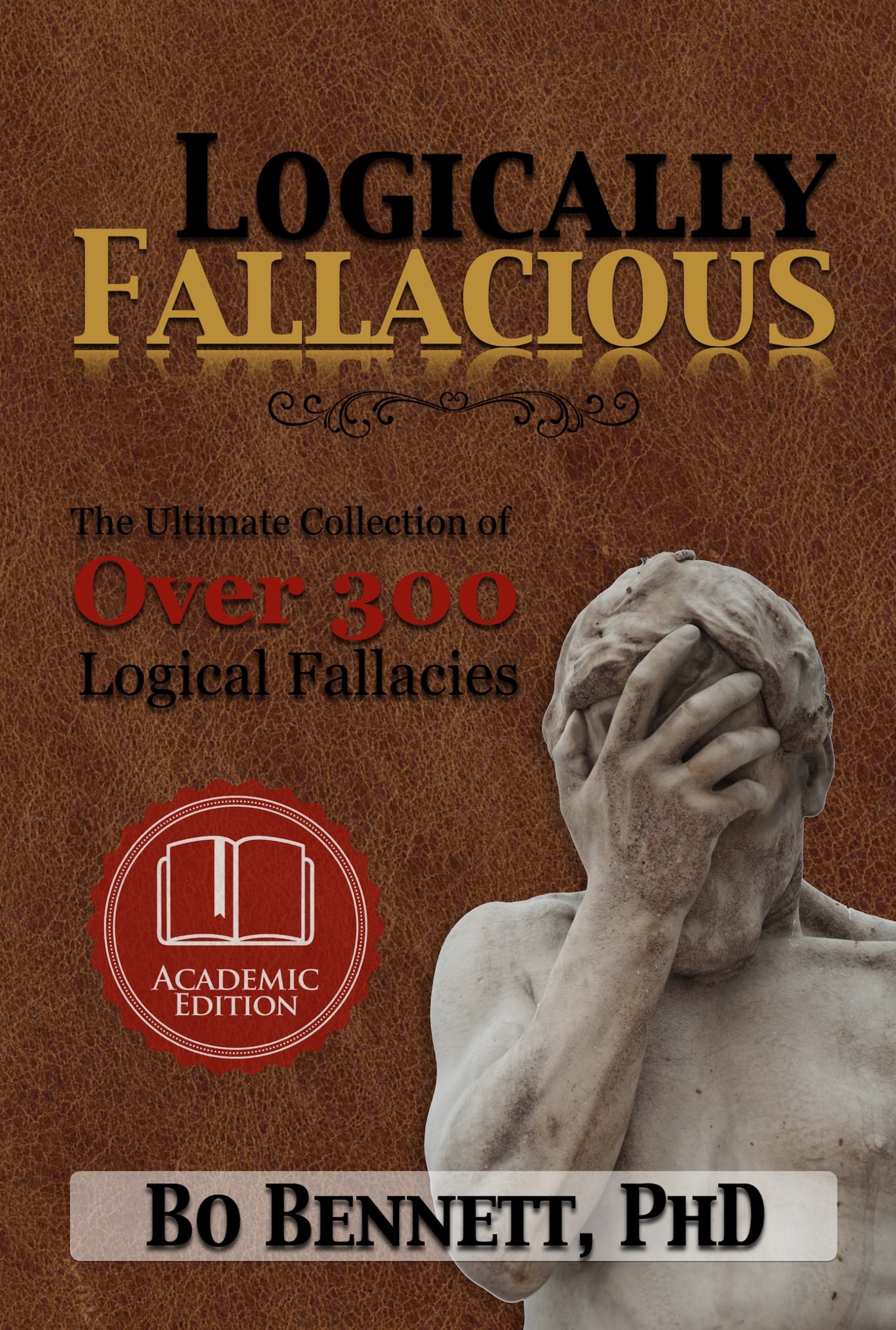
Logically Fallacious
by Bo Bennett, PhD
Key Takeaways
Summary
Logically Fallacious is, at heart, a handbook of intellectual hygiene. Bo Bennett’s aim is simple and urgent: teach readers to recognize, name, and resist the many ways someone can be persuaded without good reasons. The book is not a dry technical manual. It is a brisk, often witty tour through more than three hundred logical fallacies, organized so that a commuter or a student can dip in, learn a pattern, remember an example and walk out of a conversation intact. Bennett writes with the impatience and humor of a teacher who has seen the same bad arguments repeated over and over—on talk radio, at the water cooler, and most infectiously, on the internet—and wants to inoculate his readers against them.
Bennett begins by laying out the foundations: what reasoning is, what arguments are meant to accomplish, and how beliefs should be supported by reason and evidence. He emphasizes that reasoning is the process by which we move from premises to conclusions, and that arguments are tools for advancing beliefs or persuading others. Importantly, he distinguishes between the psychological fact of holding a belief and the normative standard of having reasons for that belief. A lot of the book’s energy flows from that distinction: we can feel confident and yet be wrong, or be uncertain and nonetheless have excellent grounds for a conclusion. Understanding this lets you see how easily rhetoric can substitute for reason.
So what, exactly, is a logical fallacy? Bennett’s working definition is practical: a logical fallacy is an error in reasoning that renders an argument invalid, weak, or deceptive. Fallacies can be formal—where the structure of an argument is invalid—or informal—where the content, context or language misleads. The formal ones follow recognizable patterns of propositional or categorical logic that commit structural mistakes; the informal ones rely on ambiguity, emotional manipulation, or relevance errors. Bennett stresses that fallacies are not simply rude rhetoric or factual mistakes. Confusing a factual error for a fallacy muddies the water: a false premise is a factual problem, but the fallacy lies in the inferential move that illegitimately draws a conclusion from that or other premises. Likewise, cognitive biases—well-studied psychological tendencies—are not the same as fallacies, though they often make fallacious reasoning more likely.
Throughout the book Bennett insists on three practical criteria for labeling an argument fallacious: first, there must be an identifiable error in reasoning; second, that error must be relevant to the truth of the conclusion; and third, the error must have some deceptive or persuasive force that plausibly leads people to accept the conclusion. In other words, a fallacy is not just wrong, it is wrong in a way that fools people into thinking they have a good reason. This pragmatic approach helps readers decide when to call something a fallacy and when to treat it as merely an odd argument.
Bennett’s method is simple and effective. Each entry follows a pattern: the name of the fallacy (often with alternate names), a short description, a logical form where appropriate, concrete examples, an explanation of why the move is illegitimate, exceptions when the move is not fallacious, practical tips for handling it, and sometimes references or humorous “fun facts.” This makes the book a sort of field guide; you learn what these errors look like in the wild and how to dodge them. Bennett’s voice is conversational, sometimes sardonic, which helps the reader retain the lessons: humor is another persuasive technique, and he uses it to teach resisting persuasion.
The book then dives into the catalogue, and here it becomes a rich parade of patterns and anecdotes. The ad hominem family gets early attention: attacking the person instead of the argument can look like an argument if it is framed as casting doubt on reliability, but Bennett shows variations—abusive ad hominem (insults), circumstantial (suggesting motive undermines the claim), guilt by association, or the tu quoque “you do it too” rebuttal. The point is not that personal information is never relevant—if someone’s bias is germane, mention it—but that substituting character for reason is fallacious when it doesn’t address the argument’s merits.
Bennett gives plentiful, memorable examples. To see a formal fallacy, he uses affirming the consequent: the structure “If P then Q. Q. Therefore P.” He illustrates with a bathroom joke—“If it’s brown, flush it down. I flushed it down. Therefore it was brown”—to show that the consequent’s truth doesn’t prove the antecedent. For alleged certainty, he counters sweeping assertions like “Everyone knows X” by reminding readers that “everyone” rarely does; such statements substitute rhetorical force for evidence. The alphabet-soup fallacy, a more mundane social media complaint, points out how acronyms and credentials can be wielded to intimidate or obscure rather than clarify.
Among the rhetorical tricks, Bennett highlights the appeal to authority and its many disguises: appeal to celebrity, anonymous authority, false authority, blind authority. Authorities can provide evidence, but an appeal becomes fallacious when the person cited lacks relevant expertise or when consensus is replaced with mere citation. He pairs that with appeal-to-intuition and appeal-to-gut examples: people sometimes reject well-supported claims because they “feel” wrong. Bennett is fair enough to acknowledge that intuition can be the distilled wisdom of experience—like a firefighter’s sense about opening a door in a burning building—but warns that intuition and imagination are easily conflated. When time allows, he advises corroborating intuitions with reasons.
Emotional appeals get an entire gallery. Appeals to fear, pity, anger, flattery, and spite are persuasive and appear everywhere in advertising and politics. Bennett’s examples are vivid: a boss threatening an employee who asks a fair question is an appeal to force; a parent threatening a summer of solitude to compel church attendance is an appeal to coercion. The Jonestown tragedy appears as the extreme example of an appeal to loyalty and charismatic authority: where loyalty replaces evidence and dissent is treated as disloyalty, catastrophic outcomes follow. Bennett uses that case to warn readers about the dangerous combination of charisma and unchallenged loyalty.
The book also unpacks subtler misdirections. The red herring, for instance, is an intentional diversion—change the topic to one you can handle. Examples—shifting from “Why did you cheat?” to abstruse questions about morality—show how a conversation can be derailed. The straw man gets a similar treatment: misrepresent your opponent’s view in an easier-to-refute caricature. Bennett’s examples include public debates and internet flamewars, where straw men thrive. Closely related are the moving-the-goalposts and the argument-from-silence fallacies. Moving the goalposts is refusing to accept a satisfactory rebuttal by demanding endlessly raising standards; argument-from-silence treats someone’s refusal to provide evidence as admission of guilt—Silent Bob’s silence does not logically establish that he took the car keys.
Statistical and probabilistic mistakes are frequent and dangerous. The base-rate fallacy, the ecological fallacy, the Texas sharpshooter, and survivorship bias all misread data. Bennett points out that group statistics do not directly tell you about any individual. Men scoring higher on average in a test doesn’t make any given man better than a given woman. The Texas sharpshooter metaphor—shoot randomly then draw a bullseye around the biggest cluster—captures cherry-picking and post hoc pattern-hunting. Similarly, the gambler’s fallacy and the hot-hand fallacy show how people misunderstand chance: a streak doesn’t imply a cause and isn’t necessarily predictive. The regression fallacy shows how natural fluctuations—like a headache subsiding—can be mistaken for causal effects when they would have changed anyway.
Language and definition are another major theme. Equivocation—the shifting of a word’s meaning within an argument—can make a premise appear to support a conclusion when it doesn’t. Etymological fallacy, where someone appeals to the historical meaning of a word as if that is its binding sense today, receives a playful chastisement: words evolve, and using ancient meanings to rescue a point is usually a weak move. The book stresses careful use of definitions, because many debates dissolve when terms are clarified.
Bennett’s catalogue also covers conspiratorial thinking—conspiracy theories, the Gish gallop of throwing many weak claims at once, and the tendency to prefer far-fetched or magical explanations over simpler ones. He dissects the “fallacy of many questions” or complex question fallacy—trap questions that assume what they purport to ask—and the false dilemma that forces a choice between two extremes when many alternatives exist. The “lose-lose” or alternative advance examples—where both options presented are the same with different wording—are common techniques in sales and politics. Bennett’s advice: always look for unstated alternatives.
An important section distinguishes logical fallacies from cognitive biases. Fallacies are errors in the structure or relevance of an argument; biases are predictable mental shortcuts. The book lists numerous biases—anchoring, availability, confirmation bias, choice-supportive bias, Dunning-Kruger in effect through overconfidence, mere exposure, loss aversion, planning fallacy, framing effects, and many others—each illustrated with a quick example. These biases explain why fallacies work: people already have cognitive tendencies that make them receptive to certain rhetorical moves. Understanding biases helps you see why a fallacious argument persuades even reasonable people.
Bennett doesn’t ignore the rhetorical environment. He shows how repetition, fast-talking, emotional language, and selective reading can manipulate audiences. The hypnotic bait-and-switch is a sales technique where a sequence of agreeable statements softens resistance before a controversial claim is introduced. Advertisers and demagogues rely on the “get the audience used to saying yes” tactic. The book’s practical tips often boil down to the same advice: slow the conversation down, demand evidence, check sources, and think probabilistically.
The author sprinkles helpful exceptions and tips throughout. He acknowledges that not every appearance of a pattern is fallacious. For instance, sometimes appealing to an authority is appropriate; sometimes emotional arguments are apt when values are in play. The “argument to moderation” fallacy—that the middle ground between two claims must be correct—is critiqued, but Bennett admits there are negotiation contexts where compromise is appropriate. The moralistic fallacy—deriving “is” from “ought”—and its mirror, the naturalistic fallacy, get serious treatment because they are central to many public debates. Science tells us what is; policy debates require values.
Bennett gives readers defensive strategies as well. Name the fallacy when appropriate, ask for premises, insist on definitions, and request evidence. Be charitable but skeptical: offer your interlocutor the benefit of the doubt, then press for support. He cautions against becoming a mere “smart-ass” who seeks to win arguments by nitpicking trivialities. The goal is not rhetorical point-scoring but improving the quality of discourse. He also warns against the opposite sin: seeing fallacies everywhere and becoming paralytically skeptical. Apply the three criteria mentioned earlier: error, relevance, and deceptive power.
The book is full of memorable examples that stay with you. The Jonestown example anchors the danger of appeals to loyalty; the “if it’s brown, flush it down” bathroom joke makes affirming the consequent unforgettable; the Office Space Hitler-card moment highlights reductio ad Hitlerum; Silent Bob’s silence illuminates argument from silence; Willard’s “I will never go bald” absurdity demonstrates the beard or continuum fallacy; the magician-like hypnotic bait-and-switch shows how persuasive sequencing works. Bennett pulls anecdotes from literature, film, journalism, history and everyday life to show the ubiquity of bad reasoning.
Bennett also addresses unfalsifiability: claims structured so they cannot be contradicted by any possible evidence. Any unfalsifiable claim escapes rational evaluation and should be treated with skepticism; such claims are often religious or metaphysical, and while they might have emotional or existential meaning, they do not function as empirical arguments. Closely connected is the problem of cherry-picking and selective use of data. Bennett’s statistical examples—ecological fallacies, base-rate neglect, and the Texas sharpshooter—are practical reminders that data is only as good as how it’s used.
Toward the book’s end, Bennett catalogues cognitive biases and frames them as a partner to fallacies. Where fallacies are the moves in argumentation, biases are the cognitive soil that makes those moves grow. He lists a large set of biases—anchoring, optimism bias, confirmation bias, negativity bias, stereotyping, self-serving bias, and many more—each accompanied by a crisp definition and quick illustration. This section is less about naming errors in argument form and more about understanding our own mental faults so we can correct for them.
The final lessons are both practical and ethical. Bennett urges readers to be accurate in attributing fallacies: naming helps, but being cavalier in labeling every flawed argument a fallacy diminishes credibility. He counsels patience: the point is education, not humiliation. Be ready to provide better reasoning and evidence rather than merely point out mistakes. And he returns to his central pedagogical motto: teach people how to think, not what to think. A person who can spot a logical error in their own reasoning has gained a tool for lifelong learning.
Logically Fallacious is therefore more than an index of errors; it is a training manual for intellectual resilience. By giving names to patterns—ad hominem, straw man, red herring, false dilemma, appeal to authority, argument from ignorance, slippery slope, equivocation—Bennett empowers readers to see arguments clearly. The repeated structure of description, form, example, and tip makes the book usable in the moment: when you encounter a dubious claim online, you can think, “that’s a Gish gallop,” or, “that’s an argument from ignorance,” and respond accordingly.
The tone of the book makes learning enjoyable. Bennett doesn’t merely scold; he invites readers to laugh at ridiculous arguments and then learn from them. He brings an academic appreciation for logical rigor together with an educator’s impatience for sloppy thinking and a comedian’s timing. The mix works. You leave the book with a toolkit: a set of labels, a set of questions to ask, and a set of mental checks to slow down your own cognitive shortcuts.
If there is a final practical takeaway, it is this: be skeptical but constructive. When you detect a fallacy, explain it briefly, ask for evidence, and offer an alternative way of framing the issue. Don’t let rhetorical flourish substitute for argument. Demand clarity in definitions, insist on relevance in premises, and think probabilistically when data and chance are involved. Logical literacy is civic literacy; the ability to identify and respond to fallacious reasoning is essential in an era of viral misinformation and emotionally charged public debate.
Bo Bennett’s book is a companion for that task. It hands you language for error, examples to remember, and a steady voice that says: mistakes in reasoning are common, but they can be taught, corrected, and often avoided. With practice, the patterns become visible, and conversations become less about defeating opponents and more about discovering what is actually true. That is the promise of Logically Fallacious: a more reasoned world, one named fallacy at a time.
Related BookGist summaries
Who Should Read This
by Bo Bennett, PhD


