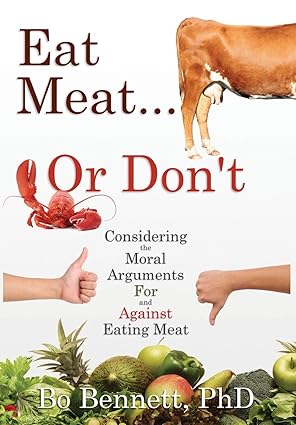
Eat Meat... or Don't: Considering the Moral Arguments For and Against Eating Meat
by Bo Bennett
Summary
This preface begins as a conversation—part personal introduction, part philosophical primer—inviting the reader into a careful, measured inquiry about one of the most emotionally charged moral questions we routinely face: is eating meat wrong? The author opens by describing his own position and privileges: a reasonably comfortable life in a place with plentiful vegetarian options, an openness to technology and science, and the humility of acknowledging that many of the arguments he will present are tested against his own behavior. That honesty sets the tone. This is not a jeremiad calling everyone to immediate ascetic purity; it is an attempt to clear conceptual ground, examine arguments fairly, expose common rhetorical tricks, and then locate the question inside competing moral theories and the messy reality of human psychology.
Right away the preface tackles linguistic shenanigans and the tendency to confuse principle with practice. A typical trick is the “in principle but not in practice” gambit: someone concedes that, logically, if a particular trait were the basis of moral status then extreme conclusions follow—for instance, that a person in a persistent vegetative state could be killed for food—but then retreats to saying, “Well, in principle yes, but in practice no.” The author tears this down by showing how it can be used to avoid the hard work of justification: if you permit the retreat, then any principle can be protected from its implications by the safe harbor of “in practice.” That undermines consistency. The preface also rehearses the reductio ad absurdum, a classic philosophical move that forces a position to reveal its consequences. Use it well and you show a principle to be untenable; use it poorly and you build an imaginary world so far from reality that the exercise becomes absurd. The reductio used against a meat-eater who appeals to cognitive capacity—“Why is it okay to kill cows but not cognitively disabled humans?”—is powerful because it forces people to confront whether they are willing to bite the bullet and accept a morally repugnant extension of their principle. Yet the preface warns of overreach: list too many conditions away and you strip the thought-experiment of all its relevant content. The “dog poop” reductio shows that if you negate every real effect of an action you end up debating an emotional response to an empty imagination.
Precision in language matters, and so does stipulating what we mean by “eating meat.” The preface limits the discussion to the common cultural practice of consuming animals most people eat, regardless of how they were raised, while acknowledging relevant outliers—people in food deserts, unique medical conditions, or cultural subsistence scenarios. Labels are simplified for convenience: “meat-eater” for anyone who eats meat at all, and “vegetarian” to cover anyone who abstains from meat, including vegans for the purpose of argument. The author acknowledges that “meat-eater” conjures a caricature of barbarism but insists that it is the right shorthand for the discussion ahead.
Optimism punctuates the skepticism. The preface celebrates the emerging “clean meat” revolution: lab-grown meat produced without conscious animals, which promises to disrupt many moral arguments by eliminating suffering and death in the supply chain. The author is cautiously hopeful here, recounting his own experience sampling the Impossible Burger as an accessible example of how technology can alter our moral landscape. Clean meat, when it arrives at scale, will change the calculus in ways that make many current arguments obsolete; for now, though, the existing realities of factory farming, supply chains, and cultural entanglements remain the terrain for ethical analysis.
The book’s philosophical core is introduced through a tour of moral theories and a proposal. The author insists that morality cannot be decided outside a moral framework; competing intuitions about whether eating meat is right or wrong trace back to differing foundational commitments. He surveys familiar theories—moral subjectivism, cultural relativism, ethical egoism, utilitarianism, deontology, virtue ethics—and lands on sentiocentrism as the most promising universal basis for moral reasoning. Sentiocentrism values well-being in proportion to sentience: the capacity to experience pleasure and pain. It is attractive because it ties morality to something most humans value—well-being—while leaving room for reasonable differences about what counts most within that spectrum. Sentience is empirically grounded; sentient beings suffer and flourish, and that makes their welfare morally relevant.
But moral theory is only part of the story. The preface carefully distinguishes moral status—the metaphysical or phenotypical claim about what kinds of beings are morally relevant—from affective and social moral value, the subjective and collective gradations of concern we actually grant to organisms. Moral status is about whether an organism counts morally at all; affective moral value is the degree we personally care, shaped by empathy and aesthetics; social moral value is the cultural weight a group accords, shaped by institutions, traditions, and shared investments. These layers explain many everyday moral disparities: we rescue children from ponds but not raccoons on the roadside, we care more about dogs than pigs, we line up to attend football games that depend on animal products. The preface shows how affective and social values sometimes swamp the metaphysical claims of status and how situational factors—laws, norms, context—change moral calculations.
Important psychological dynamics get center stage. Motivated reasoning is spotlighted: smart people are not immune to bias; they are sometimes better at defending pre-existing commitments. The author cites Keith Stanovich’s concept of rational intelligence and encourages readers to cultivate better reasoning skills, but emphasizes that emotion and appetite are hard to dislodge. Hypocrisy is explored with nuance. Three archetypes—the private confessor who acknowledges a lapse, the private hypocrite who conceals it, and the public scolder who performs virtue in public while practicing vice in private—are used to differentiate degrees of hypocrisy and to caution against moral grandstanding. The “Goldilocks bias” is introduced as a determinant of interpersonal hostility: we tend to view others as morally deficient if they fall short of our ideal, while we dismiss those who do more as “extremists.” Recognizing this can limit needless infighting among people who are generally on the same side.
The preface turns to the famous “argument from marginal cases,” the philosophical insistence that if we grant moral value to certain humans who lack typical capacities—infants, the cognitively disabled—then consistency demands we grant moral value to animals that possess similar capacities. The author examines multiple forms of the argument, including Peter Singer’s formulation and the more elaborate “name the trait” or “trait-equalization” dialogue. The analysis is methodical and fair. The author notes that these arguments aim to show animals deserve moral status, but they do not, by themselves, establish the immorality of eating meat. To get from status to obligation requires additional premises about affective and social value, the weight of interests, and what counts as sufficient reason to kill. Several important objections to marginal case arguments are explored: the appeal to human capacities as a threshold for personhood; the risk of treating moral status as binary versus gradational; the problem of counterfactual worlds in thought experiments such as placing a human mind in a pig. The author cautions against confusing hypothetical or impossible hybrids with the actual world; many trait-equalization moves depend on imaginary scenarios that introduce equivocations and non-sequiturs.
Dualism versus monism receives a short, sharp treatment. Religious intuitions about souls provide an easy escape hatch from the argument—“people have souls, animals don’t”—but the preface points out that when we move to metaphysical claims we often step outside empirical discourse and into unfalsifiable assertions. The scientifically grounded monist view—that minds depend on brains—makes the case that minds are physical and not transferable in the way some arguments require. This undermines certain mind-swapping thought experiments and forces the conversant back into the real-world terrain where biology constrains moral attribution.
Having established that animals likely have some moral status, the author shows why many people nevertheless consider killing animals for food morally different from killing humans. Social moral value, affective moral value, situational morality, and the overall calculation of well-being in sentiocentrist frameworks explain the divergence. Cultural acceptance of eating animals, the fact that animals may contribute net benefits through food, clothing, and other products, and the different kinds of experiences animals have compared to humans all factor in. The preface does not pretend these are airtight defenses; instead, it demands we test them against the weight of suffering, the empirical lives of animals in industrial systems, and technological alternatives that could reduce harm.
The author next examines common pro-meat arguments: that nature is brutal anyway, that some existence is better than none, that minimal suffering justifies killing for food, that human well-being trumps animal well-being, or that killing animals for food is a different moral act than cruelly eating a human. Each receives a fair hearing and a critical response. The preface also acknowledges the breadth of animal-derived goods in daily life—everything from adhesives and paints to insulin and baseballs—reminding readers that modern life is enmeshed in animal product reliance. The ethical calculus becomes not just about hamburgers but about entire supply chains. The author uses vivid, specific examples—leather footballs, iPhones built on abusive labor, the leather and byproducts list—to show how moral compromise permeates modern convenience.
Practical implications follow. The author is candid about personal practice: he has eaten meat, he does not claim pure consistency, and he recognizes that conviction—more than willpower—is what changes behavior. He argues for reduction rather than pure abstinence as an ethically significant and pragmatic strategy. Reduction maximizes overall well-being in the short term by moving many people closer to less harmful patterns without triggering defensive resistance. The political and psychological lessons of sex education are invoked: harm reduction often works better than absolutist prohibitions. If the goal is to reduce the number of animals slaughtered, encouraging people to cut back, choose more humane sources when possible, and adopt lab-grown alternatives when available is both more persuasive and more effective than moral condemnation.
The preface offers practical advice for advocates. Before engaging someone, determine their moral framework. Frame arguments in ways that resonate with that framework, and give reasons at multiple levels—global, national, community, family, self—to broaden appeal. Use facts but pair them with emotional avenues—stories, videos, direct contact—that increase empathy and tilt affective moral value. Avoid loaded language such as “murder” or “holocaust” because such labels trigger defensive backlash and shut down productive conversation. Don’t rely on sophistry or impossible questions like “What’s true of the animal that if true of the human would make you okay with eating humans?”—these tend to be dishonest traps that alienate interlocutors.
The preface also addresses common questions with patient nuance. Is it hypocritical to eat factory-farmed meat while opposing cruelty? The answer distinguishes degrees of hypocrisy and calls out those who perform virtue publicly while privately acting differently. Does plant farming kill more animals than animal farming? The author acknowledges the claim is complex and not settled, but argues that the evidence does not support the idea that plant-based diets systematically kill more sentient beings; and even if they did, the type and intentionality of deaths, and the suffering involved, still matter. Is slaughter ever humane? The author adopts a purposive view: killing may be more or less humane depending on intent, method, and overall context. Slitting the throat of a grazing cow for no reason is violence; killing an animal to feed thousands, minimizing suffering and waste, is a different category.
Throughout the preface, the author refuses moral absolutism. Even committed sentiocentrists might disagree about where to draw lines between virtue and obligation. Affective and social moral values differ among individuals and cultures; our species’ unique capacities influence the weighting we give to lives. The author concludes from his inventory of theory and evidence that animals commonly eaten do have moral status and that killing them reduces well-being; but whether eating meat is immoral, in absolute terms, depends on the non-rational valuation of trade-offs—a space where empathy, cultural habit, and personal psychology matter enormously. For the author personally, the verdict is pragmatic and aspirational: he lacks the conviction to call eating meat unequivocally immoral, yet he regards choosing plant-based options as morally virtuous, sometimes obligatory depending on the animal and circumstances, and universally preferable to indulgence.
The final takeaway is practical: eat less meat. The author is not calling for moral purity tests or instant conversion; he asks readers to reduce consumption, support cleaner and more humane alternatives, and engage in honest, empathetic dialogue. Use science, logic, and reason where they help, but recognize the non-rational core of morality—empathy, sentiment, social practice. Avoid sophistry, recognize hypocrisy in oneself with humility, and aim for effective persuasion rather than moral preening. If clean meat arrives at scale, much of this debate may change; until then, the choices each of us makes—what to put on our plate, how to speak about others, how to balance conviction with compassion—will continue to shape both individual conscience and collective habit.
This preface, then, is a map. It lays out the conceptual terrain, points out the rhetorical pitfalls, and suggests a compassionate, evidence-informed route forward: ship the heavy artillery of moral theory only when necessary, cultivate empathy actively, prefer reduction and replacement strategies that minimize harm, and above all, be honest about where you stand and why. The question “to eat meat or not” is not a sloganable command but a sustained moral effort. The author invites readers to join that effort with curiosity, restraint, and the recognition that while reason illuminates possibilities, it is our affective lives that will most often determine our actions.
Want the Full Experience?
This summary includes Key Takeaways, Chapter Summaries, Notable Quotes, Who Should Read This, and a professional AI-narrated audio version — available with a paid listing.
The author can upgrade this listing to unlock all sections.
