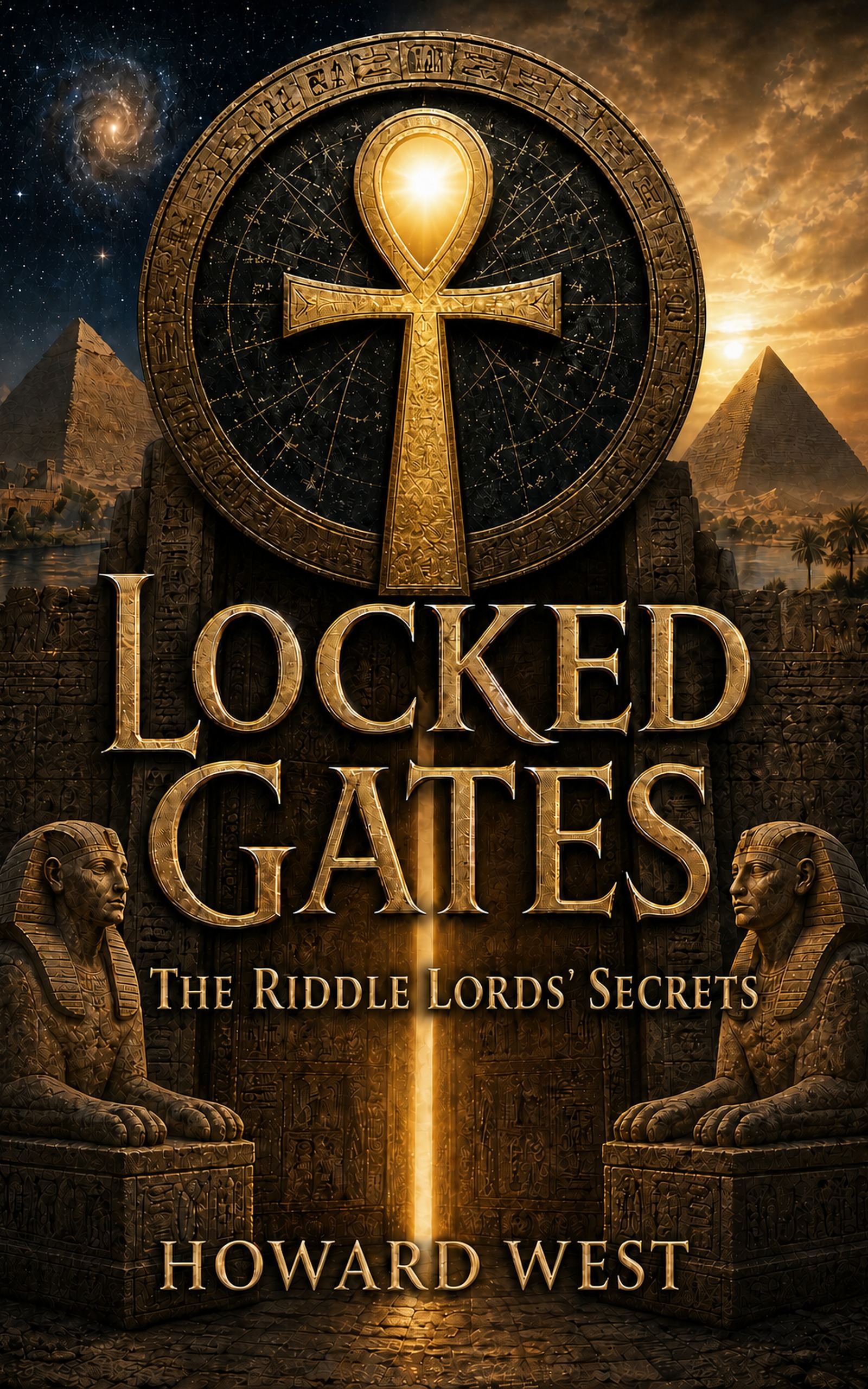
Locked Gates, Riddle Lords' Secrets
by Howard West
Summary
This book is a sweeping, highly unconventional argument that ancient myths are not merely imaginative stories, but compressed records of real history, real astronomy, and real catastrophe. The author opens by drawing a sharp line between the “haughty” gatekeepers of scholarly orthodoxy and the “wise” readers who know that riddles, legends, and sacred stories often preserve truths that later generations failed to understand. From the beginning, the book frames itself as an attempt to recover hidden knowledge that has been dismissed too quickly by modern academics. The myths of Hercules, Osiris, Isis, Horus, and especially Homer’s poems are presented not as fantasy but as a veil over actual events and actual civilizations. The familiar story of Troy, for example, is treated as a historical memory encoded in symbolic language. The author points to Aristotle, Polybius, and Michael Neander as witnesses from the tradition itself: Aristotle admitted that much wisdom had been lost and that some ancient knowledge may still survive in mythic form, Polybius recognized that political powers change stories to serve their own ends, and Neander described mythic constellations as fragments of an early tradition about divine things. Against the skepticism of modern scholarship, the book insists that researchers such as Heinrich Schliemann were right to trust Homer enough to dig, because myth can lead to physical discovery. The introduction establishes the central method of the book: treat ancient riddles as clues, cross-reference them with archaeology, astronomy, geology, and scripture, and let the pieces assemble into a picture of a forgotten world.
The first major section uses the story of Cassandra and the Gates of Troy to illustrate the core idea of the entire work. Cassandra sees the danger, warns her people, and is ignored. The Trojans are tricked by the wooden horse, and the city falls because it cannot recognize a riddle for what it is. This becomes a parable for the modern intellectual world, which also dismisses warnings that do not fit its assumptions. The author suggests that the Trojan story itself reflects a “riddle concept” used by ancient powers: deception hidden inside symbolic narrative. That theme carries into the book’s wider argument that priestesses, prophets, and poets often encoded serious knowledge in stories that only the initiated could understand. Cassandra is not just a tragic figure; she becomes a symbol of the truth teller in every age, always correct, always mocked, and always too late to be believed.
From there the book expands the notion of riddles into a comparative reading of biblical, Egyptian, Greek, Mesopotamian, and later mystical texts. The author repeatedly returns to a claim that a single hidden tradition lies behind them all. In Part One, the discussion of the Egyptian het benben, the “book of secrets,” and references to ancient star lore are used to suggest that the ancients preserved cosmological knowledge in ritual and emblem rather than in plain prose. The riddles are not decorative. They are a survival mechanism. The book implies that civilizations aware of periodic catastrophe learned to encode their science, history, and warnings in symbolic form so that some remnant might endure even if a culture was shattered. This explains the recurring emphasis on “locked gates,” “gates of Troy,” and hidden meanings: knowledge was guarded deliberately, and only later readers with the right key can unlock it.
A major turning point comes in the section on the “Power of the Sun,” where the author weaves together mirrors, light, shields, eyes, and symbolic radiance. Mythic objects such as the shield of Achilles, the shield of Hercules, Solomon’s shields, and the Egyptian Udjat or all-seeing eye are all read as solar or optical symbols that preserve ancient scientific ideas. The eye motifs are not treated as mere religious emblems; they become references to observation, reflection, and perhaps celestial alignment. The discussion of mirrors and “light codes” suggests that ancient civilizations knew how to use reflected sunlight, symbolic geometry, and coded inscriptions to pass on technical knowledge. The author also emphasizes arithmetic and numerological traditions, especially arithmomancy and cuneiform patterning, as proof that ancient societies hid information in numbers. In this reading, the ancients were not primitive storytellers but skilled coders who built knowledge into verse, iconography, and monument.
The “Bottomless Pit” and “Descending Passage” sections shift the focus from symbolism to architecture, especially the Great Pyramid and related monuments. The author presents pyramids not as tombs alone, but as repositories of pre-catastrophic wisdom designed to outlast civilizational collapse. The Great Pyramid is linked to star knowledge and to the survival of revelations about future judgments by water and fire. The idea is that ancient builders anticipated disaster and created structures to preserve cosmic understanding across epochs. This is one of the book’s recurring claims: the monuments are not merely burial sites or power displays, but preserved messages. They are cross-referenced to the stars, and their proportions and passages are treated as deliberate astronomical statements.
The third part, “Water in the Desert,” is the longest and most elaborate section, and it develops the book’s central geological and cosmological thesis. It begins with stories about drought, flood, irrigation, and resurrection, especially in Egypt. The author reads Egyptian mythology, including Isis and Osiris, as a memory of a civilization shaped by extreme environmental change. The text suggests that the Nile, dams, barges, and rituals of resurrection preserve an ancient record of rising and falling waters. Egyptian myths are tied to specific geological evidence, as if the story of the gods is really a story about climate, sea-level change, and human survival. The “legacy of Isis” and the “missing dam” are used to argue that water management and flooding were central to the region’s ancient history, and that myth may preserve the memory of lost hydrological engineering.
The author then broadens the scope to global flood traditions. Genesis, Enoch, the Brahmanas, Babylonian stories, South American traditions, and other flood narratives are read as variations on the same real event. The book argues that the story of Noah, Manu, and other flood heroes corresponds to a dramatic rise in sea level at the end of the last ice age. The author repeatedly points to modern geologic studies, especially evidence of meltwater pulses and rapid sea-level rise around 10,500 to 12,500 years ago, as scientific confirmation of these ancient accounts. Flood myths are not just allegories of moral cleansing; they are historical memories of planetary disruption. The book claims that the Earth experienced a major hydrological transformation, and myths across cultures are the surviving testimonies.
A particularly important interpretive move is the reading of Genesis not as a description of a rainbow covenant, but as a crescent moon covenant. The author argues that the Hebrew word translated as “bow” refers properly to an archer’s bow, not necessarily a rainbow. The timing in Genesis is then used to support this: the first day of the month and the twenty-seventh day are associated with the waxing and waning crescent moon. In other words, the covenant sign after the flood may have been the Moon in specific phases, not a prism rainbow in a rainy sky. This is one of the book’s signature arguments, because it links biblical language to astronomy and to the larger thesis that ancient texts preserve celestial events with precision. The Moon, in this interpretation, is a historical witness.
From here the book builds one of its most striking claims: the Moon itself has a dramatic origin story involving Mars. The author presents multiple theories before advancing an alternative that the Moon was once associated with Mars, possibly torn away from that planet, carrying an icy vapor trail that later affected Earth. The Moon is described not simply as a satellite but as a remnant of a much larger cosmic drama. As it journeyed, it carried frozen water vapor, moved through space, and may have been responsible for changing Earth’s climate and sea levels. The author connects this to the notion that the ancients personified the Moon as a dragon, a serpent, a fish, or a goddess with a fish tail. Across cultures, moon goddesses and sky serpents appear with tails of water or ice, which the book interprets as descriptions of an actual cosmic object with a trailing cloud. The “Azure Dragon,” Leviathan, Vishnu’s fish, and other figures all become names for the same phenomenon.
The Book of Enoch is central here. The author quotes Enoch’s visions of heaven shaking, angels being agitated, and monsters dwelling above the springs of water. Leviathan is reinterpreted as the Moon and its ice-vapor trail, while the second monster becomes the disaster planet or serpent associated with destruction. The language of fire and frost, judgment and healing, is read as evidence that Enoch’s author was describing atmospheric and celestial events in symbolic form. The waters of judgment becoming fire, or the freezing of vapors in space, are treated as coded references to cosmic water moving between worlds. The book’s approach is consistent: if the text seems strange, that strangeness is not poetic excess but hidden science.
The “Riddle of Saba” deepens this method by using a Kabbalistic story in which a donkey-driver asks three riddles about a flying snake, an eagle nesting in a tree that never was, and a beautiful maiden who is both one and two. The author insists that these are not random mystical puzzles but coded references to the Moon and related celestial realities. The key move is the repeated equation of “one equals two” and “two equals one,” which the author sees as a way of describing the Moon’s phases, dual identity, or relation to another celestial body. The book presents the riddles as layered signs, each requiring an astronomical rather than purely spiritual decoding. This approach allows the author to connect Jewish mystical texts with Egyptian, Greek, and biblical material under a single interpretive framework.
The section on Mars provides the cosmic climax. Drawing on Job, Enoch, and geological observations, the author argues that Mars suffered devastating bombardment, perhaps from debris associated with Venus’s passage. The text describes Mars as once having oceans, atmosphere, and tidal bulges, and it claims the Moon’s gravitational influence played a role in those tides. The author interprets the destruction of Mars in biblical terms, identifying passages in Job 18 as symbolic descriptions of a planet under attack. “Rock” becomes a planetary body, “tabernacle” becomes a home world, and the language of traps, terrors, and scattered brimstone becomes a narrative of planetary ruin. Deimos and Phobos are described as remnants of that catastrophe, while the southern destruction of Mars is attributed to meteoric debris. In this view, the mythic rebel figures such as Azazyel and Lucifer are not just moral symbols but names for celestial actors in a catastrophic solar history.
The author’s argument culminates in the idea that the Moon’s capture by Earth was tied to major climatic upheavals. Around 14,000 years ago, sea levels rose sharply, followed by drought. Later, around 12,500 years ago, the Moon was captured into Earth’s orbit, bringing its frozen vapor trail and contributing to another meltwater pulse. This sequence is used to explain the transition from post-glacial instability to the world we know. The author presents scientific data, including sea-level curves, delta conferences, ocean circulation studies, and evidence from the Younger Dryas and Meltwater Pulse events, as supporting clues. The 2007 report of a meteorite embedded in mammoth tusks becomes a modern example of how stray impacts and ancient events can leave physical traces. For the author, such discoveries validate what the myths were saying all along: Earth endured catastrophic changes from space.
The final part, “The Past and Future Collide,” returns to monuments, prophecy, and end-time expectation. The Great Pyramid is again described as a deliberate cross-reference to the stars, built to preserve revelation through future destruction. The author turns to Josephus, who is said to have reported that the children of Seth constructed pyramids to preserve knowledge of judgments by water and fire. The destruction of the Library of Alexandria is retold as an example of how knowledge can be intentionally erased, with Caliph Omar singled out as the key destroyer in the author’s account. This serves the broader theme that gatekeepers burn or suppress knowledge that challenges their worldview. The Pyramid, by contrast, survives as a stone archive.
The book closes by linking ancient prophecies and modern geopolitics. The return of the Caliph, the twelfth Imam, a new crusade, the Third Secret of Fatima, Quranic verses, Daniel, Isaiah, Psalms, and Ezekiel are all brought into the same frame. The author suggests that global religious traditions may be converging toward a final flood or final upheaval, meaning that the past catastrophe is also a warning about the future. Ancient texts, in this reading, do not merely recount what happened; they prepare humanity for what may happen again. The final effect is both apocalyptic and archival. The book argues that hidden wisdom has been encoded in riddles because civilization has repeatedly faced destruction, and that the task of the present is to recover that wisdom before the gates close again.
Overall, the book is an immense attempt to unify myth, scripture, archaeology, geology, astronomy, and prophecy into one grand narrative of lost knowledge. Its voice is combative, urgent, and distrustful of scholarly authority, but also deeply committed to reading ancient texts closely and reverently. The author’s central message is that the ancients knew far more than modern readers assume, and that their riddles preserve memories of celestial events, planetary catastrophes, flood histories, and monuments built to outlast them all. Whether one accepts its conclusions or not, the book insists that the myths of Troy, the Moon, Leviathan, Enoch, Osiris, and the Great Pyramid are not separate stories but chapters in a single, hidden history of the Earth and the sky.
Want the Full Experience?
This summary includes Key Takeaways, Chapter Summaries, Notable Quotes, Who Should Read This, and a professional AI-narrated audio version — available with a paid listing.
The author can upgrade this listing to unlock all sections.
